Evidence to be taken in Tennant Creek, on the legal case against Muckaty nuclear waste dump
 Muckaty trial to be held in Tennant Creek http://www.theaustralian.com.au/news/latest-news/muckaty-trial-to-be-held-in-tennant-creek/story-fn3dxiwe-1226880701026 NEDA VANOVAC AAP APRIL 11, 2014
THE federal government is exploiting the Northern Territory’s constitutional weakness by planning to build a nuclear waste facility there  against traditional owners’ wishes, Senator Nova Peris says.
This week it was decided that a Federal Court trial would sit in Tennant Creek and Darwin in June to take evidence on the proposed dump, which is fiercely opposed by four of the five traditional owner groups at Muckaty, about 120 kilometres north of Tennant Creek.
Legal proceedings have been running against the federal government and the Northern Land Council (NLC) since June 2010, with those opposed accusing the NLC of breaching its duties by failing to properly identify the traditional Aboriginal owners of the nominated land, not consulting adequately and not getting proper consent before recommending the site. “The Northern Territory is not our nation’s dumping ground,” Senator Peris told a Muckaty dinner in Darwin on Thursday.
“The only reason the dump was proposed to be built here is because we are a Territory and not a state. Exploiting our constitutional weakness is not acceptable.”
Ms Peris called for a scientific and rational approach to determining how Australia would deal with its nuclear waste.
Lawyer Elizabeth O’Shea said it was a victory for traditional owners to have part of the trial sit in Tennant Creek.
“We’re very concerned about the health and age of a number of our witnesses,” she said.
“It’s hugely important that the court has taken this step and we’re very pleased, and it’s caused great comfort for our clients.”
The Muckaty decision affects all of Tennant Creek, traditional owner Penny Phillips says, so it’s important for the community to be able to observe the legal process.
“All the people there, the old people and the young ones too, they can step up and start talking up,” she said.
“Our people fought for country for years and years – you get back country and you have to look after it.
“If you put the dump there, who’s going to look after the next generation?”
The trial will begin in Melbourne on June 2.
Julie Bishop visits Hiroshima. Will she reflect on the real costs of Australia’s uneconomic uranium trade?
 Julie Bishop’s visit to Hiroshima: a perfect time to debate our uranium industry http://www.theguardian.com/commentisfree/2014/apr/11/julie-bishops-visit-to-hiroshima-a-perfect-time-to-debate-our-uranium-industry Dave Sweeney theguardian.com, Friday 11 April 2014
Uranium is not like any other mineral – and because Australia is home to around 40% of the worlds’ uranium, the decisions we make on the subject matter Australia’s foreign minister Julie Bishop is in Japan today attend an international meeting on nuclear security in Hiroshima a city synonymous with nuclear threat. Indeed, a visit is not complete without wandering the hallowed grounds of the famous Peace Park, the epicentre of the early morning nuclear blast that killed up to 140,000 people on 6 August 1945.Bishop is also visiting a country that is still enduring the ongoing trauma associated with the Fukushima earthquake and tsunami and the wors tnuclear disaster of modern times – a disaster that, three years on, has left the region comprised of ghost towns and shattered lives.
In visiting Hiroshima, it would be fitting for Australia’s foreign minister to reflect publicly on Australia’s role in fuelling Japan’s continuing nuclear disaster. In October 2011, Robert Floyd, the director general of the Australian Safeguards and Non-Proliferation Office of the Department of Foreign Affairs and Trade, confirmed to the parliament that “Australian obligated nuclear material [uranium] was at the Fukushima Daiichi site and in each of the reactors”.
Given that, it would be timely for Bishop to use the opportunity to commito an independent cost-benefit assessment of Australia’s uranium trade, as directly requested by the UN secretary general Ban Ki Moon in the wake of the accident. The need for such an inquiry has never been more pressing.
n Australia, low uranium prices have seen existing uranium mines close down. New uranium mining projects are being delayed, and the sector is under pressure. And that’s not to even mention spills – such as was seen with the December 2013 uranium tank collapse and the leak at Rio Tinto’s ranger mine in Kakadu.
Australia also continues to uncritically supply our existing uranium customers, despite evidence of alarming unsafe practices in countries like South Korea. Our deal with Russia also deserves greater scrutiny, as the International Atomic Energy Agency has not carried out any inspections there since at least 2001. We aggressively push new uranium deals to countries like India, whose nuclear industry has been called unsafe by its own auditor general, and which point blank refuses to sign the global nuclear non-proliferation treaty.
Bishop’s visit to Hiroshima, of all places, is an ideal time to reflect on the very nature of Australia’s uranium – that it is not like any other mineral. Uranium can fuel both nuclear reactors and nuclear weapons, and it all becomes radioactive waste. Australia is home to around 40% of the worlds’ uranium, and the decisions we make matter. In the shadow of Fukushima, we need to review the costs and consequences of our uranium trade at home and abroad and act on the UN’s inquiry call.
If Bishop continues to put the interests of a high risk, low return industrial sector before those of our nation and region, the consequence is that it is likely that Australia’s uranium sector will fuel future Fukushimas. This need not, and must not, occur.
What happened to the sailors irradiated on the USS Reagan?
Navy Sailors: Frozen Fukushima steam blanketed ship; Crew suffered massive radiation doses, dozens have cancer — Calls for it to be sunk… still too radioactive; Navy: There’s some contamination, but it’s ok — Tepco: No way US officials would rely on information we were telling to public http://enenews.com/navy-sailors-frozen-fukushima-steam-blanketed-uss-reagan-crew-suffered-massive-radiation-doses-dozens-now-have-cancer-report-calls-for-ship-to-be-sunk-still-too-radioactive-navy-says-contam
AP, Apr 7, 2014: Nearly 80 U.S. sailors are […] alleging [Tepco] lied about the high level of radiation in the area [and] repeatedly said there was no danger to the crew when they were actually being blanketed with radiation that has since led to dozens of cancer cases and a child being born with birth defects [Tepco] said that there was no way the commanders of the aircraft carrier would have relied on the utility […] “It’s wholly implausible… military commanders in charge of thousands of personnel and armed with some of the world’s most sophisticated equipment, relied instead only on the press releases and public statements of a foreign electric utility co.”
Orange County Register, Apr. 6, 2014: Sailors on the flight deck said they felt a warm gust of air, followed by a sudden snow storm: radioactive steam. Freezing in the cold Pacific air. Blanketing their ship. And there they remained for two days, until […] aircrews returning [from] near Sendai identified levels of radioactivity [and] the Navy ordered the carrier to reposition much farther away […] the lawsuit contends, the crew had already suffered massive doses of radiation. […] dozens have developed cancers, at least one has borne a child with birth defects [Their lawsuit is] raising very strange and disturbing questions: Could the Reagan – one of the most advanced nuclear aircraft carriers in the U.S. fleet – really not know that it was being showered with massive doses of radiation? […] Some critics on the ecological front say the Reagan, now stationed in San Diego, is still so radioactive that it needs to be sunk. It floated around the Pacific for many weeks after the Fukushima humanitarian mission ended, as no Pacific Rim country would give it permission to dock. [It’s] slated to move to a new home port this year. In Japan.
Navy spokesman Lt. Greg D. Raelson: “Low levels of radioactive contamination did enter ventilation systems, which have numerous inaccessible areas difficult to perform radiological surveys and decontamination […] there is no indication that any remaining minimal levels of radiation pose any adverse health concern. Radiological controls are in place to survey, control and remove remaining contamination”
U.S. sailors’ lawsuit: “[Those exposed to radioactive releases from Fukushima Daiichi] must now endure a lifetime of radiation poisoning and suffering which could have and should have been avoided” [TEPCO] lied through its teeth, knowing all along the plant was in full-scale meltdown […] “rendered the plaintiffs infirm and poisoned their bodies.”
1000 US marines arrive in Darwin. What a target!
 Why are there U.S. marines in Darwin? Independent Australia Nick Deane 10 April 2014, The recent arrival of over a thousand marines in Darwin provides a risk for Australia, yet absolutely no reward, writes Nick Deane.
IF ONE COUNTRY INVITES the armed forces of another onto its territory, one would expect the government of the host country to have seen strategic benefits in the arrangement.
Furthermore, one would also expect, in a democracy, that this government would be happy to explain these benefits to its people. That should be simple enough.
In the case of Australia playing host to a garrison of more than 1,000 United States marines in Darwin for the next six months, the public has been offered no explanation about the strategic benefits. All we have been told (via a letter to IPAN-NSW from the Minister for Defence on 7 December 2012) is that the marines’ presence is an extension of our existing, long-standing alliance with the U.S. — as though the passage of time alone is sufficient justification for us to willingly accept foreign forces on our territory.
What is missing is any discussion of the strategic advantages to Australia that come from the presence of the U.S. garrison.
It is probably taken for granted that the advantage lies in the supposed ‘protection’ that it brings us. But are the marines really here for our protection?
And who actually benefits, in strategic terms, from this arrangement?
Certainly, the strategic benefits to the U.S. are large.
The marines occupy a ‘forward position’, thousands of kilometres beyond US territory. And, in the words of a report from CSBA (the Centre for Strategic and Budgetary Assessment):
‘Australia’s strong ties with America provide it with the means to preserve U.S. influence and military reach across the Indo-Pacific.’
Note: that’s the United States’ influence and military reach……..
where is the benefit to Australia?
What we get out of it is the certainty that we are now directly involved, if hostilities break out between America and China. That would make parts of Australia potential targets for attack…..http://www.independentaustralia.net/article-display/why-are-there-us-marines-in-darwin,6370
Energy efficiency replaced half of Japan’s nuclear power

 Japan Replaced Half Its Nuclear Power With Energy Efficiency. Could The U.S. Do Something Similar? Climate Progress, BY ARI PHILLIPS ON APRIL 10, 2014 The March 2011 earthquake and tsunami in Japan didn’t only shut down the Fukushima Daiichi Nuclear Power Plant, it caused Japan to close all 50 of its nuclear plants over safety concerns and to reconsider its entire energy strategy for the rest of the century. Before the disaster Japan got about 30 percent of its electricity from nuclear power and had plans to raise that to about half by 2050. To replace that energy, Japan had to look elsewhere, both domestically and abroad. Japan doesn’t have its own significant fossil fuel reserves, and so it must import oil and gas — an expensive and environmentally unfriendly approach for a country that has prided itself on leading the fight against climate change. To help offset this, Japan also established a lucrative feed-in tariff for solar power that lead to a rapid growth in installations.
But replacing nearly one-third of their energy supply — especially going into peak summer demand — was not a realistic option, and the population braced for rolling blackouts to accompany the crippling impacts of the tsunami and earthquake. The government and the people also turned to another option, energy efficiency and conservation. A campaign called ‘setsuden’ (power saving) was established to generate support. It worked, and by allowing dressed-down outfits and rotating air-conditioning schedules, the country averted blackouts. But many worried that this short-term effort would prove to be just that, and that in the long-term an elevated demand for electricity would return, once again taxing the system.
“To push renewable and safe energy to the national forefront and reduce Japan’s reliance on nuclear energy, it is important to sustain the current public setsuden mood,” Kazuko Sato, of Soft Energy Project, an NGO that lobbies for renewable energy expansion, told the Guardian in 2011. “I am worried that the public support could be temporary.”
However, it turns out these worries were unwarranted — Japan has managed to replace half its missing nuclear power capacity through energy efficiency and conservation measures that endure three years later.
“These temporary measures have proven to have long-term impact,” reports Greentech Media. “They’ve dramatically increased the awareness of energy use and energy efficiency, and large companies are running high-profile efficiency programs:” “The key lesson from the Japanese experience is that coal plant construction is simply too slow to be relevant in the modern world, where resiliency is highly valued. To cope with rapid loss of generation capacity, Japan needed fast, nimble and modular 21st-century solutions. That means efficiency and clean energy.”
The article states that even with these leaps in efficiency, there is still significant room for improvement in Japan. What about in a country like the U.S., where we haven’t had to overcome anything close to shutting down the nearly 100 nuclear plants that provide around one-fifth of the country’s power?
Two analyses from 2009, one from the National Research Council and the other by McKinsey & Co. found that within about a decade the U.S. could cut total energy use by 20 percent or more. President Obama may have seen these studies, because in 2011 he called forachieving a 20 percent improvement in energy efficiency in buildings, which use about 20 percent of all energy in the U.S., by 2020. Obama also wants to double U.S. energy efficiency by 2030……http://thinkprogress.org/climate/2014/04/10/3425406/japan-energy-efficiency-replacement/
Very low doses of radiation may in fact be more harmful than just low doses
In addition to the detection of statistically significant levels of certain illnesses among the liquidator cohort, they have made the argument that, instead of being linear, radiation health effects are “bi-modal” at certain low dose levels i.e. more harmful than the linear model predicts.
Radiation and the Ronald Reagan, China Matters, 10 April 14, “….. I address the tendency of governments to minimize/mislead/suppress information concerning radiation releases from nuclear accidents and the overall uncertainty pervading their efforts. ….
The biggest minefield in the issue of nuclear accidents is the issue of the health effects of radiation exposure. The international standard for nuclear safety is the “Linear No Threshold” or LNT model, which argues that the negative health impacts of low-level radiation exposure are, well, low. People who give credence to claims of extensive radiation-related illness as a result of nuclear accidents are frequently dismissed as cranks.Interestingly, the only place that is serious about emphasizing the health hazards of radiation is a country very much in the news today, Ukraine. Doing the right thing by Ukrainian citizens after the injustices inflicted by the Soviet Union on the Chernobyl front has been an important part of Ukrainian national identity, and claims of radiation-related illness are given a hearing largely denied to them in the West, Japan, or Russia.
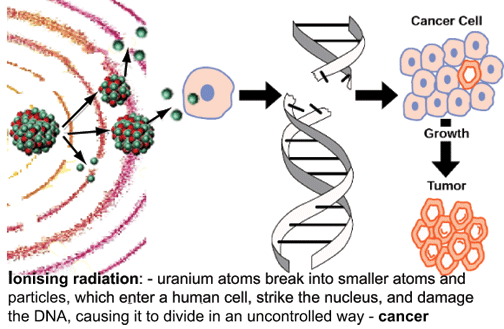
The international pushback against academics trying to make the statistical and biomedical case for extensive Chernobyl-related illnesses has been intense, including the attempt to explain any statistically significant health effects as a combination of “radiophobia” (the debilitating fear occasioned by radiation exposure) and the overall decline in public health in Ukraine following the collapse of the Soviet Union. Continue reading
Decentralised renewable energy providing the safest answer to poverty in India
- Coal is not the answer to energy poverty
http://www.abc.net.au/environment/articles/2014/04/11/3982877.htm CHAITANYA KUMAR 11 APR 2014 Decentralised energy generation owned and maintained by the community is gaining favour in India Despite the coal industry’s claims, the developing world is looking to move away from the antiquated, polluting energy source. COAL DOES NOT alleviate poverty, it aggravates it. We of course rarely ask the poor what poverty means to them and what it will take to move them out of it. But Brendon Pearson, the chief executive of the Minerals Council of Australia says we need coal fired power to pull the world’s poor out of energy poverty.
But to be fair on Mr Pearson, you could arrive at that conclusion too if you deliberately ignored the social and economic contexts of coal in India or the developing world at large.
A recent study has shown that coal pollution in India results in 80,000 to 115,000 premature deaths every year (pdf) and this statistic is expected to rise to 1.5 million if we continue on our current path.
Coal remains the single biggest contributor to climate change, the devastating impacts of which are already being suffered by the poor and most vulnerable. In fact the International Energy Agency (IEA) itself has called for a massive overhaul of existing fossil fuel plants and mines, suggesting that if we are to contain global warming to a two-degree rise, no new energy intensive infrastructure can go online post 2017.
Coal is mired in deep social inequities. Travel to any major coal belt in India and the people living around a coal plant face regular power outages. This cruel irony is explained by the fact that the power generated is often for the cities, the energy guzzlers, while the negative residual impacts of coal are to be borne by those living next to it. The industry is often set up on the pretext of providing jobs, greater compensation for land and adequate rehabilitation and resettlement for displaced communities. None of these promises have ever been satisfied and the coal belts of India stand testimony to that fact.
Coal and corruption are synonymous. Take the recent case of the National Thermal Power Corporation (NTPC) of India, the largest coal power generator of the country. It received clearance from the federal environment ministry to set up a 2400 MW coal plant in southern India. The clearance was recently revoked when it was found, through images from Google Earth submitted by a local petitioner, that the proposed site was prime agricultural land as opposed to a barren land that the company had claimed it to be. Such is the haste of the Government to approve projects that not a single visit to the site was undertaken to verify the company’s claims. If you believe such corruption could never happen in Australia, look to the recent ICAC findings concerning Eddie Obeid.
Decentralised renewable energy is a safer, cleaner and viable
source of energy for the rapidly evolving societies of the coming decades.
Various grassroots groups that have taken shape over the last decade are struggling to curtail the coal industry’s expansion. Millions of people now recognise the myth that coal equals development and are putting up a tough front against it. Why would they do so when, according to Mr Pearson, they need it for becoming poverty-free?
The answer of course lies in the simple adage that you can’t solve a problem with the same thinking that created it. With 40 per cent transmission and distribution losses across the grid, a heavily nationalised process of mining and generating power and the recent rise in consumer tariffs, coal is not the solution but in fact the reason that 300 million odd Indians continue to live in darkness.
The need of the hour therefore is a decentralised, democratically owned renewable energy deployment to fight energy poverty.Glimpses of its success and reliability are already being felt across the world. Decentralised renewable energy is a safer, cleaner and viable source of energy for the rapidly evolving societies of the coming decades.
The banks and financial institutions are increasingly wary of investing in coal and rightly so. The fossil fuel divestment movement in Australia, North America and Europe coupled with local community struggles are a force to reckon with. It is no longer a debate that only the so-called environmentalists are engaging in with the coal industry but everyone from boardrooms to the common people are in it too.
Pearson and his colleagues are clearly making a last ditch effort to revive an obsolete and dangerous industry and we would do our future generations and ourselves a favour by giving coal the boot.
Chaitanya Kumar works as the South Asia campaigns coordinator for 350.org. He is based in New Delhi and works on issues of coal and climate change.
UV radiation – the balance between Vit D needs, and skin cancer risks
 Too much or not enough? Spotlight goes on UV research http://www.voxy.co.nz/national/too-much-or-not-enough-spotlight-goes-uv-research/5/187427, 11 April, 2014 Scientists, dermatologists, skin cancer experts and health professionals are among those meeting in Auckland next week to discuss the latest research into UV radiation and how best to improve public awareness of UV issues.
Conference organiser and NIWA atmospheric scientist Richard McKenzie said UV – a major cause of skin cancer – remains a huge health issue for New Zealanders, despite an expected slow recovery in the ozone in coming years.
“Our summer UV was already too high before the onset of ozone depletion, and will remain high in the years ahead. But for people to be able to make sensible decisions about UV exposure, they need to know how strong the UV radiation is, and how strong it will be in the hours ahead that they may be outside,” he said.
Dr McKenzie said fair-skinned New Zealanders especially were at risk from skin cancer because of high summer UV amounts, our outdoor lifestyle, and skin types.
“On the other hand, we have a growing number of people with naturally very dark skin which includes many people from Africa, the Indian subcontinent and the Middle East whose skin types may be better adapted to environments with much higher UV. These people may be more at risk of not getting enough UV in winter,” Dr McKenzie said.
Low UV in winter means some New Zealanders may be unable to establish healthy levels of Vitamin D which helps maintain bone strength .
NIWA provides a UV Index updated daily on its website to enable people to make informed decisions about their health when outdoors. However, Dr McKenzie said he would like to see the index publicised more widely.
“We must ensure greater awareness and understanding of advisable sun exposure among New Zealanders,” he said. One of the aims of the workshop is to identify projects that make use of newly-developed technologies such as smart phones, GPS capabilities and personal UV dosimeters that measure an individual’s exposure to UV.
Also on the programme are presentations on attitudes to tanning, melanoma trends, and what makes New Zealanders different when it comes to UV exposure.
The workshop also aims to improve understanding of the production of vitamin D from and its role in human health as well as improving public awareness of UV issues.
About 100 people from New Zealand, Australia, the UK, US, Germany, Japan and Thailand are expected to attend from a range of disciplines involved in UV research, including scientists, health professionals, developers of instruments and public health advisory tools and analysts of their effectiveness.
The workshop will be opened by NIWA CEO John Morgan on Wednesday, April 16 at Auckland’s Heritage Hotel.
Sponsors include NIWA, Cancer Society of New Zealand, Health Promotion Agency, Royal Society of New Zealand, Queensland University of Technology, Australian National University, and the New Zealand Dermatological Society.
1 This month
7 April – WEBINAR – Australia and the Doomsday Clock – Preventing nuclear war through NoFirstUse and other policies
Online | Tuesday April 7, 4:00-5:30pm, Australian Eastern Time / 8:00-9:30am Central Europe Time
– Access the registration link
15 April – Zoom –Nuclear Power is Not the Solution
Apr 15, 2026 01:00 AM in Canberra, Melbourne, Sydney

Join the International Physicians for the Prevention of Nuclear War (IPPNW) on Tuesday, April 14th for a timely webinar exploring the risks associated with nuclear power and challenging the myth that it offers a simple, safe, carbon-free solution to the climate crisis

21 April Webinar: No Nuclear Weapons in Australia
Start: 2026-04-21 18:00:00 UTC Canberra, Melbourne, Sydney (GMT+10:00)
End: 2026-04-21 19:30:00 UTC Canberra, Melbourne, Sydney (GMT+10:00)
Event Type: Virtual
A virtual link will be communicated before the event.
Host Contact Info: australia@icanw.org

of the week – Australians for War Powers Reform (AWPR)
To see nuclear-related stories in greater depth and intensity
 Antinuclear