Julie Bishop is out of step with Australian opinion on nuclear weapons
 Julie Bishop says banning nuclear weapons impractical ABC Radio National, Tanya Nolan reported this story on Friday, April 11, 2014 TANYA NOLAN: Foreign Minister Julie Bishop is representing Australia at a 12 nation summit in Hiroshima today discussing global efforts to eliminate nuclear weapons. Disarmament activists in Hiroshima are lobbying hard for agreement to be reached on a global ban on nuclear weapons.
But Australia is one of a group of countries that is unlikely to support any such push: Ms Bishop says banning weapons won’t get rid of them and any global treaty would be impractical without the support of the world’s nuclear armed states – something unlikely to be achieved.
The International Campaign to Abolish Nuclear Weapons say Australia’s position is out of step with the views of most Australians. 
It’s released a survey of 1,500 Australians who were asked whether they think the Government should support a global ban on nuclear weapons. I spoke to Dr Tillman Ruff, co-chairman of the campaign who is in Hiroshima for the Non-Proliferation Disarmament Initiative.
So the International Campaign to Abolish Nuclear Weapons, ICAN has released its poll showing 84 per cent of Australians think the Government should support a global treaty banning nuclear weapons. Don’t you think it would have been more accurate to pose the question would a global ban on nuclear weapons be effective without the support of those countries that have nuclear weapons?
TANYA NOLAN: But Foreign Minister Julie Bishop has a point doesn’t she, that any global ban on nuclear weapons won’t be effective if you can’t get the nuclear armed states on board?
TILLMAN RUFF: Well, of course the elimination of nuclear weapons is going to require the states that have them to do that. I mean I think that’s obvious, but what we’ve seen essentially over the last 70 years is a failure of the nuclear armed states to live up to their legally binding obligation under the non-proliferation treaty to disarm.
There are currently no negotiations underway and arguably our, the danger of nuclear weapons being used, many experts are suggesting is actually increasing. Proliferation is certainly not under control so it’s hard to claim that business as usual is getting us very far, very fast.
So, you know, the states that have the weapons have so far shown really no serious intent to get rid of their nuclear weapons. ……….
Small is not beautiful when it comes to Small Modular Nuclear Reactors (SMRs)

Aboriginal community in the North to develop a strategy for the long term
For our power now lies outside of Labor or Liberal. The big parties have lost the true path. The north cannot be developed without our advancement, too. What is required now for remote Aboriginal people is a strategy beyond the election cycle. There are numerous complexities in coaxing participation out of welfare-dependent communities or productivity out of government-funded community programs. Part of the solution is developing an environment where private businesses can grow, in order to foster private wealth. That requires a strategic and efficient program of infrastructure development, including the local Aboriginal workforce.
Instead of driving remote economic development, the Labor and Liberal parties continue to treat remote Aboriginal people as a uniquely unresolvable problem. Australia’s Northern Territory has become a new colony — a moral crisis zone. By now it should be obvious there will be no change in remote Aboriginal communities unless the residents are willing. The arrogance of the major political parties will never inspire willingness.
The only path to advancement is via the bush bloc http://www.theaustralian.com.au/national-affairs/opinion/the-only-path-to-advancement-is-via-the-bush-bloc/story-e6frgd0x-1226881272887# 12 April 14, Alison Anderson MLA for Namatjira.
POWERFUL factions in the major political parties have failed Aboriginal people in the Northern Territory. That failure can be attributed almost wholly to a poor understanding of the aspirations of remote Aboriginal people. It’s simple — the people in power do not want to take the time to sit in the dirt and communicate with the most disadvantaged people, even if those same people gave them their power at the ballot box. Rather, they treat us as useful idiots. Continue reading
Thorium, Uranium and “Safe” Reactors
NuClear News No.61 April 2014 There’s a modern mythology that suggests that thorium might be able to replace uranium and deliver a safer and cheaper nuclear reactor with more abundant fuel. In March press reports suggested that Chinese scientists have been told to accelerate plans to build the first fully-functioning thorium reactor within ten years, instead of 25 years as originally planned. The Telegraph said they “may do the world a big favour. They may even help to close the era of fossil fuel hegemony.” (1)
Jan Beránek, leader of Greenpeace International’s Energy Campaign says we’ve heard all this before. Thorium technology is in principal based on nuclear fission and therefore keeps fission’s inherent problems. While it partially addresses some of the downsides of current commercial reactors based on uranium (plutonium) fuel, such as limited reserves of uranium and unwanted production of plutonium and transuranic isotopes, it still has significant issues related to fuel mining and fabrication, reactor safety, production of dangerous waste, and the hazards of the proliferation of nuclear weapons. (2)

The Union of Concerned Scientists point out that thorium cannot be used by itself to sustain a nuclear chain reaction: it must be used together with a fissile material such as enriched uranium, uranium-233, or plutonium. The U.S. Department of Energy has concluded after a review that “the choice between uranium-based fuel and thorium-based fuel is seen basically as one of preference, with no fundamental difference in addressing the nuclear power issues [of waste management, proliferation risk, safety, security, economics, and sustainability].” (3)
UCS continues some people believe that liquid fluoride thorium reactors, which would use a high-temperature liquid fuel made of molten salt, would be significantly safer than current-generation reactors. However, such reactors have major flaws. There are serious safety issues associated with the retention of fission products in the fuel, and it is not clear these problems can be effectively resolved. Such reactors also present proliferation and nuclear terrorism risks because they involve the continuous separation, or “reprocessing,” of the fuel to remove fission products and to efficiently produce U-233, which is a nuclear weapon-usable material. Moreover, disposal of the used fuel has turned out to be a major challenge.
Even the UK Department of Energy and Climate Change commissioned a report which concluded in 2012 that the claims by thorium proponents who say that the radioactive chemical element makes it impossible to build a bomb from nuclear waste, leaves less hazardous waste than uranium reactors, and that it runs more efficiently, are “overstated“. http://www.no2nuclearpower.org.uk/nuclearnews/NuClearNewsNo61.pdf
“My Country” – sophisticated and disturbing art from Black Australia
 Sophisticated, disturbing Aboriginal art on show, National Business Review, NZ John Daly-Peoples | My Country, Contemporary Art from Black Australia Auckland Art Gallery Until July 20
The new exhibition My Country at the Auckland Art Gallery is an opportunity to see art by contemporary aboriginal artists. While there are a couple of examples of the dot paintings which have generally been regarded as the first style of contemporary work produced by Australian aborigines, most of this exhibition has a more challenging approach. This is art which gives an insight into the social, political and personal; aspirations and reflections of aborigines.
The exhibition features the work of 46 Aboriginal and Torres Strait Islander artists, including film, photography, installation, painting, drawing and sculpture. Highlights include The Oyster Fisherman, a photographic series by Fiona Foley who has received the Australia Council Visual Arts Award; I Forgive You, Bindi Cole’s work of Emu feathers made in response to Kevin Rudd’s 2008 apology; and Stranded, Warwick Thornton’s epic and immersive 3D film.
“The exhibition covers three core themes of history, contemporary life and country in which ancestral myths the response to colonisation are combined with the politics of life today.
Michael Cook’s series of photographs called Civilised, some of which were exhibited at last year’s Auckland Art fair are included in a reflection on the cultural divide between the early settlers and the indigenous people. Cook’s images imagine aborigines as being incorporated as part of European society wearing clothes, using weapons and accepting the myths and history of Europe.
This implies an acceptance by the European colonists of aborigines being their equal, which was not the case, with the indigenous people being regarded as lesser people, not even offered a treaty as happened in New Zealand………http://www.nbr.co.nz/article/sophisticated-disturbing-aboriginal-art-show-jd-154483
Electromagnetic radiation from mobile phones IS a danger
New Studies Show Health Risks from Wireless Tech: Warnings from the BioInitiative Working Group http://www.businesswire.com/news/home/20140411005708/en/Studies-Show-Health-Risks-Wireless-Tech-Warnings April 11, 2014 RENSSELAER, N.Y.–(BUSINESS WIRE)--The BioInitiative Working Group says evidence for health risk from wireless tech is growing stronger and warrants immediate action. The Group released a mid-year update covering new science studies from 2012 to 2014.
New studies intensify medical concerns about malignant brain tumors from cell phone use. “There is a consistent pattern of increased risk for glioma (a malignant brain tumor) and acoustic neuroma with use of mobile and cordless phones,” says Lennart Hardell, MD, PhD at Orebro University, Sweden, according to studies released in 2012 and 2013. “Epidemiological evidence shows that radiofrequency should be classified as a known human carcinogen. The existing FCC/IEEE and ICNIRP public safety limits are not adequate to protect public health.”
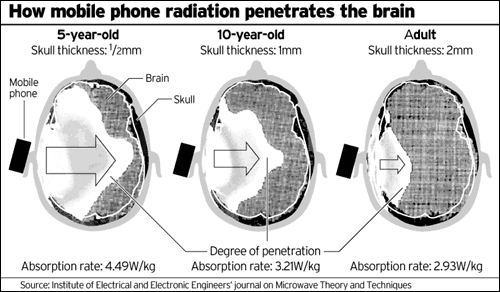
The BioInitiative reports nervous system effects in 68% of studies on radiofrequency radiation (144 of 211 studies) in 2014. This has increased from 63% in 2012 (93 of 150 studies) in 2012. Studies of extremely-low frequency radiation are reported to cause nervous system effects in 90% of the 105 studies available in 2014. Genetic effects (damage to DNA) from radiofrequency radiation is reported in 65% (74 of 114 studies); and 83% (49 of 59 studies) of extremely-low frequency studies.
Mobile wireless devices like phones and tablets are big sources of unnecessary biological stress to the mind and body that can chip away at resilience over time. The Report warns against wireless in schools. Schools should provide internet access without Wi-FI.
“It is essentially an unregulated experiment on childrens’ health and learning. Microwave from wireless tech disrupts thinking – what could be worse for learning? Technology can be used more safely with wired devices that do not produce these biologically-disruptive levels of microwave radiation,” said Cindy Sage, Co-Editor of the BioInitiative Report.
Federal programs like ConnectED and E-Rate are calling for wireless classrooms while ignoring the health evidence. Hyperactivity, concentration problems, anxiety, irritability, disorientation, distracted behavior, sleep disorders, and headaches are reported in clinical studies.
Government reviews on health impacts of wireless radiofrequency radiation from the European Union and Australia continue to be inconclusive largely because they require certainty before issuing warnings. The FCC review of health impacts from wireless technologies is still underway, but has not affected the federal push for wireless classrooms.
Contacts
BioInitiative Working Group
David O. Carpenter, MD
(518) 525-2660
dcarpenter@albany.edu
info@bioinitiative.org
www.bioinitiative.org
1 This month
7 April – WEBINAR – Australia and the Doomsday Clock – Preventing nuclear war through NoFirstUse and other policies
Online | Tuesday April 7, 4:00-5:30pm, Australian Eastern Time / 8:00-9:30am Central Europe Time
– Access the registration link
15 April – Zoom –Nuclear Power is Not the Solution
Apr 15, 2026 01:00 AM in Canberra, Melbourne, Sydney

Join the International Physicians for the Prevention of Nuclear War (IPPNW) on Tuesday, April 14th for a timely webinar exploring the risks associated with nuclear power and challenging the myth that it offers a simple, safe, carbon-free solution to the climate crisis

21 April Webinar: No Nuclear Weapons in Australia
Start: 2026-04-21 18:00:00 UTC Canberra, Melbourne, Sydney (GMT+10:00)
End: 2026-04-21 19:30:00 UTC Canberra, Melbourne, Sydney (GMT+10:00)
Event Type: Virtual
A virtual link will be communicated before the event.
Host Contact Info: australia@icanw.org

of the week – Australians for War Powers Reform (AWPR)
To see nuclear-related stories in greater depth and intensity
 Antinuclear