The Small Modular Nuclear Reactor project is looking sick
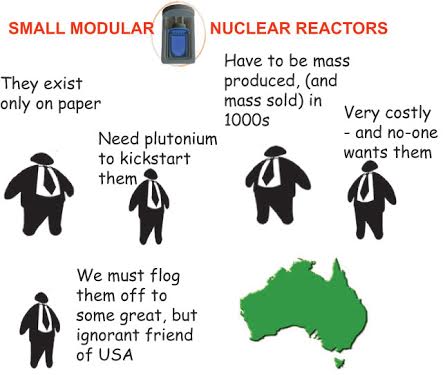
 While the BHP-funded Grattan Institute and a number of other “authoritative” bodies tout Small Modular Nuclear Reactors (SMRs) – powered by Thorium, for Australia, the bottom is falling out of the SMR project. The big firms involved are pulling out. Westinghouse already has. Babcock and Wilcox will be next.
Lobbyists like the USA’s nuclear front group, the Breakthrough Institute, have worked successfully on Australia’s pro nukers to flog off these (so far non-existent) SMRs to Australia. Note that they leave out the word “nuclear”, knowing that this word gives their project a bad smell.
However, – forget the associated bad smells of terrorism targets, proliferation dangers, waste problems that go with these nasty little nuclear reactors.
The biggy is economics. They just don’t stack up economically. (It’s such bad taste to mention this – but reneweable energy does stack up economically. And when you’re talking about small decentralised power sources – well – solar and wind are obviously the go.)
Austtralia’s hypocrisy. Government knows full well that Israel has nuclear weapons
 Australia still denies Israel’s open secret of a nuclear arsenal, SMH, April 15, 2014 Phillip Dorling
Secret government files reveal that Australian governments, diplomats and spies have known for more than 30 years that Israel has an arsenal of nuclear weapons, while continuing to deny any knowledge of its existence to the point of misleading Parliament.
Previously secret diplomatic files declassified by the National Archives reveal a longstanding policy to turn a blind eye to Israel’s nuclear arsenal. Last week the Department of Foreign Affairs and Trade again declined to comment on whether the Australian government thinks Israel is an undeclared nuclear weapons state.
Foreign Affairs Department briefing papers prepared for former Labor foreign minister Bill Hayden in 1987 state that ”intelligence assessments are that Israel has a small arsenal of nuclear weapons (possibly about 20). Israel’s technological capabilities would enable it confidently to deploy such weapons without recourse to a nuclear test.”
Mr Hayden and Dr Blix were talking against the backdrop of the treason trial of Mordechai Vanunu, the Israeli nuclear technician who in 1986 disclosed detailed evidence of Israel’s nuclear weapons production. The Foreign Affairs Department advised Mr Hayden to publicly deny knowledge of Israel’s nuclear weapons capabilities. Mr Hayden told Parliament on September 17, 1987: ”We have no information to corroborate these allegations.”
However, Foreign Affairs’ files, declassified in response to applications by Fairfax Media, reveal that Australia had been monitoring Israel’s nuclear program from its beginnings in the 1950s………
Australian policy remains unchanged, with the Abbott government deciding last October not to support a UN General Assembly resolution on nuclear proliferation in the Middle East – 169 countries voted for the resolution. Only five – the US, Israel, Canada, Palau and the Federated States of Micronesia – voted against. Australia abstained……..http://www.smh.com.au/federal-politics/political-news/australia-still-denies-israels-open-secret-of-a-nuclear-arsenal-20140414-36nr4.html
Uranium mining plans by Toro Energy – expensive, polluting, and under investigation
 Toro uranium expansion plan: premature and polluting http://www.ecovoice.com.au/toro-uranium-expansion-plan-premature-and-polluting/
Western Australia’s peak environmental group has condemned a move by uranium mining hopeful Toro Energy to expand their unrealised Wiluna mine plan into a much larger uranium mining precinct spanning 100km and two ecologically sensitive lake systems in the East Murchison region.
The state EPA has released details of the expansion plan while the company is under investigation by the Australian Securities Exchange for a second time over claims they have released misleading information to shareholders and the market. (See background below).
“Toro have never successfully mined anything before and have a long way to go to get their original single-mine project approved – let alone any new expansion,” said CCWA Nuclear Free campaigner, Mia Pepper.
“Contrary to their statements to shareholders, the company needs to complete additional environmental management , mine closure, tailings management and transport plans for assessment before any mining can commence at the Wiluna site.”
The company has struggled to find investors and currently needs $300 million in start-up costs and a further $300 million in upfront bonds.
“This new plan to attract investors is likely to draw further scrutiny from both regulators and the wider community who will be looking at the cumulative impacts of a regional uranium precinct covering 100km and two arid zone Lake Systems.”
“Toro plans to double its water consumption and store radioactive mine waste from several mine sites in a Lake bed. This idea lacks credibility and the company lacks capacity, experience and financial backing.”
Toro’s new plan involves four deposits over one hundred kilometres – Lake Way, Centipede, Millipede and Lake Maitland, with the company’s long term plans including mining an additional three deposits Nowthanna, Dawson Hinkler and Firestrike – covering a hundred kilometres in the other direction.
Also in the region is WA’s largest uranium deposit – Yeelirrie, which is now owned by Cameco. Traditional Owners have consistently opposed this project for forty years.
CCWA is partnering with a range of public health, union and faith groups to call for a public inquiry into the Toro mine plan.
ASX investigation
The Mineral Policy Institute and the Conservation Council of WA received formal notification that the Australian Securities Exchange is investigating Toro Energy for the second time over the release of potentially misleading information. Continue reading
Babcock and Wilcox step back from uneconomic Small Modular Nuclear Reactors (SMRs)
 B&W scales back its small nuclear reactor project, Charlotte Observer, By Bruce Hendersony, Apr. 14, 2014 Charlotte-based Babcock & Wilcox said Monday it will scale back its mPower small modular nuclear reactor program after being unable to attract needed investors or contracts. The president of its mPower subsidiary, Christofer Mowry, left the company as of Sunday, B&W said in a securities filing. Mowry was terminated “without cause,” the filing said. William Fox III will replace him.
Announced in 2009, small modular reactor technology had been the company’s largest research and development project……Babcock & Wilcox announced an “accelerated” search for additional investors in the program last November.

But the project struggled to find additional investors or construction contracts that would bring in enough revenue to continue its development, B&W said Monday……..mPower recorded an $87 million operating loss in 2013, B&W said in a March proxy statement. http://www.charlotteobserver.com/2014/04/14/4841485/bw-scales-back-its-small-nuclear.html
Earthquake scale 4 – 7 just off Fukushima coast
Quake hits just off Fukushima plant, felt along 500 kilometer stretch of Japan coast — Seismic intensity of 4 on scale up to 7 — Camera shakes for about 1 minute (VIDEO) http://enenews.com/quake-hits-just-off-fukushima-plant-felt-along-500-kilometers-of-japan-coast-camera-shakes-for-about-1-minute-video?utm_source=feedburner&utm_medium=email&utm_campaign=Feed%3A+ENENews+%28Energy+News%29
Japan Meteorological Agency, Apr. 13, 2014:
Time: 18:16 JST
Date: Apr. 13, 2014
Depth: 60 km
Location: Fukushima-ken Oki
Coordinates: 37.3N 141.2E
Magnitude: 4.9
Seismic Intensity: 4 out of 7
[Centered 30 km east of Fukushima Daiichi]Watch video of the quake here (at 8:00 in, 2x speed)
Australia to work with United Arab Emirates in developing nuclear technology
| UAE declares launch of nuclear energy cooperation deal with Australia | |||
|
|||
|
ABU DHABI, April 14 (KUNA) — The United Arab Emirates said on Monday that an agreement on the use of nuclear energy for peaceful means signed with Australia in 2012 has come into force.
The announcement was made in an official statement published on state news agency, WAM, which mentioned that the decision for the move was made during a meeting between Foreign Minister Sheikh Abdullah bin Zayed Al-Nahyan and Australia’s visiting Minister of Trade and Investment Andrew Robb. The Emirati foreign minister said that enacting the agreement will “provide broader opportunities for cooperation between state institutions and businesses operating in the nuclear energy field.”…….. According to the report, the discussions also touched upon enhancing existing economic and trade ties, and encouraging joint investments.
Sheikh Abdullah went on to stress the importance of exchanged visits in supporting bilateral cooperation and assessing the levels development and growth in each of the two countries…… The Australian minister, for his part, commended the level of cooperation between the two sides, emphasising the need to further these ties.
He also noted to the high reputation the UAE has managed to make for itself on the international scene, through providing a lucrative location for international businesses. (end) asa.sd http://www.kuna.net.kw/ArticleDetails.aspx?id=2372272&language=en |
Australia is part of USA’s increased market for exporting weapons to this region

The Obama administration has pushed through a streamlining of the licensing process in order to facilitate an increase in military exports – in part to compensate U.S. arms manufacturers for a decline in orders from the Pentagon…..
The more advanced weaponry U.S. allies purchase, the more they are locked into future acquisitions. The United States emphasises “interoperability” among its allies. Not only are purchasers dependent on the United States for spare parts and upgrades, but they must consider the overall system of command and control (which is now C5I — Command, Control, Communications, Computers, Combat systems and Intelligence).
World Cuts Back Military Spending, But Not Asia, Inter Press Service Analysis by John Feffer WASHINGTON, Apr 14 2014 (IPS) – For the second year in a row, the world is spending a little less on the military. Asia, however, has failed to get the memo. The region is spending more at a time when many others are spending less. Continue reading
How long can Tony Abbott and his media lackeys keep up his pretense about Climate Change?
 IPCC puts more heat on Abbott’s anti-science climate policies, Crikey, GILES PARKINSON | APR 14, 2014 The IPCC says action on climate change is urgent but affordable. The Abbott government says it will “wait and see”, all the while dismantling the mechanisms that could achieve higher targets. It is probably not what he is doing right now, but Australian Prime Minister Tony Abbott should be wondering exactly how long it is that he can continue with his climate change policy charade.
On Sunday, the United Nations climate body the Intergovernmental Panel on Climate Change delivered the third of its landmark updates on the climate science, impacts and mitigation options. The chief message of Working Group III, the mitigation of climate change, was one of hope: the world still had time to avoid the worst impacts of climate change, and although this would require a dramatic and urgent decarbonisation of the world’s energy and transport systems, it needn’t actually cost that much.
Indeed, as the IPCC graph indicates, the combined impact of all the measures that would be needed to encourage renewable energy in particular, and a suite of other technologies, might subtract just 0.06% from annual global growth: (see good graphs in original of this article).
And that is without calculating the obvious benefits or reduced air pollution and enhanced energy security, and without the obvious devastating impacts on the economy if climate change is allowed to continue unchecked.
 In Australia, the IPCC reports have gone largely unremarked or cherry picked by much of the mainstream media. After the report from Working Group II last month, The Australian reprinted an article from The Wall Street Journalhighlighting how global warming might mean fewer deaths from cold. This morning its headline screamed that action to mitigate climate change would cost 10% of GDP. The Australian Financial Review and The Daily Telegraphcompletely ignored it in their print editions. Apparently, their editors believe it is neither a business issue nor one that would trouble the general public.
This media approach has created an insular and distorted view in Australia of what is happening around the world. But any chance that world governments might sweep this under the carpet, as the Abbott government has been allowed to do by the mainstream media, were swiftly torched by the United States. Within minutes of the formal release of the report, Secretary of State John Kerry issued a statement saying the report was a “wake-up call” about the global economic opportunity that the world could seize. Kerry said abatement technologies can cut carbon pollution while growing economic opportunity at the same time: Continue reading
Climate change action is essential for business: no more ‘business as usual’
 Cyclone Ita: lessons after the media deluge, WA Today April 14, 2014 Crispin Hull “…………The response to extreme weather events by climate-change sceptics and business-as-usual climate-change deniers is now down pat: ”Well, you cannot assert that the climate is changing on the basis of an isolated event (insert event: cyclone. storm, bushfire, flood, drought). We have had these things before, you know.” And scientists will generally agree.
But this mantra has to stop.
For a start, with cyclones you can confidently say that they will now be more severe because of global warming. The oceans have warmed in the past 50 years. Cyclones get their energy from the heat of the ocean.
A lot of these things have exponential effect. A little extra heat means cyclones will be a lot more powerful. A little extra wind velocity means a lot more destruction. The power of wind is a cube function of its speed. Doubling the speed results in eight times the force. Trebling the speed equals 27 times the force.
So the difference between a category three and category five cyclone 500 kilometres off the Australian coastline is enormous. Once a category five is tracked, as was the case with Ita, very costly preventive measures get set in train, as they must.
My guess is that most people in Port Douglas blew between two and four days of their lives on cyclone preparation and returning to normal. Most businesses blew at least a day’s trade.
So there can be no more business as usual. Climate change has to be a major concern of business, particularly small business. Big business has the power and resources to adapt. Small businesses suffer badly at best or go broke at worse……..
Climate change must be a matter of concern for small business. Yes, we know that Australia on its own cannot affect the global climate, but we can and should influence world opinion, as we did with the bans on fluorocarbons. Those bans stopped the depletion of the ozone layer and prevented much cancer-causing radiation hitting the Earth.
The world co-operated then and we should co-operate now. The voice of small business should rally on this. Much of big business likes a high carbon economy and it does not care about the consequences……..http://www.watoday.com.au/comment/cyclone-ita-lessons-after-the-media-deluge-20140414-zquiy.html
French analysts surprised to find that Renewable Energy Target REDUCES Australia’s energy costs
Schneider study finds boosting renewables will cut energy costs (Excellent graphs) REneweconomy, By Giles Parkinson on 14 April 2014 Analysts at French based energy components company Schneider Electric have concluded that extending or expanding Australia’s renewable energy target would lead to lower electricity prices, lower carbon emissions and increased competition.
Reducing, or removing the renewable energy target – as many incumbent generators, industry lobby groups, state governments and some of its own members are urging the Abbott conservative government to do – will have the opposite impact, pushing prices higher and creating a greater reliance on expensive gas-fired generation.
The conclusions in the white paper have apparently surprised even the four-man team from Schneider that conducted the analysis, and the unnamed large energy users who commissioned it. Large energy users have normally been against the renewable energy target, and this study – along with others that have reached similar conclusions – is causing a rethink.
The Schneider Electric analysis says Australia will benefit from maintaining, extending or expanding its large scale renewable energy target (LRET) because renewable generation has lower emissions and lower marginal costs than do fossil fuels- fired generation.
“As a result of the influence of the LRET on the generation mix, electricity generation emissions in Australia are forecast to be lower under the LRET than would be otherwise,” it says.
“Again, the LRET becomes a hedge against rising carbon prices, and may help to keep carbon prices lower as a result of the lower emissions.
“Finally, and most strikingly, is the impact of the LRET on long-term energy prices. The LRET is forecast to result in a generation mix with lower marginal cost, lower carbon emissions, and increased competition in the electricity market, all which serve to reduce prices.
“Even after taking into account the cost of Large-scale Generation Certificates, the LRET in its current form is forecast to result in prices lower in the long run than those under decreased targets or outright removal of the Large-scale Renewable Energy Target.”
The analysis is important in the light of claims made by incumbent generators about the cost of the renewable energy target on consumers, and some even wilder claims in conservative commentators that renewables could add 50 per cent to consumer bills by 2020.
Pacific Hydro general manager Lane Crockett said the analysis by Schneider and others clearly demonstrated that zero fuel cost renewable energy can act as a hedge against future price rises in coal and gas.
“This report by Schneider is one of a number of recent reports that clearly demonstrate that deployment of renewable energy technologies via the renewable energy target has played a major role in keeping wholesale electricity prices down and is likely to continue to do so provided it is largely left alone,” he said.
“This report is no real surprise and clearly shows that that promise of a cleaner, cheaper energy market is now closer than ever to becoming a reality.” …..http://reneweconomy.com.au/2014/schneider-89361

IPCC report shows that Australia must do more to develop renewable energy
 IPCC report points to ‘renewables solution’ http://www.theaustralian.com.au/business/latest/ipcc-report-points-to-renewables-solution/story-e6frg90f-1226883956621 STAFF REPORTER APRIL 14, 2014
The Climate Council says a new international report released yesterday and signed off by governments from around the world, including Australia, has found a need to lift investment in renewable energy to combat climate change.
“Renewable energy is critical to tackling climate change,” says Amanda McKenzie, Climate Council CEO.
“Australians have already taken steps to increase renewable energy and this report shows we need to do more.”
The Intergovernmental Panel on Climate Change (IPCC) report focuses on mitigation strategies for climate change and indicates that globally the world needs to at least triple the use of zero and low carbon energy sources by 2050.The think-tank says key players, like the United States and China, are quickly moving ahead. For example, the United States doubled renewable capacity between 2008 and 2012, and China increased its capacity in wind energy by 36% in 2012.
Australia currently has a national renewable energy target to generate 20% of the power mix from renewables by 2020. Over 130 other countries have similar targets to bolster renewable energy.
“It’s clear that the renewables race has begun,” says McKenzie.
“Shifting away from fossil fuels to renewable energy is a key part of tackling climate change and has other benefits, for instance growing new jobs, industries and investment,” says McKenzie.
“Australians know that solar power is just common sense here, so there is a lot of community support for greater investment in renewables.
“On the other side of the ledger, Australia is also home to some very inefficient and aging coal fired power plants. That means our current electricity supply is one of the most emissions intensive and least efficient in the world.”
1 This month
7 April – WEBINAR – Australia and the Doomsday Clock – Preventing nuclear war through NoFirstUse and other policies
Online | Tuesday April 7, 4:00-5:30pm, Australian Eastern Time / 8:00-9:30am Central Europe Time
– Access the registration link
15 April – Zoom –Nuclear Power is Not the Solution
Apr 15, 2026 01:00 AM in Canberra, Melbourne, Sydney

Join the International Physicians for the Prevention of Nuclear War (IPPNW) on Tuesday, April 14th for a timely webinar exploring the risks associated with nuclear power and challenging the myth that it offers a simple, safe, carbon-free solution to the climate crisis

21 April Webinar: No Nuclear Weapons in Australia
Start: 2026-04-21 18:00:00 UTC Canberra, Melbourne, Sydney (GMT+10:00)
End: 2026-04-21 19:30:00 UTC Canberra, Melbourne, Sydney (GMT+10:00)
Event Type: Virtual
A virtual link will be communicated before the event.
Host Contact Info: australia@icanw.org

of the week – Australians for War Powers Reform (AWPR)
To see nuclear-related stories in greater depth and intensity
 Antinuclear