Australian nuclear news this week
 Australia’s comedy shows are getting poor audiences this week. Everyone’s focussed on New South Wales and federal politics. My thanks to tweeters “Barry walks the plonk” Che Shiraz Shiraz – whatever will be , will be”
Sorry – I digressed badly there.
Uranium Now we’re going to sell uranium to Saudi Arabia. Such a stable, democratic, Middle Eastern power – no worries about a Middle East nuclear arms race ?
Uranium mining at Ranger: Energy Resources of Australia (ERA) trying to pull a real swiftie. They say they won’t rehabilitate this polluting mine in Kakadu National Park, unless they get approval to start a new underground mine. Meanwhile the parent company Rio Tinto is not prepared to pay for the Ranger clean-up – saying it’s the responsibility of the loss-making ERA. All bad news for the Mirrar people – they’re ing exploited again , as always, by the nuclear industry.
Australia’s participation in Hiroshima meeting on nuclear disarmament. We refuse to join the non nuclear nations movement towarsds banning nuclear weaposn. We mustn’t be “emotional” about nuclear bombing,, said our Foreign Minister Julie Bishop, in Hiroshima.
Politics . (No this is not about a bottle of wine. Stop it!) The Australian Labor Party in its Not wisdom, is pushing to have mining, uranium mining too, in the radioactively polluted Woomera nuclear weapons test area.
The Liberal government’s response to the IPCC report on climate change? The Anti Environment Minister, Greg Hunt, announced yesterday that Australia would promote coal and nuclear industries. Not renewable, not energy efficiency. Is it any wonder people are turning to the Greens? Looks as if Liberal and Labor are now joined at the hip.
New South Wales. A nifty new solar project that should revolutionise remote area energy systems.
Victoria. I bet Greg Hunt wishes that those pesky Morwell people would just shut up, and look after their coal -caused asthma, emphysema, etc. They have started a campaign to keep the Renewable Energy Target. And they want the government to put money that’s pledged for new brown coal projects into cleaning up Morwell after the Hazelwood coal fire. Who do they think they are? (“Ohmigawd“, – thinks the Napthine govt – “they’re voters!“)
Rooftop solar holds best promise for cheaper electricity in Adelaide
 Dennis Matthews 18 April I have been keeping records of my electricity use since 1986 and I agree with Russell Marsh (The Advertiser,18/4/14), South Australia had high electricity prices well before the first wind farm.
Poor local coal resources and expensive gas were the initial culprits. Then came privatization and the national electricity market (NEM) accompanied by increased regulation, which gave the transmission and distribution monopolies a guaranteed return on investment. The result was overinvestment in the poles and wires.
Affluent consumers suddenly decided they needed air conditioners. The increase in electricity demand during heat waves resulted in a sellers’ market. Wholesale prices jumped from $40 to $10,000 a megawatt hour (MWh).
Thanks to privatization and the NEM it was hard to pin down who was responsible; was it the Government, was it the regulators, was it the generators, was it the distributors, was it the retailers?
Rooftop solar has been the only bright spot, but until it is easily accessible by rental accommodation then its benefits will be unevenly spread.
Australia to co-operate with United Arab Emirates in nuclear-related activities
 Australia hopes to lure Emirati students to its institutions while selling uranium to the UAE The National, Caline Malek
April 17, 2014 ABU DHABI Higher education and nuclear power are areas in which the UAE and Australia will start collaborating.
During a visit to the UAE this week by Andrew Robb, Australia’s trade and investment minister, an agreement was signed with Sheikh Hamdan bin Mubarak, the Minister for Higher Education. The countries will collaborate on vocational education, training and research cooperation in higher education……..
Mr Robb said the UAE was investing in infrastructure and restructuring its economy, creating opportunities in sectors where Australia had a proven track record.
He also met senior ministers to advocate for a resumption of negotiations for a free trade agreement with the GCC.
“I [used] my visit to set out the Australian government’s trade and investment agenda, to emphasise that Australia is open for business and that we are committed to deepening our economic engagement with the region,” he said.
Australia will also begin to export uranium to the UAE for its nuclear power plants.
The Nuclear Cooperation Agreement was signed in July 2012 but was ratified and came into force only on Monday. It could lead to the export to the UAE of up to 800 tonnes of uranium a year by the end of the decade. “The agreement should now pave the way for separate commercial agreements between potential Australian uranium suppliers and the Emirates Nuclear Energy Corporation,” said Mr Kang. “The [first exports] are subject to the timeline for the construction of the UAE’s nuclear power plants, but I understand the first of these plants is scheduled for completion in 2017.”
Under the agreement, Australia will supply uranium for use in the UAE’s developing civil nuclear power programme and cooperate in nuclear-related activities, such as safeguards, security, safety and science.
“The agreement has been secured because Australia is a reliable supplier of uranium and the UAE is a responsible user of nuclear energy for civilian purposes,” said Mr Robb, who met Sheikh Abdullah bin Zayed, the Foreign Minister, this week in Abu Dhabi.
“This will open up a new long-term market for Australian uranium producers.”……….Sheikh Abdullah said the ratification of the agreement would offer more opportunities for collaboration between the Government and private sectors of both countries. He said this falls in line with the UAE’s policy of developing its peaceful nuclear energy programme in collaboration with other countries that shared the same commitment.
Hamad Alkaabi, the UAE’s permanent representative to the International Atomic Energy Agency, said the agreement constituted a governmental framework for cooperation in nuclear activities between both countries……..http://www.thenational.ae/uae/australia-hopes-to-lure-emirati-students-to-its-institutions-while-selling-uranium-to-the-uae
Tony Abbott has effectively stopped Australian large scale renewable energy
 Australian large-scale renewable energy projects at standstill http://reneweconomy.com.au/2014/australian-large-scale-renewable-energy-projects-standstill-59733 By Giles Parkinson on 16 April 2014
This is despite the fact that existing policy calls for 41,000GWh of renewable energy to be provided across Australia by 2020. However, the renewable energy industry, along with the utilities that must acquit their obligations, and the banks that would finance these projects, are convinced that the target will be severely reduced, if not dismantled.
This pessimism is reflected in the market for large-scale renewable energy certificates, which have slumped to $28.55, down 15 per cent from late December, and down nearly half from before the election of the Abbott government last September.
The pessimism has infected the industry since early 2013, when, despite the findings by the Climate Change Authority that the LRET should stay as is, the equivocation of the Coalition, and its presumed success in the September poll, brought the market to a halt.
According to data from Green Energy Trading – a major player in the market for renewable energy certificates, only four new projects have been “committed” since the start of 2013. Of these, the 53MW Broken Hill and 102MW Nyngan solar power stations are mostly financed from the now defunct Solar Flagships project, with large grants from the federal and state governments; and the 20MW Royalla solar plant in Canberra is getting a fixed tariff as part of the local government’s reverse auction program.
The only new wind farm approved in the last year – a 47MW extension to Pacific Hydro’s Portland projects – seems to have been committed because it received financing from the Clean Energy Finance Corporation, the $10 billion green bank that the Coalition wants to dismantle, despite it making a profitfor the government.
The only other new projects that are likely to be committed in the short-term are the other solar projects in the ACT, and the wind projects that will be awarded in its forthcoming auction. (It should be noted that committed projects are different to “approved” projects, which merely means they have approval to be built, but not necessarily the finance).
Those solar and wind projects, part of the ACT government’s commitment to a 90 per cent renewable energy target, do not rely on the LRET. However, the proposal for new wind farms is being vigorously opposed by conservative politicians, both state and federal, as well as the Murdoch press.
Green Energy Trading estimates that if the market for LRECS is to maintain an acceptable level of market liquidity, around 4,450 MW of new projects need to be committed in the three-year period from 2014 to 2016. That is unlikely to happen until the RET review is completed mid year, and then considered by the Abbott government.
However, if the incumbent electricity industry has its way, there will be no new projects built before 2017 at the least. This is its estimate of the impact of the LRET target being reduced to a “real” 20 per cent target, which might equate to a new fixed target of around 26,000GWh.
Numerous studies have shows that not only will this result in a sharp fall in the deployment of wind and solar, it will also mean more coal-fired generation. And a new study from French energy products giantSchneider Electric says cutting the renewables target will also mean higher prices for consumers. This came as a surprise to the large energy users that commissioned the Schneider analysis. They had anticipated the opposite finding.
Still, the renewable energy industry is finding doors closed in Canberra, with ministers and advisors promising only that projects already built will not be impacted by any changes to the RET, which will be recommended by a review headed by climate science sceptic and nuclear advocate Dick Warburton.
International groups such as First Solar and Acciona have already signalled their intention to re-assess their commitment to projects in Australia, in a likely repeat of the exodus that was caused when the current energy minister Ian Macfarlane ended the then MRET (mandatory renewable energy target) when he was last in the same job a decade ago – and that decision was taken despite an independent review recommending the MRET be expanded.
Michael Denborough, medical researcher and anti nuclear activist
Life-saving researcher fought nuclear power April 18, 2014 SMH, David Denborough
Michael Denborough Medical researcher, activist 11-7-1929 — 8-2-2014
On the day of his death, Michael Denborough, Australian medical researcher, activist and founder of the Nuclear Disarmament Party, declared quietly to his loved ones: ”I’ve lived the luckiest life.”……..
There was another field in which Michael Denborough was influential – activism to prevent nuclear war. In 1970 he learned from a colleague, Roger Melick, that every time an atmospheric French nuclear test was conducted in the Pacific the levels of radioactive iodine in sheep’s thyroid glands across Australia would rise alarmingly. We were all being radiated by these tests.
Michael and Roger penned a letter to national newspapers notifying the public and so began the scientific and political protests which led to the International Court in the Hague forcing nuclear tests underground.In 1983, as acting director of the Centre for Research and Environmental Studies in Canberra, Michael convened a symposium, Consequences of Nuclear War for Australia and its Region. Its aim was to promote international nuclear disarmament. Patrick White and other distinguished speakers accepted his invitation. Physicians and scientists from Eastern and Western countries, including the USSR and the US, came to see what they could do to fix the greatest threat to world health.
In 1984, as a response to the Labor Government’s sell-out on its anti-nuclear platform, Michael Denborough and others founded the Nuclear Disarmament Party. It was a single-issue party with three policies – no uranium mining, no nuclear weapons and no US bases on Australian soil. The NDP was the political voice of a strong grass-roots social movement. People from all walks of life, and of all ages, came together to try to save the planet. Two NDP senators were elected, one in 1984 and one in 1987. The NDP continued to highlight nuclear issues in elections until 2009.
In 2003, Michael set up a lone vigil for 52 days outside Parliament House to protest what almost everybody admits now was going to be an unjust invasion of Iraq. On the day John Howard committed Australian troops Michael was thrown out of Parliament for protesting loudly from the gallery. He was 74 years old.
Michael will be remembered for his passionate opposition to war and the nuclear industry. Lives will continue to be saved as the result of his medical discoveries. ….http://www.smh.com.au/comment/obituaries/lifesaving-researcher-fought-nuclear-power-20140417-36utf.html
Radioactive wastes from fracking, in USA
 Radioactive Waste Booms With Fracking as New Rules Mulled, Bloomberg, By Alex Nussbaum Apr 16, 2014 Oilfields are spinning off thousands of tons of low-level radioactive trash as the U.S. drilling boom leads to a surge in illegal dumping and states debate how much landfills can safely take.
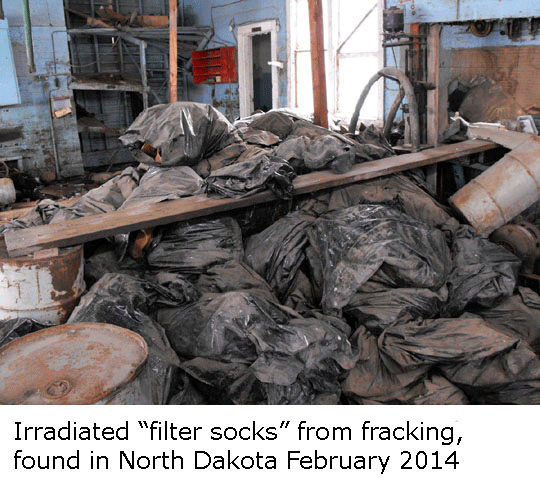
State regulators are caught between environmental and public health groups demanding more regulation and the industry, which says it’s already taking proper precautions. As scientists debate the impact of small amounts of radiation on cancer risks, the U.S. Environmental Protection Agency says there’s not enough evidence to say what level is safe.
Left to police the waste, state governments are increasing their scrutiny of well operators. Pennsylvania and West Virginia are revising limits for acceptable radiation levels and strengthening disposal rules. North Dakota’s doing the same, after finding piles of garbage bags filled with radioactive debris in an abandoned building this year. “We have many more wells, producing at an accelerating rate, and for each of them there’s a higher volume of waste,” said Avner Vengosh, a professor of geochemistry at Duke University in Durham,North Carolina, who’s studied the issue. Without proper handling, “we are actually building up a legacy of radioactivity in hundreds of points where people have had leaks or spills around the country.”
Source: North Dakota Dept of Health via Bloomberg
On Feb. 28, North Dakota officials found hundreds of irradiated “filter socks” — used…Read More
The waste is a byproduct of the drilling renaissance that has brought U.S. oil and natural gas production to its highest levels in three decades — while also unlocking naturally occurring radium from rock formations far underground…….
Radium Contamination
The issue is shale rock, the dense formations found to hold immense reserves of gas and oil. Shale often contains higher levels of radium — a chemical element used in industrial X-ray diagnostics and cancer treatments — than traditional oil fields, Vengosh said.
Freeing gas and oil is a water-intensive process called hydraulic fracturing, or fracking, in which drill bits cut thousands of feet through shale fields to make way for high-pressure water streams that pulverize the rock. The process displaces radium-tinged subterranean water that comes up through the wells, where it can taint soil and surface equipment. Radiation levels can build up in sludges at the bottom of tanks, pipeline scale and other material that comes in extended contact with wastewater.
Buried Waste
Some states allow the contaminated material to be buried at the drill site. Some is hauled away, with varying requirements for tracking the waste. Some ends up in roadside ditches, garbage dumpsters or is taken to landfills in violation of local rules, said Scott Radig, director of the North Dakota Health Department’s Division of Waste Management.
In that state’s Bakken oilfields, “it’s a wink-and-a-nod situation,” said Darrell Dorgan, a spokesman for the North Dakota Energy Industry Waste Coalition, a group lobbying for stricter rules. “There’s hundreds of thousands of square miles in northwestern North Dakota and a lot of it is isolated. Nobody’s looking at where all of it is going.”…….http://www.bloomberg.com/news/2014-04-15/radioactive-waste-booms-with-oil-as-new-rules-mulled.html
Obama promoting solar energy, what a contrast to Abbott!
 Obama to challenge private companies to boost solar power use WP, By Juliet Eilperin and Katie Zezima, April 16 E-mail the writers
President Obama will challenge companies Thursday to expand their use of solar power, part of his ongoing effort to leverage the power of his office to achieve goals that have been stymied by Congress. The new initiative comes as the White House is hosting a Solar Summit aimed at highlighting successful efforts on the local level to speed the deployment of solar energy…….
“Now is the time for solar,” said Anya Schoolman, executive director of theCommunity Power Network, a Washington-based nonprofit group that helps communities build renewable energy projects. She will be honored at the summit Thursday.
“The costs are affordable, in reach of middle America and above. We know how to do it now, we know how to scale it, and we kind of just need people to let it go and encourage it,” she said.
In an effort to make it easier for state, local and tribal governments to expand their solar portfolios, the Energy Department is launching a $15 million-dollar “Solar Market Pathways” program………
States are starting novel ways to help commercial tenants access solar energy. In Connecticut, the state set up a green bank with taxpayer dollars. When a building owner wants to access capital for solar projects, the state puts a tax lien on the building and gives the owner a loan that must be paid back over 20 years, said Jessica Bailey of theConnecticut Clean Energy Finance and Investment Authority.…
Rhone Resch, president and chief executive of the Solar Energy Industries Association, a trade group, said solar is no longer an “afterthought” in the renewable energy conversation, accounting for nearly 30 percent of new electric in 2013.
“Without question, the Obama administration has been the most solar-friendly ever,” Resch said. http://www.washingtonpost.com/national/health-science/obama-to-challenge-private-companies-to-boost-solar-power-use/2014/04/16/76bd2b20-c5a3-11e3-bf7a-be01a9b69cf1_story.html
Small scale solar energy triumphing globally, and especially in Australia
 Small Scale Solar A Stand-Out Performer http://www.energymatters.com.au/index.php?main_page=news_article&article_id=4267 Global investment in renewable energy jumped in the first quarter – and in Australia, it’s still citizens leading the revolution through rooftop solar power.
According to Bloomberg New Energy Finance (BNEF), investment in clean energy around the world reached USD $47.7bn during the first 3 months of this year.
The stand-out sector was small scale solar power (less than 1MW systems); which skyrocketed by as much as 42%. Overall investment in solar (large and small) was up 23% at $27.5bn.
RenewEconomy, drawing on data from BNEF and Pew Charitable Trusts, states Australian households accounted for nearly two thirds of total investment in renewables in the nation in 2013 ($2.8 billion), and practically all of it so far this year.
RenewEconomy states more than 4,000 applications to install small systems are being a lodged a month in the south-east Queensland region managed by Energex. In South Australia and Western Australia, small scale system uptake is more than 2,500 a month, and in Victoria just below that level.
That uptake is so strong isn’t surprising. In addition to the lure of households being able to slash or even wipe out their power bills; there is an added sense of urgency given fears with regard to the future of Australia’s Renewable Energy Target (RET). The RET provides support for the purchase of small-scale solar power systems; which can amount to thousands of dollars.
Another factor helping to drive uptake is the availability of innovative financing arrangements – such as zero dollar deposit payment plans. National provider Energy Matters’ Save As You Go initiative is structured in a way that in addition to the zero deposit; repayments are structured so many households will repay less per week than what they would spend on equivalent mains electricity supply.
According to Energy Matters, solar is still one the highest returning investmentsin Australia – outperforming shares, property, gold, global fixed interest or even fine art.
1 This month
7 April – WEBINAR – Australia and the Doomsday Clock – Preventing nuclear war through NoFirstUse and other policies
Online | Tuesday April 7, 4:00-5:30pm, Australian Eastern Time / 8:00-9:30am Central Europe Time
– Access the registration link
15 April – Zoom –Nuclear Power is Not the Solution
Apr 15, 2026 01:00 AM in Canberra, Melbourne, Sydney

Join the International Physicians for the Prevention of Nuclear War (IPPNW) on Tuesday, April 14th for a timely webinar exploring the risks associated with nuclear power and challenging the myth that it offers a simple, safe, carbon-free solution to the climate crisis

21 April Webinar: No Nuclear Weapons in Australia
Start: 2026-04-21 18:00:00 UTC Canberra, Melbourne, Sydney (GMT+10:00)
End: 2026-04-21 19:30:00 UTC Canberra, Melbourne, Sydney (GMT+10:00)
Event Type: Virtual
A virtual link will be communicated before the event.
Host Contact Info: australia@icanw.org

of the week – Australians for War Powers Reform (AWPR)
To see nuclear-related stories in greater depth and intensity
 Antinuclear