Nuclear lobby getting desperate? Flogging Small Modular Reactor Fantasy to Australia
To The Editor, The Advertiser, by Dennis Matthews, 19 April 14 Boy, do we have a deal for you! We have these super-dooper compact modular nuclear reactors (The Advertiser,19/4/14). We can’t say how many MW they would generate or how much they would cost, but the output will be less than 1/10th of the smaller (oops bigger) reactors and the proposed costs can be a fraction, somewhere between ½ and whatever.
But wait, there’s more. The essence of the technology already exists in nuclear submarines, which find them useful because they are not as smelly as generators using fossil fuels. We will put yours underground thus making it less polluting for your neighbours, except of course if they malfunction, which happens very rarely. You may have trouble with insurance but rest assured your government, like the US government, will pick up the costs at no charge to you.
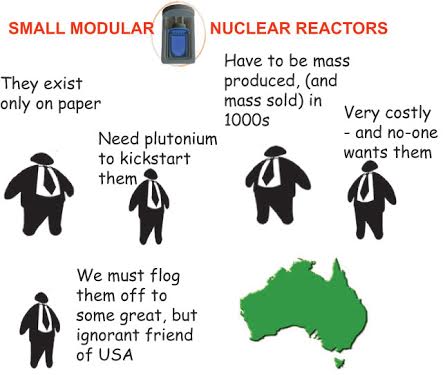
It will be at least six years before the first one is built so beat the rush and get your orders in now.
Greg Hunt Australia’s Anti Environment Minister is blind to the looming catastrophe
Coal: Stop burning it, this is the next asbestos Canberra Times, April 19, 2014 Crispin Hul In the 1960s asbestos mining was a very profitable business. And it created a lot of jobs. Asbestos was very useful – indeed, one of the best insulating materials known to humankind.
The link between asbestos and cancer was known as early as the 1930s. But mining continued. ………
But asbestos was toxic. Ultimately it was more economically beneficial to leave it in the ground than use it, aside from the human cost…….
in the long term the continued use of coal will be profoundly more damaging than the continued use of asbestos. If the world continues to burn fossil fuels the way we do, the result will not be a few mesothelioma deaths (awful as they are) and some economic loss weeding asbestos out of buildings.
Rather, the result will be massive indirect economic costs because we did not have the sense to develop a gradual transition to leave the carbon-emitting toxic fuels in the ground and develop alternatives……..
 Environment Minister Greg Hunt, for example, said this week in response to the latest report from the Intergovernmental Panel on Climate Change: “Coal will be used for decades and decades more.”
His bedrock position is that coal continues irrespective, and he presumes someone (like the CSIRO, whose funds his government is slashing) will come up with a workable scheme to capture and bury the emissions. Idiocy when proven substitutes are available.
Hunt should not work from the base, being utterly beholden to the coal industry and that coal will continue no matter what. Rather, he should work from a base of what do we need to do to prevent global warming. How can Australia lead in a global movement?
In 30 years Hunt will look like an asbestos miner so concerned about profits and economic benefits that he is blind to the looming catastrophe.
Sensible economists tell us it will be less costly in the long run to do something than not. And it will not cost hugely to move more quickly to wind and solar generating………
solar panels are about the best investment going. And their price is falling all the time while electricity prices continue to go up, presuming you are not renting, intend to stay put for several years and do not have shade trees all over your house.
The government should have built on this rather than continue homage to indefinite use of coal. Greg Hunt’s response to the IPPC report this week was woeful.
 The federal government should do something to force electricity generators – nearly all state-government owned – to stop abusing their monopoly power by paying so little for electricity generated by residents. They should also remove their limits (usually to 5kw inverters) on the amount that can be generated from the home to the grid. That would encourage even greater investment in solar.
If they were private companies, competition law would not allow them to get away with their low feed-in prices.
A quick thought on NSW: For decades NSW politicians have pursued policies that benefit individual and sectional interests and in return have received very large donations from those interests. Those donations then go into campaigns for politicians to persuade voters that, despite the pandering to sectional interests, they are governing in the best interests of everyone in the state. Wouldn’t it be easier just to govern in the best interests of all in the first place and tell all the rich and powerful sectional interests to go jump? http://www.canberratimes.com.au/comment/coal-stop-burning-it-this-is-the-next-asbestos-20140418-36wlk.html
Coal industry pretends to have grassroots support
The Minerals Council of Australia (MCA) launched the Australians for Coal website on Monday, before a television advertisement campaign, in order to extol the economic benefits of coal. The MCA has said the “silent majority” of Australians support coal, as opposed to a small but vocal group of anti-coal activists.
The site urges supporters to email their local MPs with a template letter that calls upon them to support the mining industry, which is “under attack from activists and extremists”.
When users enter a postcode, the website attributes their letter to all MPs in their home state, rather than just their local MP.
But the letters are also forwarded to “anti-coal activists”, with the Australian Conservation Foundation and Friends of the Earth confirming receipt of 28 emails. It is understood Greenpeace and anti-coal group Quit Coal were also sent emails. The emails sent to the environmental groups display each supporter’s name, postcode and email address. The emails to the non-government organisations abruptly stopped on Monday.
“It’s a really bizarre strategy – I now have these people’s names, emails and postcodes,” said Cam Walker, a campaigner at Friends of the Earth. “From go to woe this has been a pretty sloppy campaign.”
Walker said the MCA’s campaign had been “soundly trounced” by a largely critical reaction on social media……Bandt, the deputy leader of the Greens, said: “One of the emails came from Dame Gina Rinehart, so I’m not sure of its authenticity.
“The coal barons are terrified and rightly so. Coal is the next asbestos or tobacco and big coal is trying to fight that. I’m pleased this campaign has galvanised people who want to phase out coal.
“If everyday Australians love coal so much, why have one million of them put solar panels on their roofs? People are voting with their feet.”………
The MCA didn’t respond to questions put to it by Guardian Australia.http://www.theguardian.com/world/2014/apr/18/australians-for-coal-sent-supporters-letters-to-environmental-groups
Renewable energy city produces 4 times more energy than it consumes

 Sonnenschiff: Solar City Produces 4X the Energy it Consumes http://inhabitat.com/sonnenschiff-solar-city-produces-4x-the-energy-it-needs/ by Andrew Michler, 07/27/11 Sonnenschiff solar city in Freiburg, Germany is very much net positive. The self-sustaining city accomplishes this feat through smart solar design and lots and lots of photovoltaic panels pointed in the right direction. It seems like a simple strategy — but designers often incorporate solar installations as an afterthought, or worse, as a label. Designed by Rolf Disch, the Sonnenschiff (Solar Ship) and Solarsiedlung (Solar Village) emphasize power production from the start by smartly incorporating a series of large rooftop solar arrays that double as sun shades. The buildings are also built to Passivhaus standards, which allows the project to produce four times the amount of energy it consumes!
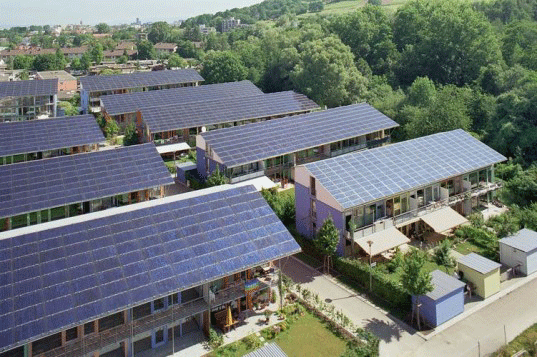
The project started out as a vision for an entire community — the medium-density project balances size, accessibility, green space, and solar exposure. In all, 52 homes make up a neighborhood anchored to Sonnenschiff, a mixed-use residential and commercial building that emphasizes livability with a minimal footprint. Advanced technologies like phase-change materials and vacuum insulation significantly boost the thermal performance of the building’s wall system.
Diplomacy gives the best chance of a successful deal between Iran and the West

 Why we must give Iran nuclear deal a chance, Global Public Square By Tyler Cullis and Jamal Abdi, Special to CNN, 17 April 14 Editor’s note: Tyler Cullis is a policy associate at the National Iranian American Council. Jamal Abdi is policy director at NIAC. The views expressed are the authors’ own.
The United States could be on the verge of securing a historic agreement over Iran’s nuclear program, one that verifiably limits it and opens the door to further cooperation between the two countries. Yet with a diplomatic victory on the horizon, the rhetoric of those who have long opposed any diplomatic resolution is reaching dizzying heights of disingenuousness.
During a recent Senate hearing, Senate Foreign Relations Committee Chairman Robert Menendez (D-NJ) hit out at reports that negotiations with Iran may produce a deal that “only” extends Iran’s nuclear breakout timeline to 6 to 12 months.
“I don’t think we did everything that we’ve done to only get a six to twelve month lead time,” Menendez lamented as he grilled Secretary of State John Kerry over the progress of the talks………
The Israeli government appears to believe that threatening possible military strikes on Iran’s nuclear facilities is the solution. But here’s the kicker: some estimates suggest that an Israeli strike on Iran would delay Iran’s breakout timeline by…six to twelve months – the same as the negotiated approach. The problem, of course, is that unlike a diplomatic solution, which would trade sanctions relief for verifiable limits on Iran’s nuclear program, an Israeli (or U.S.) military strike would have the opposite effect, and could prompt Iran to kick out inspectors and make a dash for a nuclear deterrent.
All this suggests an understanding of the potential timelines under these scenarios points to one conclusion – the White House is taking the best approach, one that extends the breakout timeline and has the best potential for securing an intrusive inspections regime to ensure Iranian compliance.
Opponents of diplomacy would do well to reflect on the reality that as the United States has tried to leverage sanctions against Iran, Tehran has responded by ramping up the production of centrifuges. As a result, the U.S. has long been in need of a new direction in its policy toward Iran.
Tentatively, but unmistakably, the Obama Administration has pursued a new approach – one that has brought us the first freeze on Iran’s nuclear program in a decade and which reports suggests have led to significant concessions on Iran’s Arak reactor.
If such a deal is not good enough for some in Congress or Israel’s government, then they must be prepared to speak up and offer viable alternatives. In the meantime, they should avoid undermining one of the most promising prospects for limiting Iran’s nuclear program in years. http://globalpublicsquare.blogs.cnn.com/2014/04/18/why-we-must-give-iran-nuclear-deal-a-chance/
Nuclear industry desperate as it manipulates the media
 You know the nuclear industry is desperate when…Michael Mariotte April 1, 2014 You know the nuclear power industry is getting desperate when it solicits its CEOs to start piling on ghost-written op-eds in publications chosen for their reach to key audiences. And you know the industry is really desperate when it brings out big guns like a couple of paid-for former U.S. Senators to support nuclear power in The Hill newspaper, which, as its name implies, is aimed at current legislators. And you know the industry is super desperate when it pulls out none other than Rudy Giuliani, who continues stuffing his wallet with nuclear-powered green.
And when it rolls out all three on the same day? That’s when you know that the nuclear industry knows what not enough clean energy activists have yet understood: the nuclear power industry is in real trouble; it’s sensing its near-imminent demise; and like the dinosaur snarling and wagging its tail on its way to extinction, it’s in a dire, and ultimately likely to be unsuccessful, scramble for its very existence…..…
The nuclear industry’s sense of desperation is palpable. Activists need to understand what the industry obviously knows: it’s in serious trouble. This is our time to really join together, ramp up our efforts, and kick more of these reactors over the edge; they’re already teetering. They’re dangerous, they can’t provide cost-effective electricity, they don’t have a solution to their radioactive waste and they exist now only because they were built decades ago and the utilities want to milk them for everything they can before they surrender to the inevitable and have to begin spending huge sums of money again–but this time it won’t be to build new reactors, it will be to decommission their dinosaurs http://tinyurl.com/n3b9myt
1 This month

of the week – Australians for War Powers Reform (AWPR)
To see nuclear-related stories in greater depth and intensity
 Antinuclear