UV radiation: melanoma now more common among children, though still rare
 Pediatric melanoma a growing occurrence Pediatric melanoma, rare but becoming more common, is a serious but treatable disease Chron, By Todd Ackerman | April 23, 2014 M.D. Anderson sees more child patients than anywhere else in the nation, partly because it gets so many referrals from nonspecialists who don’t know what to make of adolescents getting a disease that scientists say usually takes a decade or more to develop, most of the time because of too much exposure to the sun. Even now, only a few doctors specialize in the disease in children, said Dr. Dennis Hughes, an M.D. Anderson pediatric oncologist who treats most of the center’s youngest patients.
Melanoma develops when skin cells called melancytes become abnormal and multiply in an uncontrolled way. The cells, which normally give skin its color and protect the deeper levels from sun damage, form a mass of tissue, or a tumor, when they’re multiplying uncontrollably that can spread and damage healthy tissue.
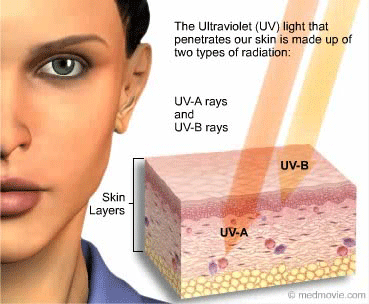
The reasons for the jump in pediatric cases are unclear. Some suspect – though there’s no supporting data – it may involve the depletion of the ozone layer, which absorbs most of the sun’s ultraviolet radiation. Hughes notes that more skin gets exposed now but also thinks it’s because of improved awareness. More doctors now know that melanoma is not just an adult disease.
It is not, however, an easy diagnosis. Frequently mistaken for warts or mosquito bites, pediatric melanoma can look quite different from the adult disease, often light-colored and well-defined instead of irregularly pigmented. A 2011 study found that 60 percent of melanoma-afflicted young children didn’t meet the common melanoma-detection criteria (the ABCD warning signs of asymmetry, border irregularity, color variation and diameter over 6 millimeters).
In children younger than 10, it also usually doesn’t show up in sun-exposed areas.
For such reasons, pediatric melanoma is often diagnosed late, not a good thing in a cancer a recent study found spreads more quickly in children than in adults. Hughes estimates that a third to a half of such child patients arrive at M.D. Anderson with a delayed diagnosis, something Hughes has no difficulty understanding.
“Warts are common,” he said. “Pediatric melanoma isn’t.”
Hughes doesn’t want parents to overreact, given pediatric melanoma’s rarity. . But he also wants them to know it’s possible that what they think is a wart that isn’t getting better could be melanoma…….http://www.chron.com/news/health/article/Pediatric-melanoma-a-growing-occurrence-5424359.php
No comments yet.
1 This month
7 April – WEBINAR – Australia and the Doomsday Clock – Preventing nuclear war through NoFirstUse and other policies
Online | Tuesday April 7, 4:00-5:30pm, Australian Eastern Time / 8:00-9:30am Central Europe Time
– Access the registration link
15 April – Zoom –Nuclear Power is Not the Solution
Apr 15, 2026 01:00 AM in Canberra, Melbourne, Sydney

Join the International Physicians for the Prevention of Nuclear War (IPPNW) on Tuesday, April 14th for a timely webinar exploring the risks associated with nuclear power and challenging the myth that it offers a simple, safe, carbon-free solution to the climate crisis

21 April Webinar: No Nuclear Weapons in Australia
Start: 2026-04-21 18:00:00 UTC Canberra, Melbourne, Sydney (GMT+10:00)
End: 2026-04-21 19:30:00 UTC Canberra, Melbourne, Sydney (GMT+10:00)
Event Type: Virtual
A virtual link will be communicated before the event.
Host Contact Info: australia@icanw.org

of the week – Australians for War Powers Reform (AWPR)
To see nuclear-related stories in greater depth and intensity
 Antinuclear
Leave a comment