Farmers and irrigators up in arms about Santos radiation leak near Lismore, NSW
Santos uranium scare raises tensions with farmers GRAHAM LLOYD THE AUSTRALIAN APRIL 28, 2014
A LEAKING waste-water pond that has caused a uranium scare in an underground aquifer at NSW’s biggest coal-seam gas project would be empty within two weeks, project operator Santos Ltd has said.
The company is nearing completion on the construction of a major new dam at the Pilliga project as it prepares to seek approval to move from exploration to production drilling.
But confirmation of the leak has increased tensions between Santos and farmers concerned about the long-term threat to the productive agricultural region. Tensions are also building at Bentley, near Lismore in the Northern Rivers region, where a large protest camp is expecting strong police action this week to allow site entry for junior miner Metgasco to drill an unconventional gas-exploration well…….confirmation of the leak has angered local farm and water groups. Jon-Maree Baker, from Namoi Water, which represents 3000 water licence holders in the Narrabri region, said the spill raised significant concerns.
“The question for us is can the risks be managed adequately by the regulatory process and are the unintended risks something that can be mitigated?” Ms Baker said.
Santos plans to drill 850 gas wells throughout the Pilliga forest and across private farmland as part of the Narrabri Gas Project, before expanding across northwest NSW. http://www.theaustralian.com.au/business/mining-energy/santos-uranium-scare-raises-tensions-with-farmers/story-e6frg9df-1226897706487#
Low dose radiation harmless? Medical authorities think otherwise
Chernobyl – how many died?, The Ecologist Jim Green – Nuclear Monitor 26th April 2014“………Little scientific confidence on quantifying radiation risk While the overwhelming weight of scientific opinion holds that there is no threshold below which radiation exposure is harmless, there is less scientific confidence about how to quantify the risks.
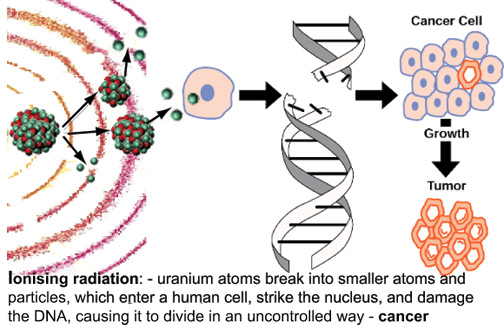
Risk estimates for low-level radiation exposure are typically based on a linear extrapolation of better-understood risks from higher levels of exposure. This ‘Linear No Threshold’ (LNT) model has some heavy-hitting scientific support. For example a report in the Proceedings of the National Academy of Sciences states:
“Given that it is supported by experimentally grounded, quantifiable, biophysical arguments, a linear extrapolation of cancer risks from intermediate to very low doses currently appears to be the most appropriate methodology.” [1]
Likewise, the 2006 report of the US National Academy of Sciences’ Committee on the Biological Effects of Ionising Radiation (BEIR) states that “the risk of cancer proceeds in a linear fashion at lower doses without a threshold and … the smallest dose has the potential to cause a small increase in risk to humans.” [2]
Uncertain risk does not equal zero risk
Nonetheless, there is uncertainty with the LNT model at low doses and dose rates. The BEIR report makes the important point that the true risks may be lower or higher than predicted by LNT. This point needs emphasis and constant repetition because nuclear apologists routinely conflate uncertainty with zero risk. That conflation is never explained or justified – it is simply dishonest.
The UN Scientific Committee on the Effects of Atomic Radiation (UNSCEAR) and the International Commission on Radiological Protection recommend against using collective dose figures and risk estimates to estimate total deaths.
The problem with that recommendation is that there is simply no other way to arrive at an estimate of the death toll from Chernobyl – or Fukushima, or routine emissions from the nuclear fuel cycle, or weapons tests, or background radiation, etc.
Indeed UNSCEAR itself co-authored a report which cites an estimate from an international expert group – based on collective dose figures and risk estimates – of around 4,000 long-term cancer deaths among the people who received the highest radiation doses from Chernobyl. [3] And UNSCEAR doesn’t claim that low-level radiation exposure is harmless – its 2010 report states that
“the current balance of available evidence tends to favour a non-threshold response for the mutational component of radiation-associated cancer induction at low doses and low dose rates.” [4]
Nuclear amplification
The view that low-level radiation is harmless is restricted to a small number of scientists whose voice is greatly amplified by the nuclear industry – in much the same way as corporate greenhouse polluters and their politicians amplify the voices of climate science sceptics.
In Australia, for example, uranium mining and exploration companies such as Cameco, Toro Energy, Uranium One and Heathgate Resources have sponsored speaking tours by Canadian junk scientist Doug Boreham, who claims that low-level radiation exposure is beneficial to human health.
Medical doctors have registered opposition to this dangerous quackery and collusion. [5] http://www.theecologist.org/News/news_analysis/2370256/chernobyl_how_many_died.html
Democratizing the Energy System with decentralised wind and solar
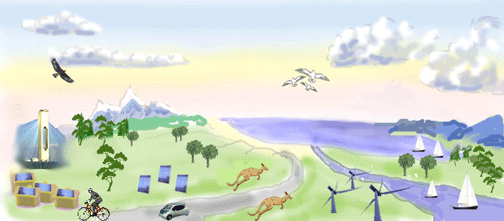 Communicating The Renewable Energy Revolution, Clean Technica, Zachary Shahan 27 April 14, The clean tech movement is about a shift toward a more peaceful world, a world in which there is more respect for others and in which our ways of living leave a smaller environmental footprint. Clean energy is not just about cleaning our air, preserving our water supplies and helping to protect our climate; it is also about democratizing the energy sector……
Solar Power and Wind Power
Solar power has been a dream for ages. In 1931, Thomas Edison wrote, “I’d put my money on the sun and solar energy. What a source of power! I hope we don’t have to wait until oil and coal run out before we tackle that.”
The energy potential from sunshine for one single year is far greater than the energy potential of all known coal, oil, uranium and natural gas reserves combined. The circles in the chart shown here represent annual potential for renewable sources.
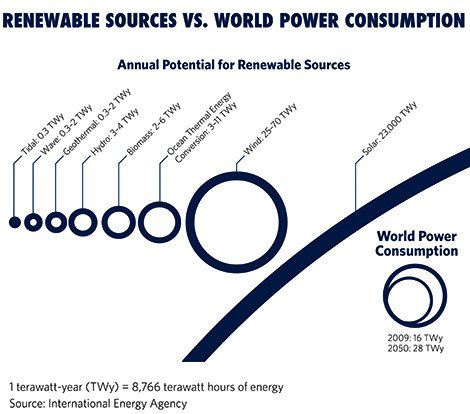
The potential is amazing. The solar energy hitting the state of Texas each month is greater than the total amount of energy the Texas oil and gas industry has ever produced.
Importantly, while sunshine is free, the solar panels needed to collect the energy in that sunshine and convert it into electricity are not. However, solar panels today are over 100 times cheaper (per watt) than they were in 1977. Since 2011, the cost of solar panels has dropped by approximately 60 percent, and growth has also been a big part of the stimulus for the cost drops. It is a virtuous circle. The growth curve for the solar panel market over the past few years is steep and resembles that of a plant shooting out of the earth toward the sun!
Solar power is now cheaper than retail electricity for millions of households. In the developed world, it can save countless homeowners tens of thousands of dollars. Meanwhile, all across the developing world, solar power is actually cheaper than power generated from fossil fuels. Just as many people in the developing world leapfrogged from no phones to cell phones, these populations will leapfrog from no electricity to electricity from solar panels.
The cost of wind power came down much earlier than the cost of solar power. In many regions of the world, wind power is currently the cheapest form of renewables-based electricity available–and also cheaper than electricity generated from coal, natural gas, nuclear power and oil, even if related health and environmental costs, which are staggering in themselves, are not taken into account. And costs continue to fall. The cost of wind turbines has fallen by approximately 29 percent since 2008.
In 2012, more wind power capacity was installed in the US than for any other power source. Wind is also routinely at the top of the global charts for annual power capacity additions.
Democratizing the Energy System
One of the major implications of solar power growth, electric vehicle growth and wind power growth to some extent (wind turbines are great additions to farms and small communities) is that they are essentially democratizing our energy system. They decentralize ownership and provide more societal power and more money to common citizens and small businesses. They create more energy independence and security for families, cities and nations, which I believe will ultimately contribute to greater peace in the world.
Also, there has got to be some positive psychological effect from people realizing that they are no longer burning the bones of dinosaurs (amongst other fossils!) for their energy needs, but are instead using renewable sources of energy such as sunlight and wind. http://cleantechnica.com/2014/04/27/communicating-renewable-energy-revolution/
Abbott’s Direct Action plan will cost tax-payers, not the polluting industries
 Direct Action transfers emission cutting costs from polluters to taxpayers, SMH, April 26, 2014
“…..the Abbott government’s official position is that greenhouse emissions created by humans are contributing to the dangerous warming of the planet, and that it must do something about it. Precisely what this government proposes to do is a matter of great public interest.
So it was unhelpful that Hunt chose to release those details – as scant as they were – shortly before the close of business on the eve of the Anzac Day long weekend.
Taxpayers have every reason to be sceptical about his motives. They, after all, will be the ones paying for the government’s so-called Direct Action climate change strategy. Its centrepiece is an ‘‘emissions reduction fund’’, a pool of $2.55 billion of taxpayers’ money in the first four years, from which some of the nation’s biggest polluters will be paid incentives to cut their greenhouse gases.
To be clear, creating this fund will transfer the cost of cutting emissions from the polluter to the taxpayer, should the government succeed in pushing its bill through the Senate.
The fund would displace both the carbon tax and the emissions trading scheme that had been advocated not only by Labor but by the Howard government in 2007. ‘‘To reduce domestic emissions at least economic cost, we will establish a world-class domestic emissions trading scheme,’’ the Howard policy had promised.
The Liberals now in power may still believe in market forces, but not yet for carbon abatement. Instead of making the biggest emitters pay, they are asking taxpayers to reward them for reducing their pollution. This would be done by means of a ‘‘reverse auction’’. The firms proffering the lowest bids – the least expensive way to reduce emissions – would get government subsidies…….
government is asking taxpayers to relieve industry of the cost of carbon abatement at the same time that it tells Australians they must make many other sacrifices. …….
The case for shifting the carbon burden from polluters to taxpayers, however, is yet to be made. The government still needs to convince Australians and a hostile Senate.
It could have done much better than calling a news conference at 3pm on the eve of Anzac Day to produce a flimsy policy in the hope that nobody would notice. ……. http://www.smh.com.au/comment/smh-editorial/direct-action-transfers-emission-cutting-costs-from-polluters-to-taxpayers-20140427-zr04d.html#ixzz30DsXmZG3
Aboriginal climate ambassadors assess impact of climate change
 Indigenous ambassadors assess climate impact on native land SBS World News, Two young Indigenous climate ambassadors have been touring Australia to document the impact of the changing natural environment on traditional communities. By Gary Cox Source NITV News, 27 April 14 Narelle Long and Malcolm Lynch were the first young Indigenous people to set foot in Antarctica back in 2012.
Wind power popular in France, majority dislike nuclear power
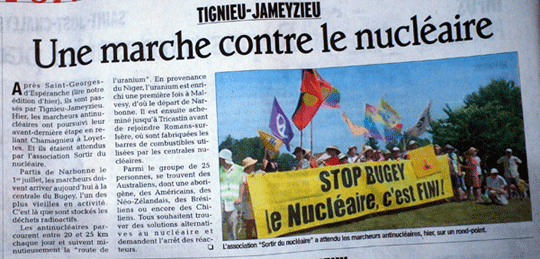 France moving away from Nuclear power http://www.enn.com/energy/article/47327 27 April 14 France may be the world’s most nuclear energy dependent country, but times are changing as the country looks to increase the amount of wind—sourced electricity in its power mix.
When French President François Hollande took the reins of power in 2012 he pledged to reduce the country’s nuclear dependency from 75% to 50% by 2025. Today, France has a goal of reaching 19 GW of wind energy by 2020, up from its current level of 8.2 GW, according to the European Wind Energy Association’s (EWEA) latest statistics. This will significantly raise the percentage of wind powered electricity in the country from the 3% wind covers today. And, according to a very recent survey, the French people are firmly behind the transition.
Some 64% of French people see wind energy as a solution, among others, in the context of the energy transition, says a CSA survey published in March 2014. Moreover, 80% of the 1010 respondents consider it necessary to invest in wind without waiting for the traditional power plants to reach the end of their lifecycle.
65% of those surveyed said that they would invest in renewable energy (wind and solar/photovoltaic) today if they had to personally invest in one energy source, while 15% chose nuclear, 7% chose gas and 1% chose coal. Meanwhile, 69% of French people would choose wind energy if they had to choose one energy type to be constructed in their region. 75% chose solar, 21% chose nuclear, 16% chose gas and 4% chose gas.
The results show that the French are aware that an energy transition must take place, they are confident enough in renewables to invest if they could, and they know that the time to act is now.
Anti nuclear movement prevails in Taiwan, as government halts construction of nuclear power plant
 Taiwan to halt construction at fourth nuclear power plant The Taiwan government will halt construction at the island’s fourth nuclear power plant as local opposition to atomic energy continues to mount. Australia Network News 28 April 14
President Ma Ying-jeou’s Kuomintang party says a decision has been made to seal off the plant’s first reactor after the completion of safety checks.
And construction of the second reactor will be halted immediately.
The move is the latest sign of pressure on Mr Ma’s administration from opposition parties and anti-nuclear activists, who are concerned about the safety of such facilities in earthquake-prone regions of Taiwan following the 2011 Fukushima disaster in Japan.
Tens of thousands of protesters gathered in downtown Taipei over the weekend, urging the government to abandon nuclear energy……..http://www.abc.net.au/news/2014-04-28/an-taiwan-nuclear-protest/5414294
New Zealand helping Pacific islands with renewable energy (Why aren’t we?)
 NZ Lends A Solar Helping Hand In Pacific Nations http://www.energymatters.com.au/index.php?main_page=news_article&article_id=4277 New Zealand is supporting the construction of the Pacific’s largest solar panel array in Samoa and also providing a helping hand for other Pacific Nations to pursue clean energy.
 According to New Zealand’s Foreign Minister, Murray McCully, the country is working in partnership with the Government of Samoa, the European Union and the Asia Development Bank to increase renewable energy in Samoa.
Part of the project includes the construction of 2.2 MW installation at the Apia Sports Complex, a smaller array on the rooftop of one of the gymnasiums at the Complex; plus another solar power system in Salelologa, Savaii.
“Renewable energy is a strong focus of New Zealand’s support to developing countries. The investments in Samoa reflect commitments made at the Pacific Energy Summit in Auckland last year,” Mr McCully said.
Elsewhere in the Pacific, New Zealand has been assisting in Tuvalu where 95 percent of electricity is currently gained from diesel generation.
New Zealand has funded the construction of four small scale solar-hybrid systems on the Islands of Niutao, Nanumanga, Nanumea and Vaitupu; which will provide 90 per cent of the islands’ electricity needs and improve continuity of service.
Last week, New Zealand also entered into a partnership with the European Union (EU), and Tuvalu to continue this work
“This in an excellent example of New Zealand’s cooperation with the EU on renewable energy and the sort of practical projects we can deliver in partnership with Pacific countries,” Mr McCully says.
On Kiribati’s Kiritimati Island, which also has a heavy reliance on imported diesel fuel for electricity generation, New Zealand and the EU have entered into an agreement to allow for greater technical cooperation relating to renewable energy project development on the island.
Many Pacific nations are low-lying and particularly threatened by sea level rises spurred on by global warming; so the shift from fossil fuels is as much about survival and setting an example for the rest of the world to follow as it is about saving money.
What is the real death toll from the Chernobyl nuclear disaster?
A number of studies apply that basic method – based on collective radiation doses and risk estimates – and come up with estimates of the Chernobyl cancer death toll varying from 9,000 (in the most contaminated parts of the former Soviet Union) to 93,000 deaths (across Europe).

unqualified claims that the death toll was just 50, should be rejected as dishonest or uninformed spin from the nuclear industry and some of its scientifically-illiterate (in this field if not in others) supporters.
And sadly, that has to include every last one of the self-proclaimed ‘pro-nuclear environmentalists’ – among them James Hansen, Patrick Moore, Mark Lynas, George Monbiot, Stephen Tindale and James Lovelock.
Chernobyl – how many died?, The Ecologist, Jim Green – Nuclear Monitor 26th April 2014“………Fifty immediate deaths
About 50 people died in the immediate aftermath of the Chernobyl accident. Beyond that, studies generally don’t indicate a significant increase in cancer incidence in populations exposed to Chernobyl fallout.
Nor would anyone expect them to because of the data gaps and methodological problems mentioned above, and because the main part of the problem concerns the exposure of millions of people to low doses of radiation from Chernobyl fallout.
For a few fringe scientists and nuclear industry insiders and apologists, that’s the end of the matter – the statistical evidence is lacking and thus the death toll from Chernobyl was just 50.
If they were being honest, they would note an additional, unknown death toll from cancer and from other radiation-linked diseases including cardiovascular disease.
Best estimates Continue reading
1 This month

of the week – Australians for War Powers Reform (AWPR)
To see nuclear-related stories in greater depth and intensity
 Antinuclear