A new model of small scale solar power production to be piloted in Australia
Australia to pilot new power plan GREGG BORSCHMANN, ABC Environment1 MAY 2014 Householders have the potential to disconnect from the grid under a new system proposed by Sunpower
One of the largest solar companies in the world has chosen Australia as the proving ground for a new model of power production that promises to give householders more control – and cut bills. ‘WHAT DO YOU DO when the sun doesn’t shine?’
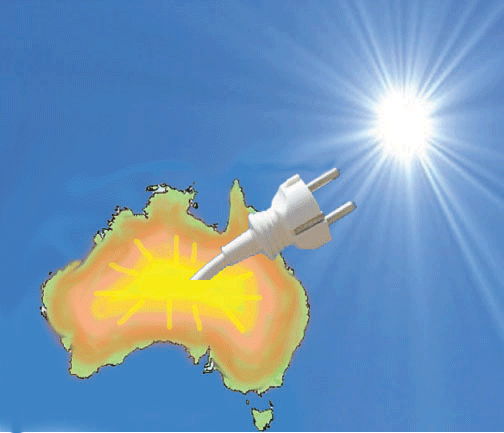
It’s been one of the criticisms levelled at the solar panels that are now so common on residential and commercial roofs across Australia.
Australia has the world’s greatest penetration of solar photovoltaic panels (PV). By the end of 2013, more than 3,000 megawatts of small-scale solar was installed across 1.1 million households, with the average system now 3.9 kilowatts in size.
Now Sunpower Corporation – which builds solar panels but also large-scale solar plants – has flagged that it will be using Australia as a global testing ground for a new model for providing electricity.
An announcement on a pilot project in Victoria, focused on the economics of storing domestically produced solar power, is expected in the next two months.
For years, it’s been keenly understood that the next big thing – the Holy Grail if you like for solar – would be the ability to store energy generated from solar panels for later use at a reasonable cost. At the moment, domestic solar PV generators can be supplying power into the grid but only getting paid 8 cents kw/hour during daylight hours, and then be charged as much as 30 cents kw/hour if they use electricity in the early evening peak. Solar storage gets around this problem.
For consumers it could mean being able to manipulate power use – and cut bills by avoiding expensive peak electricity times.
While Sunpower operates in 10 countries across the globe, president Tom Werner has told the ABC that his company has chosen Australia as the country to prove up the economics of power generation from many small-scale sources.
“Australia has a great solar resource,” says Werner. “We see penetration rates in Australia that are higher than other parts of the world, it has frankly expensive power and therefore solar can compete, [and] it has largely de-regulated the electricity markets, so it opens the market up to innovative structures”.
Perhaps the most important of those ‘innovative structures’ is what’s called distributed power generation. “What’s cool is that the consumer will be their own generator and then they’ll use things like storage and energy management to control load. When you combine the control of load – or when you use electricity and how much you use – with generation and being able to use storage … the combination of those two become really, really powerful…
“We see Australia as a market where we can do that early on, learn from that and do that in other parts of the world”.
It seems at first blush impossible to believe. Solar PV installations have slowed since the winding back of generous tariffs for homeowners supplying power to the grid. And then there’s all the uncertainty associated with yet another government review of the 2020 Renewable Energy Target (RET).
But Werner believes Sunpower’s model could be a game changer.
“Think of transitions like wired phones to cell phones to smart phones – it’s going to take a while, but in the next 10 years the way we get electricity will be considerably different.
“To say that the landscape will look a lot different in the next five to ten years is virtually certain, I think the disruptive nature of cost effective renewable has already happened, and it’s very hard to put that genie back in the bottle, so to speak”.
He also believes that distributed solar energy generation can provide cheaper power for consumers.
“We can build distributed generation and have economic energy and that’s what consumers want, they want renewable energy, and they want it to be economic… so the more solar there is, the more economic energy is going to be in Australia. If you combine that with economic storage and energy management and then you add creative financing schemes like we have in the US, you could have an offering where the consumer has way, way more control over their energy bill than they do today”.
Disconnecting
Some retailers are already offering finance packages and loans for home solar systems. Chris O’Brien, General Manager, Sunpower Corporation Australia, says consumers can install solar PV systems with no upfront cost. The loan repayments are covered with the savings on their energy bill, and they can be ahead from year one.
If careful energy use and cheap, sustainable storage is added to this offering, it has major implications for the future of the grid – the network of poles and wires in Australia. http://www.abc.net.au/environment/articles/2014/05/01/3995957.htm
No comments yet.
1 This month
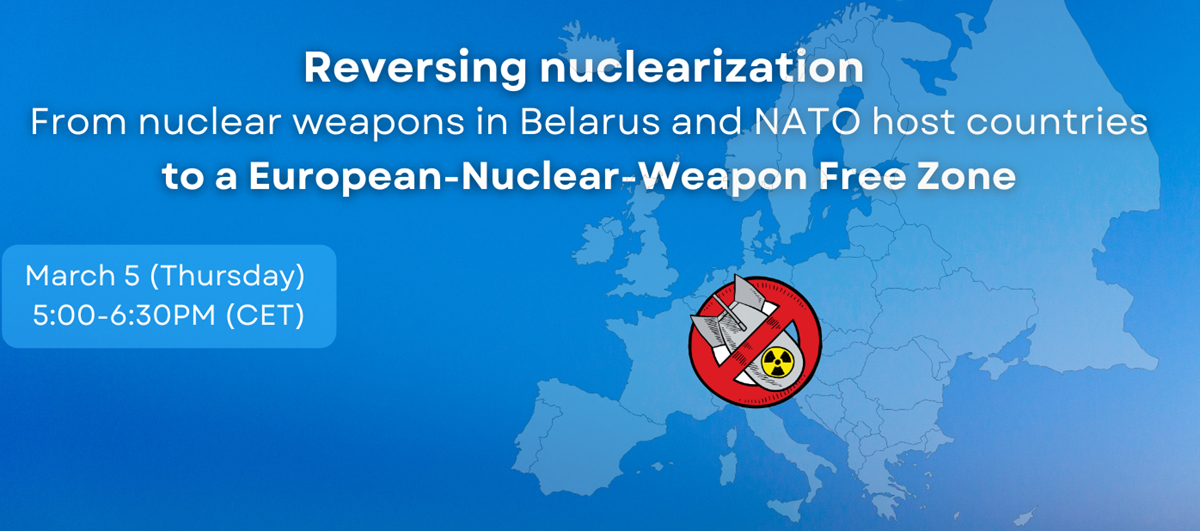
6 March -Online – Reversing nuclearization:
From nuclear weapons in Belarus and NATO host countries to a European-Nuclear-Weapon Free Zone
Mar 6, 2026 03:00 AM in Canberra, Melbourne, Sydney

of the week – Australians for War Powers Reform (AWPR)
To see nuclear-related stories in greater depth and intensity
 Antinuclear
Leave a comment