WOMEN and Nuclear Power – theme for May 2014
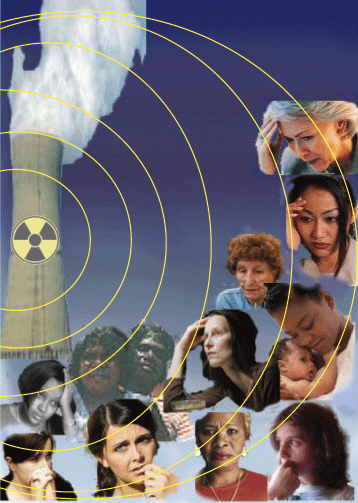
Decisions on nuclear power, nuclear weapons, nuclear wastes are almost exclusively made by men.Yet the brunt of nuclear-caused cancer is suffered by women and children, as is the brunt of nuclear war, and of depleted uranium spread.
Opinion polls over many years, and in many countries, consistently show that women are opposed to nuclear power and nuclear weapons.
More women than men are concerned about health and environmental effects of the nuclear industry.
Yet they are consistently reassured by narrowly educated nuclear physicists, and other technocrats, that nuclear power is safe, and that they have nothing to worry about in regard to ionising radiation.
Decisions on nuclear power and ionising radiation. The nuclear power heirarchy is almost uniformly male, though the nuclear lobby tries hard to pretend that they have equal rights credentials by getting a few token women to show off. And, a favourite male trick, – put a woman in an untenable position – as for example, Anne Lauvergeon was put at the top of France’s rather wobbly 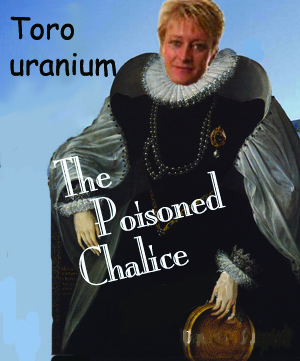 pinnacle of nuclear expansionism – AREVA.
In Australia they’ve given the CEO job for Toro Energy – with its unlikely-to -be profitable uranium enterprise to Vanessa Guthrie
Australia’s Treasurer Joe Hockey on the attack against wind energy
 What hope green energy? Hockey says turbines “utterly offensive” http://reneweconomy.com.au/2014/hope-green-energy-hockey-says-turbines-utterly-offensive-72824 By Giles Parkinson on 2 May 2014 The prospects of a re-start of large scale renewable energy projects in Australia dimmed further on Friday when Treasurer Joe Hockey described the sight of wind turbines as “utterly offensive.” Hockey, speaking to ultra-conservative shock-jock Alan Jones on radio 2GB, said wind turbines were a “blight on the landscape” and vowed to axe “the vast number” of environmental agencies
Hockey’s comments were made after Jones asked him about the “nonsense” of climate change, and renewable energy policies, and asked why – when the government had rejected support for SPC Admona and car makers – was it “chasing” Thai and Chinese-made wind turbines.
This is the conversation from there:
Hockey: “If I can be a little indulgent, I drive to Canberra to go to parliament and I must say I find those wind turbines around Lake George to be utterly offensive.”
Jones: “Correct.”
Hockey: “I think they’re just a blight on the landscape.”
Jones: “Correct. The people you are talking to are paying for them. When are you going to knock them off?”

Hockey: (chuckling) “Well, we can’t knock those ones off, they are into locked into a scheme. There is a certain contractual obligation, I’m told, associated with those things. But you will see in the budget we will address the massive duplication that you have talked about, the vast number of agencies involved in the same thing. We have considered that very carefully. When I say we’ve seen the age of entitlement, that applies to business as much as it applies to the rest of us.”
Hockey also told Jones that the government would cut a swathe through environmental agencies, including, he said, the Clean Energy Regulator, which environment minister Greg Hunt says we need to manage and operate the emissions reduction fund in the ludicrous Direct Action scheme.
Hockey probably meant the Clean Energy Finance Corporation. Attention to detail has not been the government’s strong point, and it has been determined to dismantle any authority or scheme with the words “clean” or “climate” or “carbon” in front of it – the carbon price, the Climate Commission, the Climate Change Authority – even the Cleantech awards had to be renamed.
The CEFC, along with the Export Finance Investment Corporation, attracts private funds, and delivers a positive return to the government. But even EFIC has been slated for closure in what the AFR’s Chanticleer columnist described as one of a series of “brain explosions” from the Far Right revealed in the National Audit Commission.
The wind turbines around Lake George that Hockey finds so offensive are part of Infigen Energy’s Capital wind farm (pictured). Neighbouring regions areas are a hot-bed of anti-wind farm activitism, particularly from business leaders such as Maurice Newman, Abbott’s hand-picked head of his business advisory body.
Local state MP Pru Goward, the newly appointed minister of planning for NSW, has described wind turbines as “hideous”, and federal MP Angus Taylor is one of the many fierce opponents of wind farms in the Coalition. Amid all this, the ACT government is trying to commission 200MW of wind capacity as part of its plans to go 90 per cent renewable.
The federal government, on the other hand, appears comfortable with 90 per cent fossil fuels. It has commissioned a review panel to assess the renewable energy target, and has chosen a team led by climate change denier Dick Warburton, who has said that nuclear energy is the only viable alternative to coal, to make a judgement on the scheme that is designed to bring in more wind and solar energy to the energy system.
The constant uncertainty about green energy policy has meant that no new large scale wind farms have been committed in Australia since 2012 – apart from some solar farms supported by other schemes, and the massive investment by Australian households in rooftop solar. The emergence of solar, and soon enough storage, as a cost competitive alternative to energy delivered through expensive networks, is causing Australia’s major utilities to reassess their business models, and the way they deliver electricity. However, they lament that politicians and regulators are looking to the past, rather than the future.
They have argued, as has Tony Abbott, that the renewables scheme is very expensive, even though regulators note that it adds only about 3 per cent to consumer bills.
The Clean Energy Council this week produced a report that suggested that the fall in wholesale prices caused by the influx of renewables would offset the cost of certificates and actually lead to cheaper bills for consumers in the medium to long term.
This assessment was rejected by Hunt this week. And in a further sign of the government’s, and the panel’s hard-line attitude to renewables, Warburton said a complete dismantling of the renewable energy target could not be ruled out, even though this would lead to billions of dollars in losses, and to the removal of the “contractual obligation” that Hockey appeared to lament.
The Australian Renewable Energy Agency is also in danger of having its funding stripped and of being absorbed back into a government department.
UK MP calls for justice for nuclear veterans and their children afflicted by radiation-induced illnesses
 John Baron MP: It’s time to recognise our nuclear test veterans http://www.conservativehome.com/platform/2014/05/john-baron-mp-its-time-to-recognise-our-nuclear-test-veterans.html By John Baron MP , 2 May 14, John Baron MP is a member of the Foreign Affairs Select Committee. When compared with how other countries treat their nuclear test veterans, Britain has a shameful record. Ministry of Defence (MoD) references to war pensions do not wash. The very high rate of serious ill health amongst veterans’ offspring reinforces the fact that, although no side can lay hold to firm scientific evidence, there is a case to be answered. The Government needs to build on its good track record of acknowledging past wrongs, and finally recognise the debt of gratitude we owe to these veterans and their families.
During the 1950s and 1960s, over 20,000 British and Commonwealth servicemen, many of whom were on national service, took part in British nuclear tests in the South Pacific and Australia. They played an essential part in developing Britain’s independent nuclear deterrent, and their contribution to winning the Cold War can not be overstated.
The tests were carried out at the very beginning of the nuclear age, and the science was imperfectly understood. Precautions for the servicemen were primitive and inadequate. The only people wearing protective suits were the scientists. Many veterans believe their health, and that of their descendants, has been adversely affected by their presence during the nuclear tests.
The veterans feel forgotten, and some years ago came together to form the British Nuclear Test Veterans’ Association (BNTVA), the principal charity which campaigns on their behalf. I am honoured to be their Patron, and since 2011 we have been running a cross-party campaign in Parliament. The campaign has involved two stages. The first was to secure a Health Needs Audit from the MoD, to ease the path of our veterans through the NHS, which we have now secured. The second has been to secure official recognition of their service from the Government. This has not been forthcoming, and is very important not only to the diminishing number of veterans – only around 3,000 are still alive – but also to the descendents of those no longer with us. An acknowledgement from the Prime Minister, either orally or in writing, would make a huge difference.
A further aspect of our recognition campaign is to secure an ex gratia payment of £25 million from the Government to help establish a Benevolent Fund to distribute grants to veterans and their descendents to help with their care. Access to the Fund would be on the basis of need, not entitlement – thus reinforcing the fact our campaign is one of recognition, not compensation. For the record, the BNTVA has never taken part in any of the legal proceedings against the MoD.
Our recognition campaign was launched in Parliament last June, and over 80 MPs have expressed support for its aims. In October, I led a Parliamentary debate on the issue, during which I highlighted that Britain lies towards the bottom of the ‘international table of decency’ when it comes to how we treat our test veterans.
Canada and the US, for example, both offer payments to nuclear servicemen of £47,000 and £15,000 respectively. Crucially, no causal link between presence at a test and illness is required – this is in contrast to our war pensions scheme, which inevitably finds against veterans. The Isle of Man, our near neighbour, makes an £8,000 payment to any resident nuclear veteran. In all three cases, nuclear veterans receive free health care. Even the Russians ply their test veterans with medals and pensions, in recognition of their contribution.
Underlining the veterans’ case is the fact that their descendants suffer a much higher rate of congenital illness at birth. Against a national rate of around 2.5 per cent, over a third of veterans’ offspring have a serious medical condition. Figures obtained from French nuclear test veterans are broadly similar. Though this may not be scientific, it is nevertheless strong circumstantial evidence that the veterans’ service has cast a long shadow, and explains why the Benevolent Fund must be extended to veterans’ descendants.
Faced with the prevalence of ill health amongst descendants, a significant number of veterans opted to take the life-changing step not to have any children, and still more have terminated pregnancies rather than take the risk. These, together with the sad toll of multiple miscarriages and stillbirths, make up a ‘hidden story’ of anguish and uncertainty precipitated by service at nuclear tests.
The MoD’s defence of the indefensible is the existence of its war pensions scheme. But 90 per cent of nuclear test veterans have failed to get a war pension, in part because they find it difficult to establish a casual link between their presence at the tests and their ill health. This is despite the fact some of these veterans have received money through American schemes. Derek Spackman was a British navigator in an RAF Canberra aircraft. Flying out of Darwin, in 1954 he was tasked with sampling radiation levels following the American tests on the Marshall Islands. His widow was repeatedly denied a war pension by the MoD; however the US Government awarded her $75,000 for his service.
No doubt further information will come to light, as veterans respond to the BNTVA’s ‘call for evidence’. What comes through strongly is that the veterans have a compelling case, and that the goals of the campaign – official recognition and a £25m Benevolent Fund – are in truth very modest.
The BNTVA and I are hosting a Parliamentary film reception for veterans, their families and supporters on June 25. Having met the Prime Minister just before Easter, he is now going to ask further questions within government. Our hope is that he will recognise that our campaign is fair and just. After 60 years of waiting, the nuclear test veterans and their descendants deserve no less.
Over generations of Chernobyl birds, many are harmed by radiation, some adapt to it
 Some birds adapt to Chernobyl’s radiation, Sarah Zielinski, 2 May 14, https://www.sciencenews.org/blog/wild-things/some-birds-adapt-chernobyl%E2%80%99s-radiation On April 26, 1986, the world saw the worst civilian nuclear disaster in history when Unit 4 of the nuclear power station in Chernobyl, Ukraine, was destroyed. The explosion and subsequent fire released radioactive material into the environment that lingers today. The Soviet government closed off a 30-kilometer area around the plant, and hundreds of thousands of people were evacuated, never to return home. Workers are still trying to cap the site with a giant arch that would entomb the remains of the nuclear reactor.
The effects on local plants and wildlife have been varied. Pine trees close to the disaster died in the days soon after. Other plants thrived in the spaces abandoned by humans. Wildlife, too, seemed to be doing well. Rare birds were spotted. A herd of Przewalski’s horses, escaped from captivity, grew. Wolves and boar were seen on the streets of one town.But all was not good. Radiation, after all, is not healthy for living things. And so studies have documented negative effects of Chernobyl’s radiation on the region’s plants and animals, including changes in abundance, distribution, life history and mutation rates. Scientists have found that birds living in the area have eye cataractsor smaller brains. And insects, microbes and other decomposers aren’t behaving normally.
A new study, however, finds that some birds may be adapting to the low levels of radiation that persist around Chernobyl. Thestudy was published April 24 in Functional Ecology.
Ismael Galván of Paris-Sud University and colleagues captured 152 birds representing 16 species from sites within and near the Chernobyl exclusion zone. They took blood samples and analyzed the birds’ levels of antioxidants, how much their DNA had been damaged and their body condition. They also measured the levels of the pigment pheomelanin in the birds’ feathers.
When the researchers compared birds captured in higher radiation areas with those in lower radiation spots, they found something surprising: The birds from the higher radiation zones were generally in better condition, and they had higher levels of antioxidants. These molecules can help cells by stopping the reaction through which ionizing radiation damages DNA.
“To our knowledge, this represents the first evidence of adaptation to ionizing radiation in wild populations of animals,” the researchers write.
Two species, great tits (Parus major) and barn swallows (Hirundo rustica) didn’t follow the pattern and were doing worse in the high radiation locations. These birds had higher levels of pheomelanin in their feathers. Antioxidants are consumed in the production of pheomelanin, so to produce higher levels, the birds would have used up more antioxidants. Perhaps, the researchers write, these birds aren’t left with enough antioxidants to effectively deal with the DNA damage caused by radiation.
However, anyone thinking that this is good news for Chernobyl’s wildlife should think again. “The effects of radiation at Chernobyl on populations of organisms, and for birds in particular,” the researchers write, “have been negative overall.”
Radiation exposure to workers kept secret from property owner, by coal seam gas company
CSG company fails to tell landowner of radiation Coal Seam Gas News May 2, 2014 The Chronicle Melissa Mobbs
JULIE Fairweather simply wants an apology.
After the Chinchilla- based landowner discovered QGC workers were exposed to radiation while drilling on her property, she was horrified the company had not informed her.
Mrs Fairweather told Chinchilla News a neighbour had called to tell her about the incident the day after it had happened. “There was no phone call, no knock on the door, no email from QGC. I had to hear it through the grapevine,” she said. “It’s just dreadful, to have this happen on our property, no more than 700m from our home, and not even be told.”
QGC released an official statement last week confirming four workers were exposed to “low level radioactivity” while on the Montrose Rd property on February 28 this year.
“It would have been no problem if they had of just told me what had happened instead of trying to hide it,” Mrs Fairweather said.
“There was no regard for us or our health and safety whatsoever.”
Western Downs based anti-mining activist Graeme Henderson is speaking out on behalf of the family in an effort to find a positive solution……Mr Henderson said his biggest concern was the lack of communication between the coal seam gas company and the Fairweathers.
“Even if it is a low level of radiation, which they’ve provided no evidence of, then why hide it?” he said.“If it’s such a small risk then why go to so much effort to keep it from the land owner, that’s my question.”…..http://coalseamgasnews.org/qld/csg-company-fails-to-tell-landowner-of-radiation/
As solar energy storage comes in, electricity costs will become a whole new ball game
Storing solar power is the key to cutting energy bills, CSIRO says May 2, 2014 Peter Hannam Environment Editor, The Sydney Morning Herald :”…………From the roofs of 1.3 million Australian homes – with about 50,000 added in the first three months of this year – PV panels are already hurting baseload fossil-fuel generators by flattening the peak demand periods that used to deliver windfall profits.
The real disruption, though, will come if batteries linked to solar PV and other renewable energy sources such as wind become affordable.
“The whole system is built on the fact that you can’t store energy,” Dr Graham said. “If electrical storage could actually become a reality that really turns the whole system on its head.”
“If you’ve got that, (consumers) can potentially disconnect from the grid.”……….
Don’t pull the plug just yet, said Damien Moyse, research director at the Alternative Technology Association.
“You have to pay $15,000 to $20,000 now for batteries” that would enable most families to exit the grid,” Moyse said, so making the move economic “is a fair way off at the moment”.
Entrepreneurs such as Elon Musk, though, plan to bring that day a lot closer. The US billionaire is close to picking a location for a $US5 billion ($5.4 billion) “gigafactory” to mass produce batteries for his Tesla electric cars, aiming to drive down costs by 30 per cent.
“Storage is where PV was five or 10 years ago,” Tom Werner, SunPower’s chief executive said during his first visit to Australia this week. “Consumers will go from being essentially passive to having total control of your energy bill within five to 10 years.”
SunPower, which last month joined Google to lease out PV to about 18,000 US households, will soon start a pilot in Australia to finance PV and storage with plans to broaden the offering “in a small number of years”, Werner said.
However, big incumbent generators, such as Origin Energy and EnergyAustralia, have made it clear they plan to resist further erosion of their business models………
The clean energy industry fears the review panel, led by businessman and climate change sceptic Dick Warburton, will recommend the target be delayed or cut.
For the solar PV industry, though, the worry is the hammer will fall hardest on the small-scale renewable energy scheme that gives an upfront credit for up to 15 years on power their panels will produce.
Ric Brazzale, president of industry group REC Agents Association, said the sale of the small-scale technology certificates brought the cost of a typical 3.5-kilowatt capacity PV panel down about a third from $9500 to $7000.
“People are very concerned about the future of the (solar PV) support,” said John Grimes, chief executive of the Australian Solar Council.
The industry is on course to install 800 megawatts of PV this year, nudging the total towards 4 gigawatts, a rate that would probably halve next year without the aid, Grimes said.
Technology advances, though, will eventually catch up with incumbents. The CSIRO unit has moved on, and among other things, is working on flexible “organic” solar cells.
“They can be less efficient (than silicon-based PV) but they can be more ubiquitous,” Dr Graham said. “It’s the whole roof, not just what you have to attach to it.”…….http://www.theage.com.au/environment/energy-smart/storing-solar-power-is-the-key-to-cutting-energy-bills-csiro-says-20140502-zr2zw.html
1 This month

of the week – Australians for War Powers Reform (AWPR)
To see nuclear-related stories in greater depth and intensity
 Antinuclear