Queensland uranium mining not to happen any time soon (perhaps never?)
 Uranium mining to face delays North West Star By CHRIS BURNS May 5, 2014,
QUEENSLAND Resources Council chief executive Michael Roche says he does not expect a rush of uranium mine development in the North West when Queensland regulations are approved later this year.
Unsatisfactory answers on coal seam gas radiation leak
 More questions on CSG uranium scare #agchatoz http://coalseamgasnews.org/news/world/australia/nsw/more-questions-on-csg-uranium-scare-agchatoz/ May 5, 2014 Mike Foley A RANGE of unanswered questions have emerged over Santos’ Pilliga uranium aquifer contamination , as the environmental watchdog’s investigation report comes to light.
In March 26, 2013, Santos advised the NSW Environment Protection Authority (EPA) its monitoring measures had detected aquifer contamination was caused by a leaking storage pond at the Bibblewindi site, which contained salty water which had been sucked up from underground during coal seam gas (CSG) activates.
Nearly a year after Santos was fined, in March 2014, the EPA finalised its report on the contamination.
But the EPA investigation leaves key questions unanswered concerning remediation of the Pilliga’s groundwater, the reliance of the authority on companies for information and public health risks. It confirmed a groundwater system beneath the Bibblewindi storage pond contained heavy metals and other elements, including elevating uranium levels to 20 times the safe drinking limits. Santos was fined $1500 by the EPA for causing the contamination.
The investigation report details correspondence between the EPA and other government agencies, highlighting areas requiring further information, including:
Can the contaminated groundwater be repaired? Santos advised the EPA in October its trial efforts to remove contaminated water had failed.
“The results of the trial concluded that recovering the perched water by abstraction in the surrounding shallow perched bores is impractical,” Santos said. Further remediation plans are not discussed.
Have all potential health concerns been laid to rest?
The NSW Office of Health was consulted on potential impacts on drinking water. Its advice, reproduced in the EPA’s report, noted the “nearest public drinking water supply is 27 kilometres away (Narrabri) and does not appear to be affected by the Bibblewindi site.
NSW Health said it “would be appropriate” for the NSW Office of Water to independently review the technical information Santos’ provided to the EPA to establish its accuracy. “This is considered somewhat justified given that the report has some comprehensive limitation attached,” NSW Health said.
Does the EPA have enough resources to monitor effectively?
The data on which the EPA’s report is based has been provided by Santos. The Land does not suggest impropriety on either Santos or the EPA’s behalf, but this does highlight the limitations of the government regulator and the significant role the gas proponent plays in monitoring its environmental impacts.
Wilderness Society Newcastle campaign manager Naomi Hogan said: “Santos said it would never threaten groundwater, but it has polluted an aquifer with uranium and other toxic heavy metals and the EPA report says Santos can’t fully clean up the mess”.
A Santos spokeswoman said “rehabilitation works are continuing”, noting the contamination poses no health risk. The water from the storage pond will be transferred to a treatment facility, she said. “Monitoring will continue to ensure the isolated groundwater underlying the pond is rehabilitated. There remains no risk to people or livestock.”
Marshall Islands deplores Australia’s backward steps on climate change
 Australia risks ‘going backwards’ on climate change and straining Pacific ties Marshall Islands foreign minister says ‘it is as if our big brother doesn’t understand us’ theguardian.com, Monday 5 May 2014 17 John Vidal Australia risks going “backwards” on climate change, straining relations with small Pacific island states that are being hit by unusually powerful storms, floods, droughts and massive tides, according to the foreign minister of the Marshall Islands.
“Australia has always been our friend but the change in their government last year has resulted in problems,” said Tony de Brum on a visit to London to address British and other countries’ economic and political leaders about the physical plight that Pacific states such as the Marshall Islands find themselves in.
“We are having difficulty understanding Australia’s climate change policies and their new environmental regime. We don’t understand what they are thinking. We worry that the change in their policy may result in movement backwards.”
Australia’s Coalition government is trying to repeal carbon pricing in favour of a grants system for businesses to lower their emissions. Repeated independent analysis has shown its Direct Action plan is unlikely to achieve its target of a 5% cut on emissions by 2020, based on 2000 levels.
The Coalition has also set about abolishing climate change agencies, slashed staff numbers at the Department of the Environment and declined to send a minister to international climate talks.
Small island states around the Pacific are sending Australia the same message about climate change, according to De Brum. “Australia has always been generous,” he said. “But it is as if our big brother doesn’t understand us. The same message is going to Australia from other countries in the Pacific forum. Little brother is saying, ‘Big brother should get up and smell the flowers.’ ”
Scattered across 2m square kilometres of ocean, the Marshalls have all experienced extremes linked to climate change in the past year, he said. “We have had major drought in the north, floods in the south, seawater intrusion of groundwater, and thousands of people displaced by a king tide. That is the reality. What does Australia not understand?”
Pacific states including Kiribati, Tuvalu and the Marshalls are suffering at the present level of emissions, he said, making the prospect of future sea level rises and more powerful cyclones frightening.
“Some islands and atolls are already disappearing. One, called Enebok … is now underwater. Yet 20 years ago it had coconut palms and houses. At the moment we are [able to move] people around the islands. But any prudent leader would always have evacuation at the back of their mind.”
Climate change and the lack of cash to invest in renewable energy technologies, such as ocean thermal energy conversion, is now putting a brake on development, he said…… http://www.theguardian.com/environment/2014/may/05/australia-risks-going-backwards-on-climate-change-and-straining-pacific-ties
USA urges Australia to join in real action against climate change
US urges closer ties on climate change http://www.heraldsun.com.au/news/breaking-news/us-urges-closer-ties-on-climate-change/story-fni0xqi4-1226906292654 NICK PERRY MAY 05, 2014 UNITED States ambassador John Berry has urged Australia to work closely with its ally in Washington on climate change, pointing to the major economic opportunities available in tackling the global challenge.
The US is one of the world’s largest polluters, but has made significant progress reducing its emissions since climate change was made a top-priority issue by the Obama administration.
Data in April showed the US had slashed greenhouse gas emissions 10 per cent below 2005 levels, meaning it’s more than halfway to achieving its target of a 17 per cent reduction by 2020.
Ambassador Berry said the US had managed to cut pollution while maintaining economic growth, defying the argument that achieving green outcomes was too expensive and hard on business.
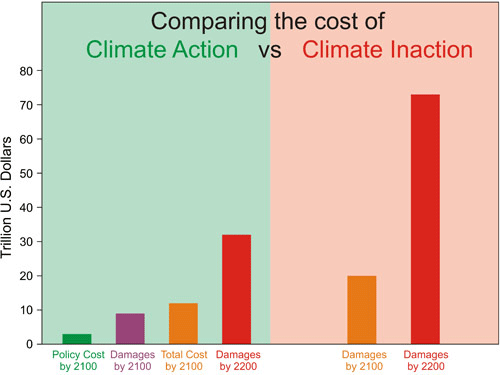
The US would lead by example and be challenging world leaders to do their part by adopting “aggressive” pollution goals of their own.
“The issue is serious, it deserves everyone’s attention,” Ambassador Berry told a climate summit attended by Environment Minister Greg Hunt on Monday. “We know you will continue to work with us – both bilaterally and in multilateral organisations – on the tremendous challenges climate change presents in the region.”
The federal government has promised to reduce emissions by five per cent of 2000 levels by 2020, but will review this target in 2015 as world leaders prepare to hammer out a new binding climate deal.
The US has forged agreements with other major polluters like India and China in the lead up to the 2015 summit, and wants to see climate change on the G20 agenda in Brisbane in November.
Ambassador Berry said the US should work closer with Australia to chase the huge economic benefits posed by the growth of renewable energy. “It’s not only good environmental policy, it’s also good business,” he said.
Landmark USA report: climate change is clear and present danger
 Climate change is clear and present danger, says landmark US report National Climate Assessment, to be launched at White House on Tuesday, says effects of climate change are now being felt Suzanne Goldenberg US environment correspondent theguardian.com , Monday 5 May 2014 On Sunday the UN secretary-general, Ban Ki-moon, said the world needed to try harder to combat climate change. At a meeting of UN member states in Abu Dhabi before a climate change summit in New York on 23 September, Ban said: “I am asking them to announce bold commitments and actions that will catalyse the transformative change we need. If we do not take urgent action, all our plans for increased global prosperity and security will be undone.”

- Gary Yohe, an economist at Wesleyan University and vice-chair of the NCA advisory committee, said the US report would be unequivocal that the effects of climate change were occurring in real-time and were evident in every region of the country.
- “One major take-home message is that just about every place in the country has observed that the climate has changed,” he told the Guardian. “It is here and happening, and we are not cherrypicking or fearmongering.”
- The draft report notes that average temperature in the US has increased by about 1.5F (0.8C) since 1895, with more than 80% of that rise since 1980. The last decade was the hottest on record in the US.
- Temperatures are projected to rise another 2F over the next few decades, the report says. In northern latitudes such as Alaska, temperatures are rising even faster.
- “There is no question our climate is changing,” said Don Wuebbles, a climate scientist at the University of Illinois and a lead author of the assessment. “It is changing at a factor of 10 times more than naturally.”
- Record-breaking heat – even at night – is expected to produce more drought and fuel larger and more frequent wildfires in the south-west, the report says. The north-east, midwest and Great Plains states will see an increase in heavy downpours and a greater risk of flooding.
- “Parts of the country are getting wetter, parts are getting drier. All areas are getting hotter,” said Virginia Burkett, chief scientist for global change at the US Geological Survey. “The changes are not the same everywhere.”……..
The assessments are the American equivalent of the UN’s Intergovernmental Panel on Climate Change (IPCC) reports. This year’s report for the first time looks at what America has done to fight climate change or protect people from its consequences in the future.
Under an act of Congress the reports were supposed to be produced every four years, but no report was produced during George W Bush’s presidency.http://www.theguardian.com/environment/2014/may/04/climate-change-present-us-national-assessment
As Australia’s coal industry winds down, wind energy surges ahead
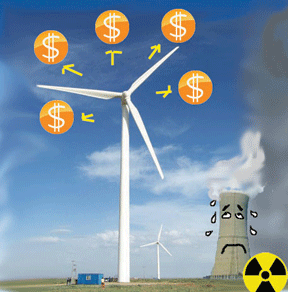 Wind energy surges to record share as coal ebbs May 5, 2014 Peter Hannam Environment Editor, The Sydney Morning Herald Wind energy’s share of Australia’s main electricity market jumped to a record last month, helping to curb emissions from the power sector even as hydro output shrank, according to energy consultancy Pitt & Sherry.
Wind farms, derided last week by Treasurer Joe Hockey as “utterly offensive” blights on the landscape, increased their share of the market to a record 4.6 per cent, up one percentage point from a year earlier, the company said in its monthly CEDEX report.
With major black-coal fired plants such as Liddell and Bayswater in NSW continuing to operate well short of capacity, greenhouse gas emissions from the National Electricity Market for the month were 5.8 million tonnes lower than a year earlier, or down 3.5 per cent.
Coal’s share of the market remained near its record low of 73.8 per cent.
However, the shift away from coal may soon be reversed as politics and markets combine to alter the economics of energy.
The Abbott government remains steadfast in its plans to remove the carbon tax – now at $24.15 a tonne – which has helped make black coal-fired plants, in particular, relatively expensive.
Senior members, including Prime Minister Tony Abbott, have also signalled their intent to weaken the Renewable Energy Target, a move likely to freeze new investments in wind farms………
Broken promise in the offing?
Mark Butler, the opposition’s climate change spokesman, said the Abbott government was “crab-walking” away from its pre-election promise to leave the Renewable Energy Target unchanged at 41,000 gigawatt-hours by 2020.
The government has set up a review of the target, led by climate change sceptic Dick Warburton, with many in the clean energy industry fearing the panel will recommend a delay and or weakening of the goals.
“This is a just another broken promise driven by ideology in face of the clear evidence that this has been a major policy success,” Mr Butler said.
While falling energy demand has contributed to falling emissions, “the big driver” for the industry has been the rise of renewables, he said.
Two-thirds of the emissions drop has been “because renewable energy increased its market share by 25 per cent in the first 12 months” of the carbon tax’s start, he said. http://www.smh.com.au/environment/climate-change/wind-energy-surges-to-record-share-as-coal-ebbs-20140505-zr4rg.html#ixzz30zIKSJIQ
Australia’s coal mining in decline as India and China turn to renewable energy
 Australian coalmining is entering ‘structural decline’, reports says. Oliver Milman, The Guardian 6 May 14 Demand from India and China predicted to falter due to higher uptake of renewables and make huge projects commercially unattractive Coalmining in Australia is entering a “structural decline”, with projects set to become unviable due to unrealistic expectations over the potential to export the fossil fuels to China and India, according to a new report.
The study, by the US-based Institute for Energy Economics and Financial Analysis, suggests that two huge coalmining projects in central Queensland, backed by Indian cash, “are likely to prove uncommercial” due to unfavourable market conditions.
The projects, backed by Adani and GVK, which bought its coal assets from Gina Rinehart in 2011, will attempt to open up vast deposits of coal buried in the Galilee Basin region. Clive Palmer’s China First mine is also slated for completion by 2017, removing a projected 40m tonnes of coal a year for export.
But the IEEFA analysis shows that the wholesale cost of electricity in India, a key export market, is half that of Galilee coal-fired power, making it financially unattractive for the Indian government.
That, coupled with a new focus on renewable energy such as solar and wind, and a falling coal price due to the flood of new resource from the Galilee Basin, will cause significant problems for Australian projects, the study found.
“Renewables are a lower cost, cleaner solution, particularly when the deflationary impact of wind and solar is incorporated,” the study state The price of coal has dropped sharply in the past three years. The mining industry has claimed this is part of a cyclical reverse in fortunes as the resources boom cools.
However, several high-profile projects have been cancelled recently, including the departure of BHP, Anglo American and Lend Lease from the vast mine, rail and port operation required to mine and ship coal from the Galilee Basin.
Tim Buckley, director of IEEFA, told Guardian Australia that India is likely to follow China in looking more to renewable energy than coal-fired power.
“People think India will just follow the same growth of China, but India’s economy has choked on coal energy and it doesn’t need more expensive coal imports,” he said…..
Buckley said China’s huge investment in renewable energy will be replicated, albeit on a smaller scale, by India, influenced by the pro-solar policies of prime ministerial front-runner Narendra Modi. The cost of electricity generation from solar in India has fallen 65% in the last three years.
“The last thing Australia should do is flood the market with extra coal, there’s no way it can handle the number of projects currently in train,” Buckley said…….http://www.theguardian.com/world/2014/may/05/australian-coal-mining-is-entering-structural-decline-reports-claims
Colorado’s Bill to protect groundwater from radiation due to uranium mining and milling
 House advances uranium groundwater protection bill By Joe Hanel Denver Herald staff writer 5 May 14, DENVER – New regulations on uranium processing passed the state House on Monday, despite a plea from Rep. Don Coram, R-Montrose, that they would destroy hope in the mining towns in his district.
Senate Bill 192 is intended to address an environmental disaster caused by the Cotter uranium mill in Cañon City, where radioactive waste poisoned a neighborhood’s groundwater for years.
It passed 43-22 Monday morning.
“We want to make sure there is not another Cotter mill. We want to make sure groundwater is not polluted by uranium processing,” said one of the sponsors, Rep. K.C. Becker, D-Boulder. The bill sets minimum standards for groundwater cleanups before a company can be let off the hook. It also requires uranium and thorium mines to get a radioactive materials license from the state health department if they use a new process that involves injecting water into the mine’s rock formations……..
Rep. Jared Wright, R-Fruita, said new mining technologies often pollute, despite promises to be safe and clean……..“This bill is about protecting our citizens, those we are all here today to serve,” Wright said.
If Energy Fuels reverses course and decides to build the new mill, SB 192’s groundwater cleanup requirements would apply to it, as well as to Cotter’s Cañon City mill.
Greg Hunt gets his ‘do nothing’ climate policy from Bjorn Lomborg
Lomborg’s particular brand of environmentalism – which says yes, the world is warming but it is nothing to worry about – is particularly appealing to the Coalition government. It is an approach that doesn’t have to get tangled up with opposing the science and also public opinion, while it is able to take a purely economic approach to doing nothing.
Or better yet, do something, but not at the expense of big business.
In fact, it is better to pay big business not to pollute, which makes the debt levy being flagged for the upcoming budget all the more comedic. The A$2.4 billion per year fuel tax credit scheme, which managed to escape the Commission of Audit, are simply handouts that go directly to the immense profits of mining companies.
 The Direct Action path to poverty, The Conversation,5 May 14 David Holmes The current gallery of columnists at The Australian are always interesting to read. There is a core of them that display the views of Coalition politicians only with more colour and erudition, and often more transparently than Canberra soundbites and doorstops would allow.
Where government ministers might be seen attacking an institution or a policy, these columnists are adept at rallying to such an attack, be it on the ABC, human rights, education, health, foreign affairs, the public service and, of course, climate.
One such occasional columnist who chimes in over climate change is the Danish “sceptical environmentalist Bjorn Lomborg. Lomborg is well-known for subordinating the importance of climate change to other global issues such as health and development. His work effectively focuses on short-term solutions to “immediate” problems, arguing that global warming will actually provide a net benefit to the globe up until 2065 by reducing cold-related deaths and improving crop production, after which, he tells us, heat will take over as a health and food security problem.
Lomborg’s disregard for the plight of subsequent generations might appeal to politicians whose sense of time is tightly bound to electoral cycles. But it does not sit well with anyone who has even the smallest appreciation of telos.
In his column last week, Renewables pave path to poverty, Lomborg went all-out attacking renewables, just as the Renewable Energy Target (RET) and Direct Action was beginning to spike in news cycles across the country.
Lomborg is unusual. He is not your regular climate change denier and says, as government ministers do, that climate change is real and that we have to tackle it.
But also like the government, Lomborg’s suggestions for tackling climate change are so riddled with doublethink as to render his claims to have accepted the science as implausible and disingenuous.
Critics of Lomborg’s work on the economics of addressing climate change describe him as a dangerous propagandist working on behalf of vested interests (namely the fossil fuel industry); that he “advocates what he does not believe in”; and that “all he cares about is how he can make the general public react the way that he wants”.
Does this sound familiar? Continue reading
Deathly economic climate for uranium, but Andrew Forrest gets into it
Andrew Forrest pumps $12m into uranium junior, SMH May 5, 2014Peter Ker Andrew Forrest’s investments continue to range far and wide, with the mining billionaire today investing millions into a uranium junior just days after he bought a beef exporting company.
Mr Forrest has today pumped $12 million into Energy and Minerals Australia as part of a broader $36 million funds injection for the company………
It’s the second raising that EMA has completed so far in 2014, despite the deathly environment for uranium.
1 This month
7 April – WEBINAR – Australia and the Doomsday Clock – Preventing nuclear war through NoFirstUse and other policies
Online | Tuesday April 7, 4:00-5:30pm, Australian Eastern Time / 8:00-9:30am Central Europe Time
– Access the registration link
15 April – Zoom –Nuclear Power is Not the Solution
Apr 15, 2026 01:00 AM in Canberra, Melbourne, Sydney

Join the International Physicians for the Prevention of Nuclear War (IPPNW) on Tuesday, April 14th for a timely webinar exploring the risks associated with nuclear power and challenging the myth that it offers a simple, safe, carbon-free solution to the climate crisis

21 April Webinar: No Nuclear Weapons in Australia
Start: 2026-04-21 18:00:00 UTC Canberra, Melbourne, Sydney (GMT+10:00)
End: 2026-04-21 19:30:00 UTC Canberra, Melbourne, Sydney (GMT+10:00)
Event Type: Virtual
A virtual link will be communicated before the event.
Host Contact Info: australia@icanw.org

of the week – Australians for War Powers Reform (AWPR)
To see nuclear-related stories in greater depth and intensity
 Antinuclear