Australia’s uranium industry keeps mum about its connection to nuclear weapons industry

Denis Matthews, 13 May 14, Uranium prices used to be in constant US$, that is they took into account inflation. I haven’t seen historical data expressed in, say, 2014 $US for a long time. Maybe it’s out there somewhere. If so could someone tell me where.
The other issue that is rarely raised when talking about the effect of supply and demand on the spot price of uranium is the effect of demand for uranium to make nuclear weapons either directly or via plutonium and of the effect of nuclear weapons decommissioning which greatly increases the supply of uranium through weapons grade highly enriched uranium (HEU).
I suspect that the industry is loathe to talk about the supply and demand of uranium through nuclear weapons because it proves that there is an economic connection between the nuclear power industry and the nuclear weapons industry.
Japanese mother tweeted against nuclear power – now a “dangerous criminal”?
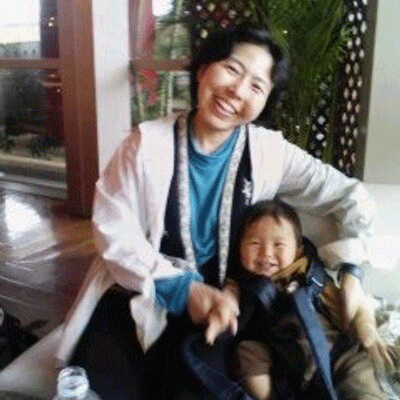 VICE: Japan mother may be jailed for “tweet critical of nuclear lobbyist” — Fukushima police travel 1,000 miles to interrogate her, examine computer — Officer: We only go outside prefecture for “potentially dangerous criminal” — “May be held without bail… without right to see lawyer”http://enenews.com/vice-japan-mother-fled-radiation-jail-tweet-critical-nuclear-lobbyist-fukushima-police-travel-1000-miles-interrogate-her-examine-computer-officer-only-prefecture-potentially-dangerous-criminal?utm_source=feedburner&utm_medium=email&utm_campaign=Feed%3A+ENENews+%28Energy+News%29
VICE, Nathalie-Kyoko Stucky, May 11, 2014: Mari Takenouchi […] wrote a tweet critical of a nuclear lobbyist. Takenouchi may go to jail […] Prosecutors confirmed they will be flying to Okinawa […] to question her on May 13. Police have already traveled from Fukushima to Okinawa to interrogate her […] [She] fled her hometown of Tokyo with her infant son days after the disaster, hoping to avoid fallout from Fukushima. […] Takenouchi said police came to her apartment in Okinawa and examined her computer […] The prosecutor’s office will decide by July whether to indict […] she may be held without bail […] without a right to see a lawyer or have one present during questioning.
Lieutenant Tadashi Terashima, Fukushima police spokesman: “We only send police officers from one prefecture to another if the subject is really a potentially dangerous criminal.”
Translation of Takenouchi’s tweet: There’s a common point between the 2 criminals of the century. Yasuhiro Nakasone, who introduced nuclear plants in Japan, said: “I didn’t expect Japan in 2011 to become such a battered country.” Ryoko Ando, a (pro-establishment) citizen activist who hosts Ethos’ human experiments in Fukushima, said: “Is this the kind of world we’ve arrived at over the 67 years since the end of World Ward Two?”
VICE on Ryoko Ando: “The Japanese head of Fukushima Ethos, a project […] funded by the French nuclear energy lobby. Fukushima Ethos encourages residents to continue living in contaminated areas as long as decontamination procedures and radiation measurements continue to be done […] Ando reported it to the Fukushima Prefectural Police, accusing Takenouchi of either criminal defamation or criminal contempt.”
Takaaki Hattori, legal expert:“Unprecedented for the police to launch a contempt investigation against a journalist for a single tweet, made in the public interest. If all debates about nuclear energy in this country are going to become grounds for criminal investigations, freedom of speech will vanish. The fact that police even sent the case to the prosecution is disturbing.”
Japan Times, Feb. 12, 2014: “Japan fell from 22nd to 53rd place on [Reporters Without Borders’ World Press Freedom Index] for “the ban imposed by the authorities on independent coverage of any topic related directly or indirectly to the [Fukushima] accident.”
Sydney Morning Herald: “The cloud was at its thickest during the three hours Takenouchi and her son, Joe, spent outside […] Joe was exposed to 145 times the normal [radiation] level”
Watch Takenouchi describe her baby’s subsequent health problems here
Uranex company faces reality: getting out of uranium industry, changing its name
 Uranex dumps uranium for graphite Brisbane Times, May 13, 2014 – Greg Roberts The 2011 Fukushima nuclear disaster killed the dreams of many an Australian uranium explorer.
One of those, Uranex, has survived by changing commodities.
It went back and kicked the dirt again on its tenements in Tanzania and discovered another resource there: graphite.
In 2012 a stubbornly weak uranium price and a 200 per cent rent hike by the Tanzanian government spurred it into action……..
Graphite is in demand because it is a necessary component in rechargeable lithium ion batteries.
An eventual predicted take-up of electric cars would spur even more demand – nearly 40kg of graphite is used in each of those batteries.
Graphite has been used in batteries for decades because it is an electrical conductor, but the technological explosion in smart phones and other portable devices has sent demand soaring.
Uranex would be in production by 2017 in a best case scenario producing 100,000 tonnes of graphite a year at its Nachu site……He also feels a bit more empowered about a name change away from `Uranex’, now that graphite rather than uranium is the main game. http://news.brisbanetimes.com.au/breaking-news-business/uranex-dumps-uranium-for-graphite-20140513-386lo.html
Former official speaks out on Fukushima radiation and nose-bleeding attacks
 Press Conference by Former Official: I’m bleeding from nose every day, many in Fukushima have similar symptoms — Author: My nose bled for days, it wouldn’t stop; Staff had same problem… Do people want me to lie? I can only write truth — Gov’t: The nosebleeds aren’t caused by nuclear crisis (PHOTO) http://enenews.com/press-conference-former-official-nose-bleeds-every-day-many-others-fukushima-developed-similar-symptoms-govt-nosebleeds-caused-nuclear-crisis-author-bleeding-nose-days-wouldnt-stop-others-same-s?utm_source=feedburner&utm_medium=email&utm_campaign=Feed%3A+ENENews+%28Energy+News%29
Jiji Press, May 10, 2014: Environment Minister Nobuteru Ishihara has criticized a manga story for linking nosebleeds to exposure to radiation […] He underscored the importance of keeping unfounded rumors in check [and] that doctors with special knowledge have denied a causal relationship between exposure to radiation after the nuclear accident and nosebleeds.
Mainichi, May 10, 2014: Katsutaka Idogawa, 67, [Futaba’s] former mayor […] is featured in the popular comic series “Oishinbo.” […] Idogawa says his nose bleeds regularly and that there are many others in Fukushima who have developed similar symptoms. […] Idogawa told a news conference on May 9 in Tokyo […] his nose bleeds every day, especially in the mornings. “There is no way I would retract my comments in the manga,” Idogawa said. Responding to Environment Minister Nobuteru Ishihara […] Idogawa commented, “The minister has no business with my physical condition.”
Author Tetsu Kariya interview, translated by Toshi Nakamura, Jan. 13, 2014: […] after I got back [from Fukushima] and was having dinner, I suddenly started bleeding from my nose, and it wouldn’t stop. I thought, “what on Earth?” I’ve rarely ever had a nosebleed so it was quite a shock. After that, I had nosebleeds at night for days after. But when I went to the hospital, they said “there’s currently no medical connection between nosebleeds and radiation” and they severed a capillary in my nose membrane with a laser. Also, after I went, I felt a great deal of fatigue. The staff who went with me and the chief of Futaba-machi suffered from nosebleeds and fatigue. They say the radiation levels are low so there’s no harm, but I wonder about that.
Statement from Tetsu Kariya summarized by Yoshihiro Kaneda, May 7, 2014: It is possible that those who have supported me would walk away from me. I don’t understand why people criticize the truth which I have collected data in Fukushima 2 years and I write it as it is. Do people want to close my eyes against the truth and write something good lies for somebody or other? […] I can only write the truth. I hate self-deceiving. Today’s Japanese society is surrounded by the atmosphere of hating inconvenient truth and desiring lies of feeling good.
Solar power – floating panels a benefit for water short South Australia
Floating solar power plant would reduce evaporation, proponent says ABC News By Matthew Doran 12 May 2014 A solar power plant which is planned for South Australia would float on a wastewater treatment basin.
Geits ANZ is proposing the venture and director Felicia Whiting thinks it would prove at least 50 per cent more efficient than a land-based solar power system.”It’s very much like a traditional solar array with the exception that it’s designed to float on the water,” she said. (Below, Solar floating panels in France)
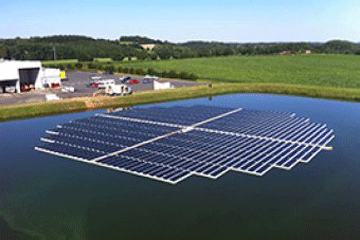
“The mass of water has a cooling effect on the panels and we also include a cooling system utilising the water body itself to be able to keep the water panels … at a constant temperature. “When that happens, you get a longer life of the photovoltaic panels and you get a greater efficiency.” In actual design, Ms Whiting says the floating solar plant would not differ greatly from a traditional one.”The system is designed from a HDP (high-density polyethylene) pipe, which is the buoyancy, and it has a structural steel pontoon sitting abreast that and then the PV (photovoltaic) panels slot into the structural system,” she said. “It’s like a racking system with buoyancy.”
She says having the wastewater largely covered by a floating plant brings other benefits. “We’re at about 90 per cent water evaporation prevention for the surface area that we cover,” she said. “In a dry climate like South Australia that’s about 2.5 metres of water evaporation depth annually that you’re saving.
“It’s a world-first for putting a system of this nature on a treated wastewater plant basin.”
Other evaporation savers in the planning
Geits has floating plants operating in France, Italy and Korea………
Geits has applied to the Essential Services Commission for an electricity generation licence.
Ms Whiting hopes construction on the ponds of the Northern Areas Council waste treatment plant can start in the second half of this year.
“Because it’s a prefabricated system we’re looking at a commissioning date of around September, October,” she said. http://www.abc.net.au/news/2014-05-12/floating-solar-power-plant-would-reduce-evaporation/5445912
Lady Elliot Island to add wind and solar to its existing hybrid energy
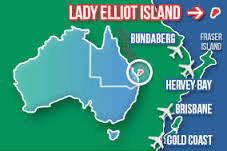 More renewable energy in the wind for Lady Elliot Island http://www.abc.net.au/news/2014-05-12/more-renewable-energy-in-the-wind-for-lady-elliot/5445804 By Frances Adcock Operators on Lady Elliot Island, north-east of Bundaberg, will consider installing wind generators to further improve the island’s energy efficiency.
One-hundred new solar panels will be installed at the island’s hybrid solar power station, which has provided more than half of the island’s power since 2008.
The island’s resort manager, Peter Gash, wants the island to become even more reliant on renewable energy.
“By Christmas we’d hope to do it by, we’d like to install a 10 kilowatt wind generator which will continue to feed power into the battery and into the grid, night and day, and if we can get the success we are hoping for with our 10 to 12 kilowatt wind generator and our 73 kilowatt of solar we will be hopeful we will be somewhere up around 90 per cent renewable,” he said.
He says after the installation of the new panels, more than 70 per cent of the island will be reliant on renewable energy. “We have a barge coming out on Wednesday and there is 125 panels on that and they are 260 watts per panel and they will go up on two separate roofs, and that’s a 16 and 17 kilowatt system,” he said.
“So another 33 kilowatts, so another 125 panels, so that puts us up at 73 kilowatts of power which is a substantial amount of power.”
Despite authorities’ backlash, Japan’s Manga anti nuclear art continues
Manga pushes ahead with antinuclear storyline, Japan Newsw, May 13, 2014 Jiji Press Japanese gourmet manga “Oishinbo” went further down its antinuclear path in the most recent serialized chapter released on Monday, after sparking controversy with the previous chapter on fallout from the nuclear accident at Tokyo Electric Power Co.’s Fukushima No. 1 nuclear power plant.
In the latest episode in Shogakukan Inc.’s Big Comic Spirits magazine, characters warned against living in Fukushima Prefecture.
The previous chapter of Oishinbo, published on April 28, drew criticism for linking nosebleeds—including one suffered by the manga’s lead character—to radiation from the northeastern Japan power station where a triple reactor meltdown occurred shortly after the March 2011 earthquake and tsunami.
At a news conference Monday, Chief Cabinet Secretary Yoshihide Suga said experts deny any causal relationship between nosebleeds and exposure to radiation following the accident. Environment Minister Nobuteru Ishihara made a similar remark on Friday…….
In the latest story, the real former Futaba Mayor Katsutaka Idogawa returns as a character who says that many locals suffer from symptoms such as nosebleeds and fatigue “because they were exposed to radiation.”
In the manga, Idogawa also criticizes the responses from TEPCO and the central government to the worst nuclear accident in Japan’s history. Futaba is one of two municipalities that host the Fukushima No. 1 plant.
Another character in the newest chapter says that Idogawa made his remarks after giving thorough thought to the issue and based on his own experience, explaining that the remarks “are immune from any lie or falsehood and are weighty.”
“You simply can’t decontaminate a wide area in Fukushima and make it a place where people can live again,” a character portraying Takeru Arakida, associate professor at Fukushima University, says in the manga. “This is the truth of Fukushima,” another character responds.The latest episode drew backlash from Fukushima Prefecture and other local governments concerned……..http://the-japan-news.com/news/article/0001274657
AUDIO: Australian Renewable Energy Agency speaks out
 AUDIO Soon-to-be-axed Australian Renewable Energy Agency speaks out http://www.abc.net.au/pm/content/2014/s4002932.htm Alexandra Kirk reported this story on Monday, May 12, 2014 MARK COLVIN: It’s emerged that in tomorrow’s budget one of 36 government agencies to be axed, on top of the 40 already slated for closure, is the Australian Renewable Energy Agency – also known as ARENA.
It was set up two years ago with bipartisan support as an independent agency to improve the competitiveness of renewable energy technologies and their uptake. And it has a budget of $3.2 billion, to be spent over eight years.
Ivor Frischknecht is the agency’s chief executive. He told Alexandra Kirk that scrapping the agency will reduce Australia’s ability to have lower cost energy in the longer term………
Southern Australia will get dry winters, as Southern Ocean winds stronger
 Southern Ocean winds strongest in 1,000 years: study Rappler. Agence France-Presse 13 May 14, According to the study’s lead researcher, Nerilie Abram, ‘The Southern Ocean winds are now stronger than at any time in the past 1,000 years’ SYDNEY, Australia – Winds in the wild Southern Ocean are blowing at their strongest in a millennia as climate change shifts weather patterns, leaving Antarctica colder and Australia facing more droughts, a study showed Monday.
Rising carbon dioxide levels in the atmosphere were strengthening the winds, already dubbed the “Roaring Forties” for their ferocity, and pushing them further south towards Antarctica, researchers from the Australian National University (ANU) said.
“The Southern Ocean winds are now stronger than at any other time in the past 1,000 years,” said the study’s lead researcher Nerilie Abram of an ocean notorious for having some of the fiercest winds and largest waves on the planet.
“The strengthening of these winds has been particularly prominent over the past 70 years, and by combining our observations with climate models we can clearly link this to rising greenhouse gas levels.”
The new research, which was published in the Nature Climate Change journal, explains why Antarctica is not warming as much as other continents. (READ:Warmer Earth, humans to blame – UN panel)………..
The research helped to explain why the westerlies were further cooling already cold parts of the continent even as they were also driving “exceptionally quicker” warming in the Antarctic Peninsula, which juts out into their path, Abram said.
The strengthening westerlies drive up the temperature at the peninsula – the only part of the Antarctica that is hit by the wind – through the warm, moist air they carry from the Southern Ocean.
This has made the peninsula the fastest-warming place in the southern hemisphere, with scientists concerned about the stability of the ice sheets and sea level rises in the region……….
“Even for a mid-range climate scenario, the trend is going to continue in the 21st century,” Phipps said, adding that southern Australia was likely to experience more dry winters. – Rappler.com http://www.rappler.com/science-nature/earth-space/57830-southern-ocean-winds-strengthRappler,
Evidence mounts on benefits of Renewable Energy target: South Australia’s wind energy success
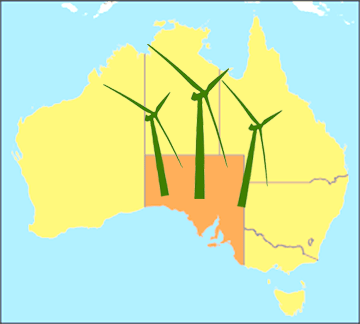 South Australian Wind Power – Economical And Effective http://www.energymatters.com.au/index.php?main_page=news_article&article_id=4299 A new report shows wind power in South Australia has not increased wholesale electricity prices, nor created a need for additional back-up power generation capacity.
Around a quarter of South Australia’s electricity is now sourced from wind power; growing substantially from just 6% in 2005/6.
The eight year study of South Australia’s electricity sector by Windlab Systems shows during the period between 2005 and 2013, wholesale electricity prices have not risen, even if the full cost of the renewable energy certificates (REC) is included. Publicly available data from the Australian Energy Market Operator (AEMO) was utilised for the study.
Reliance on expensive and emission-intensive peaking power plants has reduced as have electricity imports from Victoria states the report. Windlab says electricity related carbon emissions have plummeted 34% even though power consumption has remained stable.
“The findings should provide clear guidance to the Federal Government’s Renewable Energy Target (RET) review panel that wind energy and by association the RET should not be a scapegoat for explaining increases in domestic and business energy costs,” says Roger Price, the CEO of Windlab. “The study further underpins the conclusions of the Clean Energy Council’s commissioned report into the positive cost implications of the RET.”
The Clean Energy Council report indicates abolishing Australia’s Renewable Energy Target (RET) would see Australian households paying billions more for electricity.
A copy of Windlab’s study report can be viewed here (PDF).
The evidence is mounting that the benefits of Australia’s Renewable Energy Target far outweigh the costs. Even so, there are fears the RET review is heading towards a “predetermined and biased outcome” that will result in the loss of thousands of jobs, billions of dollars of investment and also create additional financial burden on Australian households and businesses.
1 This month
7 April – WEBINAR – Australia and the Doomsday Clock – Preventing nuclear war through NoFirstUse and other policies
Online | Tuesday April 7, 4:00-5:30pm, Australian Eastern Time / 8:00-9:30am Central Europe Time
– Access the registration link
15 April – Zoom –Nuclear Power is Not the Solution
Apr 15, 2026 01:00 AM in Canberra, Melbourne, Sydney

Join the International Physicians for the Prevention of Nuclear War (IPPNW) on Tuesday, April 14th for a timely webinar exploring the risks associated with nuclear power and challenging the myth that it offers a simple, safe, carbon-free solution to the climate crisis
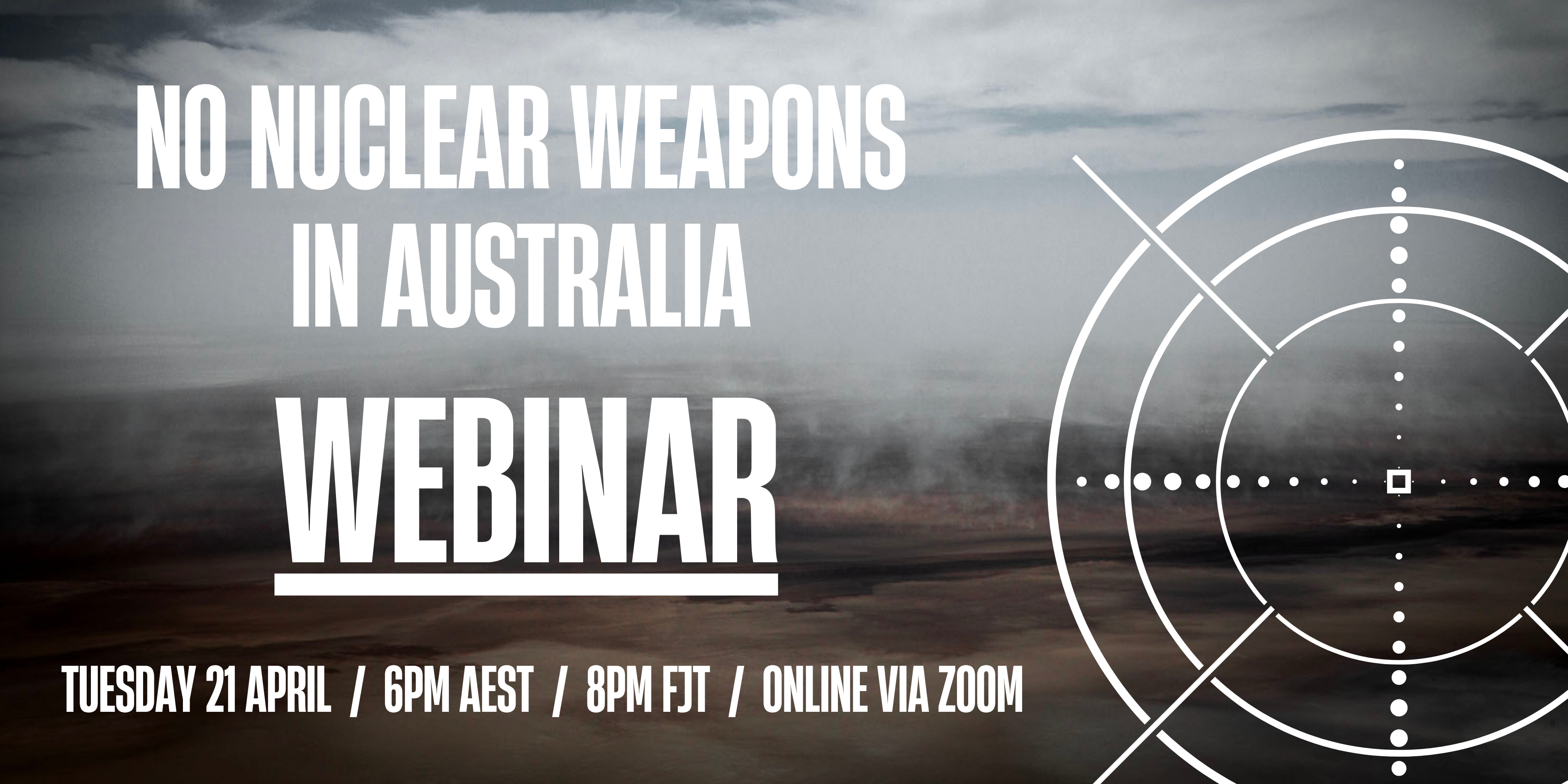
21 April Webinar: No Nuclear Weapons in Australia
Start: 2026-04-21 18:00:00 UTC Canberra, Melbourne, Sydney (GMT+10:00)
End: 2026-04-21 19:30:00 UTC Canberra, Melbourne, Sydney (GMT+10:00)
Event Type: Virtual
A virtual link will be communicated before the event.
Host Contact Info: australia@icanw.org

of the week – Australians for War Powers Reform (AWPR)
To see nuclear-related stories in greater depth and intensity
 Antinuclear