Australian government keeps nuclear ‘foot in the door’ with spending on Lucas Heights reactor etc
 Nuclear spending to top $99m http://www.theaustralian.com.au/national-affairs/budget-2014/nuclear-spending-to-top-99m/story-fnmgnk9v-1226918049789# ANTHONY KLAN THE AUSTRALIAN MAY 15, 2014 THE federal government will spend $22.5 million over the next three years developing plans for a national radioactive waste dump and will ramp-up Sydney’s Lucas Heights nuclear research reactor, at a cost of $31.6m over four years.
To handle the excess nuclear waste from Lucas Heights the government will spend another $45m to send the materials to the US for “processing and permanent storage”, the budget papers say.
“The government will provide $45m over five years to send two shipments of spent nuclear fuel assemblies from the Open Pool Australian Lightwater (Lucas Heights) nuclear research reactor to the United States for processing and permanent storage,” the government said.
“Disposal of the spent fuel assemblies will create additional capacity for the temporary storage of spent fuel … which is essentially for the continued operation of the reactor.”
Over the four years from June the government will spend $22.5m to develop “detailed design options” for a national facility to “address Australia’s future radioactive waste management requirements”.
The Lucas Heights, or OPAL reactor, uses low-level enriched uranium fuel to produce neutrons for nuclear medicine production and for “environmental and material research”, the government said.
Money to fund the ramped-up operations at Lucas Heights included funding to meet the increased costs of “nuclear fuel and electricity”.
Aruna Roy speaks on the feminist approach to nuclear issues
Women have played significance role around the world in the anti nuclear movements of 1980s where they have gone to the extent of creating a women’s forum which was aiming to get away from Nuclear Weapons where in women from Europe, the US, Canada, Australia and Japan have taken the lead, did base camps in army bases and have shown to the world the significance of feminist approach to fight nuclear establishments across the world. It is high time we realize it in this part of the world.

http://www.dianuke.org/why-saying-no-to-nukes-is-so-important-being-a-woman/
Bhargavi Dilipkumar
Gathering some thoughts around Women’s day (March 8th) – Fukushima Day (March 11th)
On the wake of the 3rd anniversary commemorating the world’s worst catastrophic failure at the Fukushima Daiichi Nuclear Power Plant and the rise of fear among the citizens of other Countries thereafter, we all have many lessons to learn yet, are we even trying hard to learn these is a big question.
Fukushima disaster triggered an ultimate fear in the minds of the people far away in the small coastal village called Idinthakarai in Tamilnadu State of India. Television footages of people wearing masks, dressed in white suits, running from one place to another, living in boxes in isolation, going through several radioactive tests and having to leave their homes created an intense impact in the minds of these villagers who share compound walls with a Nuclear Reactor on one side and the sea on the other. The Tsunami colony of this village which was built by the Tamilnadu Government for resettling the people, who were affected by Tsunami that struck the Indian Ocean in 2004, is a place where people wake up every day to face the big domes of the Nuclear Reactors of the Kudankulam Atomic Power Plant. This feeling of
“between the devil and the deep sea” is the strong catalyst which is still driving the struggle in the ground at Idinthakarai after several instances of repression, Filing thousands of false cases, police firings, coast guard raids, implementing bombs in the village, dividing the struggling group by playing the ‘money games’, by arresting the important struggle committee members and the numerous inhuman tortures.
We have read enough about the struggles in the ground against the Nuclear Energy establishments several times and have criticized as well as supported a few. Yet, there is always a great divide and disconnect between other social movements and the anti nuclear movements.
Ms. Aruna Roy while talking at the Panel discussion on “Abolishing Nuclear Weapons” on the 8th of November 2013 organized by the Coalition for Nuclear Disarmament and Peace and Pakistan India Peoples’ Forum for Peace and Democracy at IIC, Delhi said “The anti nuclear movements need to re-strategize and there should be a change in language and idiom of this conversation. The issue needs to be publically debated and a common people’s perspective need to be developed this will in turn make the other social movements to realize ‘What nuclearisation means to them?’ or ‘why is it a non issue for the struggles which fight on the ground for land rights, right to Information and women’s rights?’ There should also be a gender discourse and debate around the nuclear issues” Continue reading
Australia part of the USA’s militarisation of the Pacific
 In the coming months, the world will mark the 70th anniversary of Pacific battles in Saipan, Guam, the Mariana Islands, New Guinea, Palau, the Philippines and Burma. More anniversaries will be recognized next year to commemorate battles in Bataan, Manila and Iwo Jima, followed by anniversaries of the firebombing of Tokyo, the battle of Okinawa and then, in August 2015, the destruction of Hiroshima and Nagasaki. Each event represents death and destruction of the past in a region scarred by militarism and an ongoing legacy of war without end
The Militarized Pacific: An Anniversary Without End 14 May 2014 By Jon Letman, Truthout | Op-Ed “……..(Another) Asia-Pacific Pivot The plight of the Marshall Islands is the back-story of today’s increasingly militarized Asia-Pacific, but David Vine, associate professor of anthropology at American University, sees nothing particularly new about Obama’s Asia-Pacific pivot.
“Very early on islands were identified as playing a very important role in expanding the reach of the United States, and US commerce in particular,” Vine says, citing early US military forays into Okinawa and the tiny Bonin (Ogasawara) Islands southeast of Japan. In the 1960s US nuclear weapons were kept in Okinawan ports and have been documented as passing through Japanese islands despite Japan’s stated opposition to introducing and storing nuclear weapons.
Similarly, in 1987, the nation of Palau, under pressure from the US, dropped its opposition to the entry of US nuclear armed and powered vessels into its territory.
Vine talks about the post-World War II “forward posture” of creating a wall of Pacific islands as close as possible to Asia for its own strategic interests. He describes Pacific island nations like the RMI, Palau and FSM as being technically sovereign but, like American Samoa, Guam, Saipan and the Northern Mariana Islands, effectively run as colonies. Vine says these islands exist under conditions that overwhelmingly benefit US military interests, perhaps best illustrated by the US insisting on the “right of strategic denial.” This “right,” claimed under COFA, grants the US exclusive military control over half a million square miles of the Pacific and includes provisions allowing for the use of RTS on Kwajalein through 2066 with the option to extend to 2086. Continue reading
Now the Abbott government is wavering about its OWN “climate policy”
Doubt over emissions reduction fund , The Age, Lisa Cox 15 May 14, National political reporter The opposition says the government is preparing to slash its flagship Direct Action climate policy, the emissions reduction fund, after Tuesday’s budget showed proposed spending on the scheme would be $1.4 billion less than expected in the first four years.
But Environment Minister Greg Hunt says there has been no change to the policy and the budget still allows the government to issue contracts for the promised $2.55 billion from July 1.
Doubt over the government’s plans for its replacement for Labor’s carbon tax emerged after Tuesday’s budget papers showed $1.1 billion in projected spending on the fund, which will pay polluters to reduce their emissions, in its first four years.

The government said the figure was not a cut because the bulk of the $2.5 billion would be budgeted for in years beyond the forward estimates as polluters completed long-term projects.
But Labor environment spokesman Mark Butler said businesses could rely only on the spending outlined in the budget papers and ”the budget papers show this policy has been slashed by more than half”.
”While it barely seemed possible, last night saw Tony Abbott backslide even further on Australia’s fight against climate change,” Mr Butler said.
”This fig leaf of a climate policy now lies in tatters.”
Proposed expenditure sets out $75.5 million for the fund in 2014-15, $300 million in 2015-16 and $354.5 million in 2016-17……..http://www.theage.com.au/federal-politics/political-news/doubt-over-emissions-reduction-fund-20140514-zrcpr.html
50 years since the film “Dr Strangelove”
THE HALF-CENTURY ANNIVERSARY OF “DR. STRANGELOVE” New Yorker, BY DAVID DENBY 14 May 14 “Mein Führer, I can walk!” screams Dr. Strangelove (Peter Sellers), the ex-Nazi nuclear scientist, rising from his wheelchair to salute the American President at the climax of “Dr. Strangelove or: How I Learned to Stop Worrying and Love the Bomb.” Stanley Kubrick’s satirical masterpiece is now a half century old (Film Forum will be playing a new 35-mm. print starting this Friday), and it remains as outrageously prankish, juvenile, and derisive as ever. Which, given the subject of nuclear annihilation, is exactly right. The movie is an apocalyptic sick joke: the demented general Jack Ripper (Sterling Hayden), who thinks the Commies are using fluoridation to destroy his bodily fluids (he withholds his essence from women), dispatches a group of B-52s loaded with H-bombs to destroy Soviet targets. President Merkin Muffley (Sellers again) tries to recall them; he even helps the Soviet Union to destroy some of the planes. But, after all sorts of misadventures, one B-52 gets through, setting off a Soviet-built Doomsday Machine—chained nuclear explosions assembled in a stunningly beautiful montage, accompanied by Vera-Ellen singing the tender ballad “We’ll Meet Again (Don’t Know Where, Don’t Know When).”……….
Tony Abbott more intent on punishing Greens than in practical climate policy
 Environment: green policies casualties of Abbott’s vengeance mission, Crikey, GILES PARKINSON | MAY 14, 2014 10:47AM| TONY ABBOTT SEEMS TO HAVE TAKEN PERSONAL UMBRAGE AS A RESULT OF GREENS AND GREEN-MINDED MPS DENYING HIM POWER IN 2010. NOW HE’S IN CHARGE, AND OUR SUSTAINABLE PROGRAMS ARE ON THE CHOPPING BLOCK. FOR PRIME MINISTER TONY ABBOTT, HIS WAS NOT SO MUCH A BUDGET AS A SETTLING OF OLD SCORES.
Cast your mind back to 2010, when Abbott was denied power in a hung Parliament by Labor, the Greens and two country independents who wished to advance policy on climate change and renewable energy. Ever since, Abbott and the right-wing faction that put him there — the people Paul Keating famously described as “right-wing nutcases” — have vowed revenge.
The proposed trashing of the $3.1 billion Australian Renewable Energy Agency, which under various guises has for years backed Australia’s world-leading solar research and demonstration projects for the energy technologies of the future, was the coup de grace.
The budget has provided Abbott and Treasurer Joe Hockey the opportunity to implement many of the 75-point wish list drawn up by the influential Institute of Public Affairs, which the government attempted to disguise by asking the Commission of Audit to prepare its 86 recommendations in its ham-fisted documents. Hence the attack on education, health funding and welfare payments that will affect the least advantaged, and the tax cuts for corporates.
But it is “green policy” and anything that resembles it that riles this government the most. Consider Hockey’s comments about wind farms being “utterly offensive”. With proposals to repeal the carbon price, dismantle the Climate Change Authority and the Clean Energy Finance Corporation, and the dilution of the Renewable Energy Target already in train, the budget measures, which include the closure of the Australian Renewable Energy Agency, the dumping of the million solar roofs program (both contrary to election promises) and the research funding cuts at the CSIRO, Bureau of Meteorology and elsewhere, means that the obliteration of the Clean Energy Future package will be complete — if it can get past the Senate. The closure of ARENA, which still had $3.1 billion of funds to be invested over the next 10 years, appears the most vindictive, and like the move to pull the CEFC, a case of economic and environmental vandalism. The budget document talks endlessly about the need for “innovation”, for new investment and infrastructure. ARENA, like the CEFC, was able to leverage billions of dollars in private finance — a rate of $2.50 of private funds for every $1 invested.
Chief executive Ivor Frischknecht says that until the Senate decides otherwise, the agency will continue to work through its applications. It has more than 190 proposals worth $7.7 billion (two-thirds private money) on the table. He says that reflects not just the level of disappointment, but the “scale of investment that is unlikely to go ahead because of the proposed closure”.
ARENA has been branded as one of many examples of “corporate welfare”, but in reality more than 150 of its 180 projects already allocated are in support of research and development, a core competency of any advanced economy. Future funding of that research will be lost. Corporate welfare will continue to be doled out to manufacturers in other sectors.
ARENA was not the only victim of the budget axe. The million solar roofs program, once a $1 billion centrepiece of Direct Action to bring solar to lower-income earners and renters, has sunk without trace — replaced by a derisory $2.1 million program to install solar on RSLs and bowling clubs in seven marginal electorates (yes, really)………
The centrepiece of the government’s Direct Action policy, which replaces the carbon price, also seems to be in a state of utter confusion. The budget papers mention $2.55 billion set aside “over 10 years” rather than the four set aside by the government previously……. Welcome to the asphalt economy. http://www.crikey.com.au/2014/05/14/environment-green-policies-casualties-of-abbotts-vengeance-mission/
USA found that the Marshall Islands people were better radiation test subjects than mine are
In a 1956 Atomic Energy Commission meeting, Merril Eisenbud, director of the AEC Health and Safety Laboratory, described the Marshallese thus: “While it is true that these people do not live, I would say, the way Westerners do, civilized people, it is nevertheless also true that these people are more like us than the mice.”.
The Militarized Pacific: An Anniversary Without End 14 May 2014 By Jon Letman, Truthout | Op-Ed March 1, the 60th anniversary of the Castle Bravo test – a nuclear detonation over a thousand times more powerful than the bomb that destroyed Hiroshima – has come and gone. Predictably, major decadal events, like a 15-megaton explosion over a Micronesian atoll, garner fleeting attention, but it’s all the days between the anniversaries that tell the real story of those who live with the impacts.
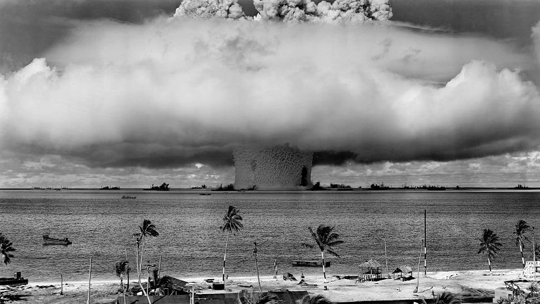
For the people of the Marshall Islands, where Enewetak, Bikini and neighboring atolls were irradiated and rendered uninhabitable by 67 nuclear tests between 1946 and 1958, the brief anniversary recognition only underscores what little attention the Marshallese and, in a broader sense, millions of peoples of the Asia-Pacific are given by the US government and public……..
places like the US-backed naval base being built on South Korea’s Jeju island and the enormous military testing and training ranges in the Northern Mariana Islands (larger than much of the western United States) receive almost no attention. Names like Pagan, Rongelap and Kwajalein are scarcely known in the country that uses these islands for its own military testing……..
increased levels and types of cancers in the Marshall Islands, based on National Cancer Institute (NCI) research and firsthand accounts by Marshallese, are the result of nuclear testing. Continue reading
1 This month

of the week – Australians for War Powers Reform (AWPR)
To see nuclear-related stories in greater depth and intensity
 Antinuclear