USA found that the Marshall Islands people were better radiation test subjects than mine are
In a 1956 Atomic Energy Commission meeting, Merril Eisenbud, director of the AEC Health and Safety Laboratory, described the Marshallese thus: “While it is true that these people do not live, I would say, the way Westerners do, civilized people, it is nevertheless also true that these people are more like us than the mice.”.
The Militarized Pacific: An Anniversary Without End 14 May 2014 By Jon Letman, Truthout | Op-Ed March 1, the 60th anniversary of the Castle Bravo test – a nuclear detonation over a thousand times more powerful than the bomb that destroyed Hiroshima – has come and gone. Predictably, major decadal events, like a 15-megaton explosion over a Micronesian atoll, garner fleeting attention, but it’s all the days between the anniversaries that tell the real story of those who live with the impacts.
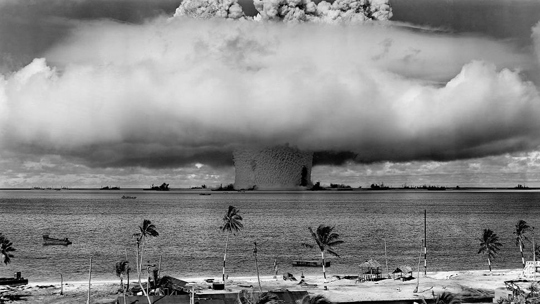
For the people of the Marshall Islands, where Enewetak, Bikini and neighboring atolls were irradiated and rendered uninhabitable by 67 nuclear tests between 1946 and 1958, the brief anniversary recognition only underscores what little attention the Marshallese and, in a broader sense, millions of peoples of the Asia-Pacific are given by the US government and public……..
places like the US-backed naval base being built on South Korea’s Jeju island and the enormous military testing and training ranges in the Northern Mariana Islands (larger than much of the western United States) receive almost no attention. Names like Pagan, Rongelap and Kwajalein are scarcely known in the country that uses these islands for its own military testing……..
increased levels and types of cancers in the Marshall Islands, based on National Cancer Institute (NCI) research and firsthand accounts by Marshallese, are the result of nuclear testing.
In a series of eight papers published in the journal Health Physics, the NCI found average thyroid radiation doses in the southern Marshall Islands ranged from 12 to 34 megarays (mGy), in the mid-latitudes from 67 to 160 mGy and in the northern inhabited atolls (closest to the nuclear tests) from 760 to 7,600 mGy. In the mainland United States, the report notes, exposure to natural radiation in the environment is 1 mGy.
The militarization that continued after World War II led to sweeping societal changes for the Marshallese as the combination of forced evacuations and relocations due to nuclear testing and the lure of jobs at the military base on Kwajalein Atoll led to rapid urbanization…….
The ongoing fear of radiation, Aguon says, is part of the reason why so many people have left the RMI, taking advantage of a special agreement that allows visa-free US residence for nationals of the RMI, FSM and Palau. These compacts of free association (COFA) are full of major shortcomings, not the least of which is the requirement to be taxed like a US citizen but with the burden of heavily restricted health care access. COFA has led to sizeable Marshallese communities in Hawaii and places like Salem, Oregon, and Springdale, Arkansas.
“To put it in historical context, these people aren’t able to trust anything that the US says only because in 1957 they were moved back with a very clear plan that they were going to be purposefully exposed to long-term low-level radiation. Not the acute exposure right after the bomb but the inhalation and the consumption of the food,” Aguon says.
Aguon describes the Marshallese as having been “corralled together and made the unwitting subjects of non-consensual medical experimentation after the Bravo nuclear test.”
In a 1956 Atomic Energy Commission meeting, Merril Eisenbud, director of the AEC Health and Safety Laboratory, described the Marshallese thus: “While it is true that these people do not live, I would say, the way Westerners do, civilized people, it is nevertheless also true that these people are more like us than the mice.”…….http://www.truth-out.org/opinion/item/23688-the-militarized-pacific-an-anniversary-without-end
No comments yet.
1 This month
7 April – WEBINAR – Australia and the Doomsday Clock – Preventing nuclear war through NoFirstUse and other policies
Online | Tuesday April 7, 4:00-5:30pm, Australian Eastern Time / 8:00-9:30am Central Europe Time
– Access the registration link
15 April – Zoom –Nuclear Power is Not the Solution
Apr 15, 2026 01:00 AM in Canberra, Melbourne, Sydney

Join the International Physicians for the Prevention of Nuclear War (IPPNW) on Tuesday, April 14th for a timely webinar exploring the risks associated with nuclear power and challenging the myth that it offers a simple, safe, carbon-free solution to the climate crisis

21 April Webinar: No Nuclear Weapons in Australia
Start: 2026-04-21 18:00:00 UTC Canberra, Melbourne, Sydney (GMT+10:00)
End: 2026-04-21 19:30:00 UTC Canberra, Melbourne, Sydney (GMT+10:00)
Event Type: Virtual
A virtual link will be communicated before the event.
Host Contact Info: australia@icanw.org

of the week – Australians for War Powers Reform (AWPR)
To see nuclear-related stories in greater depth and intensity
 Antinuclear
Leave a comment