St George & Sutherland Shire relieved that radioactive trash will go from their area to Northern Territory
 Federal Budget 2014: Radioactive waste funding relief St George & Sutherland Shire Leader May 17, 2014 THE federal budget provides $22.6 million to develop detailed design options for a national radioactive waste management site at a location outside Sutherland Shire.
This is the first firm indication that the Coalition government will press ahead with plans for a permanent nuclear waste storage.
It is expected to be welcomed by Sutherland Shire Council, which opposes plans for a temporary storage site to be built at the Australian Nuclear Science and Technology Organisation (ANSTO) at Lucas Heights.
It is thought the federal government is considering several sites in the Northern Territory……The allocation of $22.6 million over three years for the design of the permanent nuclear storage site comes under the federal Department of Industry budget.
ANSTO also received a $654 million, four-year funding allocation under the budget.
This includes $76.6 million over five years for the OPAL reactor at Lucas Heights — Australia’s only nuclear research reactor…….http://www.theleader.com.au/story/2282157/federal-budget-2014-radioactive-waste-funding-relief/?cs=1255
Aboriginal traditional landowners condemn Abbott’s policies, and scorn Warren Mundine
Traditional owners slam PM, Sky News, , 16 May 2014 Indigenous traditional owners have slammed Prime Minister Tony Abbott for not following through with his promise to be a PM for First Australians.
It came on the final day of the full meeting of the Northern Land Council in Katherine.
NLC deputy chairman John Daly said “We need Mr Abbott’s ear, not his puppets anymore.”The Government has just buried its head in the sand,” he said.There’s also been a protest over water licences and allegations the NT Government is ignoring traditional custodians.
Federal Indigenous Affairs Minister Nigel Scullion addressed the 78- members today at Katherine, 300km south of Darwin.He was grilled on budget spending cuts to Indigenous Affairs, his use of sections of the Land Rights Act to circumvent going through the NLC, and instead dealing directly with Traditional Owners.
Indigenous leaders also marched on a water summit being hosted by Primary Industry Minister and local member Willem Westra Van Holthe.Mr Van Holthe said water allocations were made to benefit all Territorians.
At the annual general meeting of the Northern Land Council in Katherine on Friday, traditional Aboriginal landowners were clearly unimpressed with what they see as a lack of consultation about the half a billion dollars to be cut from indigenous spending……..
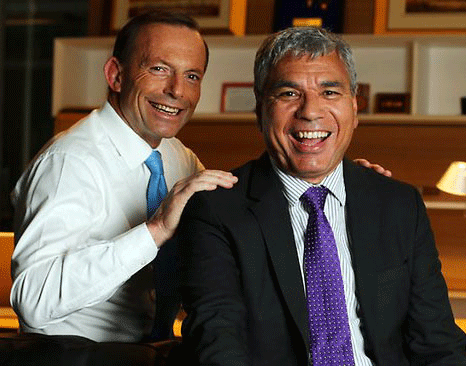 The council also derided the head of Mr Abbott’s Indigenous Advisory Council, Warren Mundine, for not taking up an invitation to visit and meet with traditional owners.
‘Warren Mundine is a poshy indigenous person who has never set his foot in this Aboriginal community,’ said Matthew Ryan, a traditional owner from the West Arnhem region.
He said Mr Mundine didn’t understand what life was like for people living in remote communities.
‘Most of us live with 30 other people in our house, he doesn’t,’ Mr Ryan said.
– See more at: http://www.skynews.com.au/news/national/2014/05/16/abbott-criticised-at-indigenous-meeting.html#sthash.AhWHWJAu.dpuf
Climate research censored by Queensland University?
 Queensland University tries to block climate research GRAHAM LLOYD THE AUSTRALIAN MAY 17, 2014 THE University of Queensland has threatened legal action to stop the release of data used in a paper that establishes a 97 per cent scientific consensus on anthropogenic climate change
The paper, lead authored by John Cook, has been the subject of debate over its methodology since it was published last year…..(subscribers only) ww.theaustralian.com.au/higher-education/queensland-university-tries-to-block-climate-research/story-e6frgcjx-1226920713818#
Thorium touted as “safe” nuclear fuel – but it’s not safe, says new report
 Is the “Superfuel” Thorium Riskier Than We Thought? A new study in Nature says that using thorium as a nuclear fuel has a higher risk for proliferation into weapons than scientists had believed. Popular Mechanics 16 May 14, By Phil McKenna Imagine a cheap, plentiful source of energy that could provide safe, emissions-free power for hundreds of years without refueling and without any risk of nuclear proliferation. The fuel is thorium, and it has been trumpeted by proponents as a “superfuel” that eludes many of the pitfalls of today’s nuclear energy. But now, as a number of countries including China, India, and the United States explore the potential use of thorium for nuclear power, researchers say one of the biggest claims made about the fuel—its proliferation resistance—doesn’t add up.
But Ashley and his co-authors say a simple tweak in the thorium irradiation recipe can sidestep the radioactive isotope’s formation. If an element known as protactinium-233 is extracted from thorium early in the irradiation process, no uranium-232 will form. Instead, the separated protactinium-233 will decay into high purity uranium-233, which can be used in nuclear weapons.
“Eight kilograms of uranium-233 can be used for a nuclear weapon,” Ashley says. “The International Atomic Energy Agency views it the same as plutonium in terms of proliferation risk.” Creating weapons-grade uranium in this way would require someone to have access to a nuclear reactor during the irradiation of thorium fuel, so it’s not likely a terrorist group would be able to carry out the conversion. The bigger threat is that a country pursuing nuclear energy and nuclear weapons (say, Iran) could make both from thorium. “This technology could have a dual civilian and military use,” Ashley says. …..

THE DIM PROSPECTS FOR SMALL MODULAR NUCLEAR REACTORS
 WHY SMALL MODULAR REACTORS ARE PART OF THE PROBLEM,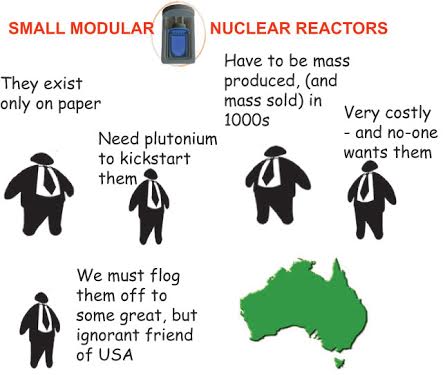
Will the Abbott govt listen to a sensible bull, along with all the rest of the bull they are guided by?
George the bull sees red over renewable energy ABC Rural Lucy Barbour, 17 May 14, “…..According to Mr Osborne, the wind turbines on his property employed 270 people during construction and currently employ 17 locals.
“It pumps $3 million into the local economy every year in wages, landowner payments, and fencing and agricultural contracts,” he said.
“It’s allowed landowners to plant tens of thousands of trees, protect and expand rare ecosystems on the site, and better manage erosion.” http://www.abc.net.au/news/2014-05-16/nrn-george-the-bull-renewable-energy-target-revew/5457174
Canadian company shows the way, exporting solar systems to Australia
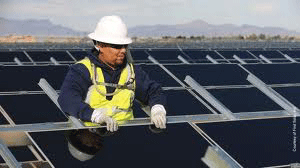 On May 14, 2014, Canadian Solar announced a partnership with IKEA Australia, a globally celebrated leader of the retail industry to build 3.6 MW of solar systems. The 3.6 MW project will span across seven IKEA sites located inVictoria, New South Wales, and Queensland, and will generate enough clean energy to offset approximately 4,000 tons of CO2 annually.
 On May 12, 2014, Canadian Solar announced that it won the Randstad Award as One of Canada’s Most Attractive Employers, in a survey by Randstad Canada, the country’s leading staffing, recruitment, and HR services company. Canadian Solar was selected as the fourth most attractive employer by more than 8,500 Canadians and ranked amongst the 150 largest companies in Canada……..
 On April 16, 2014, Canadian Solar announced the completion of the first diesel hybrid PV system in the remote microgrids in northern Ontario, Canada. The 152kW rooftop solar array on the Deer Lake First Nation Elementary School, completed by Canadian Solar with its supplier partners, is the first project under a strategic partnership with NCC Development, LP a First Nation renewable energy management company……….
Canadian Solar Reports First Quarter 2014 Results mnsn moneyu GUELPH, Ontario, May 16, 2014 /PRNewswire/ — Canadian Solar Inc. (“Canadian Solar” or the “Company”) CSIQ, one of the world’s largest solar power companies, today announced its financial results for the first quarter ended March 31, 2014. ……… Continue reading
Aboriginal people not participating in govt’s decisions that savagely cut indigenous funding
AUDIO: Indigenous affairs hit by ‘savage budget cuts’ ..http://www.sbs.com.au/news/article/2014/05/14/indigenous-affairs-hit-savage-budget-cuts By Darren Mara, 14 May 14 Government to dramatically reduce Indigenous programs, NITV News reports
Before his election last September, Tony Abbott claimed he’d be a Prime Minister for Indigenous affairs.
But in his government’s first budget, Indigenous affairs have taken some of the most savage cuts……..The budget will see 150 Indigenous program areas cut down to five: employment and land, education, health and safety, culture and remote strategies.
Funding for Indigenous languages has been cut by almost 10-million dollars over four years.
Indigenous leader and head of the Indigenous Land Corporation, Dawn Casey, says there are no other elected bodies in Australia that could fill the role played by Congress.
 “It means that Aboriginal people aren’t truly making decisions about what ever area they’re dealing in and that should happen. This is the 21st Century. What comes with the decision making comes responsbility and accountability, so don’t take that away from people, given that it’s well over 200 years since Australia was colonised. We should in fact be growing organisations to take on more of those.”
There will be some money going into Indigenous affairs – or perhaps a redirection of funding…..
Clean energy industries will require compensation as Australian govt slashes renewable energy funding
 Budget 2014: Clean energy bodies call for compensation as Government cuts green funding ABC Radio Australia, 16 May 2014, Clean energy industry representatives have slammed federal budget cuts in the sector, calling for compensation if legislation is changed. By environment and science reporter Jake Sturmer, Alex McDonald – The Federal Government has taken the sword to renewable energy, cutting hundreds of millions of dollars from various green programs.
“I think it’s a very depressing message for the industry and for the investors in it,” said Miles George, head of the 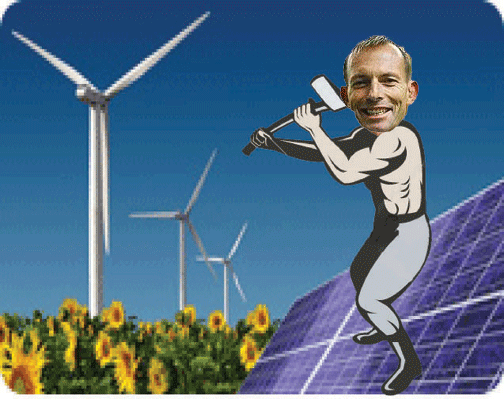 country’s largest renewable energy provider, Infigen.
Among the changes is a decision to spread the Government’s $2.55 billion Emissions Reduction Fund (direct action policy) over 10 years rather than four.
-……………………“If we actually throw away options, a fear for me is that the energy mix that we currently have just gets ossified,” said ARENA chairman Greg Bourne.
“Infrastructure is hospitals, infrastructure is schools, but infrastructure is also the energy system that you have within a country and without the energy system, your overall system begins to grind to a halt.” Mr Bourne says the current reliance on traditional energy sources is “not fit for purpose in this century”.
The last significant piece of green energy legislation, the Renewable Energy Target (RET), is currently under review. After investing billions in the sector, Mr George warns any changes would be a breach of faith. “If the legislation is now to be changed we would expect to be fully compensated,” he said.
“If [they] took the RET away tomorrow … we would lose 40 per cent of our revenue and our Australian business would fail … along with nearly all wind farms and wind farm businesses in Australia.” Mr George says Infigen has made investments over the past 10 years on the basis of legislation that had “bi-partisan support”.
“If the legislation is now to be changed retrospectively and that has a negative effect on our business, we would expect to be fully compensated,” he said. “This is the way Australia does it. Australia does not wreck existing legislation without compensation.”
The Environment Minister declined an interview but maintains that tough decisions needed to be made in the current economic climate.
Giles Parkinson muses on the Australian government’s fierce antipathy to renewable energy
 Five things we learned about … the Far Right and renewables REneweconomy, By Giles Parkinson on 16 May 2014
Prime Minister Tony Abbott doesn’t like wind turbines, and neither does Treasurer Joe Hockey, but it seems like their antipathy towards green energy runs deeper than anyone had suspected – it must be a tool of the Left, and so must be eradicated. It’s hard to find any justification, other than ideology, for the latest broken promises from the Abbott government, the proposed repeal of the Australian Renewable Energy Agency, and the disappearance of the million solar roofs program.
The decision to close ARENA – which means an end to new funding for Australia’s world leading solar research, future support for home-grown technologies in wave energy, battery storage, concentrated solar power and geothermal production – adds to a litany of actions that Abbott has taken since his election victory. The carbon price is going, the $10 billion Clean Energy Finance Corporation is going, the renewable energy target is certain to be either removed or diluted, and now ARENA and a host of energy efficiency and other schemes have been dumped. Indeed, anything that might provide a market signal that we should be making a transformation towards a clean energy economy.
Why Coalition MPs find the thought of melting glaciers amusing
There are two explanations for this – either, in the words of Climate Change Authority chairman Bernie Fraser, it is the result of the government’s “sickening and disappointing” pandering to vested interests, or it is merely continuing the Abbott “climate change is crap” ideological mantra. If you don’t have to address climate issues, then you don’t need to clean up the power supply. Or perhaps it is the result of both.
Liberal Senator Ian Macdonald appeared to speak for the majority of the Coalition MPs and ministers when he took another dig at the climate science in the Senate this week, insisting that the climate is changing, but only “as it has done for literally millions of years”. He noted that one of the reasons the south of Australia is becoming drier is apparently because of “the record amount of sea ice” in Antarctica, which he read about in that august scientific journal, The Australian newspaper.
“That always makes me smile when people talk about global warming,” Macdonald told the Senate. Less amusing, perhaps, were the scientific reports released that same day which showed that the melting of the West Atlantic Ice Cap is now considered irreversible and unstoppable, and could lead to massive rises in sea levels. Probably, however, beyond the Senator’s current parliamentary term, which is about as far as this government is willing to look.
Boganaire, unbowed by “green terrorists”, buys back into coal
That same disregard for climate policy appears to be driving not just conservative policies, but Australian coal barons – both major and minor. One of the lesser barons, Nathan Tinkler, the Newcastle “Boganaire” – as Paddy Manning’s book described him – has dusted himself off from the collapse of his first coal empire and re-entered the market with the proposed $150 million of a thermal coal mine in Queensland – vowing not to be derailed by “terrorist acts by green parties”, or even environmental considerations. He was sure, Tinkler told The Australian, that Australian coal was of such high quality that digging up hundreds of millions of tonnes of it would help the world reduce emissions.
Tinkler may be disappointed to find that it is not green terrorists and “extremists” that threaten coal projects the most, so much as the world’s financial markets and a long term structural decline in the coal industry. The Institute for Energy Economics and Financial Analysis this week noted that thermal coal prices are at a record low. Tinkler thinks that is a great time to buy, unless of course you recognise – as Citigroup suggested this week – that a combination of regulatory and technology changes will force an unstoppable transformation in energy markets. Good luck with the financing.
Conservatives continue grants to “clean” brown coal projects
Despite the death of ARENA and other incentives for renewable, one fund the federal government is continuing to support is the $90 million Advanced Lignite Demonstration Program which it shares with Victoria. The desire to export vast quantities of lignite goes against history, the financial risks identified by the Citigroup reports, and warnings from the International Energy Agency, which this week reminded everyone that coal fired generation must be phased out quickly, and gas-fired generation too from 2025, if the world is to meet climate goals. Standard & Poor’s also issued a new report highlighting increasing “sovereign risk” from climate change.
But, unbowed by what official news outlet The Australian blithely dismissed as “green alarm”, and unabashed by the aforementioned dumping of support for renewables, and its vow to remove “corporate welfare”, the Federal and conservative Victorian governments have decided to chuck $50 million into projects to turn brown coal into diesel and synthetic oils, and to try and create “vast scales” exports of a “higher grade” coal. The Victorian brown coal reserves were of national significance, said Industry minister Ian “we must extract every molecule of gas” Macfarlane.
What do camels and wind farms have in common?…..http://reneweconomy.com.au/2014/five-things-we-learned-about-the-far-right-and-renewables-18949
1 This month

of the week – Australians for War Powers Reform (AWPR)
To see nuclear-related stories in greater depth and intensity
 Antinuclear