Tony Abbott selling out the next generation on climate change, says Senator Christine Milne
 ‘Selling out future generations’: Christine Milne rounds on Tony Abbott over climate change The Age, Peter Hannam Environment Editor, The Sydney Morning Herald 19 May 14, Tony Abbott is the true “inter-generational thief” for boosting fossil fuels at the expense of renewable energy, increasing the likelihood of Australians paying a big price from climate change, Greens leader Christine Milne said.
Both the Prime Minister and Treasurer Joe Hockey have based their budget sales pitch on the need to raise taxes and slash spending to rein-in future debt that had been projected to balloon above $600 billion without policy changes.
“We could not go on running up massive debts for our children and grandchildren to pay,” Mr Abbott told ABC’s Insiders on Sunday. “That would be a form of inter-generational theft.”
Senator Milne, though, said the increases in subsidies for big miners – which rise by $720 million to almost $14 billion over the forward estimates – and efforts to promote more coal seam gas, coal mines and coal ports were the real form of “future theft”.
“Not only is it bad for the environment but these will be stranded assets which the next generation will have to pay for,” Senator Milne told media in Sydney. “Tony Abbott is the one selling-out future generations.”
The Greens will use their votes in the Senate to try to block cuts to health and education as well as plans to scrap the Australian Renewable Energy Agency, which promotes emerging clean energy such as concentrated solar power…….
The Greens would welcome a double dissolution election, if the Coalition called one.
“I say bring that on,” Senator Milne said. “The Australian community has been betrayed by the Prime Minister. Nobody signed up for this budget. Nobody knew who the PM was before the election.
“People are well and truly ready to show him what a trust deficit looks like.”
Senator Milne predicted voters would take a more favourable approach to climate-change related policies, including the carbon price, in light of the budget. http://www.smh.com.au/federal-politics/political-news/selling-out-future-generations-christine-milne-rounds-on-tony-abbott-over-climate-change-20140519-38jax.html#ixzz32KIblOef
Australian uranium companies strongly part of the callous exploitation of poverty-stricken African nations
THE SCRAMBLE FOR URANIUM IN AFRICA http://www.phantomreport.com/the-scramble-for-uranium-in-africa 19 May 14, Africa’s resources are extracted by outsiders, with benefits only reaching the involved non-African mining companies and non-African end-users of the commodity. Africa is the next frontier to meet energy needs. Oil and gas are being exploited as never before, exacerbating conflict in Darfur and Nigeria, social inequality in Angola, and environmental damage in Chad.
At the same time, renewed demand for uranium is being explored on the continent more than at any other time in history.
Yet the continent’s huge potential for renewable energy is not fully being realised. The government of Malawi granted a uranium mining licence to an Australian uranium mining company without having any legislation on the mining, handling and transportation of radioactive materials. Malawi is now home to twelve potential uranium mines.
In Niger mining companies from Australia, Canada, France and other parts of the world are scrambling for licences to explore uranium in a country which is already the world’s sixth producer of uranium. In the Central African Republic (CAR) there is a scramble amongst Chinese, American and French companies which are all interested in mining the Bakouma region.
In Tanzania the Australian Omega Corp obtained the Mkuju River concessions through its subsidiary, Mantra Resources. Other Australian juniors are represented in Tanzania, including Sabre Resources, Goldstream Mining, Uranex and Deep Yellow.
In Zambia, the Australian Energy Ventures through its subsidiary Africa Energy Resources started drilling the Kariba Valley in May 2008. Another Australian enterprise, Albion Ltd,, is also undertaking exploration.
Western Australian MP ‘s first speech in Parliament makes a strong call for renewable energy
Hughes: future in renewable energy http://www.whyallanewsonline.com.au/story/2290965/hughes-future-in-renewable-energy/?cs=12 By KAYLEIGH BRUCE May 19, 2014, Member for Giles Eddie Hughes made his maiden speech before state parliament recently in which he called for greater federal investment into developing renewable energy in South Australia.
During his parliamentary debut, Mr Hughes focussed on the role renewable energy and mining could have in creating employment and economic growth in the region.
“BELOW THE GROUND WE HAVE MINERAL RESOURCES, BUT ABOVE THE GROUND WE HAVE AN ENERGY SOURCE THAT DWARFS ALL OTHER ENERGY RESOURCES: THE DIRECT SOLAR RESOURCE AND INDIRECT SOLAR RESOURCE THAT IS WIND, CAN TURN SOUTH AUSTRALIA INTO A RENEWABLE ENERGY POWER HOUSE AND, IN THE PROCESS, GIVE US A FAR GREENER MINING INDUSTRY WHILE ALSO GREENING ALL OTHER SECTORS OF OUR ECONOMY.”- MEMBER FOR GILES EDDIE HUGHES
Mr Hughes said the electorate of Giles was already playing a role in wind energy production and noted Whyalla’s role in the manufacturing of wind tower parts by E & A Contractors.
However Mr Hughes said the city was also well-positioned to harness solar energy.
“What we are looking at now – and the process has started, but we have further to go – is developing and applying technology to capture the sun’s energy,” Mr Hughes said.
Mr Hughes took the opportunity to voice his passions to see the region’s role in producing renewable energy further developed.
“Manufacturing communities like Whyalla could increase tower production,” Mr Hughes said.
“Hubs, nacelles and blades are all imported; with investor certainty, local manufacturing facilities could be developed.
“If we captured the wind resource on the Eyre Peninsula and captured the manufacturing opportunities, it would be a big boost to employment.
“Rounding the numbers off, the stage development of 2000 megawatts on the Eyre Peninsula would mean the fabrication of 800 towers, 800 hubs, 800 nacelles and 2400 blades in addition to a wide range of job-generating ancillary services.”
Mr Hughes called on the Abbott government to realise the future of renewable energy in Australia and back the research and development needed to shape the industry. “Companies in the past have expressed their willingness to invest in Australian manufacturing, but each time that desire has been undermined at a federal level, initially when the Howard government failed to increase the two per cent mandatory renewable energy target, and now with the Abbott government’s review headed up by a man who rejects the science behind global warming,” Mr Hughes said.
“A review held just 18 months after the last review found that the mandatory renewable energy target was working to deliver cost-effective clean energy.”
Mr Hughes said with the right support, South Australia could easily achieve outstanding renewable energy production results and be a model example of renewable energy supporting the mining industry.
“The target to reach 33 per cent of the state’s electricity from renewables by 2020 is likely to be met within a year,” Mr Hughes said.
“WHY NOT SET A TARGET TO BECOME THE GREENEST MINING PROVINCE IN THE WORLD, AND WHY NOT MARRY OUR RENEWABLE ENERGY RESOURCE TO OUR MINERAL WEALTH, OR AT LEAST ANNOUNCE THE ENGAGEMENT SO THAT DOWN THE TRACK THEY CAN TIE THE KNOT?”- MEMBER FOR GILES EDDIE HUGHES
8 USA East Coast Nuclear Power Stations likely to sink below rising sea levels
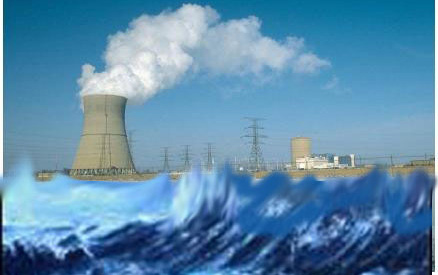 How Rising Seas Could Sink Nuclear Plants On The East Coast Shane Shifflett Kate Sheppard, HUFFINGTON POST, 19 May 14 In 2011, a tsunami sent waves as high as 49 feet crashing over the seawalls surrounding the Fukushima Daiichi Nuclear Power Plant in Japan, causing meltdowns at three of the plant’s reactors. After that incident, the United States Nuclear Regulatory Commission (NRC) ordered nuclear facilities in the U.S. to review and update their plans for addressing extreme seismic activity and potential flooding from other
  events, such as sea level rise and storm surges. Those plans aren’t due until March 2015, which means that many plants have yet to even lay out their their potential vulnerabilities, let alone address them.
During the 1970s and 1980s, when many nuclear reactors were first built, most operators estimated that seas would rise at a slow, constant rate. That is, if the oceans rose a fraction of an inch one year, they could be expected to rise by the same amount the next year and every year in the future.
But the seas are now rising much faster than they did in the past, largely due to climate change, which accelerates thermal expansion and melts glaciers and ice caps. Sea levels rose an average of 8 inches between 1880 and 2009, or about 0.06 inches per year. But in the last 20 years, sea levels have risen an average of 0.13 inches per year — about twice as fast.
And it’s only getting worse. The National Oceanic and Atmospheric Administration (NOAA) has laid out four different projections for estimated sea level rise by 2100. Even the agency’s best-case scenario assumes that sea levels will rise at least 8.4 inches by the end of this century. NOAA’s worst-case scenario, meanwhile, predicts that the oceans will rise nearly 7 feet in the next 86 years.
But most nuclear power facilities were built well before scientists understood just how high sea levels might rise in the future. And for power plants, the most serious threat is likely to come from surges during storms. Higher sea levels mean that flooding will travel farther inland, creating potential hazards in areas that may have previously been considered safe. During Superstorm Sandy, for example, flooding threatened the water intake systems at the Oyster Creek and Salem nuclear power plants in New Jersey. As a safety precaution, both plants were powered down. But even when a plant is not operating, the spent fuel stored on-site, typically uranium, will continue to emit heat and must be cooled using equipment that relies on the plant’s own power. Flooding can cause a loss of power, and in serious conditions it can damage backup generators. Without a cooling system, reactors can overheat and damage the facility to the point of releasing radioactive material.
Salem and Hope Creek Nuclear Generating Stations Operated by PSEG Nuclear, LLC.……..
Turkey Point Nuclear Generating Station Operated by Florida Power & Light Co……..
Daring dawn blockade of Berkshire’s nuclear weapons factory
 Britain: Activists Disrupt Construction of New Nuclear Weapons Factory http://www.globalresearch.ca/britain-activists-disrupt-construction-of-new-nuclear-weapons-factory/5382852 By Global Research News May 19, 2014by Action AWE (Atomic Weapons Eradication)
 £2 billion project going ahead, but Parliament has not yet voted on further nuke development.
That’s what you call “democracy”. But it is all for a good cause. Nuclear weapons are an “instrument of peace”.
Daring dawn blockade of Berkshire’s nuclear weapons factory
This morning at 7.20, a group of people began blockading the Atomic Weapons Establishment (AWE) site at Burghfield, near Reading. The protesters, acting as part of ActionAWE [1], a campaign of nonviolent direct action, are trying to disrupt construction of a new nuclear warhead factory on the site.
The new development at AWE Burghfield is being built at a cost to the tax payer of almost £2 billion, despite the fact that parliament has yet to vote on replacing the current generation of nuclear warheads that the site would build.
The eight protesters, aged between 19 and 40, are locked together using handcuffs inside ‘lock-on’ devices – made from drainpipes, and vegetable oil drums filled with concrete in order to block the gate to the construction site to prevent further work on the site. Traffic is now queued up, unable to enter the facility. The Christians amongst the protesters are singing hymns.
Catherine Bann, 40, mother of two from Todmorden, said: “The money we would spend renewing Trident could pay for all A & E hospital departments in the country for the next 40 years! It’s a huge waste of public money to be investing in nuclear weapons, and people like us must make a stand now, so that future generations do not have to bear the cost.”
Joanna Frew, 35, a member of the United Reformed Church living in London but originally from Scotland, said
“Trident is illegal, immoral and a waste of money. It is the opposite of everything that Jesus teaches us about being co-creators of life and loving your enemies. Political and religious leaders in Scotland are opposed to retaining Trident at Faslane. We have a real opportunity over the next year to say that it is no longer acceptable , and that we don’t want an illegal renewal.”
Phil Wood, 20, a student at Bradford University added
“To be spending millions of pounds and planning to spend billions more on nuclear weapons while cutting back on essential public services that people rely on is unforgivable”.
Matt Fawcett, 39, from Yorkshire CND said
“This ‘do as we say, not as we do’ policy of telling other countries they can’t develop nuclear weapons while we spend billions developing new weapons of our own, not only undermines attempts to limit the spread of nuclear weapons but also discredits Britain on the world stage. Polls show 87% of the British public are against spending on new nukes at a time of such drastic cuts, yet the construction goes on at Burghfield without any parliamentary debate”.
The UK government has an armed nuclear submarine on patrol and ready to fire at all times, with the ability to wipe out cities almost anywhere on earth within 15 minutes[2]. The UK government has a stockpile of around 225 nuclear warheads[3], each with eight times the explosive power of the bomb dropped on Hiroshima in 1945 [4] that killed an estimated 140,000 to 200,000 people. Running the Trident nuclear weapons system currently costs £2 billion a year[5], and has not seen any of the cutbacks facing other government spending and public services. The government will vote in 2016 to decide whether to invest in the UK’s Trident nuclear weapon system for another 30 years.
Operated by a consortium of Jacobs Engineering Group, Lockheed Martin and Serco, AWE Burghfield plays an integral part in the final assembly and maintenance of nuclear warheads for use in the Trident system[6]. In 2011 Peter Luff, the then Minister for Defence Equipment, announced £2 billion of spending for redevelopment of the Burghfield and Aldermaston weapons factories[7]. The total spending on Weapons of Mass Destruction in the UK will soar to over £100 Billion should the government take the decision to renew Trident in 2016 [8].
Action AWE (Atomic Weapons Eradication) is a grassroots campaign of nonviolent action dedicated to halting nuclear weapons production at the Atomic Weapons Establishment factories at Aldermaston and Burghfield………
Canceling of huge uranium mine in Saskatchewan has a dire warning for new mines

 By Dave Forest | Mon, 19 May 2014 Uranium prices took another slump the last several weeks. Spot prices for uranium oxide have now fallen below $30 per pound for the first time since 2005. Even long-term prices sagged, falling below $50–to a current $45 per pound.
That’s stopped the wave of optimism that had been running through uranium stocks earlier this year.
 Cameco..told regulators in Canada that it is shelving one of its biggest development projects in the uranium-rich province of Saskatchewan.The Canadian Nuclear Safety Commission (CNSC) said in a press release Friday that Cameco is not proceeding with permitting for the company’s Millennium project. The up-and-coming mine had been scheduled for public hearings in June, to consider the grant of a 10-year operating license.
……… Cameco is concerned about low uranium prices. And how they will affect the potential economics of a start-up at Millennium.The company has now reportedly withdrawn its application to construct and operate the mine………
Simply put, Millennium was one of the world’s premier uranium development projects. Hosting an indicated mineral resource of 46.8 million pounds uranium oxide–grading a league-leading 4.53% U3O8. The proposed mine here would have been one of the world’s largest producers. Slated to put out up to 7 million pounds of uranium oxide yearly.
But all of that supply is now lost to the market. Just another sign that current prices are too low to support much of the existing uranium mining industry. Let alone necessary expansion projects.
This is not a sustainable situation. With supply also falling in major producing centre like Kazakhstan and Africa, something will have to give…..http://oilprice.com/Finance/investing-and-trading-reports/This-Is-A-Major-Loss-For-Uranium-Supply.html
Tasmania’s successful renewable energy industry faces loss of investment if Renewable Energy Target is scrapped
 Hydro Tasmania warns scrapping Renewable Energy Target will kill off investment http://www.abc.net.au/news/2014-05-19/hydro-tasmania-warns-scrapping-renewable-energy-target-will-kil/5463404 By Lucy Shannon Australia’s largest renewable energy generator Hydro Tasmania has warned major projects will not go ahead if the Federal Government scraps the Renewable Energy Target Scheme.
The scheme, established by the Howard Government in 2001, aims to have 20 per cent of Australia’s electricity coming from renewable sources by 2020.
The Federal Government is reviewing the RET scheme, as required under legislation. Prime Minister Tony Abbott has faced strong internal pressure to scrap the target from both the Nationals and many Liberals who believe it has pushed up power prices.
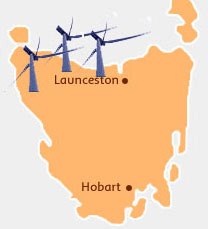
Hydro Tasmania, a state-owned business, has made its submission to the review panel. Hydro Chief Stephen Davy says the RET has stimulated $18 billion worth of investment across the country. Mr Davy says if the scheme is scrapped the proposed $2 billion dollar wind farm for Tasmania’s King Island will not go ahead.
“It would almost certainly terminate any further investment in large scale renewable energy projects, and put at risk the long term viability of existing renewable energy assets,” he said.
A second electricity interconnector with Victoria would also be unlikely.
Hydro ‘vital to economy’
The submission points to the “vital and ongoing economic contribution” Hydro makes to Tasmania’s economy. It says more than $60 million was spent with Tasmanian businesses to support the construction of the Musselroe wind farm and more than 200 workers will be employed over the life of the project.
Mr Davy says with the expected abolition of the carbon price the RET is the “only long-term, large scale policy that can drive the uptake of zero-emissions energy sources.”
Last year, Hydro Tasmania announced a record pre-tax profit of $238 million dollars largely on the back of the carbon price which added $70 million to its coffers.
The Greens Senator, Christine Milne says Tasmania should be very fearful of the Government’s review.
“It’s been clear from the start that this is a sham, virtually all the people they’ve got on the review are climate sceptics, they support the old fossil fuel sector and they see renewable energy as competition to the old order,” she said. A spokesman for Greg Hunt says the review’s terms of reference specifically mention sovereign risk as an issue that will be considered by the panel.
There is no fixed date yet for when the report will be delivered.
Victoria’s Premier Napthine pledges support fo wind energy: I wish I could believe him,
 Napthine pledges continued push for renewable energy investment http://www.abc.net.au/news/2014-05-19/napthine-pledges-continued-push-for-renewable/5461022 19 May 2014, Premier Denis Napthine says he will work with renewable energy companies in south-west Victoria, amid concerns about their future.
The Federal Government axed the Australian Renewable Energy Agency and Clean Energy Finance Corporation in last week’s budget.
It is also reviewing the Renewable Energy Target.
Portland-based company Keppel Prince makes towers for wind turbines and says 150 jobs are at risk.
Dr Napthine says he hopes planned projects go ahead.
“We’ll continue to work with the Federal Government, work with the alternative energy industry, whether it’s wind energy, geothermal energy and wave energy, to see what prospects there are to continue investment in alternative energy under the new frameworks,” he said.
Australia losing jobs in renewable energy – jobs go offshore following 2014 Budhet
2014 Budget Will Send Renewable Energy Jobs Offshore, Marc Howe, Sourceable, 20 May 14, Australia’s peak body for the renewable energy industry has decried the Coalition’s proposed scrapping of ARENA in its 2014 budget, saying the move will result in jobs and investment shifting to other countries.According to the Clean Energy Council, the Coalition’s plans to abolish the Australian Renewable Energy Agency (ARENA) will be a severe retrograde move for a burgeoning domestic industry, which has already reached the cutting edge of innovation in areas such as large-scale solar, geothermal and ocean energy.
Kane Thornton, deputy chief executive of the Clean Energy Council, said the decision to scrap ARENA sends a strong signal to both domestic and international players in the sector, and will severely vitiate the ability of Australia’s renewable energy sector to compete on a globalised playing field.
“A global race for renewable energy is on, and the removal of ARENA will see potential Australian and international investors now look to countries with much stronger support for renewable energy innovation,” she said. “We may well miss out on billions of dollars of investment and highly skilled jobs.”
Thornton further pointed out that weakening the Australia’s renewable energy sector was an imprudent move from a jobs perspective, given the large contribution the industry could make to flagging employment growth.
“Abolishing ARENA is a backwards step for the ‘clever country’ at a time when job losses in traditional industries like the automotive and manufacturing sectors mean we need new, innovative industries to take their place and fill this void,” she said……….
– See more at: http://sourceable.net/2014-budget-will-send-renewable-energy-jobs-offshore/#sthash.JyY5hPnm.dpuf
We must not forget Vincent Lingiari and the struggle for Aboriginal land rights
Lingiari’s legacy lost on the young AMOS AIKMAN THE AUSTRALIAN MAY 20, 2014
EVERY morning, the last of the Wave Hill Aboriginal stockmen gather at a place not far from where Gough Whitlam poured sand into Vincent Lingiari’s hands. Beside a dusty parking lot outside Kalkarindji store, where camp dogs and stray children eat breakfast, the old men watch passersby.The famous walk-off of Gurindji people from Wave Hill station in August 1966, protesting against poor pay and conditions, began the land rights movement that Whitlam’s gesture consummated.
Paddy Doolyak, one of the last surviving stockmen, said they walked off “for money, just for money”. Land rights came a “little bit later”.
From the time of the walk-off in 1966 until Whitlam’s historic land rights declaration in 1975, The Australian devoted prominent coverage to the Gurindji demands, commissioning a man who was central to the walk-off, the communist and novelist Frank Hardy, to write feature articles.
“The Gurindji people wanted to abandon contact with the white man and revert to their tribal ways,” Hardy wrote in one of those pieces.
He told of the day that the stockmen and their families, led by Lingiari, walked to Wattie Creek where they remained until their land rights victory so many years later…….
Indeed, they are those of virtually every indigenous group living in the remote bush. http://www.theaustralian.com.au/50th-birthday-news/lingiaris-legacy-lost-on-the-young/story-fnmx97ei-1226923245535#
1 This month

of the week – Australians for War Powers Reform (AWPR)
To see nuclear-related stories in greater depth and intensity
 Antinuclear