Tennant Creek taken over by anti nuclear, anti -waste-dump protest, led by Aboriginal elders
 Elders lead dump demo http://www.ntnews.com.au/news/northern-territory/elders-lead-dump-demo/story-fnk0b1zt-1226932228540 BY MONIKA O’HANLON NT NEWS MAY 26, 2014 THE main street of a Territory town was flooded with more than 250 people protesting the proposed nuclear waste dump at Muckaty Station yesterday. Tennant Creek was overrun by a sea of yellow signs reading “Don’t radioactive waste the Territory” as kids led the march, holding up homemade banners and chanting “land rights not dump sites”.
Seven years ago the Northern Land Council nominated Muckaty Station as a potential site for a nuclear waste storage facility, including waste from nuclear medicine and operations of the Lucas Heights nuclear reactor in Sydney.
The site is part of a land trust shared by five interrelated indigenous groups – Milway, Ngapa, Ngarrka, Wirntiku and Yapayapa. Most traditional owners oppose the plan but some said “yes” to the proposed storage facility.
Bunny Nabarula – a senior traditional elder and part of the Milway group – is among those who have spent years fighting to preserve Muckaty.
“I was eight years of age when my grandfather first showed me country, but I never forget,” Ms Nabarula said.
“We don’t want the waste here. NLC picked out the wrong people. Us mob fight for this land.”
Dianne Stokes has worked tirelessly over the years to protect the Muckaty site, and on Saturday was named an ambassador at the Tennant Creek and Barkly Region Golden Hearts Awards.
“We won’t be stopping – we will continue to talk about it,” Ms Stokes said. “It’s time to put my foot down and protect the elders’ words. They’ve passed away and now they left it to us to protect our country.”
Wirntiku woman Penelope Phillips said she was concerned what would happen if the land wasn’t protected for the next generations. “We want to send a clear message out to the politicians and the people who said yes to it,” she said. “Tell them that we are still strong and we don’t want a nuclear waste dump in our country. Come back and meet the people. See what it looks like. “The politicians don’t talk to us. They don’t reply.”
The protest comes a week before a Federal Court hearing challenging the proposal for the dump on Muckaty begins in Melbourne. The hearing will continue in Tennant Creek before finishing in Darwin on July 4.
No future in sight for Yeelirrie or Kintyre uranium mines, nor for Olympic dam expansion
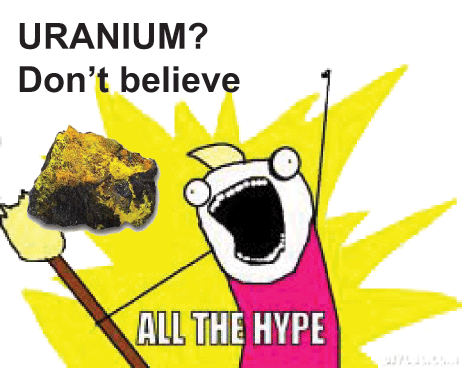 Uranium fall dents Olympic outlook BARRY FITZGERALD THE AUSTRALIAN MAY 27, 2014 BHP Billiton’s recasting of its expansion plans for its Olympic Dam copper/uranium mine in South Australia’s outback have been served up a new challenge — the collapse in uranium prices.
Spot uranium has fallen 30 per cent in the past 12 months to $US28.15 a pound, plunging most of the world’s uranium-only mines into losses. More telling has been the steady decline from the record price of $US137 a pound in mid-2007, due in part to the fall in demand in the wake of Japan’s Fukushima nuclear disaster in 2011.
BHP dropped plans for a big-bang expansion of Olympic Dam in mid-2012, blaming the $30 billion cancellation on the over-heated resources sector and the country’s high-cost environment. Concerns about uranium’s outlook post-Fukushima was also a factor……….
When it shelved the big-bang expansion plan, BHP said it would investigate a less capital-intensive design, and one that drew on new mining and processing technologies to improve the economics of the project.
BHP chief executive Andrew Mackenzie also undertook in September to say more about plans for the expansion “within about a year’’. While that timing is almost up, BHP’s considerations of what the price slump means for the future of what is the world’s biggest uranium deposit makes its planning for an expansion all the more complex.
Like the rest of the industry, BHP will be pinning its hopes on the restart of nuclear power plants in Japan, and the forecast surge in China’s nuclear power industry, to eventually produce more sustainable prices — in the context of being able to make a profit from the material at any rate……..
“uranium prices continue to suffer downward pressure and we do not see any reason to expect improvement soon.’’ -Tim Gitzel, the chief executive of Canadian uranium giant Cameco, which owns two of the world’s biggest undeveloped uranium deposits in Western Australia — Yeelirrie and Kintyre.
That means that neither Yeelirrie, acquired from BHP, and Kintyre, acquired from Rio Tinto, are about to be developed anytime soon…..
AUDIO: Jobs, investment at risk if Renewable Energy Target is scrapped
Bloomberg study says scrapping renewable energy target puts jobs and investment at risk http://www.abc.net.au/ news/2014-05-26/bloomberg-study-says-scrapping-renewable-energy/5479200?section=business
The global finance giant Bloomberg has warned that any reduction to Australia’s renewable energy target could come at a cost of $20 billion future investment. The media and financial data company’s renewable energy research division has released a report that shows scrapping the target would also put more than 10,000 jobs at risk. An expert panel is currently reviewing the future of Australia’s pledge to produce 20 per cent of the country’s electricity from renewable sources by the end of the decade. Pat McGrath
Source: PM | Duration: 4min 56sec
Hibakusha, Japan’s atomic bombing survivors on their global voyage – now in Peru
Global Voyage for a Nuclear Free World – Radiation survivors tell their story in Lima, Peru Peru This Week By Roxana Garmendia, 27 May 14 Hiroshima and Nagasaki survivors visit Lima as part of their worldwide tour campaign ‘world free of nuclear weapons.’Hiroshima and Nagasaki are two words one cannot easily forget. They represent the destruction and the immense human suffering and loss caused by the usage of nuclear weapons. On August 6, 1945, American airplanes dropped a nuclear bomb on the Japanese city of Hiroshima, and three days later on Nagasaki. 69 years have passed since then but the effects of such acts are still present to this day. To tell us more on these tragic events, a delegation of survivors recently visited Lima as part of their worldwide tour campaign on a ‘world free of nuclear weapons.’ Continue reading
Radiation levels cause closure of popular Japanese tourist park

 HITACHI SEASIDE PARK CLOSED DUE TO RADIATION, FUKUSHIMA UPDATE MAY 26, 2014
Ibaraki Prefecture, which is home to the park, neighbours Fukushima Prefecture, and therefore concerns over radiation levels have been ongoing since the 2011 nuclear disaster.
From NHK.com – “…….Hitachi Seaside Park is one of Ibaraki prefecture’s leading tourist spots and had over 350000 visitors during Golden Week this year and from now on MLIT will be carrying out decontamination of the area.” http://fukushimaupdate.com/hitachi-seaside-park-closed-due-to-radiation-fears/
Australia needs to learn from traditional Aboriginal knowledge about fire
 Living sustainably with fire, Aboriginal Knowing 26 May 14,
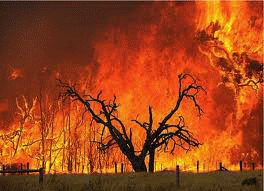
Where to burn, where to grow”………..I would suggest that the planning of Adelaide, surrounded by parklands with open spaces is based on this Aboriginal model of clearing land to create clear space around where you live. Australians need to think in this manner to protect ourselves from intense and destructive bushfires. We need to clear the trees around where we live, and we need to grow trees and plants in the right places.
Decisions of when and where to burn are informed by many environmental and social considerations, and vary with country. Our sophisticated patterns of land burning, the knowledge of what and where to burn is encoded within traditional knowledge. Such rules tell of wind directions, cloud formations, smoke patterns, soil condition, the position and movement of constellations and planets, the type of plants and stage of growth, the presence or absence of particular plant and animal species and so on.
Fire and water are interconnected. Water is a fuel for fire and fire fuels the rain. After a large fire, it usually rains.
Burning and planting in the right place can increase rainfall. (excellent references) http://aboriginalknowing.com/2014/05/22/living-sustainably-with-fire/
Murdoch media takes its”facts” on renewable energy from fossil fuel and right-wing promoters
 Why the Murdoch media hates renewable energy so much, REneweconomy, By Giles Parkinson on 26 May 2014 Here is an admission. For more than two years, over two stints, I wrote a weekly column on green energy for The Australian newspaper, called Greenchip.
It appeared prominently on the business pages, and on no occasion was I ever instructed by any editor to take a certain angle, and my copy was never changed to convey another meaning – although one sub-editor did choose the word “seaweed” in a story about algae fuels.
That’s the way it should be. And possibly the way it still is. But I make mention of it now because the position of the Murdoch media towards renewable energy has become a major issue: It appears designed to bring a multi-billion dollar industry to a halt, and apart from ideological reasons, or sympathy with vested interests, it is not clear why.
Certainly, it is not based on the facts.
Some of the reporting on renewables from the Murdoch global network has been laughable, such as the assertion by one Fox News reporter that solar could never work in the US because it didn’t have as much sun as Germany. Continue reading
Possession of a nuclear weapons must be internationally accepted as a crime against peace
In order to abolish nuclear weapons from this planet, it is necessary to introduce a new international convention prohibiting both the use and possession of nuclear weapons. To achieve this goal, we need global consensus on the above-mentioned idea that a nuclear deterrent is a crime against peace.
 Nuclear Weapons: Toward Abolition or Armageddon? By Yuki Tanaka
Global Research, May 26, 2014 People still clearly remember that on April 5, 2009 the U.S. President Barack Obama excited an audience in Prague by declaring that his government “will take concrete steps towards a world without nuclear weapons.” As the only nuclear power to have ever used a nuclear weapon, he said, the United States has a moral responsibility to act. Indeed, the U.S. has not only moral responsibility but also legal responsibility for the victims as the nation that committed a crime against humanity by indiscriminately killing tens of thousands of people and causing lifelong radiation sickness to many survivors.
Continue reading
A sun smart school in Perth is tracking UV radiation
 St Hilda’s Anglican School for Girls the first in Australia to install UV meter http://www.perthnow.com.au/news/western-australia/st-hildas-anglican-school-for-girls-the-first-in-australia-to-install-uv-meter/story-fnhocxo3-1226931735377 RACHEL NORMAN PERTHNOW MAY 16, 2014 ST Hilda’s Anglican School for Girls is now the most sunsmart school in Australia. The Mosman Park school has become the first in the country to install a meter that tracks ultraviolet radiation from the sun. If the meter hits level 3 or above, students have to cover up.
The move is an attempt to mitigate the prevalence of Australia’s most common form of cancer.
The Cancer Council says almost 77,000 skin cancer cases are treated each year in WA alone. Mark Strickland, the Cancer Council of WA’s SunSmart manager, said installation of the meter on the school’s junior campus was a positive step towards reducing skin cancer in the community.
“It has been shown that reducing lifetime UV radiation goes a long way to reducing the risk of skin cancer,” he said.
“A UV meter is another way of reminding people that the sun’s radiation in WA is strong enough that they need sun protection.
“It’s a silent but constant reminder of the ever-present need to cover up.”
Andrea McNally, the head of Junior School at St Hilda’s, said childhood was a particularly important time to recognise the need to seek shade and form good habits for the future.
“Having the visual prompt of the UV meter has taught the students that it’s not the heat that determines danger, but the UV index; and hopefully that will create a lifelong awareness and a change in their attitudes,” she said.
Data from the UV meter will also be used as part of the junior school curriculum, with students from year 1 currently monitoring and recording data every day.
Australia’s first public UV meter was installed at Deep Water Point in Melville last year.
There is also a Cancer Council meter at the Surfing WA club house at Trigg Beach.
St Hilda’s year 6 pupil Angelique Preau said she and her fellow students were paying close attention to the meter – regardless of the sort of day it was.
“When it gets to 7 or more it’s bad and you have to go into the shade and/or put sunscreen on,” the 11-year-old said.
1 This month

of the week – Australians for War Powers Reform (AWPR)
To see nuclear-related stories in greater depth and intensity
 Antinuclear