Australia needs a new and independent approach to radioactive waste management
 Comment: Australia’s radioactive waste management on trial Australia has never had an independent examination of the best way to manage our nation’s radioactive waste. It’s time for that to change. By Dave Sweeney 28 MAY 2014– “…….Internationally the industry thinking has been evolving to a series of approaches that seek to achieve both the isolation of the waste and inclusion of the community.
In a 2006 report, an expert UK committee on radioactive waste management stated:
“It is generally considered that a voluntary process is essential to ensure equity, efficiency and the likelihood of successfully completing the process. There is a growing recognition that it is not ethically acceptable for a society to impose a radioactive waste facility on an unwilling community.”
The current Muckaty plan and process is at sharp odds with this common sense and common decency approach.
It is also in conflict with Australia’s international obligations under the UN declaration on the rights of Indigenous peoples which explicitly requires that “states shall take effective measures to ensure that no storage or disposal of hazardous materials shall take place in the lands or territories of Indigenous peoples without their free, prior and informed consent.”
It is the end result of over two decades of non-transparent and non-inclusive policy making that has been determined by unaccountable departmental representatives and driven with various degrees of enthusiasm by a chain reaction of successive politicians.
Unlike most comparable nations, Australia has never had an independent examination of the best way to manage our nation’s radioactive waste. A dedicated, open and expert National Commission into responsible radioactive waste management would help address a long standing federal policy failure.
The process behind the Muckaty plan will soon be examined by the Federal Court but what is missing and needed is to put Australia’s radioactive waste management on trial.
It is time for a new approach — one that reflects and is informed by best practise, sound science and respect — a public National Commission into responsible radioactive waste management.
As a nation we need to move from the flawed and failed push to find a vulnerable postcode for a dumpsite to a credible process that actively explores the range of management options and which one ticks the most boxes.
Dave Sweeney is the Australian Conservation Foundation’s nuclear free campaigner. http://www.sbs.com.au/news/article/2014/05/28/comment-australia-s-radioactive-waste-management-trial
Japan replaces safety-conscious experts with pro nuclear ones, on Nuclear Regulation Authority
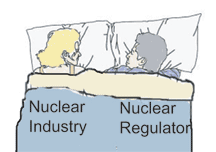 Pro-nuclear expert replacing NRA commissioner who raised flag on quake risk THE ASAHI SHIMBUN 29 May 14, http://ajw.asahi.com/article/behind_news/politics/AJ201405280023 Replacements for two outgoing commissioners of the Nuclear Regulation Authority suggest the Abe administration will find it easier to gain approval for restarts of the nation’s nuclear reactors.Few people in government circles and the nuclear industry will be sorry to see Kunihiko Shimazaki go. His successor is expected to more quickly give the green light to reactivate nuclear power plants.
Shimazaki, who is 68 and a professor of seismology, proved to be a thorn in the side of electric power companies with his calls for a reassessment of the force with which seismic waves and tsunami could pummel nuclear plants being considered for restarts.
Kenzo Oshima, 71, a former undersecretary-general at the United Nations, is also stepping down. Both men are leaving because their terms expire in September.The two newly named NRA commissioners are Satoru Tanaka, 64, a professor of nuclear engineering at the University of Tokyo, and Akira Ishiwatari, 61, a professor of geology at Tohoku University. Their terms are for five years.
With Shimazaki out of the picture, the NRA will have to get by without a seismology expert to offer advice. Tanaka once served as president of the Atomic Energy Society of Japan, and clearly is a proponent of nuclear energy. He has been a professor since 1994 at the University of Tokyo, a respected base of nuclear engineering research in Japan. He has also served on committees related to nuclear energy set up by the Ministry of Economy, Trade and Industry, a staunch backer of the nuclear industry.
The business sector, notably electric power companies, griped that Shimazaki was hindering efforts to resume operations at nuclear plants idled since the 2011 nuclear disaster in Fukushima Prefecture.
An executive with Kyushu Electric Power Co. summed up those sentiments by saying, “Shimazaki made us suffer.”
Kyushu Electric had applied for a speedy inspection of its relatively problem-free Sendai nuclear plant in Kagoshima Prefecture in its request to bring the facility back online.
Shimazaki was in no mood to acquiesce without making Kyushu Electric put in some hard work. He told the utility to reconsider the maximum force of a quake that could strike the plant. It meant the utility had to take additional safety steps, effectively thwarting the company’s hopes of resuming operations in time for this summer when electricity demand peaks.
With memories of the triple meltdown at the Fukushima No. 1 nuclear power plant still fresh, Shimazaki lashed out at electric power companies over their failure to take adequate measures to deal with towering tsunami that could devastate the coast of the Tohoku region.
It is feared that in his remaining months as commissioner, Shimazaki will continue calling for higher estimates of expected quakes–which would delay NRA approval of reactor restarts. On May 14, executives of the Kansai Economic Federation and Kyushu Economic Federation met with Katsuhiko Ikeda, the NRA secretary-general, to request that approval be given to resumed operations at nuclear plants as soon as possible.
In government circles, officials had clearly grown weary of the way Shimazaki conducts business.
“While tougher inspection standards were called for, Shimazaki kept raising the hurdle for inspections and he never reached a conclusion,” said one high-ranking administration official.
At a May 9 meeting of a policy committee within the ruling Liberal Democratic Party, Yasuhisa Shiozaki, the deputy policy chief, openly criticized Shimazaki when he said, “While it is acceptable to have seismologists on the NRA, the same cannot be said for someone who knows absolutely nothing about nuclear energy.”
With Tanaka as a commissioner, expectations are high that NRA approval of reactor restarts will become a formality.
As a member of an advisory panel on energy policy when the Democratic Party of Japan held power, Tanaka came out in favor of maintaining the ratio of electricity generated through nuclear energy at about 20 percent.
It was also recently learned that three years ago, Tanaka received about 1.6 million yen ($16,000) in research funds and remuneration from a nuclear plant manufacturer and a foundation linked to Tokyo Electric Power Co., operator of the stricken Fukushima plant.
Tanaka told The Asahi Shimbun in a 2012 interview that no amount of self-reflection over the Fukushima nuclear accident would be adequate considering the scale of the disaster. At the same time, he said, “Nuclear energy is still a technology that is needed in terms of energy security as well as for its contributions to the industrial sector.”
Hideyuki Ban, a co-director of the anti-nuclear Citizens’ Nuclear Information Center, said, “I have doubts about whether someone who has long been a proponent of nuclear energy can become thoroughly involved in regulation.”
He said Tanaka’s appointment could damage trust in the NRA.
The other new commissioner, Ishiwatari, has only tepid links to the nuclear industry. Those who have worked with him in the NRA describe him as an able coordinator with a keen sense of the task in hand.
Applications have been filed with the NRA to reactivate 18 reactors at 11 nuclear power plants.
Can things get any worse for Australia’s uranium industry?
Specious comparisons between Australian uranium and Saudi oil have also been made by former South Australia premier Mike Rann, pseudo-academics Ian Plimer and Haydon Manning, Access Economics, and Comrade Paul Howes from the Australian Workers Union.
But Australia’s uranium export revenue in 2011 was 466 times lower than Saudi oil revenue in the same year − Australia would need to supply entire global uranium demand 31 times over to match Saudi oil revenue. The uranium industry accounts for 0.015 per cent of jobs in Australia, and in the 10 years from 2002-11 it accounted for just 0.29 per cent of national export revenue (with most of that revenue never coming anywhere near Australia because of the high level of foreign ownership).
The uranium industry hoped that the post-Fukushima spot price would rebound after it fell to $US50/pound … but then it fell to $US40 … and now it has fallen below $US30.
The uranium spot price fell to $US29/pound U3O8 on May 5 and has not budged since. Not since mid-2005 has the price been so low. The price is less than one-half of the pre-Fukushima price, and less than one-quarter of the price at the peak of the 2007 bubble.Uranium Investing News notes that “the phrase ‘uranium renaissance’ has been uttered so often that it has begun to feel like a bad joke”.
What’s going on?
The uranium lobby has been arguing that plans to begin restarting reactors in Japan later this year (all of Japan’s 48 reactors are currently shut-down in the wake of the Fukushima disaster) will lead to higher uranium prices. But as As FNArena notes, progress towards reactor restarts in Japan “has been glacial and anti-nuclear protest has been powerful”.
Japan’s uranium inventories probably amount to around 100 million pounds (45,400 tonnes) according to David Sadowski, a Raymond James analyst.
Sadowski added that many utilities around the world “are sitting on near-record piles” of uranium. It could take a decade or more before Japanese utilities exhaust existing inventories.
China is buying uranium − but is now sitting on stockpiles sufficient to meet current annual consumption eight times over. The uranium lobby hoped that the December 2013 end of a US-Russian agreement to downblend weapons uranium for use in power reactors would stimulate a price increase. But the spot price has fallen 17 per cent this year alone.
French state-controlled nuclear group Areva’s first-quarter revenue from its uranium mining unitfell 63 per cent. The mining arm of Russia’s state-controlled utility Rosatom has frozen uranium expansion projects in Russia and elsewhere (hence the Honeymoon mine in South Australia has been put into care-and-maintenance). Canadian giant Cameco has abandonedits earlier uranium production growth targets (and scaled back uranium exploration and development work in Australia). In 2012 BHP Billiton cancelled its planned expansion of Olympic Dam in South Australia and disbanded its uranium division. Wannabe uranium miner Marathon Resources gave up on the uranium game last year, stating that the “risks were more likely to exceed rewards”. Energy Resources of Australia is struggling with the political and economic fallout of a December 2013 leach tank collapse at the Ranger mine in the Northern Territory resulting in the spillage of 1.4 million tonnes of radioactive slurry; the collapse of a ventilation shaft a few weeks ago; and the revelations of a whistleblower published in the Mining Australiamagazine on May 5.
Australian-based Paladin Energy operated two mines in Africa but production at one of those mines has been suspended and the company is at risk of going bankrupt. As Paladin Energy chief executive John Borshoff said last July, “the uranium industry is definitely in crisis”.
A nuclear insider’s view
Just about everyone in and around the uranium industry consoles themselves with the thought that uranium prices will have to rebound sooner or later to stimulate new production, which will be required even if global nuclear power capacity continues to stagnate. A contrary view comes from Steve Kidd, an independent consultant and economist with 17 years of work at the World Nuclear Association and its predecessor, the Uranium Institute.
Writing in the Nuclear Engineering International Magazine on May 6, Kidd states that “the case made by the uranium bulls is in reality full of holes” and he predicts “a long period of relatively low prices, in which uranium producers will find it hard to make a living”……http://www.businessspectator.com.au/article/2014/5/29/energy-markets/uranium-%E2%88%92-how-low-can-it-go
Public trust low in Japan, as Japan changes staff on nuclear safety watchdog
 TEPCO public trust remains low as Japan shuffles nuclear watchdog http://www.channelnewsasia.com/news/asiapacific/tepco-public-trust/1125884.html The Japanese government announced it will replace two of its five officials on the Nuclear Regulation Authority, while the Tokyo Electric Power Co. (TEPCO) is still grappling with low public trust. TOKYO: Japan’s government has announced it will replace two of its five members on the Nuclear Regulation Authority which determines if a nuclear plant is ready for a restart.
Speculation is rising that the government is removing the seismic expert responsible for actually beefing up the requirements for nuclear plants. The Tokyo Electric Power Company (TEPCO) is eager to spread the message that the Kashiwazaki Kariwa (KK), one of the world’s largest nuclear plants, is ready to be restarted after having been offline since the March 2011 Fukushima nuclear plant disaster. Continue reading
Film Utopia to be shown on SBS1 on Saturday 31 May
 A nightmare in Utopia The West Australian, 28 May 14, If Australia is one of the world’s wealthiest countries, with a standard of living that is the envy of people around the globe, how can so many of its citizens live in abject poverty?
That is the question fuelling Utopia, award-winning filmmaker John Pilger’s latest investigation into Australia’s colonial past and the ongoing treatment of Aboriginal people – which has its television premiere on Saturday on SBS1…….
The result is a powerful and confronting look at life away from Australia’s cities and beaches, which has polarised audiences since its cinematic release in UK in November and Australia in January.
While Australian of the Year Adam Goodes has described Utopia as “a must-see for all Australians”, Utopia has also drawn criticism in the media for a perceived lack of balance and negativity. Pilger dismissed the criticism and said he felt the overwhelming majority review for Utopia had been positive.
“More than 4000 people attended its premiere in Redfern and as the credits rolled they all stood in tribute,” he said.
“In fact, Utopia is a celebration of Aboriginal resistance. The indigenous people I interview are heroic, having achieved extraordinary things against the odds and in that respect, Utopia is a very positive film.”
Pilger said while he had received complete cooperation from the Aboriginal communities who took part in Utopia, getting politicians to agree was more difficult and his request to interview Prime Minister Tony Abbott was turned down.
Pilger’s dismay at the lack of progress made over the past three decades since he visited similar communities for his 1985 documentary The Secret Country, and the apparent inability of successive federal governments to solve the problems is palpable.
He pointed to the recent Federal Budget’s $534 million cuts to indigenous programs as an example of the Government’s lack of commitment to Aboriginal communities.
“One of the most disgraceful budget cuts is the decimation of what was left of the indigenous languages program,” he said. “Teachers in remote communities will lose their jobs. The Aboriginal Legal Service is being cut back.
“If Australian governments take anything seriously, it is their unrelenting attacks on this country’s first people.”
Pilger said he believed a treaty between “those whose land was stolen . . . and those who stoleit” was the solution to inequalities explored in Utopia. “Such a treaty, negotiated between equals, would be a bill of rights to health, education, land and dignity – everything that most non-Indigenous Australians take for granted,” he said.
“If that does not happen, if we do not give back to the first people their nationhood, we can never claim our own.” https://au.news.yahoo.com/thewest/a/23910255/a-nightmare-in-utopia/
Background to the Federal Court case on the proposed Muckaty radioactive wastes dump
 Comment: Australia’s radioactive waste management on trial Australia has never had an independent examination of the best way to manage our nation’s radioactive waste. It’s time for that to change. By Dave Sweeney 28 MAY 2014 IT IS A LONG WAY FROM THE LORE OF THE WORLD’S OLDEST CONTINUING CULTURE TO THE LAW COURTS OF MELBOURNE BUT A STORY THAT STARTED YEARS AGO IN CENTRAL AUSTRALIA WILL SOON BE THE FOCUS OF A MONTH LONG FEDERAL COURT TRIAL SEEN BY MANY AS A TEST OF BOTH AUSTRALIA’S SOCIAL CONTRACT WITH ITS FIRST NATION PEOPLE’S AND COMMITMENT TO RESPONSIBLE ENVIRONMENTAL STEWARDSHIP.
In May 2007 the Northern Land Council nominated an area of land on a pastoral station called Muckaty around 120 kilometres north of Tennant Creek in the Northern Territory as a site for a national radioactive waste dump.
The proposal was advanced through a commercial in confidence agreement between the NLC, an Aboriginal clan group and the then Howard government that saw the group “volunteer” an area of the shared Muckaty Land Trust for the burial and above ground storage of radioactive waste in return for federal payments, promises and a “package of benefits” worth around $12 million.
The dump plans lack of transparency, inclusion and scientific or procedural rigour left the majority of Aboriginal land-owners without any awareness of or ability to input into the process or the plan.
Like all things nuclear, this is an issue with shelf life and now after years of sustained community opposition a Federal Court trial is set to explore the unresolved issues of ownership, consultation and consent at hearings in Melbourne, Tennant Creek and Darwin throughout June.
Critics maintain that the dump plan fails two fundamental tests: it has explicitly excluded and marginalised Aboriginal landowners from decision making processes and power and it is based on an approach to radioactive waste management that is increasing at odds with international industry best practise and sound thinking.
The Federal Court’s focus will be the question of consent and control, and these concerns are of pivotal importance. Shared title for the Muckaty lands was only formally granted to Aboriginal people fifteen years ago and now many are saddened and angry that access to this area could be lost for centuries to come through a secretive process and without their knowledge or consent. Further, it is unreasonable and unconscionable for any government to play the politics of carrot and stick with some of the nation’s poorest people in order to find a remote place to dump some of the nation’s nastiest industrial waste.
The need to responsibly manage the serious and long term environmental and human risks posed from any industrial waste is a clear test of a mature society. When that risk involves the unique properties of radioactive waste then the need is magnified and multiplied.
Radioactive waste is a serious environmental management challenge. The material is often hot, always hazardous and extremely long-lived. Current problems at waste facilities in the US and elsewhere highlight the complexity of the issue and no nation on earth currently has a safe, final disposal facility for high level radioactive waste. This issue demands and deserves genuine attention but for too long been mismanaged by successive politicians seeking a short term ‘fix’ to a long term threat……. http://www.sbs.com.au/news/article/2014/05/28/comment-australia-s-radioactive-waste-management-trial
Large scale solar industry under threat, with Australian govt review of Renewable Energy Target
Bloomberg: Revisions To Australia’s Renewable Energy Target Threaten Large-Scale Solar http://solarindustrymag.com/e107_plugins/content/content.php?content.14179
| i |
|
by SI Staff on Wednesday 28 May 2014 A new report from Bloomberg New Energy Finance (BNEF) evaluates some of the changes to Australia’s 45 TWh renewable energy target (RET) that the government may be considering in its current review of the policy.
BNEF estimates that Australia’s current RET scheme is expected to drive AUD 35 billion of investment in 14.2 GW of new renewable capacity by 2020. This will come at an average nationwide cost to consumers of AUD 500 million per year from 2015 to 2020, with 24,800 workers employed each year in construction and operations, BNEF says. The RET is expected to reduce power sector emissions by 5% in 2020, compared with 2013 levels. According to the BNEF report, the RET will save end-consumers on average AUD 2 billion per year after 2015 through 2030 because the costs of the policy are outweighed by the reductions to wholesale electricity prices it achieves. However, the scheme could run into trouble if the 10-year tail end of the current design proves too short for projects to obtain financing, the report concludes. The Australian government is expected to make a decision on RET revisions in the middle of this year. “In particular, the review will consider the contribution of the RET in reducing emissions, its impact on electricity prices and energy markets, as well as its costs and benefits for the renewable energy sector, the manufacturing sector and Australian households,” says a joint statement from the Australian ministries of industry and environment. “Australia’s diversity of energy sources is one of our greatest national strengths. Renewable energy has contributed to the energy mix, but we must ensure that the program is operating effectively.” If the RET is abolished, BNEF says, renewables investment will fall by 59%, and 63% less capacity will be installed by 2020 than under the current plan. Small-scale PV would become the only viable clean energy industry. The cost to consumers between 2015 and 2020 will be 22% higher at AUD 600 million annually, the report calculates, because no savings would come from wholesale power prices and legacy assets would continue to be compensated. Power sector emissions will be 5% higher, and 11,100 fewer people will be employed, BNEF says. |
Big utilities in Australia out to destroy renewable energy – Greenpeace launches petition
Big Energy Playing Dirty On Renewable Energy – Greenpeace http://www.energymatters.com.au/index.php?main_page=news_article&article_id=4324 29 May 14, Greenpeace have launched a petition that they will deliver to the headquarters of Origin, AGL and Energy Australia ‘in a spectacular, public way that they won’t be able to ignore’. The ‘Dirty 3’, says Greenpeace, which control 77% of the residential energy market; are lobbying hard to destroy the strongest driver of renewable energy in Australia – the Renewable Energy Target.
“They just don’t want any competition. So they’re using their political muscle to try to destroy the Renewable Energy Target, which would lock out solar and wind and lock in higher household bills and climate-driving coal and gas power for decades to come.”
This isn’t just an environmental issue – cutting or abolishing the Renewable Energy Target will result in the loss of thousands of jobs, billions of dollars of investment and also increase electricity bills.
According to Bloomberg New Energy Finance, the only parties that stand to benefit from a gutting of Australia’s Renewable Energy Target would be the fossil fuel based power generators; which would rake in 6-12 billion dollars in extra revenue from 2015 to 2020. Households would be $142 worse-off each year.
“The Dirty Three are trying to squeeze as much profit out of consumers as it can before their old business model is completely broken,” state’s Greenpeace’spetition page. “But while it suits them to harm renewable energy, it’s certainly not in the interests of the rest of us.”
Greenpeace is planning a hard-hitting and high profile campaign to expose what it says are the real motivations behind Origin Energy, AGL and Energy Australia’s stance on the RET; which will be launched in a few weeks.
 “For now, let’s start by showing the Dirty Three – who rely on us for their revenue – that we’re not impressed when they play dirty. Every name on this petition is a potential customer lost, and a person with the power to spread the word to others,” says the group.
1 This month

of the week – Australians for War Powers Reform (AWPR)
To see nuclear-related stories in greater depth and intensity
 Antinuclear