Obama might mention climate change – how embarrassing for Tony Abbott!
 Obama describes climate change as ‘creeping national security crisis’ LAURIE OAKES THE DAILY TELEGRAPH
MAY 31, 2014 WHILE Australian politicians continue to debate the Budget, Barack Obama has been talking about national security.In a speech to cadets at the West Point military academy, the US President outlined a new foreign policy doctrine based on more soft power diplomacy and less recourse to military might.
One section of the speech in particular would have attracted the attention of those involved in planning Tony Abbott’s visit to Washington in a couple of weeks. Obama described climate change as “a creeping national security crisis”.
Politics watchers in Washington were already predicting climate change would be “the elephant in the room” when the leaders meet in the Oval Office.
The Washington Post reported the President “routinely brings up climate change in closed door meetings with world leaders”.
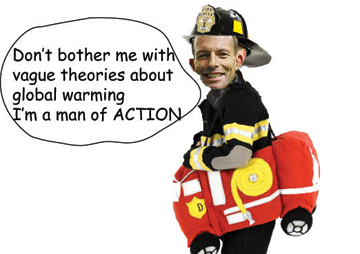 But with Abbott, there will be little common ground — and considerable potential for embarrassment.
Even if Abbott and Obama tiptoe around the issue, journalists might not co-operate at the customary joint media conference afterwards. One skilfully framed question could expose the deep differences between the Australian Prime Minister and his host on a matter that has become a key focus of the White House.
Now that Obama has made the problem of global warming part of America’s national security agenda, the subject will be even more difficult to avoid……..
The President and his advisers are all too aware that Abbott once described climate change science as “crap” — even though his public line these days is that “climate change is real”.
The White House is presumably well briefed on the way the Abbott government has been winding back action on climate change, including Budget cuts to research and renewable energy programs.
It would also know about the efforts of Australian diplomats to have climate change references removed from agendas and communiques at various international forums.
In the West Point speech Obama attacked political leaders who deny that global warming is taking place.
He was referring specifically to American politicians, but it is not hard to see why his view of Abbott is said to be unflattering.So even though it will be summer in Washington, the temperature could be a little cool when Abbott sits down in the Oval Office. “I don’t think we’d care,” a senior Liberal said yesterday — reflecting the fact that the Abbott government is not overly fond of Obama either……
Obama, as his West Point speech shows, is convinced that climate change is a factor in major fire, drought and flood events.In another speech on climate change a few weeks earlier he said: “It’s causing hardship now. It’s affecting every sector of our economy and our society — more severe floods, more violent wildfires.”
When a senior United Nations official suggested last year’s big NSW fires were linked to global warming, the PM accused her of “talking through her hat”.
If the subject comes up in Washington he’ll presumably be a little more diplomatic. http://www.dailytelegraph.com.au/news/opinion/obama-describes-climate-change-as-creeping-national-security-crisis/story-fni0cwl5-1226937966154
USA. Obama’s historic action on Climate Change – attack on carbon pollution
Obama to unveil historic climate change plan to cut US carbon pollution
• Proposed regulations could cut carbon pollution by up to 25%
• President still faces potential opposition from Republicans
• Q&A: why the carbon proposal could make climate history
Suzanne Goldenberg, US environment correspondent theguardian.com, Friday 30 May 2014 President Barack Obama will unveil a plan on Monday that will cut carbon pollution from power plants and promote cap-and-trade, undertaking the most significant action on climate change in American history.
The proposed regulations Obama will launch at the White House on Monday could cut carbon pollution by as much as 25% from about 1,600 power plants in operation today, according to those claiming familiarity with the plan.
Power plants are the country’s single biggest source of carbon pollution – responsible for up to 40% of the country’s emissions.
The rules, which were drafted by the Environmental Protection Agency and are under review by the White House, are expected to do more than Obama, or any other president, has done so far to reduce the carbon dioxide emissions responsible for climate change.
They will put America on course to meet its international climate goal, and put US diplomats in a better position to leverage climate commitments from big polluters such as China and India, Obama said in a speech to West Point graduates this week.
“I intend to make sure America is out front in a global framework to preserve our planet,” he said. “American influence is always stronger when we lead by example. We can not exempt ourselves from the rules that apply to everyone else.”
It won’t be without a fight. Obama went on in his remarks at West Point to take a shot at Republicans who deny climate change is occurring, and the White House press secretary, Jay Carney, on Thursday accused critics of making “doomsday claims” about the costs of cutting carbon…….
Obama had originally hoped to cut carbon pollution by moving a bill through Congress. Four years after that effort fell apart, campaigners say the EPA rules could deliver significant emissions cuts – near the 17% Obama proposed at the Copenhagen climate summit – and the cap-and-trade programmes that were so reviled by Republicans.
The EPA, using its authority under the Clean Air Act, proposed the first rule phase, covering future power plants, last September.
In this the more politically contentious phase of the plan, it is widely believed the EPA will depart from the “inside the fence-line” convention of earlier environmental regulations for mercury and other pollutants, which focused on emissions-scrubbing on specific power plants.
The EPA administrator, Gina McCarthy, is seeking steep reductions – as much as 25% – but she has hinted repeatedly that she will allow states latitude in how they reach those targets.
The plan would allow electricity companies to reduce pollution by shutting down the oldest and most polluting coal plants. They can install carbon-sucking retrofits. They can expand wind and solar energy, upgrade the electrical grid, encourage customers to update to more efficient heating and cooling systems, or more efficient appliances and lightbulbs.
“They have recognised huge emissions reductions opportunities are often cheaper than trying to do it all inside the plant,” said David Doniger, who heads the climate programme at the NRDC. “If you want to get substantial reductions and you want to get it economically, you have to take into account a system-wide approach.”…….http://www.theguardian.com/environment/2014/may/29/obama-unveil-historic-climate-plan-carbon-pollution
Genetic effects of Fukushima: deformities in generations of butterflies
Japan Scientist: We gave butterflies food from Fukushima… then, they died; Deformities get worse with each generation — TV: “Truly horrifying… it doesn’t really even look like a butterfly anymore” (PHOTOS & VIDEO) http://enenews.com/japan-scientist-butterflies-fed-leaves-fukushima-died-deformities-worse-generation-tv-doesnt-look-like-butterfly-anymore-especially-scary-photos-video?utm_source=feedburner&utm_medium=email&utm_campaign=Feed%3A+ENENews+%28Energy+News%29
Vice on HBO, Season 2 Episode 10, May 24, 2014 (at 5:30 in):
- Dr. Joji Otaki, lead researcher, University of Ryukyus: We collected houseplant leaves from Fukushima, and those leaves are given to [butterfly] larvae collected from Okinawa… Those larvae aresupposed to be healthy. But they ate contaminated food from Fukushima. Then we see what happens.
- Vikram Ghandi, Vice: What happened?
- Otaki: They died.
- Ghandi: Dr. Otaki’s experiments have shown the truly horrifying effects contaminated food can have on living organisms.
- Otaki: You can see wrinkled wings.
- Ghandi: It doesn’t really even look like a butterfly anymore.
- Otaki: We found that mortality rate and abnormality rate of the 2nd generation is much higher — even worse in the 3rd generation.
- Ghandi: The evidence contaminated food has increasingly worse effects over the course of generations is especially scary since one of Fukushima’s primary industries is agriculture.
- Kazuya Tarukawa, farmer in Sukagawa 50 miles from Fukushima Daiichi: We had been growing produce that measured 3,000 [Bq/kg] without even knowing it. Selling such produce to the markets made me feel severely guilty.
- Ghandi: His father was consumed with guilt.
- Tarukawa: He hung himself from the tree.
Fukushima: Over 75 tons of highly radioactive liquid flowing out everyday
Official: Breach at Fukushima reactor blamed on saltwater corrosion — Over 75 tons of highly radioactive liquid flowing out everyday (PHOTOS & VIDEO) http://enenews.com/official-breach-at-fukushima-reactor-blamed-on-saltwater-corrosion-over-75-tons-of-highly-radioactive-liquid-flowing-out-everyday-photos-video?utm_source=feedburner&utm_medium=email&utm_campaign=Feed%3A+ENENews+%28Energy+News%29
Kyodo News, May 28, 2014: [Tepco] has identified the location of a leak at the bottom of the container in the No. 1 reactor […] water was leaking from a joint in a pipe […] The metal bellow joint is likely to have been corroded [“destruction of materials from chemical reaction“] by seawater [the Tepco official said.] The official denied the possibility that the leakage was caused because the earthquake damaged equipment. He said the company will continue to investigate if there are other areas of leakage nearby.
Jiji Press, May 28, 2014: Tepco said it had confirmed water was leaking from a pipe in the reactor containment vessel inside the plant’s No. 1 reactor building. The utility used a camera-mounted remote-controlled robot […] water was leaking from the vessel’s bottom near the pipe, at a rate of up to 3.2 tons per hour [76.8 tons/day]. In the No. 1 to No. 3 reactor buildings, highly contaminated water leaking from the vessels has amassed, preventing work to remove nuclear fuel.
NHK,May 27, 2014: The water is leaking from a point on a pipe leading to the containment vessel. An image taken by a robot probe shows a black area on the brown pipe. The leak point is above a donut-shaped unit called a suppression chamber where a robotic investigation detected flows of contaminated water last November. The chamber is in the lower part of the containment vessel. […] A contaminated water leak has also been found in the containment vessel of the Number 3 reactor. Officials say they will now investigate the suppression chamber and other parts of the Number 2 reactor.
Watch footage of the Unit 1 suppression chamber survey published on May 28 here
Watch NHK’s broadcast here
VIDEO: a warning from China that Australia could scuttle global carbon emissions trade
 VIDEO: China warns Australia risks scuttlling global emissions trade Lateline Australian Broadcasting Corporation Broadcast: 30/05/2014 Reporter: Stephen McDonell
The head of China’s most advanced carbon emissions exchange says australia could scuttle the creation of a global system of carbon trading by dumping its scheme at a crucial time.
Transcript
EMMA ALBERICI, PRESENTER: The Vice President of China’s most advanced carbon emissions exchange says Australia could scuttle the creation of a global carbon trading system.
As Australia prepares to dump its emissions trading scheme, the world’s largest carbon emitter has set up a pilot plan, designed to form the basis of a China-wide network with the potential to link to those in other countries.
China correspondent Stephen McDonell reports from Shenzhen.
STEPHEN MCDONELL, REPORTER: Shenzhen was at the forefront of China’s opening up in the 1980s. It was given special economic status to spring board the country into a market system.
Today, the city is again being used as a Guinea pig but this time for carbon trading.
The Shenzhen carbon exchange is the first of a series of seven pilot schemes around the country to test how China might run a domestic trading system.
GE XING’AN, VICE PRESIDENT, CHINA EMISSIONS EXCHANGE: Carbon trading is going to have a huge impact on the economy and the companies. We have to first test whether the carbon trading suitable for different, each economic development area…….STEPHEN MCDONELL: Ge Xing’an is Vice President in Shenzhen. His organisation possibly hoping to one day run the entire national system goes by the English name China Emissions Exchange………
STEPHEN MCDONELL: Really, the entire global market might be jeopardised by Australia pulling out?
GE XING’AN: Of course. Of course. Australia is a very important player in the climate change issues and also the carbon market.
STEPHEN MCDONELL: Beijing and Shanghai have also just opened their exchanges but even the most optimistic observers say it could be more than five years until a China-wide trading system is established.
Stephen McDonell, Lateline. http://www.abc.net.au/lateline/content/2014/s4016127.htm
Defeat for consumers, victory for utilities if Renewable Energy Target is scrapped
 Scrapping Australian Renewable Energy Target Bad For Consumers, Great For Utilities http://cleantechnica.com/2014/05/30/scrapping-australian-renewable-energy-target-bad-for-consumers/ Scrapping the Australian Renewable Energy Target could have catastrophic ramifications for the renewable energy industry in the country, as well as consumers and employment, all the while delivering huge profits to power companies, according to new analysis from research firm Bloomberg New Energy Finance.
The recently elected Tony Abbott/Liberal Government is reviewing the current Renewable Energy Target — a target of producing at least 20% of all electricity from renewable energy sources by 2020 — in line with the party’s absurd take on clean energy. Earlier this year, Treasurer Joe Hockey was reported as saying that the wind turbines he drives past on his way to work are “utterly offensive” but that he is powerless to close them down. Hopefully there are few — if any — budget decisions based on whether or not Joe Hockey’s view is obstructed.
According to Bloomberg New Energy Finance (BNEF), the current Renewable Energy Target is expected to drive $35 billion (AUD) of investment in clean energy, employ 25,000 workers each year in construction and operations, reduce greenhouse gas emissions from power generation by 5%, and prevent future surgest in power prices by supplying electricity for 20-25 years without ongoing fuel costs.
The catch? It will oversupply the electricity market and could place pressure on the profitability of existing electricity generators.
Heavens no! A changing market affecting the entrenched behemoths? How on Earth could we have ever seen this coming?
Compare those benefits with the changes that would follow if the Renewable Energy Target is reduced in line with the hopes of some power company proposals: a drop of $12 billion AUD in investment; a drop of 6,600 jobs; 3% higher greenhouse gas emissions; and the kicker — power prices that increase by 1% in the year 2020 for the average household, a price that will increase a further 3% by 2030.
Needless to say, if the Target is cut altogether, the figures get even worse. “Cutting or reducing the Renewable Energy Target is likely to result in less competition among fossil-fuel power generators and strong future increases in the price of electricity,”said Kobad Bhavnagri, Bloomberg New Energy Finance’s head of Australia. “This helps to explain why many of Australia’s largest power companies are now pushing for a reduction in the target.”
The White Paper compiled by BNEF is available here, but one thing is for sure, there will need to be a tonne of pressure placed on Tony Abbott, Joe Hockey, and the Australian Liberal Government if Australia is to prevent itself falling even further behind industrialised nations in a world of changing climates — both environmental and economic.
Australia’s role in renewable energy across the globe
 Renewable Energy Across the Globe: Australia Wind and hydroelectric leaders Green Action News, May 21, 2014 by Kathryn Hannis Great steps have been made across the globe toward adopting more environmentally conscious energy sources. How each continent makes use of their varied resources is what sets them apart from each other.
Here’s what’s happening in Australia:
By the end of 2012 Australia was producing almost 30,000 GWh of electricity from renewable energy sources annually. The main renewable sources utilized in Australia are hydroelectric, and wind, with some smaller amounts produced from bioenergy, solar, and geothermal sources.
Currently in Australia there are over 3.2 GW of solar panels installed. Two commercial-scale PV power plants have been opened since 2011 with 1 MW and 10 MW capacities, respectively, and there are plans for many new solar power farms and stations in the future.
There are over 50 wind farms in Australia, with over 1000 turbines between them, which produce 5,000 gigawatt-hours (GWh) of electricity each year, representing 2% of Australia’s total electricity, 23% of electricity from renewable sources, and enough to power over 700,000 homes. The largest wind farm in the southern hemisphere, in terms of area, the Waubra Wind Farm in Victoria, was completed in 2009 and produces 192 MW of electricity. The largest capacity wind farm is Lake Bonney Wind Farm, which produces around 240 MW, despite having 30 fewer turbines. An even larger farm was set to open in 2013 with a capacity of 420 MW.
Hydroelectricity represents almost 60% of renewable energy production on Australia, with several tidal energy projects in the works for the future.
Currently, a geothermal power plant in Queensland produces 80 kW of electricity. Geothermal energy is otherwise underutilized as a source of power. There are recorded potential locations with detectable geothermal activity with further exploration planned, however. It was the goal to have at least three power generation demonstration projects running by 2012.
Energy from biomass in Australia generally takes the form of ‘Bagasse’, or burning sugar cane waste. Together with burning wood, this accounts for 8% of renewable energy production in Australia……. http://greenactionnews.net/blog/renewable-energy-across-the-globe-australia/#
Uranium miners and others will have to deal with some very savvy Aboriginal landowners in the Kimberley
 Protests, jailing pay off as elder finally sees native title granted VICTORIA LAURIE AND PAIGE TAYLOR THE AUSTRALIAN MAY 31, 2014 JOHN Watson stood on an Aboriginal picket line at Noonkanbah 36 years ago opposing the mining industry and earned himself a place in Australia’s land rights history. The respected Kimberley elder vividly remembers the drilling rigs advancing, the police convoy that held objectors back, and the moment when drilling began on sacred ground at the remote Fitzroy Crossing cattle station.
The dispute had gathered pace after the land rights of Aborigines in the Northern Territory had been recognised in parliament in 1976, a development Mr Watson and other Noonkanbah protesters highlighted as they tried to block company AMEX at Pea Hill.
Mr Watson and others were eventually carted off to jail in Fitzroy Crossing, an experience he describes as terrifying……..
This week, Mr Watson took centre stage in a new chapter in the Kimberley’s land rights history.
He watched as state Attorney-General Michael Mischin and Federal Court officials handed native title rights over about 26,000sq km of land to his Nyikina Mangala people.
Their land is a new frontier for exploration, mining and drilling. There are 96 pending and granted mineral titles and 20 pending and granted petroleum titles on it. Mr Watson said his people were willing to talk to miners and oil and gas companies but that did not mean the companies could have everything they wanted.
“The door is not open for mining, not open for mining but open to sit down and talk and get a good feeling,” he said. “We want to get a good outcome.”
Thursday’s determination means Western Australia has reached a landmark of one million square kilometres to have been recognised as Aboriginal land………..
1 This month

of the week – Australians for War Powers Reform (AWPR)
To see nuclear-related stories in greater depth and intensity
 Antinuclear