As Tony Abbott aims to kill off Climate Action programs, he praises USA’s new Climate Action
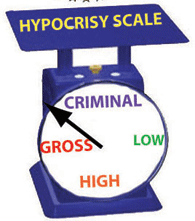
 Australian Prime Minister Praises U.S. Climate Action, While Trying To Kill Similar Program http://thinkprogress.org/climate/2014/06/06/3445853/australian-epa-sensible/ BY ANDREW BREINER ON JUNE 6, 2014 AUSTRALIAN PRIME MINISTER TONY ABBOTT TOLD THE PARLIAMENT THIS WEEK THAT THE NEW U.S. CARBON LIMITS ARE “SENSIBLE,” EVEN THOUGH HIS GOVERNMENT IS TRYING TO END AN AUSTRALIAN LAW THAT ESSENTIALLY USES SIMILAR TACTICS TO CUT EMISSIONS. “THERE IS NO EMISSIONS TRADING SCHEME IN THE UNITED STATES,” HE TOLD PARLIAMENT. BUT THAT’S NOT ENTIRELY TRUE.
While the EPA rule doesn’t set up a federal carbon pricing or emissions trading system, those are available and encouraged options for states, and they’re already being used successfully. The Regional Greenhouse Gas Initiative has been going strong for several years in Northeastern states, making money for state governments while cutting carbon. California’s cap-and-trade system, set up in 2006, will likely also provide a model for states looking to comply with EPA regulations. More states are expected to join or create cap-and-trade systems to meet EPA limits.
Abbott says he likes U.S. climate policy, but his real model seems to be Canada, where oil money has stifled recognition of climate change, climate policy, and activism. In Australia, the law and private spying have been used to make protest harder, and climate denial has become common in Abbot’s government.
It’s unclear at this point whether Abbott will be able to repeal the Clean Energy Future laws that establish a price on carbon and emissions trading program in Australia. But there’s no question that his Liberal Party government has beenhostile to climate action and clean energy, and quite committed to helping the coal industry. Meanwhile, Australia is dealing with significant climate change impacts, including record-breaking heat waves and droughts.
Australia could aim for 50% renewable energy by 2030 – International Report
 Australia urged to aim for 50+% renewables by 2030 REneweconomy. By Giles Parkinson on 6 June 2014 Leading international agency says Australia should become one of world leaders in renewables, arguing that the world could double renewable capacity by 2030, save money and slash emissions in the process.
The International Renewable Energy Agency has finalised its ground making REMap 2030 report, confirming its previous estimates that the world could double its renewable energy capacity by 2030,which would not only save money, it would help avoid climate catastrophe.
 The report, released in New York overnight, finds that scaling up renewables to 36 per cent renewable energy by 2030 is not just doable, it is affordable and would lay a crucial pathway to meeting climate goals of capping emissions at below 450 parts per million.
Australia is one of the countries seen in a position of leadership on renewables. As this graph below illustrates, IRENA says that Australia could aim to have more than 50 per cent renewables in its electricity grid by 2030, largely through wind, but also with significant contributions from solar.
Australia is one of the countries seen in a position of leadership on renewables. ( graph ), IRENA says that Australia could aim to have more than 50 per cent renewables in its electricity grid by 2030, largely through wind, but also with significant contributions from solar.
IRENA says the role of variable renewables such as wind and solar is critical, but does not pose any serious technological barriers. Even at a global average of 18 per cent wind and solar, this is less than the share of variable renewables icurrently are integrated into the electricity systems of De mark, Germany, Ireland, Portugal and Spain – and South Australia it should be noted.
“Only a handful of countries – Australia, Denmark, Germany, Morocco, Tonga and the United Kingdom – will reach shares of variable renewables of 30 per cent or higher,” it says………http://reneweconomy.com.au/2014/australia-urged-aim-50-renewables-2030
Illnesses in the nuclear workplace – reports from Hanford, USA
 NBC stations reveal nuclear workers suffering severe brain damage, dementia — Toxic waste raining down from sky, wore baseball caps for protection — Brains being eaten away, teeth falling out — Workers raising safety issues framed using false evidence, fired — Gov’t not allowed in to investigate (VIDEO) http://enenews.com/nbc-stations-reveal-nuclear-workers-suffering-severe-brain-damage-dementia-toxic-waste-raining-down-from-sky-wore-baseball-caps-for-protection-brains-being-eaten-away-workers-raising-safety NBC Right Now,Apr. 30, 2014: Former Hanford Worker Sick from Nuclear Waste
- Jane Sander, reporter: A nuclear waste spill happened hours before at the tank farm.
- Lonnie Poteet, Hanford worker: I was already burning from my glove line to my t-shirt line and… starting to lose a little bit of vision in my right eye… Why didn’t they say something?
- Sander: Poteet describes living his life now as recluse… sharp pains in his head, they cause him to often twitch. He says medication prevents him from collapsing in pain due to severe nerve damage in his brain.
- Poteet: [More Hanford workers] are going to be exposed to the same situation… Nobody is going to do anything to stop it… As long as there’s profit… and they get their bonuses on a decent time, that’s all they care about… Most of the workers onsite right now are running scared. They will not bring up any safety concerns because as soon as you do, you’re going to be labeled and thrown off the site, just as fast as they can go. They’ll either create stuff that never happened, or they’ll find ways to get you.
NBC Right Now, June 5, 2014: Sick Former Hanford Worker Speaks Out
- Jane Sander, reporter: He sadly lives his life with a deadly disease…
- Lawrence Rouse, Hanford worker: I have toxic encephalopathy… it eats your brain away.
- Sander: Near the end of his almost 20 years at Hanford… he began to develop severe symptoms. Stuttering, memory loss, losing teeth…emotionally unstable…violent outbursts.
- Rouse: [My son] wrote this letter, this little poem, and said that his dad is gone… It would rain the chemicals on you from the stack. That’s why we wore the baseball caps.
- Sander: The Washington Dept. of Labor and DOE denied [compensation]… Since the [EEOICPA] program began in 2001, they’ve paid more than $1 billion in compensation and medical bills to [6,936 Hanford] workers…
- Rouse: DOE has always denied everything. And that’s not going to change.
- Sander: More Hanford workers continue to file claims for their illnesses.
- Watch the broadcast here
KING 5 Seattle (NBC), June 4, 2014: It’s an unprecedented series of workplace accidents in the state. Since mid-March the number Hanford workers seeking medical help after breathing in chemical vapors has risen to 34.
- Susannah Frame, reporter: Vapors causing serious illnesses at Hanford is not new… at the most contaminated workplace in the nation, OSHA can’t get past the gates to investigate.
- Diana Gegg, Hanford worker: It’s turned my life upside down.
- Frame: Brain damage, sudden tremors, vision loss, dementia – Illnesses the gov’t admits were caused by exposure… she can’t go out without a wheelchair, cook, or drive.
America’s Inherited Nuclear Waste Problem
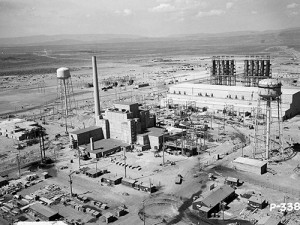 Breaking Bad: A Nuclear Waste Disaster By Joseph Trento, DC Bureau, June 5th, 2014 “………The original Manhattan Project, which developed our nuclear capability, paid little attention to waste. Plutonium was dumped in the ground at Hanford where the production reactors for the Manhattan project operated. The pressures of the Cold War made environmental and health concerns a low priority issue at the old and secretive Atomic Energy Commission as it vastly expanded weapons production with the creation of the Savannah River Site to produce plutonium for H-Bombs. At SRS, nuclear contamination was disposed of carelessly and is widespread over a site bigger than Washington, D.C.
Physical surveys done at Hanford and SRS revealed massive mishandling of high-level nuclear materials over decades. Over a hundred million gallons of high-level nuclear waste is stored in huge leaking and corroded tanks at Hanford and SRS. This was the volatile chemical stew that came from extracting radioactive materials to create nuclear bomb pits. The labs spent tiny amounts of their budgets trying to figure out ways to mitigate the waste – but bomb improvement and design were overwhelmingly the first order of business. Facts about high-level radiation became the enemy. Everything that radioactive materials touch also become radioactive. For example, water and chemicals used in the weapons process has to be segregated as it becomes radioactive. That is how the liquid waste vastly increased at both SRS and Hanford tank farms.
In addition to the large amounts of weapons waste, a huge civilian nuclear reactor program was building a waste stream of its own. Once fuel roads are used in a reactor, they are extremely dangerous. This spent fuel has no place to go. Decades of the rods are being stored at local power reactors adding expensive storage costs for public utilities. The government’s inability to agree on a repository for this material brought home the politics of the nuclear age. Nothing but time – often hundreds and sometimes thousands of years – will degrade the dangers. The public has little protection from what President Obama described as “our bridge to the energy future.” Science simply has not figured out a way to really mitigate nuclear waste and by the time Obama came into office, the waste had already overwhelmed DOE.
No Place To Put The Waste and No Way To Get Rid of The Radiation – ………..Presidents and Congress believed assurances from NNSA that new technologies such as suspending high-level nuclear waste in glass and using the new MOX fuel plant would point a path to the remediation of materials. Their faith was misplaced. – http://www.dcbureau.org/201406059835/natural-resources-news-service/breaking-bad-nuclear-waste-disaster.html
On global comparisons, Australia fast falling backwards on renewable energy
“With more than 140 countries now adopting renewable energy targets in some form, Australia is part of a mainstream global move towards cleaner sources of power such as solar, wind, bioenergy, hydro, ocean and geothermal energy,” Mr Green said.
“But Australia is at risk of being left behind as other countries continue to strengthen their targets for renewable energy. The process of constantly reviewing Australia’s Renewable Energy Target is destabilising the market and stalling local investment.”
Mr Green said US President Barack Obama announced another acceleration in renewable energy construction this week as part of a comprehensive clean energy package.
“China has introduced an ambitious clean energy program to deal with its air pollution, and in 2013 the installation of new renewable energy capacity in China passed fossil fuel and nuclear power for the first time. Last year alone China installed more wind and solar than any other country in the world,” he said.
“India’s new Prime Minister Narendra Modi has pledged to provide enough solar power to run at least one light bulb in every home. And meanwhile some of the world’s largest economies are those with the most renewable energy installed, including the United States, Germany and Canada.
“Australia has some of the best sun, wind and waves in the world. The Renewable Energy Target needs to be left to get on with the job it was designed to do under former Prime Minister John Howard and expanded in 2009 with the support of the major parties. Business can then get on with driving the creation of much-needed jobs and investment in partnership with local communities.”
Key results from REN21’s 2014 Global Status Report include:
- By early 2014, 144 countries had renewable energy targets, an increase of six from the year before
- An estimated 6.5 million people worked directly or indirectly in the renewable energy sector in 2013
- For the first time, more solar than wind power was installed worldwide in 2013
- China accounted for nearly a third of the global renewable energy capacity added in 2013
- China’s new renewable energy capacity exceeded its new fossil fuel capacity for the first time
- 72 per cent of new energy capacity in the European Union came from renewable energy for the sixth straight year, a stark turnaround from a decade earlier when fossil fuel investment accounted for about 80 per cent of new generation capacity.
REN21 Chair Arthouros Zervos said global perceptions of renewable energy had shifted considerably, with the many technology advances and rapid deployment of renewable energy technologies over the last decade.
Renewable energy cut off in New South Wales by Federal and State budgets
Budget cuts closing off clean energy Newcastle Herald, By JOHN KAYE June 6, 2014 THE future of the state’s renewable energy industry is taking a series of body blows. In one corner is the federal Abbott government, wielding the 2014 budget axe and deploying phrases such as ‘‘cutting green tape’’. In the other is the state government, with a particular enthusiasm for throwing up roadblocks to renewable energy development.
Despite having promised prior to the 2013 election not to touch the Renewable Energy Target scheme (RET), the Abbott government wasted little time in commissioning a review. The chief examiner is businessman and climate change denier Dick Warburton, who is joined by fossil fuel lobbyist Brian Fisher and the former head of Western Australian coal-powered generator Verve Energy.
Without a substantial fightback from the renewable energy industry and climate activists, it would seem the RET is doomed, either to be weakened to the point of futility or deleted entirely.
The attacks on the RET coming from Canberra are about ideology and business pressure, not some failure of the program. The RET, which sets a target of generating 20per cent of energy from renewable sources by 2020, has been the main driver of the growth in wind and other clean energy sources. The figures show it has cut emissions and generated jobs……..
There is an inherent irony in conservative MPs on one hand arguing that clean energy is too expensive while at the same time systematically undermining even budget-neutral efforts to help the renewable energy sector emerge and compete on a level playing field with existing fossil fuel technologies.
With or without such programs as the RET, there is little doubt that eventually Australia will shrug off fossil fuels in favour of sustainable and renewable energy forms.
However, every week, every month, every year that state and federal governments refuse to foster a market environment conducive to investment in renewable energy is a lost opportunity to benefit from an industry that can provide jobs, reduce environmental strains and ease the health burden on communities. http://www.theherald.com.au/story/2335342/opinion-budget-cuts-closing-off-clean-energy/?cs=308
Finland’s Greens in government remain strongly opposed to new nuclear power
 Greens meet to strategise, remain cold on new nuclear power, UUTISET, 6 June 14 Delegates from Finland’s Green League are gathered at an annual party congress in Jämsä, central Finland to hammer out a campaign platform ahead of parliamentary elections due next year. Green party chair Ville Niinistö said although the party wants to stay in governmen it’s holding its ground on its opposition to new nuclear power in Finland.
One thing became clear from the start of this year’s three-day Green League party congress: the Greens want to stay in government. Green party chair and Environment Minister Ville Niinistö pointed to the party’s recent achievement in orchestrating government agreement on a proposal for climate change legislation.
 However, the party is not prepared to give way on its opposition to new nuclear power facilities in Finland. It intends to hold fast to the current government programme, which stipulates that no new decisions-in-principle on nuclear energy should go before the parliament…….
The party has hinted that it is prepared to leave the government if a revised permit for the proposed Fennovoima nuclear power plant returns to parliament for consideration.
Niinistö added that nuclear power contractors are now experiencing great difficulties.
Nuclear power “not rational” for Finland
“The question is, at what stage will the parties admit their mistake, which is that holding on to nuclear power no matter what at the taxpayers’ expense isn’t rational for the Finnish economy, for our jobs, our business community, or for us to develop domestic forms of renewable energy,” Niinistö declared…….http://yle.fi/uutiset/greens_meet_to_strategise_remain_cold_on_new_nuclear_power/7284419
1 This month

of the week – Australians for War Powers Reform (AWPR)
To see nuclear-related stories in greater depth and intensity
 Antinuclear