Muckaty nuclear waste case: Commonwealth law may prevail over Aboriginal owners’ wishes
The Commonwealth Radioactive Waste Management Act (2005) states that even if an Aboriginal community or group that might be affected by the proposed nomination has not been consulted and does not consent, the nomination can go ahead.
And even if Justice Anthony North rules that the NLC behaved improperly, the facility might still be built at Muckaty.

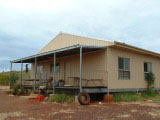 Nuclear waste dump may still go ahead https://au.news.yahoo.com/thewest/national/a/24233270/nuclear-waste-dump-may-still-go-ahead/ NEDA VANOVACJune 13, 2014, The news is always a little old at the Tennant Creek newsagency.It takes a while for the papers to be transported to the town, 1000km south of Darwin and about 500km north of Alice Springs in the rocky, semi-arid Barkly tablelands.
At 283,648 square kilometres, the tablelands are one-fifth of the Northern Territory and bigger than New Zealand. However, even eight years after the battle over the proposed Muckaty waste dump began, this dispute is anything but old news. The Federal Court this week took evidence from locals in what many hope will be a long-awaited resolution to a situation that has split the town.
In 2006, a small patch of land on Muckaty Station, 120km north of Tennant Creek, was put forward by the Northern Land Council (NLC) to the Commonwealth government to become Australia’s national radioactive waste storage facility. The council had the permission of the Lauder family of the Ngapa clan, which it determined were the rightful owners of that spot.
However, seven clans lay claim to land within the 221,000ha station, and all have dreamings and songlines that overlap and intersect, meaning the court will have to untangle what it can to determine which group can claim to the roughly two square kilometres that would house the facility if it goes ahead.
The case is arguably the biggest of its kind since the Jabiluka mine blockades of the 1990s.
This week, numerous members of the Milwayi group told the court the NLC failed to consult all groups properly over the proposal, and their people were the appropriate traditional owners. Over and over, they told the court they didn’t want the dump, that it would kill their bush tucker and poison their land. “It will affect our lifestyle and how we live,” Ronald Brown testified on Friday.
“Probably every four, five years we get a good rain. Water down here is hard to find. The only water we have is the artesian basin. That’s all we need to keep our water safe from this bad thing.”
The site would hold low-level and long-lived intermediate-level waste, but Pamela Brown said she was scared by stories of the British nuclear weapons tests in Maralinga in South Australia in the 1950s, and the ongoing health problems faced by indigenous communities there.
“The spirit is alive” at Muckaty, she said, and the spirit people didn’t want poison on their land. The witnesses gave evidence that the NLC hadn’t properly informed them of what was planned: one elder thought the community would be getting a rubbish dump, while traditional owner Dianne Stokes said she thought she had been taken out for a site visit for a new mine.
A financial package of $12 million was agreed upon, with $9 million to be held in a charitable trust – to pay for initiatives benefiting all indigenous groups on Muckaty Station – plus $2 million for a road and $1 million for educational scholarships. The Lauder family also received $200,000 at the time of the nomination.
“There shouldn’t be a back-door deal,” Mr Brown told the court, something the NLC refutes.
“We know it’s dirty money,” elder Bunny Nabarula said. “I think our land is more important than money,” Jeannie Sambo said.
Numerous witnesses denied any knowledge of a charitable trust.
The NLC has declined to comment to the media on the matter during the litigation, but its legal position is becoming clearer as witnesses are cross-examined.
It suggests that Milwayi traditional owners agreed that trucks transporting the waste to the facility could use a haulage road on their land near the site, and says the Milwayi did not declare themselves rightful owners of the site, despite having the opportunity at several meetings during the nomination process in 2007.
They changed their minds after the fact, the defence counsel put to numerous witnesses, under the influence of the Beyond Nuclear Initiative campaigners.
But suggesting people were so easily swayed was “a put-down”, Marlene Bennett told the court. “People know their own minds. They’re entitled to change their minds.” Defence lawyers asked a number of witnesses why they didn’t speak up at community meetings, but Ms Bennett said they were too intimidated.
“Quite often indigenous people don’t feel they have the right to stand up and say things because they see non-indigenous people, educated, in suits and that, they feel disempowered and avoid speaking up.”
But in the end, whether they speak up or not may not matter.
The Commonwealth Radioactive Waste Management Act (2005) states that even if an Aboriginal community or group that might be affected by the proposed nomination has not been consulted and does not consent, the nomination can go ahead.
And even if Justice Anthony North rules that the NLC behaved improperly, the facility might still be built at Muckaty.
Hearings will resume in Darwin on June 23, when members of the Lauder family and the NLC will give evidence.
No comments yet.
1 This month

of the week – Australians for War Powers Reform (AWPR)
To see nuclear-related stories in greater depth and intensity
 Antinuclear
Leave a comment