AUDIO: Report on Day 8 of Muckaty Nuclear waste Dump Court Case
 AUDIO Report on Day 8 of Muckaty nuclear waste dump court case. http://caama.com.au/wp-content/uploads/2014/06/Muckaty-Day-8.mp3
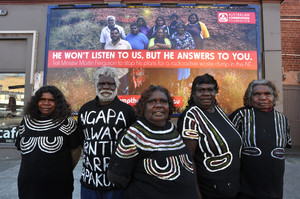
The Muckaty mob have been so strong in this court-room. It’s an intimidating system. Gladys Brown – strong indigenous woman, grilled by white men in an intimidating manner. Australian govt and NLC didn’t want the court case to come to Muckaty and Northern Territory. Awful to watch the NRC lawyer denigrating the cultural knowledge of these Aboriginal women. Trying to trip them up all the time – about their dreaming stories. But these witnesses are holding their ground, sticking to their guns. That the Land council anf govt did not listen to them A very disturbing process to watch.
Confronting for these women to be surrounded by white men – challenging their cultural knowledge.
White law is given absolute upper hand, through these whole proceedings.. It’s the Aboriginal women who are on trial. These women being put through the ringer. No acknowledgement of the strength of the law and knowledge in this area.
So much is being revealed about the consultation process.
One of the darkest aspects – The government and lawyers always emphasise the low level waste – medical equipment etc. They never talk the spent nuclear fuel – from Lucas Heights, currently overseas, but coming back as its the most dangerous industrial waste of all. It is never discussed in detail
Very obvious that in the early consultations – the people were not told a true account of what nuclear waste is. None of this contained a genuine discussion about the spent nuclear fuel rods.
As soon as the traditional owners started to get information, from the Environment Centre, they started action against the dump. From Day one it should have been explained. It was never brought up by the Northern Land Council. The NLC claim the protest comes from outsiders. Not so.
Tony Abbott just doesn’t ‘get’ the connection between climate change and economics
 Abbott wrangles with his own climate paradox The Drum, By ABC’s Jonathan Green 12 Jun 2014, Tony Abbott’s language so far on his overseas tour betrays a complete lack of connection between what climate change is and what it might do, writes Jonathan Green. In September 2003 a young man with a fair degree of climbing talent scaled an old power station chimney in central Melbourne and then lowered himself down its long concrete face, painting as he went.
The result was a towering vertical billboard that read, in painstakingly rollered sweeps of white paint: “No jobs on a dead planet.” Continue reading
Community Energy Congress in Canberra, as Farmers warn against weakening Renewable Energy Target
 Farmers, activists warn against reducing renewable energy target on Global Wind Energy Day http://www.smh.com.au/environment/climate-change/farmers-activists-warn-against-reducing-renewable-energy-target-on-global-wind-energy-day-20140615-zs8ix.html June 16, 2014 Markus Mannheim Public service editor Over the years, Boorowa grazier Paul Magee watched each of his five children become adults and leave the family farm to find work.
For him and his wife, Lynette, the opportunity to host wind turbines on their 700-hectare property, about 110 kilometres north of Canberra, may have come a little too late.
But the lamb farmer hopes the growing wind-energy industry will help lure young people back to the bush, and says the federal government must maintain its backing for renewable energy. “There is a possibility that one [of my children] could move back here and help to improve the farm and make it more productive – if the renewable energy target is not changed,” Mr Magee told a rally of activists outside Parliament House on Sunday, Global Wind Energy Day.
“There is a further possibility that others … may gain employment in the area. The economic benefits would help stop the drift to larger cities.”
A review of the so-called RET – an aim for 20 per cent of the nation’s electricity to come from renewable sources by 2020 – is due to be completed shortly, amid fears the Abbott government will reduce the target or scrap it entirely.
Last month, Treasurer Joe Hockey launched an unprompted attack on windfarms near Lake George, just outside the ACT, telling conservative radio commentator Alan Jones he found them “utterly offensive” and “a blight on the landscape”. Climate activists have also noted that the RET review’s leader, former Caltex chairman Dick Warburton, and other panel members have close links to the fossil-fuel industry.
Mr Magee said he could not understand the Treasurer’s view. “It could be argued that the very same four-lane freeway he was travelling on is more offensive and a bigger blight on the landscape, and indeed the urban development that has ruined the north shore of Sydney,” he said, referring to Mr Hockey’s electorate.
Small groups of residents near windfarms occasionally oppose the industry, saying turbines are noisy and reduce rural property prices.
However, NSW government polling in 2010 found almost nine in 10 residents in the region near the ACT border supported windfarms, including 61 per cent of people who lived one to two kilometres away from turbines.
Regardless of what happens to the federal RET scheme, ACT Environment Minister Simon Corbell told the rally that Canberra would maintain the nation’s most ambitious renewable energy policy: 90 per cent of the ACT’s electricity would be sourced from renewable energy by 2020.
He also noted that the Royalla solar farm – the largest in Australia – was just a few months’ away from being commissioned.
“The sad thing about that project is that it’s only 20 megawatts. When you look at renewable energy and solar energy around the world, you see that so many nations are investing in schemes and in projects that are in the hundreds of megawatts.
“In a country like Australia, we should be doing the same.”
Sunday’s rally preceded the 2014 Community Energy Congress, which will be held on Monday and Tuesday at the National Library. About 300 delegates are expected to attend from across Australia and overseas.
In Japan, anti-nuclear activists ratch up protest against nuclear power restart
 Anti-nuclear activists ratchet up pressure to block restart of Kagoshima reactors June 14, 2014 Asahi Shimbun By MASANOBU HIGASHIYAMA/ Staff Writer KAGOSHIMA—More than 1,000 protesters assembled before the prefectural government building here June 13 to oppose moves to restart a local nuclear power plant.
If the Sendai nuclear plant in Satsumasendai, Kagoshima Prefecture, were to go back online, it would mark the nation’s first restart under new safety standards brought in after the March 2011 nuclear disaster in Fukushima Prefecture.
The rally, which organizers deemed a “critical phase” in their anti-nuclear efforts, coincided with the start of the prefectural assembly session.
“Governor, why don’t you pick a fight with the central government like the Hakodate mayor has done to protect the life and health of residents?” Satoshi Kamata, a noted nonfiction writer who has written extensively about labor and environmental pollution issues, barked through a loudspeaker.
Kamata, 76, was referring to a lawsuit filed in April by the Hakodate municipal government in Hokkaido to demand a halt to the construction of a nuclear power plant across the Tsugaru Strait in Oma, Aomori Prefecture.
“After serious problems of pollution in the 1970s, Japanese learned that their lives are more important than the nation’s economy. Why are we regressing to the same situation in the question of nuclear power?” asked Kamata, who flew in from Tokyo, where he regularly participates in a weekly anti-nuclear protest held outside the prime minister’s office.
Among the other participants were evacuees from the disaster at the Fukushima No. 1 nuclear power plant. The rally was organized by about 90 groups, including a local co-op.
The protesters submitted to prefectural officials a petition signed by about 120,000 people from across Japan in protest to the restart of the plant, which is operated by Kyushu Electric Power Co…….http://ajw.asahi.com/article/0311disaster/fukushima/AJ201406140025
India’s People’s Movement Against Nuclear Energy (PMANE) standing strong
 We are fighting against entire global nuclear industry: S P Udayakumar Q&A with anti-nuclear activist and convenor of PMANE Business Standard, India , Gireesh Babu | Chennai June 14, 2014 S P Udayakumar, anti-nuclear activist and convenor of the People’s Movement Against Nuclear Energy (PMANE), has been at the forefront of protests against the Kudankulam Nuclear Power Plant as well as the nuclear power policy of the government. A report filed by the Intelligence Bureau (IB) to the Prime Minister’s Office allegedly says Udayakumar has “deep and growing connections with US and German entities” and has an unsolicited contract with Ohio State University Institute, US, to submit “fortnightly reports” for a financial consideration.
Are you receiving any foreign funding and what are the sources of funding for the operations of your movement?
The movement, as I have said umpteen number of times, is funded by the local people and by contributions from the neighbouring villagers and college and school students. We absolutely have not received even a rupee from any Indian or international organisation for our struggle.
You are saying that the leakage of the IB report which named you as a receiver of huge foreign funds is a conspiracy. In general, authorities in India do not want anyone to pose problems in their proposed development projects and if anyone decides to stand up and speak for the poor people, they want to discredit them by saying that they are working for foreign countries. The government has every mechanism to go into the villages and find out for itself if we are giving any money or other incentives to people to join the protests. The media too have not gone to the villages to find out whether Udayakumar is paying the people to join the struggle. The whole thing is orchestrated by the authorities. Authorities include the state government, central government and the officialdom. I would also include the media.
How do you see the government and its policy? You earlier said that Prime Minister Narendra Modi seemed to prefer renewable energy rather than nuclear power.
If Modi cares for the people of India, and if he thinks that Indian lives have value, he should go for renewable energy because all over the world, countries are shunning nuclear power and going for the renewable energy sources.
Do you think that the the IB report has been “leaked” on the instigation of foreign powers?
It could well be because we are not fighting against just the state government and the central government. We are fighting against the global nuclear industry. Americans, Russians and the French – they are all out there to get us. For them, it is a multi-billion business. They don’t want a few individuals and groups like us damage the prospects………http://www.business-standard.com/article/current-affairs/we-are-fighting-against-entire-global-nuclear-industry-s-p-udayakumar-114061400793_1.html
Australians’ uptake of solar power is having a dramatic effect on electricity markets
 Solar turns tables on Australia’s electricity markets REneweconomy By Giles Parkinson on 16 June 2014 Australia’s electricity markets are forecast to experience more declines in consumption over the next three years, as homes and businesses conserve energy, use smarter appliances and turn increasingly to generating their own electricity.
The 2014 National Electricity Forecasting Report issued on Monday by the Australian Energy Market Operator has highlighted once again how all previous assumptions about electricity demand have been turned on their head in recent years.
As we reported on Friday, AEMO has been forced to revise down its forecast demand for 2013/14 for a second time, and it now expects demand from the National Electricity Market to continue falling for at least another three years.
AEMO notes that in the past five years, instead of surging demand, consumption from the grid has actually fallen by an average of 1.8 per cent a year from 2009–10 to 2013–14.
Ironically, this has been driven, it says, by surging network costs – which have risen in turn because of the $45 billion that was invested on the basis of high demand forecasts five years ago.
These rising costs, in turn, have encouraged consumers to conserve energy, turn to more energy efficient appliances, and look to rooftop solar to deflect their costs. Demand has also been reduced by declining industrial production.
The fall in demand, or at least the fall in demand from the grid (because many houses with solar PV are still consuming, just producing much of their own needs), is being used by incumbent generators and others with vested interests as an excuse to halt, or slow down, the pace of deployment of renewable energy in Australia……
The situation is even more dramatic in South Australia, where we explain here that a textbook decarbonisation of the grid is occurring thanks to its high penetration of rooftop solar, the big uptake of large-scale renewables, and the sidelining of old coal generators.
Of course, as we have seen in the submissions to the RET Review, the incumbent generators hate this. Origin Energy argued that the RET was never designed to force incumbent generators out of the market – it was always presumed that demand would rise and renewables would account for most of new capacity…….. http://reneweconomy.com.au/2014/solar-turns-tables-on-australias-electricity-markets-81352
Collapse of the Aboriginal dream of Redfern
After four decades, Redfern’s dream in tatters, SMH. June 13, 2014 Saffron Howden It has been 40 years since a group of idealistic, young Aboriginal men and women got fed up with living in “slums and pig sties” and formed a housing association in the heart of Sydney.
The early 1970s were heady times for the Indigenous rights movement in Australia and Redfern was its home ground – arguably the birthplace of land rights, dedicated legal services, and Aboriginal healthcare.
But after just four decades, the dreams of a disparate nation carried by those pioneering activists are on the brink of collapse.
On Saturday morning, the ranks of a newly-established tent embassy, pitched in the heart of The Block, will be bolstered with a rally by the community against their own – the modern-day Aboriginal Housing Company headed by Mick Mundine.
The company has a membership capped at 100 and says it cannot afford to provide housing for Aboriginal people on The Block……..
for the many community members Fairfax has spoken to, the problem is simple: power in Aboriginal Redfern has been consolidated in the hands of a few people.
A Fairfax reporter visited a Redfern community centre in 1973 and recorded the words on a sign there that promised so much, but seem cruel in 2014: “[The Block] project belongs to the black community. Please don’t destroy it. This means you.”http://www.smh.com.au/nsw/after-four-decades-redferns-dream-in-tatters-20140613-zs6qw.html#ixzz34qL0sO1Y
1 This month

of the week – Australians for War Powers Reform (AWPR)
To see nuclear-related stories in greater depth and intensity
 Antinuclear