A historic first, as Australia’s nuclear racism loses out on Muckaty waste dump plan
Nuclear waste dump defeat makes history https://www.greenleft.org.au/node/56682 June 21, 2014 The Environment Centre NT welcomes news that the Northern Land Council and the federal government have agreed not to act on the nomination to establish a nuclear waste dump on Aboriginal land at Muckaty.
This decision is a historic win for Aboriginal land rights and for the protection of our environment from the threat of nuclear waste. It is a historic day for the rights of all Territorians to clean country and healthy communities and marks the end of a long struggle against the federal government’s nuclear waste plans.
The withdrawal of the Muckaty decision today is met with great relief and is a long overdue admission of failure by the federal government in the handling of this complex and longstanding Territory issue.
We congratulate the outstanding efforts of Muckaty traditional owners who have been on the frontline for more than seven years challenging the waste dump plan both in the community and the Federal Court.
From one of the nation’s poorest and most remote regions, the Muckaty community has successfully stood up and challenged the federal government’s cruel vision of their homeland as a dumping ground for the nation’s most dangerous and long-lived waste.
We salute the inspiring leadership demonstrated by Muckaty elders and the younger generations who have fought so strongly for a nuclear-free future and to have voices heard.
With Muckaty out of the firing line, the federal government must now take the first steps towards a responsible approach to Australia’s radioactive waste problem and repeal the National Radioactive Waste Management Act. The establishment of an independent national commission to consider all options for radioactive waste management is the only way to ensure that no other community in Australia is forced to endure such a bitter struggle for justice.
Since a Territory dump was first announced, the Environment Centre NT has been proud to campaign alongside Muckaty traditional owners, and public health, trade union, faith and civil society groups to highlight the injustice of a process that seeks to silence affected communities, risk people’s health and our environment and extinguish Aboriginal culture and land rights.
Australia has a shameful legacy of radioactive racism, from atomic testing on Aboriginal lands at Maralinga in South Australia in the 50s and 60s, to the first federal government attempt to dump nuclear waste on Arkoona Station in the South Australian desert, a plan beaten by the determined efforts of the Kungka Tjuta.
The Muckaty win is further proof that the federal government can no longer hide from its responsibilities to deal with the radioactive legacy it has created by dumping it on communities it sees as voiceless.
Today we thank Muckaty traditional owners for demonstrating with such persistence, good humour and strength that with the smallest of resources, even the largest obstacles can be overcome. We look forward to working with our friends and allies in the Barkly and beyond for a nuclear-free Territory.
Over 70% of Australians want to keep the Renewable Energy Target
Majority Of Australians Support Renewable Energy Target http://www.energymatters.com.au/index.php?main_page=news_article&article_id=4359 A survey has found not only do most Australians want to maintain the nation’s Renewable Energy Target, a majority want to see it set higher.
A related report to be released on Monday by the Climate Institute states the number of people supporting an RET of 20 per cent and above has risen to 71 per cent this year. Just 9 per cent want to see the target reduced or abolished altogether.
76 per cent believe state governments should be putting in place incentives for more renewable energy.
On Sunday, the Climate Institute kicked off a last-ditch campaign dubbed Stop The Dinosaurs, urging Parliament to take note of public sentiment and key factsand save not only the Renewable Energy Target, but also carbon laws.
One of the high-profile people supporting the campaign is former Liberal Party leader Dr John Hewson. “From 2010 to 2012, Australians were subject to a historic scare campaign about the impacts of the carbon laws, but it is quite clear now that these laws are not a ‘wrecking ball’ or ‘python squeeze’,” said Dr. Hewson.
“The fact is that since the carbon laws were enacted, Australia’s pollution has been reduced by millions of tonnes and the economy has grown. Average households are not worse off as many feared they could be.” The survey also indicates the Prime Minister’s claimed commitment to battling climate change isn’t believed by many Australians.
“Only 20 per cent trust Tony Abbott when he says he is concerned about addressing climate change, in contrast to 53 per cent who do not, including 37 per cent who strongly distrust the Prime Minister,” states The Climate Institute. 82 per cent of Australians choose solar power in their top three energy sources and 64 per cent choose wind. Coal, recently referred to by the Prime Minister as one of “nature’s gifts“, was even less popular than nuclear.
“It is OK to like dinosaurs, but this year’s Climate of the Nation survey shows that it may well be politically dangerous to be one when it comes to climate change and its solutions,” said John Connor, CEO of The Climate Institute.
The full Climate of the Nation 2014 report will be available at 11am on Monday from the Climate Institute web site.
Australia’s Climate Denialism: the Age of Abbott
 How Rupert Murdoch created the world’s newest climate change villain, Salon Australia was once a leader on climate action. Thanks to American conservative powerhouses, that’s no longer true ALEXANDER WHITE 21 June 14, Australia, the sunburned country, is uniquely vulnerable to the dangers and risks of global warming. Whether it is the severe effects of flooding, unseasonal heat waves, devastating bush fires or decade-long droughts, Australia’s people, economy and natural environment have all keenly felt the impact of extreme weather and climate change.
Australia’s national scientific organizations have been raising the alarm for more than a decade, and the previous government accepted that scientific consensus and enacted a cap-and-trade scheme in 2012. But after a divisive election last year — one that saw native-born Rupert Murdoch exercise his considerable influence in Australian media markets to disastrous effect — the country is now governed by a deeply unpopular Liberal-National government, crafted in the image of the most climate-denying elements of the Tea Party. And its position on climate change has significant impacts on global efforts to reduce carbon emissions: Australia is not only the chair of the G-20 group of nations, but also holds a place on the U.N. Security Council.
The rest of the world saw this ideology on full, embarrassing display with the recent visit by Prime Minister Tony Abbott to Canada and the United States. Continue reading
Babies born with out brains – high rate near nuclear sites
 TV: 8 times more babies than usual born without brain near U.S. nuclear site; Much higher rate than anywhere else in country — “It’s scary the cause is such a mystery” — CNN: Experts speak out over failure of officials to conduct proper investigation — “The lamest excuse I’ve ever heard” (VIDEO) http://enenews.com/tv-8-times-more-babies-than-usual-born-without-brain-near-u-s-nuclear-site-much-highest-rate-than-anywhere-else-in-country-cnn-experts-speak-out-over-failure-of-govt-to-conduct-proper-investi
KEPR, May 14, 2014 (Emphasis Added): Serious and sometimes fatal birth defects are much more prevalent right here than anywhere else in the country. Benton, Franklin and Yakima Counties are being hit the hardest by neural tube defects, from spina bifida to anencephaly [fatal defect where large part of brain/skull is missing]. “it’s scary that the cause of this is such a mystery,” said Candelaria Murillo. […] Rate of babies being born without a brainin our part of the state is eight times the national average.
AP and other media outlets put the figure at “at least four times the national rate”. However, theYakima Herald reports: “[Officials] issued a news release Jan. 30 announcing that eight cases of anencephaly had occurred in Yakima County in 2012. Typically [they] expect only one all year.”
NBC News, June 17, 2014: Health officials, scientists and other experts gathered to discuss the cause of an alarming local spike in the disorder […] [Local residents] wanted to know exactly how long the problem had been going on, whether it could be linked to diet, occupation, geography — or the Hanford nuclear plant in nearby Richland. State officials reiterated their previous answers — no, no, no and no […] “The next step is to interview the mothers and fathers of these babies,” [Allison Ashley-Koch, an anencephaly expert at the Duke University Medical Center for Human Genetics] said. “The challenge at this point is that many of these conceptions happened four years ago. So for parents to try and remember particular eating habits, environmental exposures and such is challenging.” […] “I believe it is an ongoing problem and I believe that the environment might have something to do with it,” Don Dufault said.
Oregon Public Broadcasting, June 16, 2014: Health officials have discounted several possible causes including: pesticide exposure, nitrates in water wells, and radiation from the Hanford Nuclear Reservation.
Obstetrician Anita Showalter: “First thing I ask […] what environmental thing might have happened […] that we don’t know or understand yet?” […] She wonders if there might be chemicals present […]
CNN, June 1, 2014: Nearly two years after the state of Washington was alerted to a possible cluster of babies born with severe birth defects, experts are speaking out, criticizing the state health department for not doing enough to save babies’ lives. […] TheWashington Department of Health has steadfastly refused to interview the parents of these babies and has failed to accept offers of help from world-renowned anencephaly experts. “It really looks like they’re dragging their feet,” said Richard Finnell, a pediatric geneticist and birth defect expert at the University of Texas. He said that to find the cause of the cluster, state investigators need to speak with the parents of children with birth defects […] Butthe state has not contacted these parents. […] A team of experts […] offered help to Washington investigators back in February but hasn’t received a response. “We’re frustrated that they’re not moving more quickly to find the cause,” said Janee Gelineau-van Waes […] an associate professor of pharmacology at the Creighton University School of Medicine […] “It’s very intrusive to start knocking on doors of people who’ve had a pretty major trauma in their lives,” [state epidemiologist, Juliet VanEenwyk] said. “That’s the lamest excuse I’ve ever heard,” said Billy Petersen, reflecting the viewpoint of several families interviewed by CNN whose children have neural tube defects. “We want to talk to them,” he said. “We’d do anything to help find out why our baby died and help other families. We don’t want anyone else to go through what we’ve been through.”
Clean Energy Council report shows Australia reached15% renewable energy in 2013
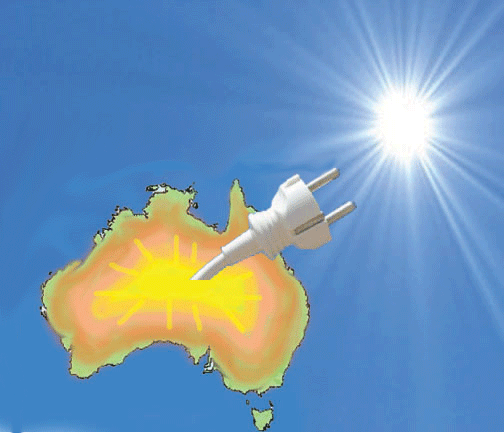 Clean Energy Australia Report 2013 http://www.energymatters.com.au/index.php?main_page=news_article&article_id=4360 24 June 14 A just-released report from the Clean Energy Council reveals renewable energy provided 14.76 per cent of Australia’s electricity last year.
While hydro power made up the lion’s share, Clean Energy Australia Report 2013 states 1.25 million solar power systems were installed by the end of 2013, with more than 200,000 systems installed during last year. There were 4595 solar installers across Australia at the end of 2013.
Again addressing the “solar is for the rich” myth; the report says: “Residents from affluent inner-city suburbs generally installed solar at much lower rates than those in mortgage belt, retirement and regional areas.”
Wind power provided 4 per cent of Australia’s overall electricity demand in 2013, with 1639 wind turbines cranking enough clean power to supply the needs of 1.3 million homes.
Renewables continued to be a significant employer in Australia, with 21,000 jobs across all sectors.
The report states the renewable energy industry has contributed $5 billion of investment to the economy each year for the past three years.
“This report shows that this is an industry poised to unlock tens of billions of dollars in investment, if the national Renewable Energy Target remains in place following the current review process,” said Clean Energy Council Chief Executive Dave Green.
Problems becoming apparent with Fukushima’s giant ‘slurpee’
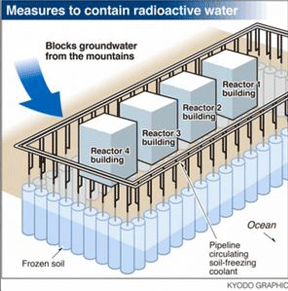 Fukushima ‘ice wall’ looking more like a dirt Slurpee http://america.aljazeera.com/blogs/scrutineer/2014/6/18/fukushima-ice-walllookingmorelikeadirtslurpee.html by Gregg Levine Skeptics of the plan to build a massive ice wall around Japan’s crippled Fukushima Daiichi nuclear facility didn’t have to wait particularly long for their first “I told you so.”
TEPCO, the nominal operator of the battered plant, announced Tuesday that while construction on the network of pipes, pumps, and compressors has begun on what is intended to be a huge ice barrier to prevent mountain runoff from mixing with radioactive water inside the facility, attempts to form a smaller ice wall around already-contaminated water are failing.
“We have yet to form the ice stopper because we can’t make the temperature low enough to freeze water,” a TEPCO spokesman said.
The project is already behind schedule and over budget, and engineers are adding more cooling pipes in hopes they can complete this first small step next month.
While the ground freezing procedure has been used to construct tunnels near waterways, it has never been used for nuclear cleanup and has never been done on such a massive scale. Estimates of the project’s success can best be termed “hopeful.” But freezing the ground around the plant is not strictly a “Why the hell not?” proposition. As previously noted, the plan comes with a list of concerns:
What if freezing causes the ground to sink? What if the ice and the ensuing expansion and contraction interrupts or further damages drainage in the reactor buildings? What if a heat wave or heat from the plant causes parts of the wall to melt? And, what if there is a prolonged loss of power to this cooling system?
The ice wall is only intended to help with the problem of irradiated runoff — the question of what to do with the thousands upon thousands of gallons of water contaminated in the daily fight to cool the melted cores of the damaged reactors and the stored rods in the spent fuel pools remains largely unanswered.
Last month TEPCO began diverting what they say is only moderately radioactive water into the ocean after assuring local fishermen that the levels were safe. Last summer, it was revealed that 300 tons of contaminated water was seeping from the nuclear site into the Pacific every day.
While freezing parts of the ground surrounding the disaster site may or may not be an effective part of the final cleanup and decommissioning, problems continue to outpace response at Fukushima. TEPCO’s experiment around the margins does nothing to address the hot mess at the core (as it were) of the crisis, and is cold comfort to those people still displaced or a country and hemisphere facing generations of radiologic contamination.
Japan’s plans to restart nuclear reactors – not likely to save Paladin
 Japan to restart nuclear reactors: Will it save Paladin Energy Ltd? http://www.fool.com.au/2014/06/23/japan-to-restart-nuclear-reactors-will-it-save-paladin-energy-ltd/ By Mike King – June 23, 2014 Plans to restart at least two of Japan’s 48 nuclear reactors could have positive implications for the price of uranium and deliver a boost to ASX-listed uranium miners, including Paladin Energy Ltd (ASX: PDN).
According to The Diplomat, Japan’s Nuclear Regulation Authority (NRA) is about to begin safety inspections on at least one power plant. Japan’s nine nuclear power companies all have plans to restart their nuclear reactors.
But with 58% of Japanese people opposing any restart, and 59% opposing the use of nuclear energy to kickstart economic growth, the government and the energy providers will have their work cut out for them. The issue for Japan is that meeting peak summer energy demand without the nuclear power plants is going to be tough.
Uranium prices have crashed since the Fukushima incident in 2011, losing a further 30% in the last year to hit US$28.15 a pound. That’s well below the cost of production for most uranium miners. And in the short to medium term the outlook is not good, with RBC Capital Markets Analysts forecasting a price of US$31.50/lb this year and US$40 for 2015. But RBC has slashed its forecasts for 2016 to 2018 to between US$40 to US$45/lb, amid expectations that the uranium market will be in surplus until 2021.
Paladin’s cost of production in the last quarter at its Langer Heinrich mine stood at US$29/lb – and that’s not the all-in sustaining cost. The company was forced to place its other main mine Kayelekera mine on care & maintenance, with its production cost running at US$32.90/lb in the last quarter.
So it appears that the tough times will continue for Paladin and other ASX-listed uranium miners, including Energy Resources of Australia Limited (ASX: ERA) – which is majority-owned by Rio Tinto Limited (ASX: RIO). Investors may want to skip the uranium producers for now.
1 This month
15 April – Zoom –Nuclear Power is Not the Solution
Apr 15, 2026 01:00 AM in Canberra, Melbourne, Sydney

Join the International Physicians for the Prevention of Nuclear War (IPPNW) on Tuesday, April 14th for a timely webinar exploring the risks associated with nuclear power and challenging the myth that it offers a simple, safe, carbon-free solution to the climate crisis

of the week – Australians for War Powers Reform (AWPR)
To see nuclear-related stories in greater depth and intensity
 Antinuclear