Renewable energy certificate prices to rise, regardless of what Tony Abbott says
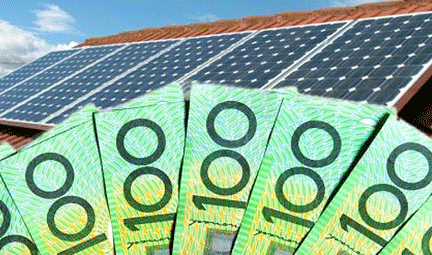 Ignore Abbott, renewable energy certificate prices should rise, Business Spectator TRISTAN EDIS 2 JUL The key barometer of the health of the renewable energy sector, particularly wind power, is the price of large-scale renewable energy certificates or LGCs. These certificates are the currency through which the electricity retailers comply with the large-scale Renewable Energy Target and make up more than half the revenue a wind farm earns (the other component is the underlying price for wholesale electricity).
On the day prior to Clive Palmer’s press conference with Al Gore, LGCs plumbed a low of $21 on the spot market. The market had only ever gone this low once before, in early 2007 when the final RET target was just 9500 gigawatt-hours.
The day after the Palmer-Gore press conference they surged to as high of $32, but then subsided and just yesterday changed hands at $28.70.
This is way too low and does not reflect the economics of renewable energy projects nor the political situation surrounding the Renewable Energy Target. Instead it reflects how the market is punch drunk from one bad piece of news after another enveloping the scheme in a cloud of uncertainty. ………
Complete repeal of the scheme with existing holders and producers of LGCs left stranded appears highly unlikely. Even as Joe Hockey was decrying wind farms as “utterly offensive”, he also told Alan Jones that they couldn’t leave those holding contracts high and dry. After all, the people on the hook are power retailers and banks – hardly the enemies of the Coalition. Also, in response to questioning from Climate Spectator, Environment Minister Greg Hunt told an audience of several hundred in May that no matter what comes out of the RET review, the scheme will continue…………https://www.businessspectator.com.au/article/2014/7/2/renewable-energy/ignore-abbott-renewable-energy-certificate-prices-should-rise
Plutonium discharged into Pacific Ocean from Fukushima nuclear reactors
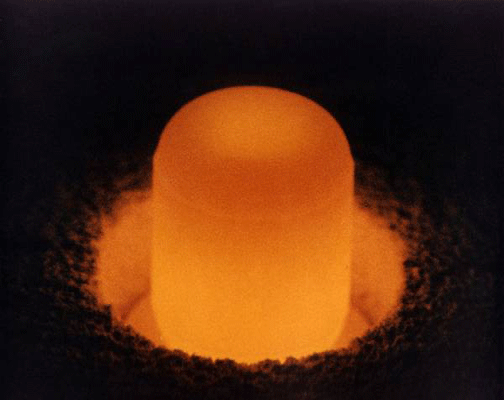 Gov’t Expert: Plutonium is certainly being discharged into Pacific Ocean from Fukushima plant; Flowing out of ruptured containments — TV: Reactor water turns into ‘yellowish, fizzing liquid’ from damaged fuel rods… “It actually vibrates” (PHOTO & VIDEO) http://enenews.com/study-plutonium-being-discharged-fukushima-pacific-ocean-flowing-ruptured-containment-vessels-tv-reactor-water-becomes-yellowish-fizzing-liquid-damaged-fuel-rods-actually-vibrates-video?utm_source=feedburner&utm_medium=email&utm_campaign=Feed%3A+ENENews+%28Energy+News%29
Bossew, German Federal Office for Radiation Protection, PLUTONIUM EMISSION FROM THE FUKUSHIMA ACCIDENT (pdf), 2013 (emphasis added): While much has since been published on environmental contamination and exposure to radio-iodine and radio-caesium, little is known about releases of plutonium […] The inability to cool the fuel led to melting of parts of the reactor cores (which parts exactly, is not yet well known) […] [Causes of the containment] ruptures and leaks […] are not entirely clarified […] explosion seems to have produced further structural damage in the containments, at the one hand, and on the other hand released large amounts of radionuclides into the environment. […] the fraction of Pu released into the environment can be expected to be higher [than] atmospheric releases only. Certainly some Pu has been released with liquid effluents and discharged into the ocean. […] The liquid discharges certainly also contained Pu. […]
‘Modern Marvels‘ History Channel (at 19:45 in): It is now 28 hours since the accident at Three Mile Island began. The men in the control room have no way of looking into the reactor…. it now seems clear some of the 36,000 slendertubes holding the uranium fuel have cracked, this is allowing radioactivity to escape into the reactor coolant water. It is imperative operators know how much radioactivity is now in the coolant. Too much, and the nuclear chain reaction could restart… Foreman Ed Hauser agrees to risk his life to take the readings. This is allowing radioactivity to enter the coolant water. He is in for an even greater scare when he draws the coolant water sample. The water from the reactor should be clear; instead he stares at a yellowish, fizzing liquid… It actually vibrates in his hand.
Troubled rare earths miner Lynas to move from Sydney to malaysia
 Nervous investors ditch Lynas ahead of move to Malaysia July 3, 2014 The Age, Brian Robins Troubled rare-earth miner Lynas Corp is to shift its head office abroad as part of a renewed cost-cutting regime as the company seeks to stop haemorrhaging cash.
It also comes amid production difficulties at its recently commissioned Malaysian processing unit that have yet to be resolved, and as negotiations continue to refinance a key funding package.
Lynas said it would move its head office to Kuala Lumpur, from Sydney, which will result in an unspecified number of job losses, with further jobs to go at its Perth office…….Investors were unnerved by the latest news, pushing Lynas shares down 7 per cent to close at 13¢.
Lynas is not the only rare earths producer encountering ongoing problems in lifting output, with US group Molycorp also struggling to bed down a capacity expansion.
Equally important to Lynas Corp’s near-term progress is resolving negotiations to refinance a $US325 million loan, via Nomura.
There has been ”no material development” with this refinancing, a Lynas spokesman said.
To help shore up its balance sheet, Lynas recently raised $40 million from shareholders as well as replacing its chief executive. http://www.smh.com.au/business/nervous-investors-ditch-lynas-ahead-of-move-to-malaysia-20140702-3b8so.html#ixzz36Xf4ozEk
Clean Energy Finance Corporation continuing to fund solar energy initiatives
 Australia’s A$10 Billion Clean-Energy Bank to Reveal Solar Deals http://www.bloomberg.com/news/2014-07-03/australia-s-a-10-billion-clean-energy-bank-to-reveal-solar-deals.html By James Paton Jul 2, 2014 The Australian government’s A$10 billion ($9.4 billion) clean-energy bank is set to announce a number of solar deals in the next week as it looks at investments in industries from mining to manufacturing.
“The interest in solar is across the board,” Clean Energy Finance Corp. Chief Operating Officer Meg McDonald said today after a presentation in Sydney. She declined to give more details.
The CEFC, created as part of former Prime Minister Julia Gillard’s legislation to reduce carbon emissions, invested more than A$800 million in more than 50 projects in its first year, McDonald said. The corporation has been lobbying to stay in business amid efforts by the Tony Abbott-led government to dismantle a price on carbon emissions and related agencies.
Clive Palmer, whose party holds the balance of power in Australia’s upper house starting this month, said last week he will reject Abbott’s plan to get rid of the clean-energy bank. Palmer, joined by former U.S. Vice President Al Gore at a June 26 news conference in Canberra, also said he supports keeping Australia’s renewable energy target to get 20 percent of the nation’s electricity from renewable sources by 2020.
Palmer reiterated that he backs the government’s bid to repeal the price on carbon emissions.
“There had been an acceptance that everything was going to go,” McDonald said in the presentation, referring to Abbott’s plans. Gore’s “intervention allowed space for a rethink about what the future looks like,” she said.
Australia’s wind energy brought down wholesale wind prices, (but not passed on to consumers)
 Big savings from renewable energy target but consumers miss out, SMH July 2, 2014 Peter Hannam Environment Editor, The Sydney Morning Herald While Prime Minister Tony Abbott says renewable energy significantly increase electricity bills, a new study finds wind energy actually forced down wholesale power prices by more than $3.2 billion over six years – but that little of the savings flowed through to consumers. Mr Abbott on Tuesday said the renewable energy target, which has largely driven investment in wind farms, was ”very significantly driving up power prices”.
”It’s precisely the opposite,” John Foster, one of the authors of the study that has been submitted to a review of the target, said. “The [target] – and the stimulation of wind – has increased supply and flattened out the expensive peaks.”
For instance, modelling of 30 minutes of heavy demand for electricity in Victoria on January 31, 2011 showed the wholesale price of $1.4 million would have ballooned to $45.6 million had only coal and gas-fired power plants had been able to respond.
Mr Abbott’s statement has been interpreted as signalling his government may weaken or scrap the target requiring at least 20 per cent of power from renewable sources once a review into the scheme is complete………
Once other costs including the purchase of renewable energy certificates were taken out, the target delivered a net benefit of $870 million from 2007 to 2012, the study found.
Little of that benefit reached consumers, though, with a lack of transparency masking just how much retailers snagged of the gains, Ms Molyneaux said. “We don’t see evidence of consumer prices going down.”
Debate over the target is expected to intensify with coal baron Clive Palmer saying last week his party will use its balance of power in the new Senate to preserve the existing target – now set at 41,000 gigawatt-hours of renewable energy by 2020 – until at least 2016, whatever the recommendations of the government’s hand-picked review panel………
Among the states, Victoria was the biggest beneficiary, snaring $2.37 billion of the $3.2 billion in wholesale savings. It hosts the second-largest wind turbine capacity of the states and can tap the largest – in South Australia – because of good transmission connections, the researchers said.
NSW lagged with only $136 million in wholesale savings because of its modest wind farm presence, while wind farm-free Queensland had barely any savings at all.
By 2012, wind farms were also responsible for reducing carbon emissions at the rate of 4 million tonnes a year, the study said.
Separately, the latest Cedex report by energy consultants Pitt & Sherry found carbon emissions from the National Electricity Market fell 10.4 per cent, or 18 million tonnes, in the two years of the carbon tax.
A fall in electricity demand contributed part of the drop, as did a switch to more wind and hydro electricity. Coal supplied 73 per cent of the power to the National Electricity Market – which serves eastern Australia – a year to the end of June, almost certainly a record low, according to Hugh Saddler, principal consultant with Pitt & Sherry. Gas supplied 12.7 per cent, hydro 9.6 per cent and wind 4.7 per cent.
Windy conditions over the past week saw wind farms supply 14.5 per cent of the generation in NSW, South Australia, Tasmania and Victoria from Monday to Saturday.
At 4.25am on Friday, South Australia’s wind generation exceeded demand in the state for the first time, according to Infigen Energy, a wind farm operator.
”The greatest significance of these figures is probably the demonstration that the [market] is sufficiently robust to be able to accommodate such large shares of wind generation, with no effect on the supply of electricity to consumers,” the report said. http://www.smh.com.au/federal-politics/political-news/big-savings-from-renewable-energy-target-but-consumers-miss-out-20140702-zstn1.html#ixzz36XYUb9LS
1 This month

of the week – Australians for War Powers Reform (AWPR)
To see nuclear-related stories in greater depth and intensity
 Antinuclear