Doubts on whether ERA’s Ranger 3 uranium mine can go ahead
Technical hitches bedevil ERA’s Ranger mine by: Matt Chambers The Australian July 12, 2014 http://www.theaustralian.com.au/business/mining-energy/technical-hitches-bedevil-eras-ranger-mine/story-e6frg9df-1226986174550 URANIUM producer Energy Resources of Australia could face more problems at its Ranger uranium mine in Kakadu National Park, flagging potential higher costs that Credit Suisse says could stop a planned underground expansion.

The Darwin-based Rio Tinto subsidiary said its Ranger 3 Deeps exploration decline project was experiencing tougher than expected geotechnical conditions. “Some geotechnical conditions have been encountered that are less favourable than assumed,” ERA said in its June quarter report, released on Thursday.
“These findings are being factored in to the mine design and the pre-feasibility study.”
While the market was little moved by the report on Thursday, Credit Suisse analyst Matthew Hope saw red flags.“We believe the results of the Deeps resource drilling are poor,” Mr Hope said yesterday in a note to clients.“The rock is probably heavily fractured, so extensive rock bolting and meshing will likely be required to prevent the access drives from collapsing,” Mr Hope said.
Credit Suisse downgraded its rating on ERA from outperform to underperform, and cut its target price by two-thirds from $1.50 to just 50c.
Mr Hope said value in ERA was almost entirely based on whether Ranger 3 Deeps would be mined. “If ERA announces at the end of this year that Ranger Deeps is not viable, then the share price should collapse to very low levels, with only option value remaining,” he said.
“Ranger Deeps either adds value or there is close to none, and risks are increasing towards the latter.”Ranger shares slipped 0.5c to $1.16 yesterday, giving the company a market value of $600m.
Conflict of interest: Abbott’s Aboriginal man Warren Mundine and the Martu people’s missing $millions

For Mundine, today’s revelations raise questions about his business judgment – and specifically about his company’s role in the Reward Minerals deal. How could anyone believe that the Martu people were being properly represented by the Western Desert corporation during negotiations when one of its top executives had an undisclosed interest in a predetermined outcome?
The sorry tale of Lake Disappointment, the missing mining millions and Warren Mundine, SMH. July 10, 2014 Richard Baker and Nick McKenzie “……once again, he [Darren Farmer] was doing what he had been told not to do. This time he was asking questions. He strode towards Biljabu, who was deputy chairman of the [Western Desert] Corporation. Where, he demanded to know, was the paperwork? And why couldn’t he or the others see it?
The paperwork in question outlined details of the deals Western Desert had struck with mining companies to allow them to dig on the 136,000 square kilometres of resource-rich Pilbara that are the Martu’s traditional lands.
These deals had brought about $50million into the corporation, a non-profit prescribed body corporate that is meant to use the money to benefit all Martu. But little of the money had gone into improving Martu townships.
Farmer kept on with his questions. Why had the Western Desert corporation spent $7million in four years on its handful of employees and paid directors more than $1million? How had well-connected corporate advisers pocketed millions, while much of the Martu mob lived in poverty? Why had the views of senior elders on mining proposals been ignored? Everyone at the meeting that day could tell it was not going to end well.
There are conflicting accounts of what happened next……….
Heated debate – and sometimes violence – is nothing new at indigenous land-council meetings across Australia. These are the forums where the future clashes with the past; where members of some of Australia’s most impoverished communities weigh up the riches that mining can deliver against the cultural cost of digging up their sacred sites.
But what was different about that meeting last July was that the deals at the centre of all the trouble had been brokered by companies owned by the biggest names in Australia’s indigenous community, including the nation’s most influential Aboriginal, Warren Mundine.
The accountant Dalgleish, true to stereotype, was a stickler for detail and decided to dig further into Wolf and Wright’s activities. He found that in mid 2008 they had separately bought more than $1million worth of Perth property. This was close to the time Wright joined WDLAC and the Rio Tinto $21million deal was done.
Although he had no proof that the property purchases involved money from Rio Tinto, Dalgleish was intrigued by the confluence of events and brought them to the attention of WDLAC’s board. On May 7, 2009, Dalgleish wrote a confidential memo to WDLAC’s chairman in which he wondered how Wolf could have approved such an “outrageously excessive fee” as the $2.35million paid to Procter.
A day later, Wright paid out Dalgleish’s contract and asked him to leave. He was able to do this because he had become the corporation’s acting chief executive following Wolf’s departure, a promotion that had bumped his salary to $250,000.
Three days after his departure, Dalgleish reported his concerns to the WA police fraud squad, which in turn contacted Western Desert corporation. According to the police file, detectives were assured by Western Desert in September 2009 that Procter no longer acted for the corporation, and that an “independent third party” would examine the issues and provide recommendations.
A WA police spokeswoman says police never received a copy of any third-party review.
‘‘The matter is currently filed pending further contact from WDLAC as the complainant,’’ she says.
Procter is bewildered as to why anyone would seek police attention over the Rio deal. His company, he says, acted with integrity and its role was supported by the Martu people, who were $20million richer because of IndiEnergy’s involvement.
Dalgleish also contacted the federal regulator, the Office of the Registrar of Indigenous Corporations, which is meant to ensure good governance and financial probity at the more than 2500 indigenous bodies across Australia. ORIC also decided not to investigate.
Meanwhile, in early 2009, the Australian Uranium Association – the peak body for uranium miners – announced the members of its indigenous dialogue group. Wolf and Mundine were among those named to promote the potential for uranium mining to enrich indigenous communities.
At the same time, Procter was busy expanding the reach of his company, IndiEnergy. He began appointing ‘‘special advisers’’ from the mining, legal and financial worlds. By far his most important appointment was that of Mundine as a special adviser and advisory board member.
The two had known each other since 2004 when the Howard government appointed them as members of the body that replaced ATSIC.
By the time Abbott announced Mundine as head of his Indigenous Advisory Council in September 2013, he was a close business associate of both Wolf and Procter.
Australia may be a big country, but the indigenous business and politics scene is small and replete with overlapping interests. It was only a matter of time before one of Mundine’s business relationships would clash with his quasi-ministerial role.
Mundine’s potential for a conflict of interest became a reality in February when Procter announced IndiEnergy had taken a stake in an indigenous company whose co-owner, Larrakia Development Corporation, is actively seeking Commonwealth support.
Procter highlighted Mundine in the February announcement of his new venture, praising him and Abbott for promoting indigenous business opportunities. ‘‘Skin in the game is the only way indigenous organisations can attract the right people to assist them in reaching their commercial dreams,’’ Procter said.
But having skin in the game means you risk losing some. And this is the risk that emerged for Mundine when a company he part-owned became involved in the Western Desert corporation’s most contentious mining deal…………
For Mundine, today’s revelations raise questions about his business judgment – and specifically about his company’s role in the Reward Minerals deal. How could anyone believe that the Martu people were being properly represented by the Western Desert corporation during negotiations when one of its top executives had an undisclosed interest in a predetermined outcome?……………
In December 2011, Reward announced it would pay the Western Desert corporation $500,000 upon the signing of an agreement. Another $500,000 would come when mining began and there would also be royalties of 1.25per cent on potash sales. This money was meant to be held in trust for all Martu.
But the biggest prize was Reward’s issuing of 9.5million share options to the Western Desert corporation and Poynton’s Azure Capital, which was in effect the parent company of Indigenous Investment Management. The value of the options at the time was almost $10 million. The Martu will get millions more options as the project progresses.
With money now in the bank, the Western Desert corporation went on a spending spree. Despite its own rules banning the handing out of funds without the approval of all members, the board decided on February 16, 2012, to use the first $500,000 from Reward and $100,000 from the corporation’s operating budget to pay 30 select elders $20,000 each.
Five board members, including Biljabu’s brother, received $20,000 each. Another recipient had just finished his term as a director, and the parents of three board members were also paid. Wolf says ensuring money is properly handled is easier said than done. ‘‘Some Martu live on $9000 a year and so when money hits the account you say ‘that should go to education or something’ but it’s hard when you live in poverty.’’
Still, Farmer says many Martu people are bewildered by their board’s capitulation over Lake Disappointment. ‘‘Why did we fight so hard, only to let it go?’’
So where has the federal regulator been in all this? ORIC has long been aware of governance issues at Western Desert corporation. In 2010, it found the Western Desert corporation had failed to keep proper records, paid money to the board’s chair and deputy in breach of its rules and provided cars to directors – including Biljabu – without member approval. But no disciplinary action was taken against individuals responsible.
Farmer’s fight for answers has taken a toll. ‘‘I’ve been isolated, lost sleep, become ill and [been] made out to be the troublemaker who is stopping people getting their money,’’ he says.
Meanwhile, he says, the Martu communities have not benefited as much as they should have from the mining deals. ‘‘Go out into the communities and there is f— all to show for all the millions.’’………: http://www.smh.com.au/national/the-sorry-tale-of-lake-disappointment-the-missing-mining-millions-and-warren-mundine-20140711-zt2b8.html#ixzz37Iu9KYXJ
Former Liberal leader supports Renewable Energy Target
Liberal veteran Hewson backs Renewable Energy Target, Sunshine Coast Daily Daniel Burdon | 11th Jul 2014 A FORMER Liberal Party leader has urged the Abbott government not just to retain the renewable energy target, but increase it to ensure carbon emissions can be curbed.
 But Dr Hewson said the RET, likely the only specific target for reducing Australia’s emissions left once the carbon tax is removed, is doing the job. He said while the RET and other climate change policies could help to reduce emissions, in less than a week, Australia could be without any overarching policy on climate change………http://www.sunshinecoastdaily.com.au/news/former-liberal-party-john-hewson-renewable/2315456/
The testimony of Fukushima nuclear plant manager Masao Yoshida
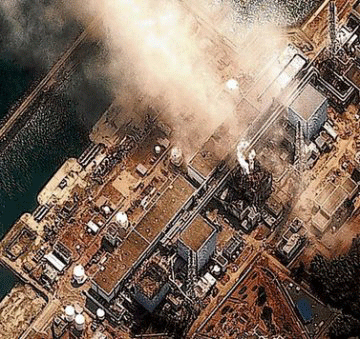 The Yoshida Testimony. The Fukushima Nuclear accident as told by plant manager Masao Yoshida http://www.asahi.com/special/yoshida_report/en/ 12 July 14
Prologue
The Asahi Shimbun has recently obtained a copy of the transcripts of testimony given before a government investigation panel by Masao Yoshida, who served as general manager of the Fukushima No. 1 nuclear power plant when it succumbed to a Level 7 disaster, the highest on the International Nuclear Events Scale, following the Great East Japan Earthquake and tsunami of March 11, 2011.
The document remains the only available official transcript of the testimony by Yoshida, the on-site commander of efforts to bring the situation under control, who died in July 2013 without having disclosed much to media organizations about the accident at the plant, operated by Tokyo Electric Power Co. Continue reading
Tony Abbott’s Aboriginal Adviser Warren Mundine, involved in murky mining deal
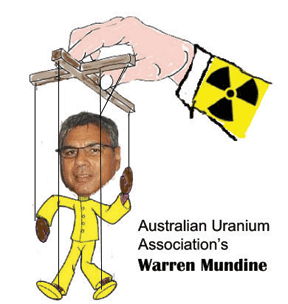
 Questions over Warren Mundine’s involvement in mining deal http://www.afr.com/p/national/questions_over_warren_mundine_involvement_DJUrsCD9hl6GHsajefKFoI RICHARD BAKER AND NICK MCKENZIE 12 July 14 A company part owned by Warren Mundine, the federal government’s chief indigenous adviser, helped broker a contentious deal that gave a mining company access to an Aboriginal sacred site in outback Western Australia.
The revelation raises questions about Mr Mundine’s past business relationships and comes as he seeks to drive reforms to ensure good governance in Aboriginal corporations through his role as head of Prime Minister Tony Abbott’s Indigenous Advisory Council.
Documents show Indigenous Investment Management, which was part owned by Mr Mundine at the time, was hired in 2010-11 by Reward Minerals. Continue reading
Hamas rockets targeting Israel’s nuclear reactors?

 Hamas Commits Act Of Nuclear Terrorism, According To U.N Definition The Daily Caller 10 July 14, In the latest step in a war of attrition with Israel, Hamas targeted one of the country’s nuclear reactors with rockets — an act which escalates the recent outburst of violence in the area to the level of nuclear combat.
An act of terrorism against a nuclear reactor in any form is defined as terrorism, as set out by the United Nation’s 2005 International Convention for the Suspicion of Acts of Nuclear Terrorism.
According to the United Nations, “any nuclear reactor, including reactors installed on vessels, vehicles, aircraft or space objects for use as an energy source in order to propel such vessels, vehicles, aircraft or space objects or for any other purpose,” or “any plant or conveyance being used for the production, storage, processing or transport of radioactive material.”
Three rockets were fired towards Israel’s nuclear reactor in Dimona, but the rockets were intercepted, and there are no signs of damage to the reactor. Immediately after the attack, Hamas claimed responsibility for the rockets, stating that they launched long range M-75 rockets towards the reactor in southern Israel……..: http://dailycaller.com/2014/07/10/hamas-commits-act-of-nuclear-terrorism-according-to-u-n-definition/#ixzz37JCyTK6G
Radioactive racism, the war to dump nuclear waste on Aboriglnal land in Australia

legal rights and protections are repeatedly stripped away whenever they get in the way of nuclear or mining interests. Thus the Olympic Dam mine is largely exempt from the SA Aboriginal Heritage Act. Sub-section 40(6) of the Commonwealth’s Aboriginal Land Rights Act exempts the Ranger uranium mine in the NT from the Act and thus removed the right of veto that Mirarr Traditional Owners would otherwise have enjoyed. NSW legislationexempts uranium mines from provisions of the NSW Aboriginal Land Rights Act. Native Title rights were extinguished with the stroke of a pen to seize land for a radioactive waste dump in SA, and Aboriginal heritage laws and land rights were repeatedly overridden with the push to dump nuclear waste in the NT
The bipartisan nuclear war against Aboriginal people, Dr Jim Green, Online opinion 11 July 14 The nuclear industry has been responsible for some of the crudest racism in Australia’s history. This radioactive racism dates from the British bomb tests in the 1950s and it has been evident in more recent debates over nuclear waste.
 Since 2006 successive federal governments have been attempting to establish a nuclear waste dump at Muckaty, 110 kms north of Tennant Creek in the Northern Territory. A toxic trade-off of basic services for a radioactive waste dump has been part of this story from the start. The nomination of the Muckaty site was made with the promise of $12 million compensation package comprising roads, houses and scholarships. Muckaty Traditional Owner Kylie Sambo objected to this radioactive ransom: “I think that is a very, very stupid idea for us to sell our land to get better education and scholarships. As an Australian we should be already entitled to that.”
While a small group of Traditional Owners supported the dump, a large majority were opposed and some initiated legal action in the Federal Court challenging the nomination of the Muckaty site by the federal government and the Northern Land Council (NLC). Continue reading
Jeff McMullen on Aboriginal policy run in the interests of mining companies
Jeff McMullen: Neoliberalism, market fundamentalism and the colonization of Aboriginal policy The Stringer, by Colin Penter March 14th, 2014 “Neo-liberalism is a hungry beast and this 21st Century strain of capitalism is shaping the agenda for control of Aboriginal lands………..Australian Government policy is heavily influenced by neo-liberalism through its extraordinary emphasis on managing access for mining companies to resources on Aboriginal lands. This involves controlling what is still perceived as ‘the Aboriginal problem’ and forcing a social transition from traditional values and cultural practice to ‘mainstream’ modernism of a particular brand. It also involves displacing many Aboriginal people from their traditional lands and concentrating them in ‘growth towns…….To make any sense of the aggression behind most current Indigenous policy in Australia you need to study the impact of neo-liberalism around the globe” Jeff McMullen……..
Analyzing Aboriginal policy through the lens of neoliberalism as McMullen does, helps us to understand what drives social policies such as the Northern Territory Intervention and the social engineering to control Aboriginal people still living on traditional lands, as well as the aggressive land grab by mining and resource companies, aided and abetted by Federal and State Governments, which divides Aboriginal communities, and even Aboriginal families. He writes:
‘Neoliberalism connects the agendas of modernising Aboriginal culture and allowing mining companies to vigorously exploit and minimal cost the mineral treasures on Aboriginal lands’.
McMullen points to the divide and conquer tactics of mining companies and governments in the Kimberley and Pilbara in Western Australia, across the Northern Territory, on Cape York and in parts of NSW and South Australia, as manifestation of these neoliberal agendas.
McMullen is scathing about the role played by influential Aboriginal leaders, such as Noel Pearson, Marcia Langton and Warren Mundine who have become influential advocates and brokers for neoliberal policies and have gathered adherents and supporters in both political parties and corporate Australia.http://thestringer.com.au/jeff-mcmullen-neoliberalism-market-fundamentalism-and-the-colonization-of-aboriginal-policy/#.U8H2JZRdUnk
Rich fossil fuel polluters would benefit from abolition of Renewable Energy Target
Abolishing renewable energy target rewards rich polluters http://www.smh.com.au/comment/abolishing-renewable-energy-target-rewards-rich-polluters-20140710-zt2v7.html#ixzz37JAosxiy July 10, 2014 Matt Grundoff Why is there such a big push on to scrap the renewable energy target? My report for The Australia Institute, Fighting dirty on clean energy, released on Thursday, found the same as most other energy analyses: that the target will decrease electricity prices, not increase them.
To find out why there’s such an opposition to the target, all you need to do is follow the money. The biggest winners from scrapping the target are the existing fossil fuel electricity generators, to the tune of $13 billion.
The target is injecting new supplies of energy into a shrinking market and this added competition is forcing down the wholesale price of electricity. Coal-fired power stations are being mothballed and, worst of all, from the point of view of the incumbent generators, renewables are moderating peak power prices. These peak prices are very important to their profitability, with research showing that 25 per cent of revenue is earned on just 40 hours of generation each year.
Like many big industries with strong lobbying power, the fossil fuel power generators have been calling for the target to be scrapped or weakened. Arguing that new competition is cutting their profitability is not going to generate much sympathy.
The other big problem the industry has is that renewable energy and the target are popular with the public. Polling done for my report found that 86 per cent of people want more renewable energy, and 79 per cent want the government to support an expansion of renewable energy. Seventy-one per cent of people supported the target and 68 per cent agreed with the 20 per cent target or thought it should be higher. With such strong support for renewable energy and the target, how are industry and the government going to bring it down?
When industry or government wants to make a change, public relations 101 says to emphasise any benefit to the public, whether said benefit exists or not. This is especially true if that change profits a vested interest.
Enter the government’s latest RET review.
This review has been designed to put cost of living pressures front and centre. Rather than have the Climate Change Authority do the review, as specified in legislation, the government has instead hand-picked a special squad of climate sceptics, free marketers and former fossil fuel energy interests. It’s led by self-declared climate change sceptic Dick Warburton.
This is clearly a review designed to reach a predetermined outcome. It is designed to exaggerate the tiny impact the RET has had on electricity prices, believed to be between 3 and 4½ per cent. It also needs to ignore that the doubling of electricity prices which has occurred over the last six years is largely due to poles-and-wires upgrades.
Most importantly from the point of view of the incumbent generators, it needs to ignore the uncomfortable fact that most respected energy consultants have found that the RET will actually reduce electricity prices in the next few years.
The reason that fossil fuel generators want the RET gone is the same reason that the RET is going to deliver lower power bills to consumers. More competition and lower peak prices all lead to lower electricity bills. Scrapping the RET has been estimated to cost electricity users $500 million over the next 10 years.
So far, the RET review has not gone completely to plan. A preliminary result from the modelling work commissioned by the review team has shown what all the other energy modellers have found. The RET is going to make electricity prices lower, not higher.
With Clive Palmer announcing he will not support changes to the RET, the new Senate seems closed to any change the industry might want. But don’t expect it to stop trying.
When the results of the RET review are released, expect to see a lot of focus on very small increases in electricity prices and little on the long-term impact of the RET. Industry lobby groups don’t give up easily, not when there are billions of dollars riding on the outcome.
Matt Grudnoff is a senior economist at The Australia Institute and the author of Fighting Dirty on Clean Energy.
German renewable energy – new law on funding suits European Union
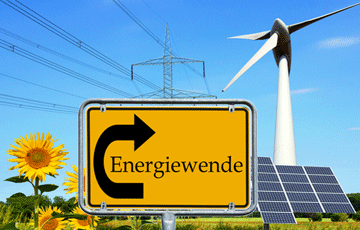 German green energy law clears final hurdle http://af.reuters.com/article/commoditiesNews/idAFL6N0PM3KB20140711?pageNumber=2&virtualBrandChannel=0 FRANKFURT, July 11 (Reuters) – Germany’s upper house of parliament, the Bundesrat, approved on Friday revamped legislation on funding renewable energy, clearing the way for the law to come into force on Aug. 1.
The far-reaching law, which seeks to cap support payments for renewables without jeopardising the country’s shift towards a low carbon economy, had hung in the balance, after months of negotiations, due to wrangling with European Union authorities over its compatibility with state aid guidelines.
But Brussels granted its consent this week, providing encouragement to the Bundesrat, which represents Germany’s 16 states, to vote through the reform package to the renewable energy act (EEG) in its Friday session.
“Germany has embarked on a long project to derive the energy supply of an industrial nation from renewable energy sources, which is historically without parallel,” Stefan Wenzel, environment minister of the state of Lower Saxony, told the Bundesrat.
Germany’s lower house of parliament, the Bundestag, approved the reform package two weeks ago. On Wednesday, European Competition Commissioner Joaquin Almunia said Berlin had allayed concerns that German industry might receive unfair advantages through exemptions from obligatory payments towards the cost of funding green energy. He also said Germany had cleared up two other remaining issues – the need to bring foreign renewable power into planned auctions for green energy from 2017 and to change the system of allowing industrial companies, which produce their own power, full discounts on the EEG after that date.
In 2011 Germany embarked on a strategy to accelerate its exit from nuclear energy in light of Japan’s Fukushima crisis, stepping up its renewables expansion and lowering its dependence on power stations that run on gas and coal.
Green energy from sources such as wind or sunshine has already reached a share of 25 percent of Germany’s power mix and is meant to reach 45 percent by 2025 and 60 percent by 2035.
The EEG reform is aimed at lowering the cost of green energy funding for consumers, among a number of other elements that will be introduced in future, including compensation of conventional producers for loss of market share. (Reporting by Markus Wacket and Vera Eckert; Editing by Gareth Jones)
Using medical radiation judiciously
 Radiation risk or timely diagnosis, Kevin MD,com SKEPTICAL SCALPEL, MD | CONDITIONS | JULY 8, 2014 “………..An article in Scientific American puts some of the radiation risk into perspective. It is long, but worth reading as it explains how risk has been calculated, the best guess as to the true level of risk, and what radiologists are doing to lower the radiation exposure associated with CT scanning.
According to that article, “Any one person in the U.S. has a 20 percent chance of dying from cancer [of any type]. Therefore, a single CT scan increases the average patient’s risk of developing a fatal tumor from 20 to 20.05 percent.”
No one ever comments about weighing the potential harms that may have been prevented by a timely CT scan diagnosis against the radiation risk.
CT scans should be ordered judiciously. The area scanned and the amount of radiation should be limited as much as possible.
But if you need a CT scan to help diagnose your problem, go ahead and have it. Bottom line: When it comes to accuracy in diagnosis versus radiation-induced cancer risk, parents overwhelmingly chose the former.
“Skeptical Scalpel” is a surgeon blogs at his self-titled site, Skeptical Scalpel. http://www.kevinmd.com/blog/2014/07/radiation-risk-timely-diagnosis-parents-choose.html
How South Australian Aboriginals won in their battle against nuclear waste dumping
The bipartisan nuclear war against Aboriginal people, Dr Jim Green, Online opinion 11 July 14 “……….Dumping on South Australia The failed attempt to establish a dump at Muckaty followed the failed attempt to establish a dump in South Australia. In 1998, the Howard government announced its intention to build a nuclear waste dump near Woomera in South Australia. Leading the battle against the dump were the Kupa Piti Kungka Tjuta, a council of senior Aboriginal women from northern SA. Many of the Kungkas personally suffered the impacts of the British nuclear bomb tests at Maralinga and Emu in the 1950s.
The proposed dump generated such controversy in SA that the federal government hired a public relations company. Correspondence between the company and the government was released under Freedom of Information laws. In one exchange, a government official asked the PR company to remove sand-dunes from a photo to be used in a brochure. The explanation provided by the government official was that: “Dunes are a sensitive area with respect to Aboriginal Heritage”. The sand-dunes were removed from the photo, only for the government official to ask if the horizon could be straightened up as well. Terra nullius.
In 2003, the federal government used the Lands Acquisition Act 1989 to seize land for the dump. Native Title rights and interests were extinguished with the stroke of a pen. This took place with no forewarning and no consultation with Aboriginal people.
The Kungkas continued to implore the federal government to ‘get their ears out of their pockets’, and after six years the government did just that. In the lead-up to the 2004 federal election − after a Federal Court ruling that the federal government had acted illegally in stripping Traditional Owners of their native title rights, and with the dump issue biting politically in SA, the Howard government decided to cut its losses and abandon the dump plan.
The Kungkas wrote in an open letter: “People said that you can’t win against the Government. Just a few women. We just kept talking and telling them to get their ears out of their pockets and listen. We never said we were going to give up. Government has big money to buy their way out but we never gave up.”
The Kungkas victory had broader ramifications − it was a set-back for everyone who likes the idea of stripping Aboriginal people of their land and their land rights, and it was a set-back for the nuclear power lobby. Senator Nick Minchin, one of the Howard government ministers in charge of the failed attempt to impose a nuclear dump in SA, said in 2005: ”My experience with dealing with just low-level radioactive waste from our research reactor tells me it would be impossible to get any sort of consensus in this country around the management of the high-level waste a nuclear [power] reactor would produce.” Minchin told a Liberal Party council meeting that ”we must avoid being lumbered as the party that favours nuclear energy in this country” and that ”we would be political mugs if we got sucked into this”………http://www.onlineopinion.com.au/view.asp?article=16489&page=3
1 This month

of the week – Australians for War Powers Reform (AWPR)
To see nuclear-related stories in greater depth and intensity
 Antinuclear