Conflict of interest: Abbott’s Aboriginal man Warren Mundine and the Martu people’s missing $millions
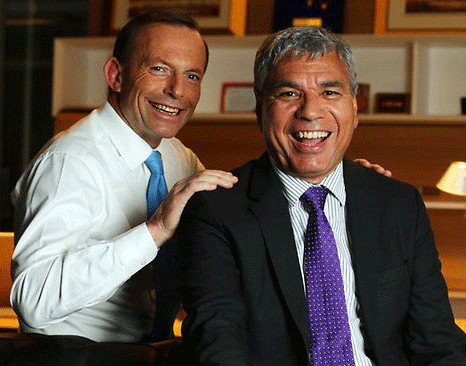
For Mundine, today’s revelations raise questions about his business judgment – and specifically about his company’s role in the Reward Minerals deal. How could anyone believe that the Martu people were being properly represented by the Western Desert corporation during negotiations when one of its top executives had an undisclosed interest in a predetermined outcome?
The sorry tale of Lake Disappointment, the missing mining millions and Warren Mundine, SMH. July 10, 2014 Richard Baker and Nick McKenzie “……once again, he [Darren Farmer] was doing what he had been told not to do. This time he was asking questions. He strode towards Biljabu, who was deputy chairman of the [Western Desert] Corporation. Where, he demanded to know, was the paperwork? And why couldn’t he or the others see it?
The paperwork in question outlined details of the deals Western Desert had struck with mining companies to allow them to dig on the 136,000 square kilometres of resource-rich Pilbara that are the Martu’s traditional lands.
These deals had brought about $50million into the corporation, a non-profit prescribed body corporate that is meant to use the money to benefit all Martu. But little of the money had gone into improving Martu townships.
Farmer kept on with his questions. Why had the Western Desert corporation spent $7million in four years on its handful of employees and paid directors more than $1million? How had well-connected corporate advisers pocketed millions, while much of the Martu mob lived in poverty? Why had the views of senior elders on mining proposals been ignored? Everyone at the meeting that day could tell it was not going to end well.
There are conflicting accounts of what happened next……….
Heated debate – and sometimes violence – is nothing new at indigenous land-council meetings across Australia. These are the forums where the future clashes with the past; where members of some of Australia’s most impoverished communities weigh up the riches that mining can deliver against the cultural cost of digging up their sacred sites.
But what was different about that meeting last July was that the deals at the centre of all the trouble had been brokered by companies owned by the biggest names in Australia’s indigenous community, including the nation’s most influential Aboriginal, Warren Mundine.
The accountant Dalgleish, true to stereotype, was a stickler for detail and decided to dig further into Wolf and Wright’s activities. He found that in mid 2008 they had separately bought more than $1million worth of Perth property. This was close to the time Wright joined WDLAC and the Rio Tinto $21million deal was done.
Although he had no proof that the property purchases involved money from Rio Tinto, Dalgleish was intrigued by the confluence of events and brought them to the attention of WDLAC’s board. On May 7, 2009, Dalgleish wrote a confidential memo to WDLAC’s chairman in which he wondered how Wolf could have approved such an “outrageously excessive fee” as the $2.35million paid to Procter.
A day later, Wright paid out Dalgleish’s contract and asked him to leave. He was able to do this because he had become the corporation’s acting chief executive following Wolf’s departure, a promotion that had bumped his salary to $250,000.
Three days after his departure, Dalgleish reported his concerns to the WA police fraud squad, which in turn contacted Western Desert corporation. According to the police file, detectives were assured by Western Desert in September 2009 that Procter no longer acted for the corporation, and that an “independent third party” would examine the issues and provide recommendations.
A WA police spokeswoman says police never received a copy of any third-party review.
‘‘The matter is currently filed pending further contact from WDLAC as the complainant,’’ she says.
Procter is bewildered as to why anyone would seek police attention over the Rio deal. His company, he says, acted with integrity and its role was supported by the Martu people, who were $20million richer because of IndiEnergy’s involvement.
Dalgleish also contacted the federal regulator, the Office of the Registrar of Indigenous Corporations, which is meant to ensure good governance and financial probity at the more than 2500 indigenous bodies across Australia. ORIC also decided not to investigate.
Meanwhile, in early 2009, the Australian Uranium Association – the peak body for uranium miners – announced the members of its indigenous dialogue group. Wolf and Mundine were among those named to promote the potential for uranium mining to enrich indigenous communities.
At the same time, Procter was busy expanding the reach of his company, IndiEnergy. He began appointing ‘‘special advisers’’ from the mining, legal and financial worlds. By far his most important appointment was that of Mundine as a special adviser and advisory board member.
The two had known each other since 2004 when the Howard government appointed them as members of the body that replaced ATSIC.
By the time Abbott announced Mundine as head of his Indigenous Advisory Council in September 2013, he was a close business associate of both Wolf and Procter.
Australia may be a big country, but the indigenous business and politics scene is small and replete with overlapping interests. It was only a matter of time before one of Mundine’s business relationships would clash with his quasi-ministerial role.
Mundine’s potential for a conflict of interest became a reality in February when Procter announced IndiEnergy had taken a stake in an indigenous company whose co-owner, Larrakia Development Corporation, is actively seeking Commonwealth support.
Procter highlighted Mundine in the February announcement of his new venture, praising him and Abbott for promoting indigenous business opportunities. ‘‘Skin in the game is the only way indigenous organisations can attract the right people to assist them in reaching their commercial dreams,’’ Procter said.
But having skin in the game means you risk losing some. And this is the risk that emerged for Mundine when a company he part-owned became involved in the Western Desert corporation’s most contentious mining deal…………
For Mundine, today’s revelations raise questions about his business judgment – and specifically about his company’s role in the Reward Minerals deal. How could anyone believe that the Martu people were being properly represented by the Western Desert corporation during negotiations when one of its top executives had an undisclosed interest in a predetermined outcome?……………
In December 2011, Reward announced it would pay the Western Desert corporation $500,000 upon the signing of an agreement. Another $500,000 would come when mining began and there would also be royalties of 1.25per cent on potash sales. This money was meant to be held in trust for all Martu.
But the biggest prize was Reward’s issuing of 9.5million share options to the Western Desert corporation and Poynton’s Azure Capital, which was in effect the parent company of Indigenous Investment Management. The value of the options at the time was almost $10 million. The Martu will get millions more options as the project progresses.
With money now in the bank, the Western Desert corporation went on a spending spree. Despite its own rules banning the handing out of funds without the approval of all members, the board decided on February 16, 2012, to use the first $500,000 from Reward and $100,000 from the corporation’s operating budget to pay 30 select elders $20,000 each.
Five board members, including Biljabu’s brother, received $20,000 each. Another recipient had just finished his term as a director, and the parents of three board members were also paid. Wolf says ensuring money is properly handled is easier said than done. ‘‘Some Martu live on $9000 a year and so when money hits the account you say ‘that should go to education or something’ but it’s hard when you live in poverty.’’
Still, Farmer says many Martu people are bewildered by their board’s capitulation over Lake Disappointment. ‘‘Why did we fight so hard, only to let it go?’’
So where has the federal regulator been in all this? ORIC has long been aware of governance issues at Western Desert corporation. In 2010, it found the Western Desert corporation had failed to keep proper records, paid money to the board’s chair and deputy in breach of its rules and provided cars to directors – including Biljabu – without member approval. But no disciplinary action was taken against individuals responsible.
Farmer’s fight for answers has taken a toll. ‘‘I’ve been isolated, lost sleep, become ill and [been] made out to be the troublemaker who is stopping people getting their money,’’ he says.
Meanwhile, he says, the Martu communities have not benefited as much as they should have from the mining deals. ‘‘Go out into the communities and there is f— all to show for all the millions.’’………: http://www.smh.com.au/national/the-sorry-tale-of-lake-disappointment-the-missing-mining-millions-and-warren-mundine-20140711-zt2b8.html#ixzz37Iu9KYXJ
No comments yet.
1 This month

of the week – Australians for War Powers Reform (AWPR)
To see nuclear-related stories in greater depth and intensity
 Antinuclear
Leave a comment