Australia’s nuclear waste from Lucas Heights is returning home – but to where?
Australia Has Nowhere to Put Its Shipment of French Nuclear Waste VICE News, By David Wood July 13, 2014 In the second half of next year France will be sending nuclear waste to Australia for permanent storage. The waste comes from uranium and plutonium exported to France between 1999 and 2004 to run its nuclear power plants. It’s coming home because of an international agreement that states that Australia — as the nation of origin — must take the spent fuel back. This same agreement means we’ll also be taking waste back from the UK sometime before 2020.

The bulk of the French waste consists of unrecycled nuclear fuel mixed into molten glass to form what’s known as a durable product. This will be accompanied by six drums ofintermediate level refuse including gloves, protective clothing, and old equipment, embedded in cement. All this makes a total volume of about 13.2 cubic meters, roughly one third the size of a shipping container, with a half-life of 24,000 years.
Despite having known about this arrangement since the ’90s, Canberra now has just 17 months to build something deep, strong, and stable enough to house 14 tons of radioactive rubble. And to make matters worse, no one even knows where to put it.
In the second half of next year France will be sending nuclear waste to Australia for permanent storage. The waste comes from uranium and plutonium exported to France between 1999 and 2004 to run its nuclear power plants. It’s coming home because of an international agreement that states that Australia — as the nation of origin — must take the spent fuel back. This same agreement means we’ll also be taking waste back from the UK sometime before 2020.
The bulk of the French waste consists of unrecycled nuclear fuel mixed into molten glass to form what’s known as a durable product. This will be accompanied by six drums ofintermediate level refuse including gloves, protective clothing, and old equipment, embedded in cement. All this makes a total volume of about 13.2 cubic meters, roughly one third the size of a shipping container, with a half-life of 24,000 years.
 Despite having known about this arrangement since the ’90s, Canberra now has just 17 months to build something deep, strong, and stable enough to house 14 tons of radioactive rubble. And to make matters worse, no one even knows where to put it.
The issue that brought the plan undone was that the government never properly negotiated with the land’s traditional owners. Muckaty has the overland telegraph built on it, has at times had cattle on it, as well as the Stuart Hwy across it. But for tens of thousands of years it’s belonged to the Warlmanpa Aboriginal people. That fact brought the issue to head in the Federal Court where it was eventually thrown out last month.
To celebrate, a party was thrown at Tennant Creek’s Nyinkka Nyunyu Aboriginal Art and Culture Centre for what was a reclaiming of land for its traditional custodians. During the event a 20-year old muso and Milwayi woman, Kylie Sambo, sang her song “Muckaty.”
“Don’t waste the Territory, this land means a lot to me,”she sang proudly. “Been living here for centuries. This place we call Muckaty.”
This sentiment makes sense to anyone who lives anywhere. Former NSW premier, Bob Carr, who comes from a markedly different background from Kylie, similarly resisted the waste being stored at Sydney’s Lucas Heights. “The Federal Government has got to look at locations that are remote, geologically stable, and dry,” he told Canberra back in 2005. “The optimal locations are going to be outside NSW.”
Both cases are textbook examples of the not-in-my-backyard philosophy. And as it turns out, if a long-term solution can’t be cobbled together before next December, the waste will most likely end up in Lucas Heights anyway — a fact which a whole new bunch of Sydney residents are now fighting………https://news.vice.com/article/australia-has-nowhere-to-put-its-shipment-of-french-nuclear-waste
Hazardous and doubtful operation: Fulushima’s ice wall against radiation
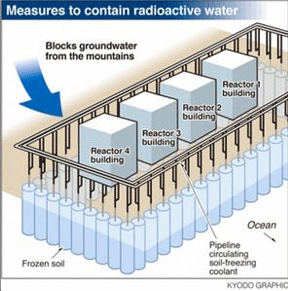 Doubts over ice wall to keep Fukushima safe from damaged nuclear reactors Frozen barrier, costing £185m, being built around Fukushima Daiichi’s four damaged reactors to contain irradiated water The Guardian, Monday 14 July 2014 “…..f all goes to plan, by next March Fukushima Daiichi’s four damaged reactors will be surrounded by an underground frozen wall that will be a barrier between highly toxic water used to cool melted fuel inside reactor basements and clean groundwater flowing in from surrounding hills.
Up to 400 tonnes of groundwater that flows into the basements each day must be pumped out, stored and treated – and on-site storage is edging closer to capacity. Decommissioning the plant will be impossible until its operator, Tokyo Electric Power [Tepco] addresses the water crisis.
Last month workers from Tepco and the construction firm Kajima Corp began inserting 1,550 pipes 33 metres vertically into the ground to form a rectangular cordon around the reactors. Coolant set at -30C will be fed into the pipes, eventually freezing the surrounding earth to create an impermeable barrier.
“We started work a month ago and have installed more than 100 pipes, so it is all going according to plan to meet our deadline,” Tadafumi Asamura, a Kajima manager who is supervising the ice wall construction, said as workers braved rain, humidity and radiation to bore holes in the ground outside reactor No 4, scene of one of three hydrogen explosions at the plant in the early days of the crisis.
But sealing off the four reactors – three of which melted down in the March 2011 disaster – is costly and not without risks. The 32bn-yen (£185m) wall will be built with technology that has never been used on such a large scale.
“I’m not convinced the freeze wall is the best option,” Dale Klein, former head of the US Nuclear Regulatory Commission and a senior adviser to Tepco, recently told Kyodo News. “What I’m concerned about is unintended consequences. Where does that water go and what are the consequences of that? I think they need more testing and more analysis.”
The 1,500-metre wall will stay in use until 2020, using enough electricity every year to power 13,000 households, according to officials.
Over the next eight months, 360 workers from Tepco and Kajima will work in rotating shifts of up to four hours a day, with each shift beginning in the early evening to combat heat exhaustion. Each worker is wrapped in hazardous materials suits and full-face masks, along with tungsten-lined rubber torso bibs for added protection against radiation.Tepco’s record of mishaps in the three years since Fukushima Daiichi suffered a triple meltdown suggests the wall project will not be trouble free. The firm has had problems freezing irradiated water – using the same method being used to build the underground wall – that has accumulated in underground trenches, raising concerns that the ice technology is flawed…….http://www.theguardian.com/environment/2014/jul/13/doubts-giant-ice-wall-fukushima-nuclear-reactors
6.5 million direct and indirect jobs in renewable energy
 Career in renewable energy? 6.5m jobs for grabs, Emirates 24/7 July 12, 2014 There may now be as many as 6.5 million direct and indirect jobs in renewable energy, according to updated data from the International Renewable Energy Agency (Irena).
Earlier assessments had put the global estimate at 2.3 million jobs in 2008 (United Nations Environment Programme) and at 5 million jobs in 2012 (International Labour Organisation).
Although these estimates suggest a strong expansion in employment in renewable energy, the figures also represent successive efforts to broaden data collection across countries and sectors, reads the Worldwatch Institute’s latest Vital Signs Online trend.

The overall upward trend in renewable energy jobs has been accompanied by considerable turmoil in some industries.
Nowhere are the upheavals more noticeable than in the solar photovoltaic (PV) sector, where intensified competition, massive overcapacities, and tumbling prices have caused a high degree of turbulence in the last two to three years, but they have also triggered a boom in installations.
Global PV employment is thought to have expanded from 1.4 million jobs in 2012 to as many as 2.3 million in 2013……….
All in all, available information suggests that renewable energy has grown to become a significant source of jobs. Rising labour productivity notwithstanding, the job numbers are likely to grow in coming decades as the world’s energy system shifts toward low-carbon sources.
Solar PV has bypassed biofuels (ethanol and biodiesel) as the top renewable energy job generator……….http://www.emirates247.com/news/career-in-renewable-energy-6-5m-jobs-for-grabs-2014-07-12-1.556215
Certainty is offered to business by the current climate policy
 One good reason why business should back the carbon price CHRISTINE MILNE ABC Environment11 JUL 2014 Certainty is offered to business by the current climate policy. The best opportunity Australian business has of policy certainty as the world moves to address global warming is to actively support emissions trading now.
AUSTRALIAN BUSINESS SHOULD tell Tony Abbott that he is killing certainty in Australia and that it is bad for business.
The golden rule of business is certainty. Not just in the short term but for decades to come, because unlike government, business deals in long term strategy and investment not just three year electoral cycles………
The choice for business is the certainty of the current law against the risks associated with chaos and dislocation of erratic policy and inevitable steep adjustment as emission reduction targets are increased.
Business groups have warned against yet another policy vacuum, like the one that followed the Rudd Labor government’s 2009 decision to dump any significant response to the greatest moral challenge of our time. And so they should.
In the south we have had Hydro Tasmania saying they will have to let 100 staff, or 10 per cent of its workforce go in the absence of a carbon price that would continue to bring in hundreds of millions of dollars of revenue. They pass this revenue on to the state government to spend on concession payments, schools and hospitals.
In the north, we have the Kimberly Land Council also set to lose millions from working on country. They won’t have a market to sell their carbon credits into anymore. The government’s so-called Direct Action is not a substitute market.
The fact is, there already exists a legislative framework for bringing down carbon pollution that businesses know they can work within, and in which investors can have confidence. Following the chaos of the last few days in the Senate, the alternatives are a gamble that Australian businesses shouldn’t take.
I am calling on Australian business to lead by calling on the Abbott government to end the nonsense of ‘axing the tax’, and instead embrace the certainty provided by the existing emissions trading scheme. It is the best chance we have of getting certainty on global warming policy in Australia at the lowest possible cost to business and the economy.
With an 18 per cent emissions reduction target in place since 31 May 2014, we can move immediately to flexible pricing to risk-proof Australian business and give ourselves a head start and competitive advantage as the rest of the world moves to conclude a treaty in 2015. Australia stands exposed to retaliatory non trade tariff barriers if we fail to commit to our fair share of emissions reduction. Already we are being left behind as China, the UK and USA negotiate economic agreements on green finance and technology………
As the Committee for Economic Development of Australia has noted, our economy will be seriously exposed in two ways if we don’t take serious action.
“The first area that leaves our economy exposed if we don’t take action relates to the consequences of increasing extreme weather events and the economic and social impact that these events have on Australia’s production capacity,” it said.
The second area was on the availability of finance. “Australia is reliant on foreign capital to fund major projects and new developments in international climate change policy are likely to impact international capital flow and investment decision making.”……..http://www.abc.net.au/environment/articles/2014/07/11/4044472.htm
Danger of the myth of nuclear power safety returning to Japan
 Beware the safety myth returning to Japan’s nuclear debate, Ft.com By Jonathan Soble, 12 July 14,
 Those leaders knew better, of course. But absolute guarantees were the only way to bring the national psyche into line with what were, in an energy-poor country, powerful political and economic incentives.
The strategy worked. Japan ultimately built 54 commercial reactors, and before the Fukushima disaster there were plans for more. But the approach did nothing to make those reactors safer, and arguably made them less so. The need to maintain the myth prompted utilities and the government to dismiss suggestions that standards could be improved………
Today, all of Japan’s surviving nuclear reactors remain offline, despite efforts by successive governments to restart them. Shinzo Abe is the most pro-nuclear prime minister since the accident, and also the most popular. Yet much of the public remains sceptical. This week regulators are expected to certify the first plant since tighter safety standards were introduced a year ago, a move that could lead to the restarting of nuclear power production as early as autumn.
Mr Abe once said an accident such as Fukushima “could never happen”. Today he is more circumspect, talking about making Japan a world leader in nuclear safety rather than a fantastical land without risks. Yet the broader debate has not changed as much as some had hoped.
Protect your eyes from ultra-violet radiation
The Asian Age Jul 14, 2014 – Kaniza Garari“……..Sunglasses must be used only outdoors. People who work for long hours outdoors need sunglasses as the UV damage to the eyes is slow and cumulates over a person’s lifetime. Those who are close to the equator, at higher elevations or constantly exposed to the mid-day sun have a higher risk of developing sun-related eye diseases. The damage to the eye is not visible in the first decade of life. So protection from the sun’s UV rays must be practiced right from childhood.
Dr Rachna Vinaya Kumar, consultant, pediatric ophthalmology and adult strabismus, at Apollo Hospitals, explains, “Sunglasses are required during summer while outdoors as the level of UV radiation is three times higher than during winter. Similarly they are required at the beach and also for those indulging in winter sports at high altitudes. They must not be worn indoors as the dark glass lenses adapt the vision by increasing photo sensitivity of the eyes and the darker the glasses the more light-sensitive your eyes get. Indoor use thus causes eye strain.”……” http://www.asianage.com/science-health/protect-your-eyes-ultra-violet-radiation-108
Aboriginal land rights and economic prosperity
 RICH SOIL: CAN INDIGENOUS LAND RIGHTS AND AUSTRALIA’S ECONOMIC INTERESTS COEXIST? RIGHT NOW, By Christine Todd 14 July 14 The Indigenous population in Australia has a long and proud history of careful land management. In the many centuries preceding British colonial settlement, Aboriginal people maximised productivity of the land, using their knowledge of navigation, the tides and the cyclical nature of the seasons to regulate their travel and food supply. They worked in tandem with the land; where the land didn’t suit their needs, they managed burns to clear undergrowth and fuel, with new growth luring grazing animals to hunt. Ecological management shaped the land and ensured continuity and balance.
With colonial settlement came European ideas of what it meant to manage the land. European agriculturalists worked the land to the extent they needed within their boundary fences. Lost was the management of the land as a cohesive, sustainable whole, replaced by a fragmented, needs-based exploitation of the land to achieve economic ends.
Dispossessed from the land they knew so intimately, entire Indigenous communities were often placed on reserves that remained under the control of the Crown. Even here, the right to merely exist on reserve land was not secure, if the government of the day chose to revoke use of the reserves.
Economic development in Australia and the management of traditional Indigenous land has been viewed as mutually exclusive, if not directly conflicting.
In 1963 the Commonwealth government chose to do just that, granting mining company Nabalco a long-term mining lease on Yirrkala Aboriginal Reserve in Arnhem Land. Home to the Yolgnu people, the decision provoked anxiety in the local community. A now-famous bark petition was organised by the Yolgnu to illustrate that the excised land was sacred to them, and vital to their present-day livelihood.
Despite a strong community response, the government ignored their claims to the land, instituting the Mining (Gove Peninsula Nabalco Agreement) Ordinance 1968 (NT), which revoked part of Yirrkala Aboriginal Reserve to enable the development of a mine by Nabalco. Those impacted by the government’s decision challenged the legislation in the Supreme Court in the now famous “Gove land rights case”, however lost on account of a lack of recognition for communal native title within Australian law.
Historically, the economic needs of the Australian government, particularly in the granting of mining projects and the management of vast mineral resources, has conflicted sharply with the acknowledgement of Indigenous land ownership. Small progress has been made over the past three decades as governments initiate land rights legislation and slowly navigate native title to return land to the Indigenous population.
But the mere acquisition of land is only the first step in a process of comprehensive reunification with the land for Indigenous communities. For years, economic development in Australia and the management of traditional Indigenous land has been viewed as mutually exclusive, if not directly conflicting. On the contrary, mutually beneficial enterprise and economic development of Indigenous land must occur in regions that can sustain it, not for the Indigenous population, but by the Indigenous population.
Statutory authorities, such as the Indigenous Land Council (ILC), are already assisting in achieving this goal. Central to their work is the belief that Indigenous land management can lead to the provision of training and employment outcomes for Indigenous people, resulting in a sustainable cycle of Indigenous-driven economic development.
A 2010 Northern Australia Land and Water Taskforce report strengthened this resolve……….
Other bodies, such as the Indigenous Chamber of Commerce, also aim to link the interests of Indigenous business with the economic prosperity of Australia, by facilitating Indigenous self-reliance and business management. Again, the sentiment here is that ownership of traditional Indigenous land and the economic prosperity of Australia ought not to be viewed as mutually exclusive. They can potentially operate hand in hand, with Indigenous knowledge of the land integrating into the Australian corporate landscape through the development of uniquely Indigenous business initiatives.
Case studies of this approach are plentiful. …….
This approach to creating Indigenous business enterprise, in partnership with building the business capacity of the community, is innovative in its ability to marry social and economic use of the land. Protection of culturally important regions can be achieved alongside an acknowledgement of Indigenous land as a unique environmental resource that the communities themselves can manage. To provide long-term benefits to Indigenous communities, a sustainable Indigenous economic foundation must be laid on Indigenous-held land. Here, opportunity, enterprise, and cultural pride may strengthen a connection to the land that many had considered lost.
Christine Todd is a staff writer for Right Now. http://rightnow.org.au/writing-cat/article/rich-soil-can-indigenous-land-rights-and-australias-economic-interests-coexist/
Home renewable energy storage now available in Australia
 PowerLegato Energy Storage System Available In Australia http://www.energymatters.com.au/index.php?main_page=news_article&article_id=4390 14 July 14 AU Optronics Corp. (AUO) has announced its PowerLegato commercial and home energy storage system is now available to Australian customers.
Available in 7.2, 4.8 and 2.4 kWh models, PowerLegato can be used in both on-grid and off-grid applications and boasts among the world’s highest energy density in such a unit. AUO says the PowerLegato can store an average 25% more energy per kilogram of weight than competing products.
Very competitively priced, the PowerLegato is the recipient of iF and Reddot design awards and the software that runs the system, EnergyOptimizer, also won this year’s iF Communication Award.
The PowerLegato’s hybrid inverter and charger architecture, EnergyOptimizer software and battery management system (BMS) helps ensure maximized power independence, safe operation and longer battery life. The system has been made to be as user-friendly as possible and incorporates a password protected touch panel.
The PowerLegato’s 48v lithium-ion batteries are made in Japan and feature over current, over temperature, over voltage and undervoltage protection.
The unit is IP31 rated, meaning it is protected from condensation.When PowerLegato is installed in conjunction with a solar panel system, the main power supply will come from the PV system during favourable conditions and once the PowerLegato is fully charged; surplus exported to the mains grid. During the night or on days with heavy cloud, the energy stored in PowerLegato can be used first and the mains grid acts as a backup. The system can also operate fully stand-alone from the grid.
The PowerLegato 7200, 4800 and 2400 is available in Australia from Energy Matters. For further enquiries and pricing details, call 133 SUN or contact Energy Matters via www.energymatters.com.au.
In April 2010, AU Optronics Corp was listed among the top 100 green companies in China. One of its subsidiary companies is BenQ Solar, the manufacturers ofBenQ solar panels.
The home energy storage revolution is at a point reminiscent of the rooftop solar revolution just a few years ago – the products are rapidly decreasing in price and the range available is growing at a fairly rapid clip. Just last week we announced the Samsung SDI All In One home energy storage system is now also available in Australia from Energy Matters
Related:
PowerLegato datasheet (PDF)
Greenhouse gases and ozone depletion are causing southwestern Australia’s long-term dry
 Australia drying caused by greenhouse gases and ozone depletion http://phys.org/news/2014-07-australia-greenhouse-gases-ozone.html#j Cp NOAA scientists have developed a new high-resolution climate model that shows southwestern Australia’s long-term decline in fall and winter rainfall is caused by increases in manmade greenhouse gas emissions and ozone depletion, according to research published today in Nature Geoscience. “This new high-resolution climate model is able to simulate regional-scale precipitation with considerably improved accuracy compared to previous generation models,” said Tom Delworth, a research scientist at NOAA’s Geophysical Fluid Dynamics Laboratory in Princeton, N.J., who helped develop the new model and is co-author of the paper. “This model is a major step forward in our effort to improve the prediction of regional climate change, particularly involving water resources.”
NOAA researchers conducted several climate simulations using this global climate model to study long-term changes in rainfall in various regions across the globe. One of the most striking signals of change emerged over Australia, where a long-term decline in fall and winter rainfall has been observed over parts of southern Australia. Simulating natural and manmade climate drivers, scientists showed that the decline in rainfall is primarily a response to manmade increases in greenhouse gases as well as a thinning of the ozone caused by manmade aerosol emissions. Several natural causes were tested with the model, including volcano eruptions and changes in the sun’s radiation. But none of these natural climate drivers reproduced the long-term observed drying, indicating this trend is due to human activity.
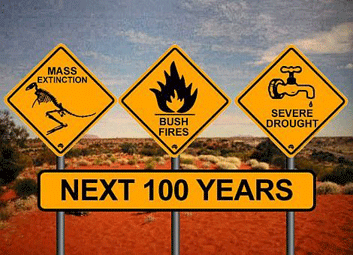
Southern Australia’s decline in rainfall began around 1970 and has increased over the last four decades. The model projects a continued decline in winter rainfall throughout the rest of the 21st century, with significant implications for regional water resources. The drying is most severe over southwest Australia where the model forecasts a 40 percent decline in average rainfall by the late 21st century.
“Predicting potential future changes in water resources, including drought, are an immense societal challenge,” said Delworth. “This new climate model will help us more accurately and quickly provide resource planners with environmental intelligence at the regional level. The study of Australian drought helps to validate this new model, and thus builds confidence in this model for ongoing studies of North American drought.”
1 This month

of the week – Australians for War Powers Reform (AWPR)
To see nuclear-related stories in greater depth and intensity
 Antinuclear