Renewable energy and diesel hybrid power for remote Coober Pedy
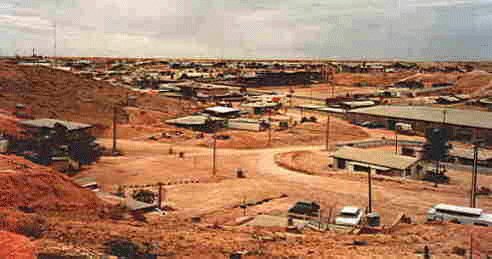 PROPOSED $18M RENEWABLE ENERGY DIESEL HYBRID PROJECT AT COOBER PEDY Coober Pedy Regional Times July 14, 2014 Coober Pedy in the Far North of South Australia, hosting a population of around 3,000 people, derives it’s electricity from a 3.9 MW diesel power station, and a 0.15MW wind turbine.
Power capacity in the small desert town is set to increase to a massive 8.9 MW pending outcomes of today’s announcement that the Australian Renewable Energy Agency has approved $18.5 million of support for a renewable energy, diesel hybrid project at Coober Pedy in South Australia.
The project is subject to a final investment decision by power provider Energy Developments Limited (EDL), along with approvals and agreements. If approved, completion is anticipated in mid-2017.
ARENA CEO Ivor Frischknecht said Energy Developments Limited (EDL) is proposing to combine wind, solar and diesel to provide the town with 70 per cent renewable energy over the life of the project. (picture below adapted from .http://cooberpedyregionaltimes.wordpress.com/2014/07/14/proposed-18m-renewable-energy-diesel-hybrid-project-at-coober-pedy/#more-8751)
“With ARENA’s support, EDL is seeking to integrate up to 2 MW of solar PV, 3 MW of wind generation and enabling technologies into its existing 3.9 MW diesel power station at Coober Pedy,” Mr Frischknecht said.
This ambitious project may demonstrate a combined approach for powering off-grid Australian communities that currently rely solely on expensive trucked-in diesel.
Yanni Athanasiadis, the Vice Chairman of Coober Pedy’s Retail Business and Tourism Association said today, “This is very good news for Coober Pedy that ARENA have allocated $18.5M towards a potential renewable energy diesel hybrid plant.”……….
Vice President of Coober Pedy Opal Miners Association John Dunstan said that the Miners Associaton has offered to allow the Solar and Wind infrastructure to be situated on a site opposite the existing power station, that the Association uses for it’s own industry purposes.
“If it’s going to help bring cheaper power to the Coober Pedy residents and businesses, the Miners Association are very willing to allow the installations of the 2 MW of solar PV, 3 MW of wind generation on it’s land.”
“Currently EDL have erected a wind monitor at the location to monitor wind speeds at Coober Pedy for the next 12 months to help determine what size turbines will be used”, said Dunstan. “Coober Pedy’s current wind turbine is 0.15MW but these new turbines will be over twice the size.” he said.
.Mr Frischknecht said the project will include short-term energy storage, fast start diesel engines and an advanced control system to enable smooth operation.
“These enabling technologies have been successfully tried and tested by Hydro Tasmania at the ARENA-supported King Island Renewable Energy Integration Project and this represents an opportunity to see them evolve for use on the mainland and in an outback community that has few alternative energy options,” Mr Frischknecht said.
“Further demonstration of these technologies is expected to reduce costs over time and improve opportunities for future deployment without subsidies…….http://cooberpedyregionaltimes.wordpress.com/2014/07/14/proposed-18m-renewable-energy-diesel-hybrid-project-at-coober-pedy/#more-8751
2020 Olympics should not be held in Japan
 Why Japan should resign as host of 2020 Summer Olympics OpEdNews 7/15/2014
By carol wolman, MD (about the author) In September 2013, the International Olympic Committee’s (IOC) met in Buenos Aires to elect a host city for the 2020 Summer Olympic Games. Japan’s Prime Minister Shinzo Abe assured the IOC that “the situation [at Fukushima Daiichi] is under control”, and convinced them to hold the Games in Tokyo.
Abe was lying. Unforunately, the site is nowhere near “under control.” Fukushima Daiichi, the nuclear reactor complex damaged by the earthquake/tsunami of March 2011, continues to spew forth radioactivity today. The groundwater, which connects with the Tokyo aquifer, picks up unacceptable levels of radiation from the molten reactor cores. There are radioactive hot spots all over northern Japan, including in Tokyo. The practice field for athletes is only 20 kilometers from the Fukushima Daiichi. If the 2020 Olympics do take place in Tokyo, Japan will be exposing the world’s finest young athletes to potentially harmful soil and water.
Siting the 2020 Olympics in Tokyo involves a huge risk. There are so many things that can still go wrong at Fukushima Daiichi over the next 6 years, that one wonders why the IOC was willing to go along with the obvious lies told by Abe-san. The answer is also obvious- the world economy and current political makeup depends on Japan’s stability, as Japan has the third largest economy on the planet, and is the linchpin of US policy in the Far East. Moreover, the powers that be are heavily invested in nuclear power, and want it to appear safe. The Olympic decision is meant to reassure everyone that Japan is fine and nuclear power is not to be feared, so as to maintain the status quo.
There is a systematic pattern of lying and coverup about conditions at Fukushima Daiichi. Continue reading
Even with safety clearance, Japan’s nuclear reactors might not restart
 Safety Clearance for Japan Reactors Won’t Guarantee Restarts WSJ, By MARI IWATA July 14, 2014 Gaining Local Approval Could Be Stumbling Block TOKYO—A victory by an antinuclear candidate in a local election points to the difficulty of restarting Japan’s nuclear reactors, all 48 of which are currently offline until they can pass new safety standards and gain local approval for restarting.
The nation’s nuclear regulator said Monday it was planning to release its review of two reactors in southern Japan’s Kagoshima prefecture on Wednesday, an indication of progress in efforts to get nuclear power in Japan back in operation. People on both sides of the nuclear debate have said the two reactors are likely to pass the technical review. But even then, the two units face local opposition and aren’t certain to restart soon. Japan’s other reactors likely face longer waits.
The election of antinuclear candidate Taizo Mikazuki as governor of Shiga prefecture on Sunday is a reminder of the continuing opposition to nuclear restarts in many areas bordering regions that host nuclear plants. Shiga prefecture is located next to Fukui prefecture, home to more than a dozen nuclear reactors. Mr. Mikazuki defeated a candidate backed by Prime Minister Shinzo Abe and succeeds an incumbent with antinuclear views who had insisted on having a say about restarting the Fukui reactors Continue reading
$1 billion for solar energy in Japan
 $1bn solar loans ‘to blossom for Japan’ Energy live News 15 july 14 Deutsche Bank is said to be planning loans worth around $1 billion (£0.6bn) to solar energy projects in Japan.
Hans Van Der Sande at the German bank’s Tokyo branch said it is ready to dish out loans for three to six projects in the next year or 18 months, reported Bloomberg.
He said: “We got reverse inquiries from some of our clients offshore saying ‘we are interested in Japan solar and developing projects there but having difficulty getting finance from Japanese banks,’” according to the news site….http://www.energylivenews.com/2014/07/14/1bn-solar-loans-to-blossom-for-japan/
UN scientific report – pathways to stopping climate change
 Efficiency, renewables, biofuels key to stopping climate change ABC News 14 July 14 The positive message from a scientific report for the UN Climate Summit is that the tough task of cutting greenhosue gas emissions to limit global temperature rise to below two degrees is definitely achievable by following a set of bold, practical steps
The 15 national pathways examined in the report all show the importance of three factors for achieving radically lower carbon emissions.
The first is greatly increased efficiency and conservation in all energy use.
The second factor is taking the carbon out of electricity by using renewable sources, “such as wind and solar, as well as nuclear power, and/or the capture and sequestration of carbon emissions from fossil-fuel burning”.
Nuclear energy still attracts widespread and determined opposition, and carbon capture and sequestration (trapping CO2 emissions and storing them underground or beneath the sea floor) has not yet proved that it can work on a commercial scale.
The third factor involves replacing fossil fuels in transport, heating and industrial processes with a mix of low-carbon electricity, sustainable biofuels, and hydrogen…… http://www.abc.net.au/environment/articles/2014/07/14/4045481.htm
AUDIO: Australian land management a failure, compared to traditional Aboriginal methods
 AUDIO: Modern mismanagement of the Australian landscape? http://www.abc.net.au/news/2014-07-14/mis-managing-a-huge-land-mass3f/5593848 NSW Country Hour By Sally Bryant Bill Gammage says modern Australians are missing the point in how we look after our natural heritage, ignoring lessons from one of the most successful and sustainable management regimes in history.
 His view of traditional Aboriginal land management is at odds with the theory held by European settlers; that the traditional owners were hunter gatherers, opportunistic and simplistic in their approach to the land and native flora and fauna.
As an historian, Professor Gammage has studied written and visual records, from the history of the Australian landscape and he says it’s clear to him that Aboriginal people had developed a complex and sophisticated suite of tools, to keep their country healthy and productive.
He says he first became interested in the issue while working on a rural property in the New South Wales Riverina, and from writing a history of the town of Narrandera.
“It became clear that what was now trees had been grassland when Europeans arrived, the riverbanks for example are described as being grassy and a pastoral paradise,…………
Professor Gammage says it’s not surprising that European settlers disregarded Aboriginal people when it came to land management; he says it is typical of the European consciousness and disregard of indigenous knowledge.
“It’s pretty typical of how Europeans treated Aboriginal people.”
And what outcome would Professor Gammage like to see, if any, from discussion of his theories? “I’d like to see us using fire to manage the landscape, to control regrowth so we’re not as exposed to the really big bushfires. “But it has to be done in conjunction with species protection.
“This is something that Aboriginal people are really good at, managing species survival; and this is when they’re managing animals and plants they are using as a food sources.” He concedes that fire might not be an ideal tool to manage large tracts of farmland, and heavily populated areas, but says there are vast tracts of Australia under natural bushland which need to be better managed.
Australian banks face risks if Renewable Energy Target is gutted or abolished
 Banks Also At Risk From RET Threat http://www.energymatters.com.au/index.php?main_page=news_article&article_id=4392 15 July 14, There’s a lot more riding on Australia’s Renewable Energy Target than just clean power, Australians taking control of their energy bills and thousands of jobs. Last week we mentioned a risk to the retirement savings of millions of Australians should the RET be gutted or abolished.
Now its been revealed Australian banks are holding nearly $900 million worth of large scale energy certificates (LGCs) connected to the Renewable Energy Target. The Australian states the banks include ANZ, Macquarie Group, Westpac and Commonwealth Bank; which hold 20 per cent of LGCs.
The value of these certificates has been fluctuating wildly as the argy-bargy over the RET continues. The Australian cites an example of LGCs plummeting from $30.50 per megawatt hour to $26.05 shortly after the appointment of climate-change sceptic Dick Warburton as head of the RET review. LGCs then hit a low of $22.43 in June due to uncertainty of the outcome of the review.
However, when Senator Ricky Muir weighed in on the subject of supporting renewables last week, their value reached $30.80. Uncertainty over the future of the RET isn’t just affecting LGC value. The situation is driving investment away from Australia and the longer the situation goes on, the more difficult it will be to attract local and foreign investment back as these investors will increasingly see Australia as wishy-washy on renewables and subsequently, high risk.
Pacific Hydro recently announced plans to cut 10 per cent of its Australian workforce due to uncertainty over the carbon tax and Renewable Energy Target.
It’s quite a ridiculous situation given the amount of investment and number of jobs at risk; along with other benefits. It’s become even more incredulous in light of the the Government’s own modelling showing the RET will reduce power bills for end consumers. Even with the facts firmly established, the Government is instead choosing to perpetuate myths about the RET.
Slow start likely to Japan’s nuclear power – encourages other energy providers
Inpex bullish on LNG as Japan’s nuke restart stalls THE AUSTRALIAN JUNE 30, 2014 1 Matt Chambers Resources Reporter Melbourne JAPAN’S biggest oil and gas company, Inpex, says it expects liquefied natural gas demand to remain strong because the country’s nuclear plants have been slow to restart after the 2011 tsunami and Fukushima meltdown.
And the 20 per cent state-owned company, which is building the $US34 billion ($36bn) Ichthys LNG project at Darwin, expects US LNG exports to have a limited effect on global prices.
Inpex’s vice-president of corporate strategy and planning, Kimihisa Kittaka, said there was still heated debate in Japan over how much of the completely shut-down nuclear power sector should be turned back on.
“Last year, people expected about 10 nuclear power plants to be activated by the end of 2014,” Mr Kittaka said. “Only one or two are under strict re-examination, so we do not expect to get near to 10.”………http://www.theaustralian.com.au/business/inpex-bullish-on-lng-as-japans-nuke-restart-stalls/story-e6frg8zx-1226971376570
1 This month

of the week – Australians for War Powers Reform (AWPR)
To see nuclear-related stories in greater depth and intensity
 Antinuclear