Lucas Heights nuclear reactor – safety fears, as safety supervisors dumped
 Fears for safety at Lucas Heights nuclear reactor: permanent supervisors to be dumped as part of cost-cutting GEOFF CHAMBERS THE DAILY TELEGRAPH JULY 25, 2014 PERMANENT frontline safety supervisors will be dumped and Australian Federal Police roles overhauled as part of cost-cutting measures at the Lucas Heights nuclear reactor.
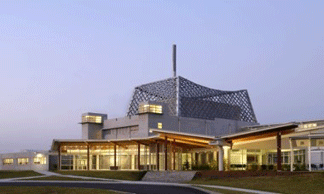 The Daily Telegraph can reveal that six permanent safety positions will be outsourced from next month at the Australian Nuclear Science and Technology Organisation (ANSTO).
Workers at the facility in Sydney’s south have expressed concern about the removal of permanent safety inspectors.
The AFP will retain an armed presence but it is expected that light duties, including boom gate operation and CCTV monitoring, will be outsourced.
With 260 production, laboratory and technical staff on its books, the Australian Manufacturing Workers’ Union has firmly opposed what it describes as a “cost-cutting exercise” by ANSTO.
The union’s state secretary, Tim Ayres, said that the reactor site was an important local employer and crucial for the innovation and manufacturing industry.
“This is in no way an improvement to safety at Sydney’s only nuclear facility, this is a decision to wind back the safety protections purely on the basis of costs,” he said.
Mr Ayres said having permanent safety inspectors on staff should be a priority for management.
The inspectors, many with years of experience, are the first point of contact at Lucas Heights during an emergency situation.
- “This sends a message that safety is a second-order issue. It will set the safety culture back,” he said………

Climate change heat forcing Sweden’s nuclear reactors to cut output
 Sweden’s nuclear plants forced to cut output due to warm weather Planet Ark, 24-Jul-14 Balazs Koranyi Sweden’s top nuclear power generators have been forced to cut output because of exceptionally warm weather in Scandinavia, and their output could be reduced for over a week, their operators said on Wednesday.
Oskarshamn, part of Germany’s E.ON and Forsmark, operated by Swedish utility Vattenfall have both cut output because warm sea water temperatures are limiting their ability to cool down.
“For each degree above 23 decrees Celsius in the cooling water, each unit has to decrease power by 3 percent,” Forsmark said in a market message. “It is uncertain how long this will last, but according to meteorologists, the warm weather will last for at least 11 more days.”
Temperatures exceeded 30 degrees in the southern part of Scandinavia this week, hitting their highest level in years…….http://planetark.org/enviro-news/item/71927
Bill Shorten, Labor Leader urges that climate change must be on the G20 agenda

Press Council raps THE AUSTRALIAN newspaper over its false story of climate change denial
 ‘Considerable concern’: Oz in hot water over climate denial errors, Crikey, by Myriam Robin, 24 July 14 The Press Council has handed down an adverse ruling against The Australian for a front-page article published in September last year that relied on a rapidly debunked Daily Mail story claiming the Intergovernmental Panel on Climate Change had revised down the rate of global warming since 1951.
In highly unusual language for the Press Council, it says it is a matter of “considerable concern” that The Australian delayed in acknowledging its errors. Asked to explain the strong language, Press Council executive director John Pender told Crikey ”the initial error was very serious and prominent, was repeated unequivocally in a later editorial, and was not corrected with sufficient speed, clarity and prominence”.
In a September 16 article, since changed online but archived here on the Media Watch website, The Australian environment editor Graham Lloyd rehashed a British story published a week before the Fifth Assessment Report of the IPCC was released that claimed the report update would say the true figure of warming since 1951 had been 0.12 degrees Celsius per decade, and not the 0.2 degrees Celsius claimed in previous reports.
The Oz’s piece continued:
“Last week, the IPCC was forced to deny it was locked in crisis talks as reports intensified that scientists were preparing to revise down the speed at which climate change is happening and its likely impact.
“It is believed the IPCC draft report will still conclude there is now greater confidence that climate change is real, humans are having a major impact and that the world will continue to warm catastrophically unless drastic action is taken to curb greenhouse gas emissions. The impacts would include big rises in the sea level, floods, droughts and the disappearance of the Arctic icecap.
“But claimed contradictions in the report have led to calls for the IPCC report process to be scrapped.”
These reports were wrong. The Daily Mail got its numbers wrong, and The Australian repeated the error, as Media Watch and The Guardian pointed out last year. The long-term trend in the IPCC report is 0.13 degrees of global warming a decade, and has been for some time — there was no retreat from higher figures……..http://www.crikey.com.au/2014/07/24/considerable-concern-oz-in-hot-water-over-climate-denial-errors/
Japanese doctor warns Tokyo residents regarding radiation

 ‘Tokyo should no longer be inhabited,’ Japanese doctor warns residents regarding radiation http://www.naturalnews.com/046112_radiation_fukushima_tokyo.html 25 July 14 (NaturalNews) In an essay addressed to his colleagues, Japanese doctor Shigeru Mita has explained why he recently moved away from Tokyo to restart his practice in western Japan: He believes that Tokyo is no longer safe to inhabit due to radioactive contamination caused by the March 11, 2011, meltdowns at the Fukushima Daiichi nuclear plant.
The essay, titled “Why did I leave Tokyo?” was published in the newsletter of the Association of Doctors in Kodaira, metropolitan Tokyo.
Soil tests prove contamination
Dr. Mita opens his essay by contextualizing his decision to leave, noting that he had a long history as a doctor in Tokyo.
“I closed the clinic in March 2014, which had served the community of Kodaira for more than 50 years, since my father’s generation, and I have started a new Mita clinic in Okayama-city on April 21,” he wrote.
Dr. Mita notes that, for the past 10 years, he had been working to persuade the municipal government of Tokyo to stock iodine pills to distribute to the population in the case of a nuclear accident. Dr. Mita’s concern had been that an earthquake might trigger a meltdown at the Hamaoka nuclear power plant. All of his requests were rejected, however, under the excuse that there was no reason to expect such an accident.
Dr. Mita compares radioactive contamination of the soil (measured in becquerels per kilogram, Bq/kg) in various parts of Tokyo with that observed in various portions of Europe following the Chernobyl disaster.
Prior to 2011, Shinjuku (the region of Tokyo that houses the municipal government) tested at only 0.5-1.5 Bq/kg. Today, levels at nearby Kodaira are at 200-300 Bq/kg.
“Within the 23 districts of Metropolitan Tokyo, contamination in the east part is 1000-4000 Bq/kg and the west part is 300-1000 Bq/kg,” Dr. Mita wrote.
For comparison, Kiev (capital of the Ukraine) has soil tested at 500 Bq/kg (Cs-137 only). Following the Chernobyl accident, West Germany and Italy reported levels of 90-100 Bq/kg, and both experienced measurable health effects on their populations.
Dr. Mita notes that the radiation situation in Tokyo is getting worse, not better, due to urban practices of concentrating solid waste in small areas such as municipal dumps and sewage plants. That is why, he says, radiation levels in Tokyo riverbeds have actually been increasing over the prior two years.
Patients showing radiation-induced sickness
Dr. Mita’s essay also chronicles the many cases he has observed of patients presenting with radiation-induced health problems. He notes that, since 2011, he has observed while blood cell counts declining in children under the age of 10, including in children under one year old. In all of these cases, symptoms typically improve if the children move to western Japan. He has similarly observed persistent respiratory symptoms that improve in patients who move away.
Other patients have shown symptoms including “nosebleed, hair loss, lack of energy, subcutaneous bleeding, visible urinary hemorrhage, skin inflammations, coughs and various other non-specific symptoms.” He also notes high occurrences of rheumatic muscle symptoms similar to those observed following the Chernobyl disaster.
“Ever since 3.11, everybody living in Eastern Japan including Tokyo is a victim, and everybody is involved,” he wrote.
Sources for this article include:
Investors interested in the success of Australia’s Clean Energy Finance Corporation (CIFC)
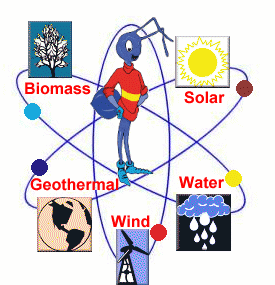 Interest in green bank continues to grow, Herald Sun 22 July 14 INVESTOR interest in Australia’s clean energy bank continues to grow despite a cloud hanging over its future.IN its first full year of operation, the Clean Energy Finance Corporation invested $900 million in renewables projects worth more than $3 billion.
For every dollar invested over the 2013/14 financial year the “green bank” attracted more than $2.20 from the private sector.The corporation was assigned $10 billion over five years to drive private sector investment in renewable energy and energy efficiency programs.The positive rate of return has been cited by supporters of the corporation as evidence of its success and reason to save it from abolition.The Abbott government has introduced legislation to parliament to unwind the green bank, arguing taxpayers money should not be spent on projects the private sector deems too risky.Revelations the corporation’s activities had no adverse impact on government debt and was actually delivering a return for taxpayers raised particular questions about the merit of axing it……. http://www.heraldsun.com.au/news/breaking-news/interest-in-green-bank-continues-to-grow/story-fni0xqi4-1226997350473
Australian Renewable Energy Agency (ARENA) funding Lord Howe Island’s hybrid renewable energy project
 Lord Howe Island’s Clean, Renewable Energy Future http://www.energymatters.com.au/index.php?main_page=news_article&article_id=4411 25 July 14 The Australian Renewable Energy Agency (ARENA) is helping to fund a hybrid renewable energy project on Lord Howe Island that will include energy storage.
ARENA will contribute $4.5 million in support for the 1 MW, $11.6 million wind, solar, storage and diesel hybrid system that will reduce the Island’s consumption of diesel by 70%.
“Lord Howe Island is 600 km off the east coast of Australia and, like other remote off-grid communities across the country, is heavily reliant on diesel generators that are costly to run and subject to volatile fuel prices,” said ARENA CEO Ivor Frischknech.
“It is another significant project to come out of ARENA’s Regional Australia’s Renewables Initiative, which is focused on increasing the uptake of renewables in offgrid Australia.”
It’s been a long road to reach this point according to Lord Howe Island Board CEO Penny Holloway; who said said the community had been working towards a renewable energy future for more than ten years and ARENA’s support means it can now become a reality.
The Lord Howe Island Group is part of the state of New South Wales; administered by the Lord Howe Island Board.
NSW Environment and Heritage Minister Rob Stokes congratulated ARENA and the Lord Howe Island Board for their vision and commitment.
“Lord Howe Island was included on the World Heritage List because of its unique natural and heritage values and this initiative is a powerful way of protecting these into the future,” he said.
In other recent news from ARENA, the body announced it is also providing $500,000 to the Clean Energy Council (CEC) to support the execution of the first stage of a project to future-proof Australia’s energy system and improve the electricity grid to support the growth of clean energy.
The CEC will be working with industry, government, regulators and consumers and commissioning various related analyses; with the first stage of the future proofing project due to be completed by the middle of next year.
New South Wales on the way to renewable energy success
Renewable energy: NSW to be ‘Australia’s answer to California’, SMH, July 22, 2014 Peter Hannam Environment Editor, The Sydney Morning Herald New South Wales aims to be “Australia’s answer to California”, accelerating the use of renewable energy and finding new ways to curb waste, in a push that puts it at odds with Coalition counterparts in other states and at the federal level.
The Baird government says it plans to adorn as many of its buildings with solar panels as possible and ease the way for more wind farms.
The announcement comes days after the Abbott government secured its almost five-year quest to axe the carbon price and amid ongoing signs it will weaken the national renewable energy target (RET), “We are making NSW number one in energy and environmental policy,” Environment Minister Rob Stokes told the Clean Energy Week gathering in Sydney……….
Mr Stokes said NSW was committed to the 41,000 GW-h goal – a target that was the federal Coalition’s pre-election commitment. Maverick MP Clive Palmer has said his party will use its balance of power in the Senate to block any effort by the Abbott government to cut the renewable energy target.
Star watch
The NSW Resource Efficiency Policy will take advantage of the government’s scale – with more than half a billion dollars spent on energy, water and waste each year – to demand savings.
Investment over the next decade is likely to reach $290 million and deliver savings to energy bills of $55 million a year by then, Mr Stokes said.“We are the country’s largest employer,” he said of the NSW government. “We purchase 1 per cent of all new cars in Australia and we own half of all the land in the state – around 400,000 square kilometres.”
All new electrical equipment bought by the state will have to meet at least the average energy efficiency star rating for each appliance. For dishwashers that means 4 stars or higher and 3.5 stars for small air conditioners.
The Energy Efficiency Council said it applauded NSW’s leadership.
“Other governments around Australia should watch what NSW is doing and follow its lead,” said chief executive Rob Murray-Leach.
Improving energy performance was “a no-brainer”, strengthening the budget, as well as forcing through higher standards that build industry capacity, benefiting other parts of the economy, Mr Murray-Leach said. Mr Stokes told Fairfax Media: “It’s never been anyone’s job in the Department of Health or Department of Education to go and look at these efficiency opportunities.
“It’s a big opportunity, we’ve got a vast building stock, and there’s been nothing to activate it.”
As part of the policy, the Health Department will be required to audit energy use for 55 per cent of their power bills by June 2018; other departments will have to audit 40 per cent of their bills. The rate will rise to 90 per cent by 2024.
Wind-farm noise
In a separate nod to the renewable energy sector, Mr Stokes said he has recommended that the Environment Protection Authority treat noise from wind farms as it would noise from other mining and resources projects.
“I’ve asked the NSW EPA to consider the inclusion of the draft noise standards for wind energy projects into the Industrial Noise Policy, which is due to be finalised by December,” Mr Stokes said.
“This will provide clarity and certainty for wind farm operators, and will facilitate appropriate and responsible siting of wind farms in regional and rural areas,” he said……. http://www.smh.com.au/environment/renewable-energy-nsw-to-be-australias-answer-to-california-20140722-zvl60.html#ixzz38YKi2HqG
Fukushima’s wild monkeys affected by radiation
Fukushima Monkeys Show Signs of Radiation Exposure http://www.nbcnews.com/science/environment/fukushima-monkeys-show-signs-radiation-exposure-n164276 24 July 14 Wild monkeys living in forests of Fukushima — the Japanese city that was the site of a nuclear power plant meltdown in 2011 — have lower blood cell counts than monkeys from northern Japan, and carry detectable levels of cesium in their bodies, researchers have found.
The researchers studied blood changes and signs of radiation exposure in 61 monkeys living 43 miles (70 kilometers) from the Fukushima Daiichi nuclear power plant, about one year after an earthquake and tsunami struck the region in 2011, causing a meltdown of three of the plant’s reactors, which released a large amount of radioactive material into the environment.
The results showed Fukushima monkeys had lower counts of red and white blood cells, and other blood parts compared with 31 monkeys from Shimokita Penisula in northern Japan. The researchers also found radioactive cesium in the muscles of Fukushima monkeys, ranging from 78 to 1778 becquerels (units of radioactivity representing decay per second) per kilogram, but they didn’t find any in Shimokita monkeys.
Exposure to radioactive materials may have contributed to the blood changes seen in Fukushima monkeys, study researchers Shin-ichi Hayama and colleagues wrote in their study, published today (July 24) in the journal Scientific Reports. Low blood cell counts could be a sign of a compromised immune system and could potentially make the monkeys vulnerable to infectious diseases, the researchers said.
“The findings are consistent with what our group had found with red blood cells and hemoglobin content for children living around Chernobyl,” said Tim Mousseau, a biologist at University of South Carolina, who wasn’t involved with the study.
The Chernobyl nuclear power plant in Ukraine exploded in 1986. Research on the aftermath of the disaster found concerning effects of radiation exposure on people, animals, insects and plants. The new study of Fukushima monkeys indicate the Japanese plant’s meltdown could have similarly negative consequences.
“The fact that they are seeing a signal in monkeys living in Fukushima city means that there’s some potential direct relevance to the human population,” Mousseau told Live Science. “These monkeys are living at levels of contamination that are very similar to what many of the people are also living in.”
– Bahar Gholipour, Live Science
This is a condensed version of an article that originally appeared in Live Science. Read the entire story here. Email Bahar Gholipour or follow her@alterwired. Follow Live Science @livescience, Facebook & Google+.
Global warming – get the facts
 Check the facts on global warming http://www.sunshinecoastdaily.com.au/news/global-warming-is-real-check-the-facts/2329388/ MIKE OWEN Sunshine Coast Daily, 25 July 14 ONCE again someone with little understanding of the facts or the science has claimed global warming has stopped and the world has not warmed for 18 years (Case Smit, SCD July 22).
The facts do not bear this out. The two warmest years on record are a tie between 2010 and 2005.
In addition May and June of this year were both the warmest ever recorded for those months, and with a likely El Nino coming up there is a good chance that 2014 will break all records.
And in our own backyard, 2013 was easily the warmest year on record for Australia.
A further worrying trend is that the oceans are warming even quicker than the atmosphere and with the approaching El Nino, that has some serious implications for the Earth’s climate.
Regarding the role of carbon dioxide in global warming – it is not computer models that suggest a role but simple physical science, known for many decades, that shows the ability of carbon dioxide to be transparent to some wavelengths of radiation and absorb other wavelengths.
It is the heat from the sun that it is transparent to and the heat the Earth in turn radiates back out into space that it absorbs, hence its role in warming.
Global warming caused by the human induced increase in carbon dioxide is unfortunately very much alive and becoming increasingly dangerous.
1 This month

of the week – Australians for War Powers Reform (AWPR)
To see nuclear-related stories in greater depth and intensity
 Antinuclear