Questionable EPA approval for Cameco’s proposed Kyntyre uranium mine
 Increased scrutiny needed as EPA radioactive rubber stamp fails the nuclear test National and state environment groups have called for a dedicated public inquiry into plans for increased uranium mining in WA following an EPA recommendation to conditionally approve the proposed Kintyre mine next to Kalamilyi National Park in the Pilbara.
“The proposal to mine uranium five hundred metres from a creek system that is part of a network of significant waterways in a national park is reckless and should not be approved,” said CCWA campaigner Mia Pepper.
“This polluting plan would put great pressure on one of WA’s special places – our largest national park – and would impact on scarce water resources and a number of significant and vulnerable species including the bilby, marsupial mole and rock wallaby.
The approval recommendation follows recent disturbing allegations that former mine owner Rio Tinto made secret payments of around $21 million to silence Aboriginal concerns and opposition while it negotiated the project’s sale to current owner Cameco.
“Uranium mining is a high risk, low return activity where the proven risks far outweigh any promised rewards,” said ACF campaigner Dave Sweeney.
“Uranium is currently trading at US$28/lb. Cameco has stated it will not mine unless the uranium prices reaches upwards of US$75/lb. The EPA is recommending a green light for yellowcake when the company has stated the finances and the plan don’t stack up.
“Uranium mining poses unique risks and long term human and environmental hazards. It demands the highest level of scrutiny and assessment – instead we have a lower order EPA report based on the hope of ‘satisfactory implementation by the proponent of the recommended conditions’. This inadequate approach is out of step with community expectations and fails to reflect the uranium sectors proven history of leaks and failure.”
“In the shadow of Fukushima, a continuing nuclear crisis directly fuelled by Australian uranium, Bill Marmion and Colin Barnett should put this controversial and contaminating sector before the people and under the spotlight via a public inquiry.”
For comment contact: Dave Sweeney 0408 317 812 or Mia Pepper 0415 380 808
Transport of toxic chemical and radioactive wastes – France says NO to Orica
 For a long time, I’ve been posting away about radioactive waste, as if it were the only pollution problem. But of course it’s not. Indeed the same stupid white males who brought us radioactive wastes also bring us chemical wastes – in a sort of mindless onslaught on the very ecosystem we need for our survival.
I thought it ironic that France is now refusing to accept toxic chemical wastes from Australia.
Meanwhile a few very greedy business individuals, and a few not very bright worthies like Bob Hawke, Martin Ferguson, Alexander Downer – are advocating that Australia import radioactive wastes from France and everybody else.
The French have woken up now to the danger and diseconomics of nuclear power, and they’ve also woken up to the dangers of transporting chemical wastes. These wastes are best stored near the point of origin. The same goes for radioactive wastes.
Fortunately, most Australians reject the idea of importing radioactive wastes. The Abbott government and the Labor opposition are forced by public opinion to pretend that they oppose this too. However, under the power of their corporate funders, both parties would be ever so amenable to a business idea like that – anything to get corporate and media support to be in office.
 French reject Orica’s toxic waste, SMH July 27, 2014 Natalie O’Brien More than 100 tonnes of highly toxic waste will have to remain at Botany after the French government vetoed plans by chemical giant Orica to ship it from Sydney to France for incineration.
Environmentalists across the world have applauded the decision after angry protests during the Tour de France bicycle race and a petition with 23,746 signatures was collected calling for the shipment to be stopped.
French Ecology Minister Segolene Royal said she would not back the plan to send the Hexachlorobenzene (HCB) waste to an area in south-east France because of fears something could go wrong to the ship which could cause marine pollution.
“The transport of dangerous waste … is an environmental aberration,” she was reported as saying.
She also said such waste “should be treated near their source of production”. ……..
It is Orica’s third attempt to ship the HCB, a carcinogenic pollutant banned in Europe since 1981, from Botany to an overseas destination for incineration. Protests stopped its planned export in 2007 to Germany and in 2010 to Denmark. Experts have said that the longer it remains at Botany the more waste is generated because it has to be repackaged every four years to keep it secure.
Objections had also been made to the Australian government from numerous lobby groups including Doctors for the Environment Australia, Friends of the Earth, the Nature Conservation Council, The National Toxics Network, Greenpeace Australia, International POPs Elimination Network, and the Basel Action Network (the Global Alliance for Incineration Alternatives).
Dr Mariann LLoyd-Smith from the National Toxics Network, said they shared Ms Royal’s concerns about transporting such a large amount of toxic waste by sea to France and they were also concerned about the repeated engineering failures and toxic emissions of the intended French incinerator.
“Now as a matter of urgency, we need to bring all the parties together and decide on a suitable non-combustion destruction technology not only for Orica’s HCB wastes but also to address current and future toxic waste,” she said.
“We then need to start the process to allow the Australian community to select an appropriate site where we can deal with our own hazardous waste in an environmentally sound way in line with Australia’s international obligations.” : http://www.smh.com.au/environment/french-reject-oricas-toxic-waste-20140725-zwd3k.html#ixzz38oF7vOkW
Nuclear industry in decline as wind and solar energy becomes cheaper
 “Even if the government can get over that hurdle, there are many problems to overcome—for example, the designs of the stations have to be finalised. The process could take years, by which time wind, solar and other renewables will have expanded so much it will make nuclear redundant.”
Boom-or-Doom Riddle for Nuclear Industry, truthdig, 27 July 14 “………The figures show that nuclear production is currently in decline from a peak in 2006, and is now producing less than 10% of the world’s electricity needs.
World solar capacity, on the other hand, increased by 35% in 2013, and wind power by 12.5%—although, added together, they still do not produce as much power as nuclear.
All the evidence is that wind and solar will continue to grow strongly, and particularly solar, where technological advances and quantity of production means that prices have dropped dramatically.
Costs of producing energy are hard to compare because solar is small and local and dependent on sunshine, while nuclear is large and distant and must be kept on all the time. However, research suggests that solar is already producing cheaper power per kilowatt hour than nuclear, the costs of which have not come down. Continue reading
Forget Australia’s Abbott government – Capital cities are going ahead with renewable energy!
 Sydney and Melbourne going green despite uncertainty over future of Renewable Energy Target
http://www.abc.net.au/news/2014-07-26/sydney-and-melbourne-going-green-despite-ret-uncertainty/5625976 By Lisa Tucker Australia’s biggest cities are setting ambitious targets to cut carbon emissions despite signs the Federal Government will wind back the Renewable Energy Target (RET).
The review into the country’s RET is expected to make its recommendations next week.
But when it comes to going green, Melbourne and Sydney are on the same page and are determined to make it happen, whatever direction Canberra takes.
The cities are rolling out solar panels, installing LED light systems and designing energy efficient buildings.
Sydney plans to reduce its emissions by 70 per cent by 2030 while Melbourne aims to have zero net emissions in just five-and-a-half years.
City of Melbourne Councillor, Arron Wood, says environmental action is at the forefront of everything the council is doing.
“We’re certainly making big inroads, but to reach that goal by 2020, there’s some pretty big numbers,” he said.
“[But] I am absolutely vehemently opposed to any relaxing of the renewable energy target. It’s done wonderful things in terms of renewable energy investment.
“Interestingly enough we talk about the cost that renewable energy targets add to people’s bills, but when you look at the wholesale cost, it’s one of the only measures which is actually putting pressure on wholesale electricity prices.”
Renewable energy key factor in reducing emissions.
Sydney’s goal is to produce 70 per cent of its electricity needs from tri-generation, a more environmentally friendly, low-carbon production method with solar and wind power making up the rest.
Melbourne is aiming for a renewable energy contribution of 50 per cent.
“Really, you do have to have a large proportion of your energy mix coming from renewable to have a hope of reaching that target,” Cr Wood said.
“Even the Urban Forest Strategy, which is about cooling our city: we’ve got a target of doubling the canopy cover in the city by 2040.
“That’s really about decreasing ambient temperatures and meeting the urban heat effect. But what it does is, it also makes the city look good.”
Sydney’s Lord Mayor Clover Moore says any change to the target will make Sydney’s goal more difficult to achieve.
“It’s much better if the national Government is also committed to taking action on climate change,” Ms Moore said.
“We already know with the winding back of the carbon pricing that it’s making it harder to achieve our tri-generation precincts in Sydney. So that would have an effect.”
Ms Moore says the steps being taken have the community’s full support.
“We are the most urbanised country in the world and we know that our cities are where 70 per cent of emissions occur,” she said.
“I think it’s really incumbent upon city leaders to commit to taking this action and follow through on it.”
New USA nuclear plant construction not working out well
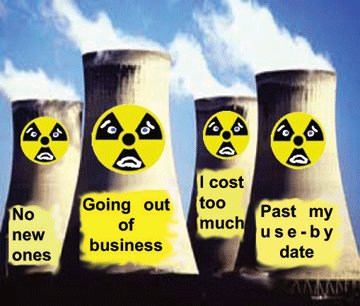
 Promises of easier nuclear construction fall short, Tri City Herald, BY RAY HENRY Associated Press July 26, 2014 WAYNESBORO, GA. The U.S. nuclear industry has started building its first new plants in decades using prefabricated Lego-like blocks meant to save time and money and revive the once promising energy source.
So far, it’s not working.
Quality and cost problems have cropped up again, raising questions about whether nuclear power will ever be able to compete with other electricity sources. The first two reactors built after a 16-year lull, Southern Co.’s Vogtle plant in Georgia and SCANA Corp.’s VC Summer plant in South Carolina, are being assembled in large modules. Large chunks of the modules are built off-site, in an effort to improve quality and avoid the chronic cost overruns that all but killed the nuclear industry when the first wave of plants was being built in the 1960s and 1970s.
Analysts say engineers created designs that were hard or impossible to make, according to interviews and regulatory filings reviewed by The Associated Press. The factory in Louisiana that constructed the prefabricated sections struggled to meet strict quality rules. Utility companies got early warnings but proved unable to avoid the problems. Now the firms leading the project are phasing out the Louisiana factory for work on the biggest modules and contracting with new manufacturers………
Inspectors for the U.S. Nuclear Regulatory Commission halted their first review of the plant the following month, saying it was not ready for in-depth scrutiny. Follow-up inspections found more issues with the plant’s quality assurance programs. NRC officials proposed a $36,400 fine against The Shaw Group for firing a quality insurance supervisor elsewhere in its company who warned a potentially faulty part may have been shipped to a project in New Mexico. The fine was dropped after the company agreed to changes. The agency also said workers at the Lake Charles facility feared raising safety and quality concerns to their supervisors………http://www.tri-cityherald.com/2014/07/26/3079384/promises-of-easier-nuclear-construction.html?sp=/99/915/
New book: Mad Science -THE NUCLEAR POWER EXPERIMENT
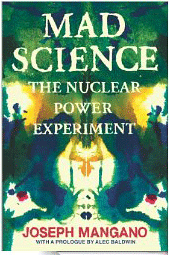 Mad Science THE NUCLEAR POWER EXPERIMENT Joseph Mangano http://www.orbooks.com/catalog/mad-science/ Foreword by Alec Baldwin
“Joe Mangano is the constant, tireless voice that has helped keep me linked to reports from the front lines of the battle to expose the staggering risks to public health posed by nuclear power . . . Joe has been one of the most dedicated, intelligent and even-handed public activists I have ever known. He has also proven to be one of the most effective, on a battlefield where gains are measured in inches, if not centimeters.” —from the foreword by Alec Baldwin
Will Americans once again play nuclear roulette?
Just one year after the Fukushima meltdown, all 54 reactors in Japan have been closed, and may never be restarted. Germany recently closed several reactors, and will shutter them all within a decade. Italy revoked its pledge to build new reactors, keeping that nation nuclear-free. All these decisions are based on the understanding that reactors are extremely dangerous and expensive.
In the U.S., the remnants of the once-overwhelmingly powerful nuclear lobby are making their last stand for “clean” nuclear energy. The sixty-year-old vision of power “too cheap to meter” (words originally uttered by a banker promoting the industry) is back. While other countries end their reliance on nuclear energy, Americans contemplate its revival, even as existing reactors, which produce a fifth of U.S. electricity, pass retirement age and are corroding.
In Mad Science, Joseph Mangano strips away the near-smothering layers of distortions and outright lies that permeate the massive propaganda campaigns on behalf of nuclear energy. He explores the history of the industry, with its origins in the Manhattan Project, through its heightening promotion during the Cold War and its entwinement with nuclear weapons.
Mad Science includes an account of nuclear accidents and meltdowns and their consequences, from Chernobyl to Santa Susana and beyond; as well as a point-by-point refutation of pro-nuke arguments. Atomic energy is unsafe – it deals with staggeringly poisonous substances at every stage of its creation – un-economical in the extreme and impractical.
Publication October 2012 • 336 pages
paperback ISBN 978-1-935928-85-0 • ebook ISBN 978-1-935928-86-7
Pacific islanders need support to invest in renewable energy transport
 Of course, as with the Abbott government, Australia barely gives any aid at all, so does this matter to Australia? Expert calls on Pacific donor community to focus on renewable energy for shipping There’s been a call for international donors to adjust their priorities and invest in sustainable sea transport to reduce the Pacific’s reliance on expensive and high-polluting fossil fuels.http://www.abc.net.au/news/2014-07-27/an-pacific-sea-transport/5627330
Dr Peter Nuttall, head of the sustainable sea transport research program at the University of the South Pacific, says the region’s strategies for moving to a low-carbon economy appear to be ignoring the need to reform the maritime sector. He says sea transport in the Pacific is facing a “looming crisis” due to the spiralling cost of fuel. “For Pacific island communities and countries, shipping is an absolute lifeline,” Dr Nuttall told the ABC. “For many small maritime communities, if you cannot get ships out to the islands, then those communities simply have no futures.” But Dr Nuttall says the donor community has focused on funding renewable energy projects in the electricity sector but ignored the need to do the same in the shipping industry. “We’re the most dependent region in the world on imported fossil fuel,” he said. “Seventy per cent, maybe as high as seventy-five per cent, of all fossil fuel burnt in the Pacific today is burnt for transport. “Many consultants (working for aid donors) come from a continental mindset where transport is the lowest user of energy and the whole concept that sea transport is critical is totally alien.” Dr Nuttall says the maritime sector is ripe for investment in more sustainable methods of transport. “There are a range of renewable energy technologies and there are a whole lot of things you can do with conventional diesel-powered ships or heavy fuel-powered ships to make them more efficient,” he said. Dr Nuttall was one of the organisers of the second Sustainable Sea Transport Talanoa conference, held recently at the University of the South Pacific in Suva.
1 This month

of the week – Australians for War Powers Reform (AWPR)
To see nuclear-related stories in greater depth and intensity
 Antinuclear