An Australian holiday for Fukushima children
 Fukushima children visit Australia A group of Japanese schoolchildren affected by the Fukushima Nuclear disaster has travelled to Australia this week, as part of a trip organised by charity project. By Helen Isbister World News Radio 1 AUG 2014
A group of Japanese schoolchildren affected by the Fukushima Nuclear disaster has travelled to Australia this week, as part of a trip organised by charity project.
The Rainbow Stay Project is designed to give the children a chance to do things they can no longer do at home, due to the fear of radiation poisoning……..The group of children, aged between ten and sixteen, are here on a charity-sponsored trip.
It is world away from the ongoing fear of radiation which affects their daily lives back home………..
Kazuki says the threat of radiation still affects her life in many ways.
“I was really sad because everything was polluted by radioactive material. I couldn’t swim in the sea anymore and my mum told me to stay inside and not touch the soil.”
There have been several trips like this since 2011, thanks to a Japanese woman living in Sydney.
Yukiko Hirano set up a Rainbow Stay Project with the aim of giving the children new hope.
” I tried to invite the Fukushima children to come over to Sydney. Beautiful environment, and no fear of radiation earthquake. They can enjoy entire holiday, without fearing those kind of things.”……..Andrew Vickers is from the Construction, Forestry, Mining and Energy Union which helped make the trip a reality.
“They can’t eat fish from the sea, they can’t pick up plants and flowers, they can’t touch any wild animals for fear of further radiation poisoning – so it’s not just coming to another country, it’s a totally new experience” http://www.sbs.com.au/news/article/2014/08/01/fukushima-children-visit-australia
Urgent need for new and thorough research on medical impacts of Fukushima nuclear catastrophe
 issue under the rug, predicting any harmful effects of the catastrophe is “unlikely.”
The UN panel made a very broad assumption about the worst nuclear catastrophe in history (or worst since Chernobyl) – and did this BEFORE research is done. However, a local health study raises alarm bells. Fukushima Medical University found 46% of local children have a pre-cancerous nodule or cyst, and 130 have thyroid cancer, vs. 3 expected. Incredibly, the University corrupts science by asserting the meltdown played no role in these high figures.
But Japanese studies must go far beyond childhood thyroid diseases. Japan isn’t the only site to study, as the fallout from the meltdown spread across the northern hemisphere.
In 2011, we estimated 13,983 excess U.S. deaths occurred in the 14 weeks after Fukushima, when fallout levels were highest – roughly the same after Chernobyl in 1986. We used only a sample of deaths available at that time, and cautioned not to conclude that fallout caused all of these deaths.
Final figures became available this week. The 2010-2011 change in deaths in the four months after Fukushima was +2.63%, vs. +1.54% for the rest of the year. This difference translates to 9,158 excess deaths – not an exact match for the 13,983 estimate, but a substantial spike nonetheless.
Again, without concluding that only Fukushima caused these deaths, some interesting patterns emerged. The five Pacific and West Coast states, with the greatest levels of Fukushima fallout in the U.S., had an especially large excess. So did the five neighboring states (Arizona, Idaho, Montana, Nevada, and Utah), which received the next highest levels.
Most of the spring 2011 mortality increase were people over 80. Many of these elderly were in frail health; one possibility is that the added exposure to radioactive poison sped the dying process.
Fukushima radiation is the same as fallout from atom bomb explosions, releasing over 100 chemicals not found in nature. The radioactive chemicals enter the body as a result of precipitation that gets into the food chain. Once in the body, these particles harm or kill cells, leading to disease or death.
Once-skeptical health officials now admit even low doses of radiation are harmful. Studies showed X-rays to pregnant women’s abdomens raised the risk of the child dying of cancer, ending the practice. Bomb fallout from Nevada caused up to 212,000 Americans to develop thyroid cancer. Nuclear weapons workers are at high risk for a large number of cancers.
Rather than the UN Committee making assumptions based on no research, medical research on changes in Japanese disease and death rates are needed – now, in all parts of Japan. Similar studies should be done in nations like Korea, China, eastern Russia, and the U.S. Not knowing Fukushima’s health toll only raises the chance that such a disaster will be repeated in the future.
Joseph Mangano is Executive Director of the Radiation and Public Health Project.
Janette D. Sherman MD is an internist and toxicologist, and editor of Chernobyl: Consequences of the Catastrophe for People and the Environment.
Silex dumped solar for nuclear: now nuclear has dumped Silex
 Silex tumbles after solar-nuclear switch hits market roadblock, REneweconomy By Giles Parkinson on 28 July 2014 Silex Systems decided in June to dump its solar business to focus on nuclear. But now the nuclear industry has dumped Silex.
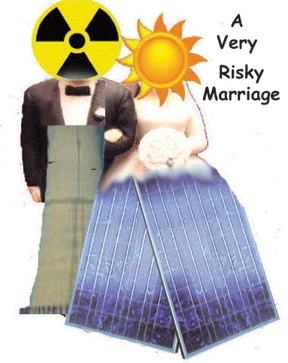 Less than one month after Australia’s Silex Systems placed its solar technology assets up for sale to focus on uranium enrichments, it has been dealt a massive blow by the suspension of its nuclear ambitions.
In late June, Silex sought to arrest its slumping share price and preserve its cash reserves by deciding to seek buyers and co-investors in its Solar Systems and Transluscent businesses.
CEO Michael Goldsworthy said at the time he wanted to focus on its laser uranium enrichment process, confident that its partnership with GE and Hitachi (GLE) could mean that the world’s first commercial laser enrichment plant could be in operation later this decade.
But those dreams are now on hold – indefinitely – after GLE said it would cease funding laser development projects at Lucas Heights in Sydney and put the main project facility near Oak Ridge in Tennessee in “cold storage”. Most contractor-based work on the project will be suspended, with the project facility near Oak Ridge, Tennessee to be placed in a safe storage mode, and GLE-funded activities at the laser development facility at Lucas Heights, Sydney to cease.
Silex appears to to have been shocked by the announcement, saying it was “unexpected” and GLE had already invested “hundreds of millions of dollars” in the project.
The share slump cames just days after “stock pickers” in Fairfax and News Ltd business pages rated Silex as the “best speculative stock” on the ASX. A day after a Fairfax collumnist called Silex “one of the best intelligent speculations on the ASX, the stock plunged rom 94c to a low of 49c. The stock has fallen from a 2009 high of $7.97 a share, and a year ago it was trading at more than $3.
Those brazen calls – and the optimism of its mostly retail shareholders – were based on the optimistic belief that the nuclear industry is about to rebound. But this is mostly based on hope – and an arrogant distrust of renewables – than any actual evidence.
GE CEO Jeff Immelt, who made the call to bring the research to a halt despite investing hundreds of millions, has said privately that nuclear is “too difficult” . (GE was one of the biggest suppliers of nuclear technology in the world.”
Goldsworthy says it is clear that the global nuclear industry is “still suffering the impacts of the Fukushima event” and the shutdown of the entire Japanese nuclear power plant fleet in 2011.
Demand for uranium has been slower to recover than expected and enrichment services are in significant oversupply, and the market could take “several years” to rebalance………..http://reneweconomy.com.au/2014/silex-tumbles-after-solar-nuclear-switch-hits-market-roadblock-51041
Queensland government willing to consider exporting uranium though Queensland Ports
 Cripps claims preference to export uranium from SA or NT, Australian Mining 1 August, 2014 Ben Hagemann With Queensland drumming up support for getting back into the uranium business, mines minster Andrew Cripps has not ruled out the prospect of exporting the radioactive resource from Queensland ports.
A statement from Queensland government yesterday said the Government had a “preference” for uranium to be exported from existing licensed ports.
Australia has only two licensed ports for the export of uranium, being Port Adelaide in South Australia (receiving ore from Olympic Dam), and Darwin in the Northern Territory (shipping ore from Ranger). Cripps said that the Queensland government would be willing to consider licensing a port within the state for shipping uranium.
Well if an application comes forward to assess a port for the export of uranium oxide, I mean, we’ll take it and we’ll assess it,” he said………
The Queensland government has invited tenders to reopen the Mary Kathleen mine, which has been closed since 1982.
Mary Kathleen is near Mt Isa in Northern Queensland, and bears rare earth elements such as lanthanum, cerium, praesodymium, neodymium, as well as uranium, all of which are present in tailings waiting to be processed.
Presently there are 7 million tonnes of tailings left at the Mary Kathleen mine, with an estimated 3 per cent rare earth purity……..http://www.miningaustralia.com.au/news/cripps-claims-preference-to-export-uranium-from-sa
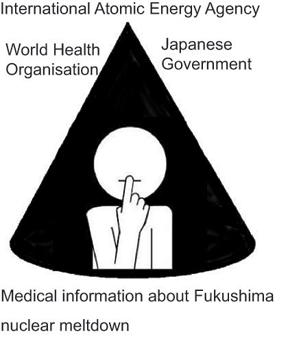
UN and Japan’s “cone of silence” on the medical effects of Fukushima nuclear meltdown
UN, Japan, Concealing Extent of Fukushima Catastrophe MWC News, By Sherwood Ross Friday, 01 August 2014 Japanese and United Nations authorities have placed “a cone of silence” over medical information an endangered Japanese public is entitled to have about the Fukushima nuclear plant meltdown.
“It is obvious that there is collaboration between the World Health Organization(WHO) and the International Atomic Energy Agency(IAEA) and also the Japanese government…to hide, to lie, and to cover-up vital medical information that must be made available to the Japanese population,” says Dr. Helen Caldicott, the medical doctor who has been showered with honors and awards for her long-time opposition to the dangers of nuclear power manufacture and nuclear war.
“Many doctors have been ordered not to inform their patients that their symptoms could be related to radiation, leaving them in a state of despair,” Dr.Caldicott says. (They) “need to know the truth about their situation and that of their children.”
 Dr. Caldicott, who has received 21 honorary doctorates for her work, says that to make matters worse, Japan Prime Minister Shinzo Abe “has passed a secrecy law which will almost certainly intimidate the media from keeping a very close watch over the tenuous (nuclear) plant.”
The government, she says, and Tokyo Electric Power Co.(TEPCO), “have been reluctant to divulge reliable data and information about radioactive releases, the ongoing state of the severely damaged reactors, the continuous outflow of radioactive water into the sea, and the possibility of a serious accident and radiation release in the event of another earthquake greater than 7 on the Richter scale which could well trigger the collapse of the seriously damaged buildings numbers 3 and 4.”
Damaged Building 3 contains over 100 tons of molten radioactive fuel which “would almost certainly release massive quantities of radioactive elements…threatening millions of people with radioactive contamination,” Dr. Caldicott points out.
She goes on to say that if precariously damaged Building 4 should collapse, 400 tons of extremely radioactive fuel will plunge 100 feet to the ground, releasing its cooling water with possible ignition of the fuel. This could release ten times more cesium than was released at Chernobyl or the equivalent of 14,000 Hiroshima-sized bombs.
Dr. Caldicott reminds that the IAEA Published reports after the April 26, 1986, meltdown of the nuclear plant in Chernobyl, Soviet Russia, that “there were no health effects due to radiation exposure.” This was an astonishing piece of misinformation as, according to one reliable report, by the year 2009, some 1 million Europeans had died. In Belarus alone, the percentage of healthy children dropped from 80% before the catastrophe to 20% afterwards.
What’s more, of the 800,000 healthy youngsters called “liquidators” brought in by the Government from around Russia to fight the burning reactor, within 19 years more than 120,000 were dead.
Dr. Caldicott urged the public to “demand that TEPCO and the Japanese government continually inform the public about the events that are and will be occurring at the Fukushima reactors, without cover-ups and denials of the facts.”
Should another major release of radiation occur, she said, the public must be informed immediately and evacuation begun immediately. http://mwcnews.net/focus/politics/44145-fukushima-catastrophe.html#sthash.5cgmPLZn.dpuf
Nuclear power could vanish in 50 years
The rise and fall of nuclear power, in 6 charts, Vox by Brad Plumer on August 1, 2014, Nuclear power is slowly going out of style. Back in 1996, atomic energy supplied 17.6 percent of the world’s electricity. Today that’s down to just 10.8 percent — and it could drop even further in the years ahead. That’s according to the World Nuclear Industry Status Report 2014, which charts the rise and fall of nuclear power over time.
What’s more, nuclear power has been eclipsed by other energy sources
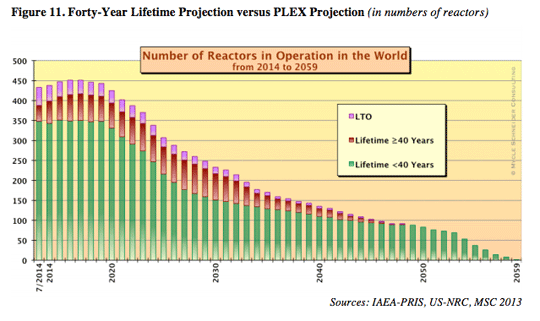
………….Without further action, nuclear power could vanish in 50 years The chart above shows how long the world’s existing reactors are likely to last in the decades ahead. By 2059, most of them are likely to be retired. That means, unless the world goes on a frenzy of new construction, nuclear power will nearly vanish by mid-century.
WE’D NEED TO BUILD 400 REACTORS BETWEEN NOW AND 2059 JUST TO MAINTAIN EXISTING CAPACITY
Here’s how the authors figure: Without new construction, the average age of the world’s nuclear reactors has now reached 28.5 years. Many reactors may shut down once they hit 40 years, although some will likely get extended for longer than that (at a cost of $1 billion or more).
It all depends on the country. In the United States, many reactors were initially licensed to last 40 years, although they can apply for a 20-year extension — and, so far, 72 of the 100 existing reactors have received government permission to keep operating for 60 years.
Eventually, however, all of the world’s current reactors will have to retire — as the chart above shows, the report pegs this date at sometime in the 2050s. That means the world will have to build around 394 additional reactors between now and then just to maintain existing capacity. And if nuclear power is to expand above current levels, we’d have to build more than that. http://www.vox.com/2014/8/1/5958943/nuclear-power-rise-fall-six-charts
How coal will kill the Great Barrier Reef
The Great Barrier Reef and the coal mine that could kill it, Guardian, Tim Flannery, 2 Aug 14 These are dark days for Australia’s Great Barrier Reef. On 29 July, the last major regulatory hurdle facing the development of Australia’s largest coal mine was removed by Greg Hunt, minister for the environment. The Carmichael coal mine, owned by India’s Adani Group, will cover 200 sq km and produce 60m tonnes of coal a year – enough to supply electricity for 100 million people. Located in Queensland’s Galilee Basin, 400km inland from the reef, it will require a major rail line, which is yet to receive final approval, to transport the coal, which must then be loaded on to ships at the ports of Hay Point and Abbot Point, near Gladstone on the Queensland coast, adjacent to the southern section of the reef. Both ports require dredging and expansion to manage the increased volume of shipping. Once aboard, the coal must be shipped safely through the coral labyrinth that is the Great Barrier Reef, and on to India, where it will be burned in great coal-fired power plants.
The proposed development will affect the reef at just about every stage. Indeed, so vast is the project’s reach that it is best thought of not as an Australian, or even an Australian-Indian project, but one of global impact and significance………..
Today, the Carmichael mine development is occurring adjacent to what is now a very sick Great Barrier Reef. A 2012 study established that around half of the coral composing the reef is already dead – killed by pesticide runoff, muddy sediment from land clearing, predatory starfish, coral bleaching and various other impacts. The coal mine development will add significant new pressures. First will come the dredging for the new ports. The 5m or more tonnes of mud, along with whatever toxins they contain, will be dug up, transported and dumped into the middle of the reef area. Some studies suggest that the suffocating sediment will not drift far enough to harm the majority of the reef. But who can say what impact tides, currents or cyclones, which are frequent in the area, will have on the muddy mass?
The raw coal itself will be another pollutant. Coal dust and coal fragments already find their way from stockpiles, conveyor belts and loaders into the waters of the reef. Indeed, existing coal loaders have already dumped enough coal for it to have spread along the length and breadth of the reef. In areas near the loaders, enough has accumulated to have a toxic effect on the corals that grow there.
There is also the ever-present possibility of a coal ship running aground on the reef……….
If the Carmichael coal mine is a global story, and the Great Barrier Reef a global asset, then the issue should not be left to Australia alone to decide. The citizens of the world deserve a say on whether their children should have the opportunity to see the wonder that is the reef. Opportunities to do this abound. Petitioning national governments to put climate change on the agenda of the G20 summit, to be held in Australia in November this year, is one. Pushing governments to play a constructive role at the 2015 climate negotiations in Paris is another, as is letting the Australian government know directly that everybody has a stake in the reef, and that it needs to act to secure its future. The Great Barrier Reef does not have to die in a greenhouse disaster like the one that devastated the world’s oceans 55 million years ago. But if we don’t act decisively, and soon, to stem our greenhouse gas emissions, it will. http://www.theguardian.com/environment/2014/aug/01/-sp-great-barrier-reef-and-coal-mine-could-kill-it
Renewable energy should be the ‘norm’ say Queenslanders
 Queenslanders want renewables to become the ‘norm’ http://reneweconomy.com.au/2014/queenslanders-want-renewables-to-become-the-norm-89672 By Giles Parkinson on 1 August 2014
That would mean that “alternative, renewable energy is a Queensland commodity. It is affordable, commercially viable and available to all Queenslanders. Our infrastructure supports these renewable energy solutions.”
The document also states: “Increasingly, Queenslanders are turning to renewable energy alternatives. In the coming decades, as new technologies emerge, cleaner alternative energy sources may help us become better and wiser at using natural resources so they are protected and last longer.”
Premier Campbell Newman hailed the plan as “a massive and exemplary exercise in listening and consulting which involved various discussion forums from summits and community think tanks to boardroom workshops and robust family debates.”
But Queenslanders shouldn’t get too excited about Newman’s LNP government making a sudden lunge towards clean energy.
Queensland may well have more rooftop solar PV than any other state – 1.1GW out of a country total of 3.4GW – but it has very few large scale renewable energy projects, and little prospect of more in the near term. Network operators have also introduced new rules that may prevent new solar installations from exporting their output back into the grid.
The Newman Government has constantly derided “green schemes”, such as the solar feed-in tariff, for contributing towards higher power prices, even though it has benefited from a huge increase in dividends from the state owned network operators derived from big increases in network costs.
The government also wants the renewable energy target brought to a halt, rather than expanded. This appears designed to accommodate the needs of the state-owned fossil fuel generators, Stanwell Corp and CS Energy, which have called for renewable support schemes to end.
Stanwell Corp, in particular, has been critical of the role that rooftop solar has played in lowering wholesale electricity prices and forcing its books into the red.
The Queensland Energy Minister, Mick McArdle, said in his submission to the RET Review panel, that efforts to reduce emissions should be delayed until the state is rich enough.
So, how will the Newman government respond to the desire of its constituents expressed in the Queensland Plan?
The document includes some suggestions about how Queenslanders can “turn their ideas into action” and “make our vision a reality”.
Specifically, the document recommends:
“Subscribe to local and international think tanks and keep up to date about alternative energy solutions and environmental issues.”
Well, that’s a start. We trust, however, that the Newman government is not suggesting the Institute of Public Affairs. We’d recommend The Australian Institute, or the Centre for Policy Development. And RenewEconomy.
1 This month

of the week – Australians for War Powers Reform (AWPR)
To see nuclear-related stories in greater depth and intensity
 Antinuclear