Solar employs, Nuclear destroys: still time to halt India uranium deal
Scott Ludlam Greens spokesperson for Nuclear Senator for WA S August 18, 2014 Australia will be directly complicit in fuelling the nuclear arms-race between India and Pakistan if reports are confirmed that a uranium deal with India is on the cards.
Prime Minister Abbott seems set to continue his high-profile series of international gaffes, missteps and humiliations, this one for the sole benefit of the mortally wounded uranium sector.
India’s scandal-prone nuclear industry has been plagued with accidents and near-misses at reactor sites; events including fires, floods, partial reactor collapses and more recently the construction of two Russian-designed plants in the tsunami-zone in the south of Tamil Nadu.
- Subrahmanyam, former head of the National Security Advisory Board in India, said: ‘it is to India’s advantage to categorise as many power reactors as possible as civilian ones to be refuelled by imported uranium and conserve our native uranium fuel for weapons-grade plutonium production’.
India first produced weapons-grade plutonium from a Canadian-supplied reactor it pledged to use only for ‘peaceful purposes’. Instead of fuelling this arms race, Australian industry should be partnering with India’s vibrant solar sector

Wastes and weapons risks of Small Modular Nuclear reactors (SMRs)
 One size doesn’t fit all: Social priorities and technical conflicts for small modular reactors Science Direct,

2014.04.15 .
“…………..Waste reduction and proliferation risk
One way that designers have tried to reduce the quantity of radioactive waste generated has been to move to reactors that use fast neutrons.23 Because a significant fraction of their energy is released through the in situ breeding of fuel, fast reactors do require far less uranium to be loaded and produce less nuclear waste. Even in those cases where the spent fuel unloaded from such an SMR is not reprocessed and ultimately prepared for final disposal, the quantity of waste generated would be significant reduced [107].
The total amount of plutonium generated with these designs, however, is much larger than for light water reactors. More importantly, the concentration of plutonium in the spent fuel is about 6–7 times higher than in LWR fuel. This characteristic translates directly into a higher risk of proliferation because would-be proliferators have to divert only a much smaller quantity of spent fuel to a clandestine reprocessing plant to produce adequate material to make one or more nuclear weapons.
Proponents of such SMRs usually claim that their designs are proliferation resistant because the plutonium in the spent fuel is not separated out routinely. However, this assertion assumes that the reactor and spent fuel are used as intended, and does not account for misuse or diversion. Indeed, the very definition of proliferation resistance from the IAEA—characteristics of a nuclear energy system that impede the diversion of undeclared production of nuclear material or misuse of technology by states in order to acquire nuclear weapons or other nuclear explosive devices [114]—involves the possibilities of misuse and diversion.
Further, despite the higher costs associated with reprocessing, there are many countries that persist with reprocessing spent fuel, including Russia and India. Many other countries have ambitious plans to embark on reprocessing. Further, outside of the United States, most fast spectrum SMRs are being designed to operate in a closed fuel cycle [43]. The high concentration of plutonium will make the reprocessing of spent fuel from SMRs that much more economically attractive. Reprocessing has traditionally been associated with greater proliferation risks and thus the widespread of adoption of the technology would enhance the risk of nuclear weapon proliferation
Waste reduction and safety
The use of fast neutron reactors to reduce the amount of waste generated also has implications for safety. In thermal reactors, the core is typically in its most reactive configuration when it is operating normally at full power. Any change to this configuration in an accident would therefore decrease the power being produced. In fast reactors by contrast, collapsing the fuel into a reduced volume increases the rate at which the chain reaction occurs. If this were to happen quickly enough, the pressure in the fuel would rise fast enough to lead to an explosion. This could fracture the protective barriers around the core, including the containment building, and release large fractions of the radioactive material in the reactor into the surroundings. Such a “core disassembly accident” (CDA) has therefore been an important concern among the fast reactor design community ever since the first fast neutron reactors were constructed [115]. CDA studies have been conducted for nearly all of the fast reactors constructed or proposed in the United States and Western Europe [116]. Core meltdown accidents can also occur without disassembly: two U.S. fast reactors have had partial core meltdowns.
Another safety problem that affects some fast reactors, including SMRs, is due to the use of molten sodium as coolant. Though sodium has some safety advantages, it reacts violently with water and burns if exposed to air.24 Further, when sodium absorbs a neutron, it is converted to an intensely radioactive isotope called sodium-24, a major problem when any component in the reactor has to be repaired. One of the persistent problems in sodium cooled fast reactors built so far has been the propensity for leaks to develop, especially in the steam generators. These have occurred in almost all countries and at various stages of the operational life, suggesting that there are fundamental reasons for such leaks [117]. These safety problems are likely to afflict SMRs that are based on the same principles as well.http://www.sciencedirect.com/science/article/pii/S2214629614000486
4.4. Proliferation resistance and economics
As discussed earlier, one avenue that has been pursued by SMR designers to improve proliferation resistance is through increasing the period between refueling. A good example of a reactor design that seeks to achieve greater proliferation resistance is the Atoms for Peace Reactor (AFPR-100). AFPR-100 is a 100 MW(e) reactor that was originally designed to have no need of on-site refueling [87]. Over the years, however, its design has been evolving (in part because of problems with the fuel that had not been envisaged) and therefore cannot be treated as finalized.25
The longer lifetime of the fuel—in this case, designed to be the lifetime of the reactor itself—comes at a price: increased fueling cost. The problem is that the operator of the reactor would have to pay upfront for two or three decades’ worth of fuel rather than being able to pay for annual or biennial loading of fuel at a time. A second factor driving up the cost is the higher uranium enrichment level needed to keep the reactor working through its lifetime. Together, these render the cost of fueling the reactor much more expensive. For example, the average enrichment level of fuel for the AFPR was about 11.3 percent [118]. This could result in a cost for uranium enrichment and fuel fabrication to be about $8000/kg as opposed to about $2500/kg for 4% enriched uranium. The total premium for the use of a larger upfront loading of uranium with higher enrichment depends on the details of the design, but we estimate that it could be of the order of $30/MWh more than a conventional LWR. This is a substantial economic disincentive.26 The case of “nuclear battery” type SMRs is likely to be similar………..
Table 1.
Generic SMR designs and the relationship of technical characteristics to various desirable goals; the implicit comparison is with standard-sized light water reactors.
| SMR family | Technical characteristic | Desirable criteria | |||
| Cost | Safety | Volume of waste | Proliferation risk | ||
| iPWR | Smaller size, lower fuel burnup | Higher | Increased | Larger | Increased |
| HTGR | Lower power density and higher enrichment level | Higher | Increased | Mixed impact | Mixed impact |
| Fast Reactors | Higher power density and higher fissile content, molten metal coolants | Higher | Decreased | Smaller | Increased |
http://www.sciencedirect.com/science/article/pii/S2214629614000486
Australia is bound to take back nuclear wastes, but govt hypocrisy continues about its destination
 Note that the Australian government has learned nothing from the Muckaty experience. They will still try to barter with Aboriginal communities – with decent living conditions as most Australians have now offered in exchange for radioactive trash dumping on Aboriginal land land.
Note that the government is still lying about the main purpose of the Lucas heights nuclear reactor – pretending that the tacked-on nuclear medicine facility is the main thing.
That’s nonsense – the Lucas Heights reactor was set up originally in 1958 as the precursor to nuclear weapons and nuclear power for Australia. Medical radionuclides can be obtained without a nuclear reactor.
 Australian authorities are searching for a site to store 14 tonnes of nuclear waste heading from overseas http://www.heraldsun.com.au/news/australian-authorities-are-searching-for-a-site-to-store-14-tonnes-of-nuclear-waste-heading-from-overseas/story-fni0fiyv-1227027497896 ELLEN WHINNETT NATIONAL POLITICAL EDITOR HERALD SUN AUGUST 18, 2014 A NATIONWIDE hunt is under way to find somewhere to store 28 containers of nuclear waste due to return to Australian shores by the end of next year.
The Federal Government is searching for a suitable site to permanently house the waste, which will be shipped back to Australia from France and the UK by the end of 2015.
The hunt follows the collapse in June of an agreement to store the waste on Aboriginal land at remote Muckaty Station in the Northern Territory.
The six cubic metres of treated waste will be held in stainless steel containers, which will weigh up to 14 tonnes. The containers will be returned to Australia in a purpose-built storage container about a third the size of a shipping container.
The Government is seeking a remote site which has low rainfall and is geologically stable, and has identified Central Australia as potentially the most suitable region. Tens of millions of dollars could be expected to be paid to any community that agrees to house the waste on their land.
Industry Minister Ian Macfarlane said the Government was looking for sites submitted by landowners.
He said several land councils in Central Australia had been invited to consider nominating a site. A national tender will be held if no site is nominated by the Northern Land Council or Central Land Council by September 30.
The Commonwealth Government owns land at Woomera, in outback South Australia, and has been considering it as a potential site for a nuclear waste dump since the Howard government.
“The Government is committed to ensuring Australia has an appropriate facility for the management of radioactive waste created within Australia, largely as a result of nuclear medicine production,’’ Mr Macfarlane said.
The waste was created by the now-defunct HIFAR and Moata nuclear reactors which operated at the Lucas Heights reactor in Sydney.
Under international agreements in the 1990s, Australia shipped the waste offshore to countries with more experience managing nuclear waste, including France, the UK and the US, for processing and storage. These countries reprocessed the waste, removing further radioactive materials from it before storing it.
The move has put pressure on the Government to find a permanent site to house the waste, and a further six drums of technological waste, generated during the reprocessing of our spent fuel.
French law does not permit the Australian waste to be held beyond 2015 and the Australian Government is not aware of any mechanism under which it could delay the return of the waste.
Tony Abbott’s plan to axe the Renewable Energy Target
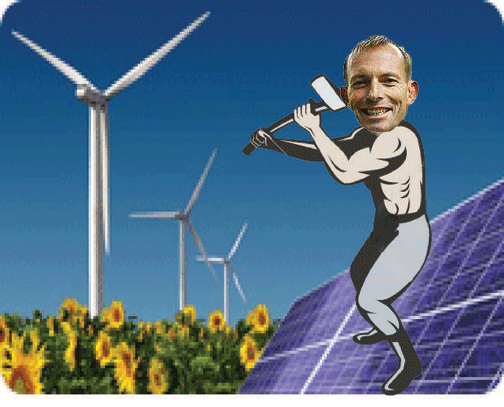 Abbott’s plan to axe RET Financial Review, PHILLIP COOREY Chief political correspondent, 18 Aug 14 The federal government is moving towards abolishing the Renewable Energy Target rather than scaling it back in a move that will cost almost $11 billion in proposed investment and which is at odds with the views of its own Environment Minister.
The Australian Financial Review understands Prime Minister Tony Abbott has asked businessman Dick Warburton, whom he handpicked after the election to review the RET, to do more work on the option of terminating the target altogether. This was after Mr Warburton’s review leant towards scaling back the RET.
Sources said Environment Minister Greg Hunt, who advocated scaling back the RET as a compromise, has been sidelined from the process and is understood to be unhappy. They said Mr Abbott, Treasurer Joe Hockey and Finance Minister Mathias Cormann are pushing the issue now.
A government source said when the government announced its decision, possibly before the end of this month, it was now “more likely’’ the RET will be abolished under a so-called “closed to new entrants scenario’’ in which existing contracts only would be honoured.
Given Clive Palmer has vowed to block any change to the RET until after the 2016 election, it remains unclear when the government could declare the RET terminated.
Independent modelling commissioned by the Climate Institute and other environmental groups, and which will be released Monday, found that under the termination scenario, coal-fired power generators would reap an extra $25 billion in profits between 2015 and 2030.
There would be no reduction to household power prices and carbon emissions would climb by 15 million tonnes a year on the back of a 9 percent increase in coal-fired power.
DIMINISHED INVESTMENTS
Abolishing the RET would diminish investment in renewable energy by $10.6 billion, said the modelling, conducted by consulting firm Jacobs…….
Miles George, managing director of renewable company Infigen Energy, said either scaling back or terminating the RET “would be devastating”.
He said the creation of sovereign risk would be significant and the very issue had been raised by prospective foreign investors, including Canadian pension funds which Mr Abbott sought to woo when abroad in June.
“Infigen’s shareholder base of over 20,000 investors has invested in renewable energy in Australia on the basis of a fixed target of 41,000 GWh by 2020,’’ Mr George said. “This is no different to investors in private public partnerships acquiring a toll road concession, or a port lease.
“If the Government pulls the rug from under institutional investors in renewable energy we shouldn’t expect those investors to come back to buy other infrastructure assets here, including the electricity networks and generation assets that the governments of NSW and Queensland are proposing to sell or lease.” http://www.afr.com/p/national/abbott_plan_to_axe_ret_H2znp8ix2CuwbJe6jyb5ZP
Australia is declared a military threat, by China

 China Declares Australia a Military Threat Over US Pact http://www.therealnewsmatters.com/2014/08/china-declares-australia-military.html By Joshua Philipp, Epoch Times , 17 Aug 14 China’s state-run media have declared Australia a threat to its national security, after Australia finalized a 25-year military pact with the United States.
The United States currently has 1,200 troops from the Marine Corps and Air Force training with Australian troops for humanitarian and disaster relief. The defense agreement will increase the number of U.S. troops at Darwin in northern Australia to 2,500.
The Chinese regime is none too pleased about the agreement, however.
Li Jie, rear admiral of China’s People’s Liberation Army Navy, told Want China Times that Australia could pressure China’s supply lines in the Strait of Malacca in a conflict over the South China Sea.
“Australia is therefore likely to become a threat to China’s national security,” it states.
Global Times reported that if a war broke out between China and Vietnam or the Philippines, the United States could deploy submarines and aircraft from Australia….
http://www.theepochtimes.com/n3/877760-china-declares-australia-a-military-threat-over-u-s-pact/
Increasing costs of safety problems in Europe’s aging nuclear reactors
 With exposure to radiation, high temperatures and pressure, the components of nuclear plants take a battering over time. “They can, for example, become more brittle, susceptible to cracking or less able to cope with temperature extremes,” said Anthony Froggatt, senior research fellow at London-based thinktank Chatham House.
Insight: The cost of caring for Europe’s elderly nuclear plants LONDON (Reuters)  18 Aug 14, – Europe’s ageing nuclear fleet will undergo more prolonged outages over the next few years, reducing the reliability of power supply and costing plant operators many millions of dollars. Continue reading
Hong Kong continues to restrict importing foodstuff from Japan’s irradiated areas
 The government of Hong Kong rejected Japanese request to lift restriction on Japanese imports http://fukushima-diary.com/2014/08/government-hong-kong-rejected-japanese-request-lift-restriction-japanese-imports/ Iori Mochizuki On 8/13/2014, Hayashi, the Minister of Agriculture, Forestry and Fisheries visited Hong Kong to request the government of Hong Kong to lift the restriction on Japanese imports however Ko Wing Man, the chief of the department of food and hygiene rejected the offer.
Since Fukushima accident, the government of Hong Kong stop importing vegetables, fruits, milk, milk based drinks and powdered milk from 5 prefectures to consist of Fukushima, Ibaraki, Tochigi, Gunma and Chiba.
Ko Wing Man commented “Lifting the restriction is difficult at this moment.”.
99% support for Australia’s Renewable Energy Target in submissions to the Review
 RET review swamped by pro-clean energy submissions, The Age, August 17, 2014 Peter Hannam Environment Editor, The Sydney Morning Herald The overwhelming majority of submissions received by the Abbott government’s hand-picked panel reviewing the Renewable Energy Target back its goals.
Analysis by the Clean Energy Council of the 865 detailed submissions found 754, or more than 87 per cent, in favour of the RET being retained or expanded. Of the rest, 55 were mixed or neutral, and 56 called for it to be abolished.
When the 23,272 community submissions are added, support swells closer to 99 per cent, the council said.
 “Five years ago when the [RET] was expanded with bipartisan support, Australians overwhelmingly wanted more clean energy – and that is more apparent now than ever,” Kane Thornton, the council’s acting chief executive, said.
Meanwhile, a separate Senate inquiry into the government’s plan to scrap the Australian Renewable Energy Agency found 125 of the 127 submissions in favour of retaining the body, the council said. ARENA provides grants to emerging clean energy technologies…. http://www.smh.com.au/business/carbon-economy/ret-review-swamped-by-proclean-energy-submissions-20140817-1050j1.html#ixzz3Amte0SEG
The high economic cost of reducing Renewable Energy Target
 Renewable Energy Target cut would hit budget: modelling, The Conversation, 18 Aug 14 Michelle Grattan Professorial Fellow at University of Canberra Reducing the renewable energy target would cost the federal budget about $680 million more to meet Australia’s target of 5% emissions reduction by 2020, according to modelling released today by climate and conservation groups.
The modelling found that cutting the RET would increase the profits of coal power stations while boosting the costs for the public through more pollution without reducing electricity prices for consumers.
It would see “the loss of billions of dollars of investment in the short term”; by further destabilising the policy environment for investors, it would drive up the costs of power sector investment in the future.
“Outright abolition of the RET would further increase pollution and undermine clean energy investment.”
The government has an inquiry underway into the RET. But Clive Palmer has said his senators will oppose any change in the term of this Parliament.
The modelling was done by Jacobs SKM and commissioned by the Climate Institute, the Australian Conservation Foundation and WWF Australia……..
….The modelling found electricity prices would not be reduced and could rise slightly if the RET were reduced – by 15% wholesale and 2.5 % retail on average in the period to 2030. “This is consistent with modelling commissioned by the government and studies conducted independently,” the report said.
“For a household consuming 6.5 MWh of electricity annually (NSW average), reducing the RET would add about $35 to the annual power bill, with most of this increase taking place after 2020. Abolition of the RET would add about $80 a year.”
Reducing the RET would diminish investment in renewable energy in Australia out to 2040 by $8 billion in present value terms. Scrapping it would increase the loss to $10.6 billion, the modelling found.
Reducing the target would mean 150 million extra tonnes of carbon pollution by 2030, and 240 million tonnes by 2040. “Higher levels of pollution lead to socialised costs we estimate conservatively to be $14 billion.” http://theconversation.com/renewable-energy-target-cut-would-hit-budget-modelling-30598
Pollutimg industries will gain from weakening of Australia’s Renewable Energy Target
Weaker RET = $10 Billion Windfall For Big, Dirty Energy http://www.energymatters.com.au/index.php?main_page=news_article&article_id=4445 18 Aug 14 It’s becoming even clearer why Big Energy in Australia want the Renewable Energy Target gone; or at least gutted.
According to modeling by Jacobs; even just reducing the national Renewable Energy Target (RET) would generate $10 billion in extra profit over the next 15 years for coal and gas-fired power generators – and households and businesses will pay more for their power.
Jacobs states reducing the large-scale RET in the way some power companies have recommended would net Energy Australia $1.9 billion in extra profit between 2015-2030 and Origin Energy would rake in $1.5 billion.
But there’s more – AGL’s extra chunk of change would be significantly boosted to $2.7 billion if its goal of buying government-owned Macquarie Generation succeeds.
The sting in the tail of this mega-profit bonanza will be borne, as always, by electricity consumers and the environment. Wholesale prices will rise an average 15 per cent and retail prices 2.5 per cent by 2030. The latter doesn’t include the inevitable price hikes in relation to network costs, which make up a good chunk of a bill.
Jacobs also state $8 billion in new renewables investment would be lost and Australia’s electricity related emissions would balloon by an extra 2 million tonnes a year by 2030 under the reduction scenario. Jacobs’ modeling was carried out for the Climate Institute, Australian Conservation Foundation and WWF-Australia. The full report can bedownloaded here (PDF).
While the Abbott Government may have its sights set on disemboweling the RET; if it should do so it would be at great risk. Many Australians are passionate about renewables and an overwhelming majority of submissions to the Renewable Energy Target Review were in support of the RET. After the black eyes the Government has worn over the recent Budget; treading on the RET could be the proverbial straw.
Still, it wouldn’t be the first time a government has acted in opposition to the will of the people and defied logic – a good reason for perhaps going solar now and taking advantage of the thousands of dollars in incentives while they are still available. For example, a 5kW solar power system can attract up to $3,120 in subsidies depending on installation location.
Maurice Newman’s anti-science slammed by Australia’s Chief Scientist
 Australia’s chief scientist tells PM’s business adviser to stick to economics , Guardian , Lenore Taylor, political editor, 18 Aug 14, Global cooling proponent Maurice Newman urged not to ‘trawl the internet’ for papers questioning scientific opinion Australia’s chief scientist has suggested Tony Abbott’s top business adviser should stick to economics rather than “trawl the internet” for papers questioning the overwhelming scientific opinion on global warming…….
“Almost everyone with knowledge would say Mr Newman’s comments are at odds with what they know, but people with no scientific knowledge persist in the view that they can find three or four papers from the hundreds and hundreds of papers on the subject and then dismiss the overwhelming bulk of evidence … it is a silly response to a very important issue.”
Chubb’s response is not the first time the prime minister’s scientific adviser has taken issue with his business adviser’s views. Continue reading
New South Wales: new Bill to enforce environmental protection laws
 Australia: Tough new environmental enforcement measures under NSW Bill Mondaq Clayton Utz, 17 August 2014 A range of new and much higher penalties, and a new power for the EPA to require bank guarantees for remediation, are the key features of the Protection of the Environment Legislation Amendment Bill 2014, introduced into the New South Wales Parliament on Tuesday.
If passed, the Bill will amend
- the Contaminated Land Management Act 1997;
- the Protection of the Environment Operations Act 1997; and
- the Radiation Control Act 1990.
Bank guarantees for remediation work
The EPA will be able to require financial assurances, such as a bank guarantee or bond, as part of a management order under the Contaminated Land Management Act. The EPA can set the amount, but it cannot exceed the EPA’s reasonable estimate of the total cost of carrying out the relevant action (including EPA supervision costs).
If the person fails to carry out the required action, the EPA can then do the action itself or contract someone else to do it, and then make a claim on the financial assurance to cover its costs.
The Court can also use this mechanism in proceedings under the Contaminated Land Management Act if it orders an offender to carry out a specified work or program for the restoration or enhancement of the environment……….
New penalties, including restorative justice
For some offences under the Contaminated Land Management Act and Radiation Control Act, the Land & Environment Court will be able to order new penalties, including ordering the offender:
- to publicise the offence and its environmental and other consequences;
- to notify specified persons, such as shareholders of the offence, via the annual report or other methods;
- to carry out a specified project for the restoration or enhancement of the environment in a public place or for the public benefit; or
- to carry out any social or community activity for the benefit of the community or persons that are adversely affected by the offence (a restorative justice activity) that the offender has agreed to carry out………
Waste tracking
It will now be an offence not to fit GPS tracking to waste transportation vehicles………http://www.mondaq.com/australia/x/334704/Environmental+Law/Tough+new+environmental+enforcement+measures+under+NSW+Bill
Democracy under threat in Tasmania
Proposed anti-protest laws a ‘brutal strategy’, Bob Brown tells Hobart rally http://www.abc.net.au/news/2014-08-16/hundreds-fill-the-hobart-city-hall-to-oppose-state-anti-protest/5675720 17 Aug 2014, Hundreds of people who rallied in Tasmania today against proposed anti-protest laws have been warned the State Government intends to misuse the prison system. More than 500 people packed into Hobart’s City Hall to protest against laws that would see on-the-spot fines and jail sentences for people who disrupt workplaces.
Former Greens leader Bob Brown labelled the laws discriminatory and out-of-balance, telling the crowd that: “These laws would have jailed Gandhi and Jesus Christ himself.”
Many see the laws as aimed at anti-forestry protesters, who have disrupted logging in state forests by protest actions.
Richard Griggs from Civil Liberties Australia told the rally the proposed laws would create mandatory prison sentences for people who on two occasions gathered on public land to protest, if they slowed or hindered a vehicle registered to a business.
“This is a misuse of the prison system by our Government. Prisons should be used by government to make the community safer, not as a way to frighten the community into silence,” he said. He said competing rights of workers to enter their workplaces, and those of people have a right to protest, were currently managed by the laws of trespass and public nuisance.
Mr Griggs said people were at the rally to stand up for the right to peaceful protests, which was a fundamental democratic freedom. Greg Barns from Australian Lawyers Alliance agreed, saying: “You can be 18, 19 years of age, you’re fired up at a protest, and you decide to run into some business premises, you end up getting a mandatory conviction. I will not be bullied or cowered by their brutal strategy.”
Previously, the Greens have compared the laws to those of Nazi Germany, while Labor’s Lara Giddings has described the legislation as draconian.
The State Government rejects the criticisms. Resources Minister Paul Harriss said the protest showed there was no issue with peaceful demonstrations. “The legislation currently before the Parliament does in no way diminish or take away from the opportunity for anyone to peacefully and legally protest.” he said.
The bill has passed the Lower House and will now be considered by the independent-dominated Upper House.
Victoria’s Napthine govt governs for coal and gas lobbies, and against the environment
Sandi Keane: Citizens unite against Alcoa’s dirty brown coal mine and pitiful power plant
The Victorian Napthine Government’s dismal record on stewardship of the environment is only equalled by its blatant disregard for the health and welfare of some of its citizens — especially the most vulnerable, our children. In May this year, with its smelter operation due to close this month, Alcoa was issued a fresh licence to generate and sell its electricity into the grid. This filthy, sulphur-belching brown coal plant at Angelsea on Victoria’s iconic Great Ocean Road – now up for sale – operates just over one kilometre from a primary school and 500 metres from residents’ homes.
This is the Government that demanded two kilometre setbacks for clean energy wind farms. In spite of the 2011 Senate finding and twenty reviews since proving no link between wind turbines and illness, the Government’s complicity in fostering these debunked claims saw an estimated $3 billion in wind investment go into free-fall.
So much for Victoria’s slice of the future low carbon economy. That’s the price Victorians and future generations will pay for the lax donor laws in this country that allow vested interests, like mining and developers, to launder millions into Liberal party campaign coffers through so-called trusts (as recently revealed by ICAC in New South Wales) and, thus, dictate policy outcomes. …
Denis Napthine once damned the Labor Government as “hypocritical when it comes to climate change” but has watered down the bilateral agreement with the former Labor Government of a 20 per cent reduction in emissions by 2020 to just “aspirational” only. As the saying goes: ‘If you take the King’s shilling, you do the King’s bidding.’
Profits for EnergyAustralia, AGL, and Origin Energy if RET is cut
 Renewable Energy Target cut would hit budget: modelling, The Conversation, 18 Aug 14 Michelle Grattan Professorial Fellow at University of Canberra “……..The current arrangement (including the large-scale RET plus existing hydro and small-scale solar PV panels) would lead to about 28% of national electricity coming from renewables by 2020-21. The modelling looked at capping it at 20% (the “reduced” scenario) as well as abolishing the RET altogether.
Reduction of the large-scale RET as proposed by some power companies would bring $8 billion extra profit to coal and $2 billion to gas generators (net present value of future profits 2015-30).
Under current ownership arrangements, EnergyAustralia is the company that would stand to gain the most. Its potential extra profit would be about $1.9 billion if the RET were reduced (and $2.2 billion if it was abolished).
But “if AGL purchases Macquarie Generation, it would become by far the biggest beneficiary of reducing the RET”, with combined extra profits of $2.7 billion if the RET were reduced.
“Origin Energy’s total extra profit would be about $1.5 billion. Origin owns the power station that would emit the largest amount of additional pollution under a reduced RET.” ……..http://theconversation.com/renewable-energy-target-cut-would-hit-budget-modelling-30598
1 This month

of the week – Australians for War Powers Reform (AWPR)
To see nuclear-related stories in greater depth and intensity
 Antinuclear