Naoto Kan, former Japan P.M. goes to Ranger uranium mine, warning against the nuclear industry
MR Kan says he wants to learn first hand about the situation at Ranger, having become aware of the debate over its future. ERA will not disclose its overseas customers, citing commercial confidentiality.
But the World Nuclear Association says Ranger has supplied the nuclear industries of South Korea, China, Britain, France, Germany, Spain, Sweden, and the US as well as Japan.
The risks of expanding the mine’s operations were highlighted on December 7 last year, when a so-called leach tank failed, discharging toxic uranium ore leachate over the site.
The federal government suspended Ranger’s operations while an inquiry was held, but gave the green light for resumption last month after an interim report found “no adverse environmental impact on human health or Kakadu National Park as a result of the incident”,
But a groundwater analysis prepared as part of the investigation conceded there was “insufficient post-spill data to either support or refute that the Leach Tank 1 spill in December last year entered the groundwater underlying the plant.”
Over the 34 years of the mine’s operation, there have been about 200 incidents of leaks, spills or other breaches of its operating licence, according to the Gundjeihmi Aboriginal Corporation which represents the Mirarr.
NT Environment Centre anti-nuclear campaigner Lauren Mellor says Mr Kan’s visit should be a “powerful reminder to the Australian government” to look at weak regulation of the industry and “really re-evaluate our role in that industry”….. http://www.smh.com.au/federal-politics/former-japan-pm-to-campaign-against-australias-uranium-20140822-106y4k.html#ixzz3BAEaqiaC
Typhoon heading for Fukushima nuclear plant area
Once-In-A-Decade Typhoon Heads For Japan Nuclear Plant Earth Changes Media August 22, 2014 Tokyo (AFP) – A typhoon described as the “strongest in 10 years” closed in on Japan on Wednesday, on a path that will take it towards the precarious Fukushima nuclear power plant.
Tokyo and surrounding areas were hit by violent winds and heavy rains in the early hours of Wednesday morning as Typhoon Wipha moved northeast off the coast of central Japan. Continue reading
Sad news for the nuclear free movement. Vale Mrs Wingfield.
Suzanne Haseldine wunyie@gmail.com 22 Aug 14, After an amazing life fighting for country and culture Kokatha Elder Mrs Wingfield passed away at her home in Port Augusta on August 8,2014.
Mrs Wingfield experienced first hand the impacts of the nuclear testing in the South Australian desert. She dedicated her life to protecting her desert country and future generations from the effects of the nuclear industry. At Cane Grass Swamp in the early 1980s she lay in front of bulldozers to try and stop the construction of the Olympic Dam uranium mine. Her tireless work continued in the 1990s with the Kupa Piti Kungka Tjuta, a senior women’s council based in Coober Pedy who led and won a successful campaign against the federal government’s plan for a nuclear waste dump in SA.
Mrs Wingfield worked with people and groups of many backgrounds, she traveled extensively to attend forums and events and lobby politicians. In 2009 she was made honorary president of the Australian Nuclear Free Alliance in recognition of her significant involvement. Mrs Wingfield will be widely remembered and acknowledged for her contribution to the nuclear free and peace movements in Australia and worldwide. Her resilience, passion and dedication remains an inspiration to everyone that met her.
May she Rest in Peace.
Funeral details: Friday August 29, 2014. 11am at the Lutheran Church, cnr of Dartmouth and Fern St, Port Augusta. The family have asked that everyone feel welcome to attend.
You can send a message to Mrs Wingfield family: 2 Cain Street, Port Augusta SA 5700.
Memories or photos to be passed on to the family when appropriate, can be emailed to: wunyie@gmail.com
Financial contributions towards Mrs Wingfield’s wake would also be greatly appreciated by her family and friends. Donate to:
Janice Wingfield Commonwealth Bank SAV BSB: 065507 AC: 10213429
China demonstrates the success of wind energy compared to nuclear
Which Is More Scalable, Nuclear Energy Or Wind Energy? Forbes, 22 Aug 14 Answer by Mike Barnard, Senior Fellow – Wind, E&PI,on Quora,
 China is the true experiment for maximum scalability of nuclear vs wind. It has a tremendous gap between demand and generation. It can mostly ignore democracy and social license for nuclear. It is building both wind and nuclear as rapidly as possible. It has been on a crash course for both for about the same period of time. It has bypassed most of the regulatory red tape for nuclear.
 So how is it doing?
- China turned on just over 16 GW of nameplate capacity of wind generation in 2013 according to the Global Wind Energy Council.
- Over the four years of 2010 to 2014, China managed to put 4.7 GW of nuclear intooperation at the Qinshan Phase II, Ling Ao Phase II, Ningde, Hongyanhe and Yangjiang plants. This is not their stated plans for nuclear, which had them building almost double this in 2013 alone and around 28 GW by 2015, but the actual plants put into production. The variance between the nuclear roadmap and nuclear reality in China is following the trajectory of nuclear buildout worldwide: delays, cost overruns, and unmet expectations.
- Modern wind turbines have a median 40.35% capacity factor and exceed 50% in the best wind resources according to the US National Renewable Energy Laboratory (NREL) who track the actuals on this sort of thing.
- Taking similarly sourced numbers for nuclear capacity factor from the Nuclear Energy Institute, we see 90.9% capacity factors for nuclear reactors. These are apples-to-apples statistics from the same country.
Running the math, that’s about 6.5 GW of real capacity of wind energy in one year vs 4.3 GW of real capacity for nuclear over four years. That’s roughly six times more real wind energy capacity than nuclear per year. 2014 might be better than average as perhaps 2 GW have been made operational this year. We’ll see what reality brings as wind energy is being expanded rapidly as well. So far nuclear is losing the race badly.
No other geography is capable of building as much nuclear per capita as China is. In the most pro-nuclear geography in the world with the most relaxed regulatory regime, the nuclear industry is being outstripped by the wind industry…………http://www.forbes.com/sites/quora/2014/08/22/which-is-more-scalable-nuclear-energy-or-wind-energy/
NUCLEAR POLITICS in JAPAN
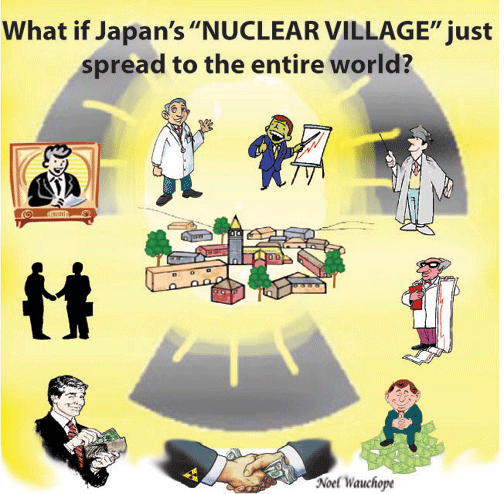
World is moving away from nuclear power, says former Prime Minister of Japan
Former Japanese PM Naoto Kan urges Australia to wean world off uranium, focus on renewables http://www.abc.net.au/news/2014-08-22/move-towards-renewables-former-japanese-pm-tells-australia/5691118 By Kate Wild and Xavier La Canna
Japan’s prime minister during the Fukushima disaster says Australia should be trying to wean other countries away from nuclear power, not increase exports of uranium.
Naoto Kan, who was prime minister from June 2010 to August 2011 is in Australia to lobby for a greater use of renewable energy sources.
He said the world was moving away from nuclear power, and Australia should not get in the way of that.
“Rather than looking at making contributions through exporting and making it more possible for more countries to be relying on nuclear power, all countries including Australia should be making efforts to do what can be done to reduce such dependence on nuclear power,” Mr Kan said.
“I hope that Australia can be exporting not uranium or coal for example, but electricity created through renewable sources,” he said.
When he was Japanese PM, representing the Democratic party of Japan, a tsunami caused a nuclear incident in which three nuclear reactors melted down at the Fukushima nuclear power plant and forced widespread evacuations.
“We were very close to the scenario of having to evacuate people in a 250 kilometre radius,” he said.
“This would have included also Tokyo, which would mean 40 per cent of the entire Japanese population – close to 50 million people.”
His party initiated policies to see nuclear power phased out in Japan by the 2030s, but this policy was overturned by the Liberal Democratic Power, which regained office in 2012.
Australia is thought to have the world’s largest uranium resources, and mines exist in the Northern Territory and South Australia, while Queensland recently lifted a 30-year ban on uranium mining.
Western Australia is also looking to develop its uranium industry.
Prime Minister Tony Abbott will soon travel to India to finalise a deal for Australia to sell uranium to their energy-hungry economy for the first time.
Wind energy is growing rapidly while nuclear is going backwards.
Which Is More Scalable, Nuclear Energy Or Wind Energy? Forbes, 22 Aug 14 Answer by Mike Barnard, Senior Fellow – Wind, E&PI,on Quora, “………… India is often touted as another great country for buildout of nuclear. Its track record is worse than China’s; it only has a total of 4.2 GW of nuclear generation capacity in operation after decades meanwhile it built 1.7 GW of wind energy in 2013 alone.
Unlike nuclear power, most countries are perfectly capable of building wind farms and are doing just that, with utility-scale wind generation in 100 states globally so far. For the past five years, wind energy has averaged 40 GW of new operational nameplate capacity according to GWEC or 16 GW of median capacity and that is expected to grow.
Meanwhile, globally nuclear capacity has diminished and is expected to continue to diminish for the next several years as France shuts off 33% of its fleet in favour of mostly wind energy, Germany shuts off its fleet entirely,Ontario intends to move from 55% to 42% supply from nuclear according to its draft long term energy plan and aging reactors globally reach end-of-life with no economic refurbishment possible. Japan will be able to restart at most a third of the reactors it shut down after Fukushima according to knowledgeable sources.
In empirical terms, it doesn’t matter what anybody claims is theoretically possible: wind energy is growing rapidly while nuclear is going backwards. That’s reality……..
Pragmatic reality limits nuclear generation growth mostly to China and India because they both are existing nuclear powers and both have vast disparity between demand and supply so will pay a premium for expensive nuclear energy. Similarly, refurbishing reactors in the developed world often makes economic sense. But there are a lot of other factors also hindering nuclear growth that don’t apply to renewables. http://www.forbes.com/sites/quora/2014/08/22/which-is-more-scalable-nuclear-energy-or-wind-energy/
In selling uranium to India, Australia will violate its international obligations
 Seen from the perspective of adherence to non-proliferation norms and commitments If Australia exports uranium to India, Australia would violate its obligations of the Treaty of Rarotonga, which binds it from not indulging in such trade. Article 4 of the Rarotonga Treaty requires India to comply with safeguards requirements of Article III(1) of the Nuclear Nonproliferation Treaty (NPT). Article III(1) of the NPT is about reaching a comprehensive safeguards agreement with IAEA. Instead, India has only acknowledged safeguards on certain foreign-supplied reactors and facilities. India’s safeguards agreement is based upon the IAEA’s ‘facility specific’ safeguards.
Australian uranium sale to India will be subjected to weak monitoring safeguards or ‘facility specific’ of IAEA, contrary to nuclear deals Australia has with other countries
AUSTRALIAN PROSPECTIVE NUCLEAR TRADE WITH INDIA – THE CONTROVERSY http://www.eurasiareview.com/21082014-australian-prospective-nuclear-trade-india-controversy/AUGUST 21, 2014 EURASIA REVIEW BY HASAN EHTISHAM
These protests have been a regular feature in Koodankulam (Tamil Nadu), Jaitapur (Maharashtra) and Gorakhpur (Haryana) and at least five activists have lost their lives since 2010 in their struggle against the Indian government’s decision without taking the affected parties on board. Radioactive waste from uranium mining in the country’s east is reportedly affecting adjacent communities. Thousands of Indians suffer from the effects of uranium mining as related to poor technical and management practices. Continue reading
Power structure that supports nuclear power – as seen in Japan’s Fukushima disaster
Life in a Fukushima world Asian Currents, By Adam Broinowski, 21 Aug 14 The focus of sovereign intervention in response to the nuclear meltdowns since 3/11 risks long-term consequences for short-term gains.The meltdowns of the Fukushima Daiichi Nuclear Power Plant (NPP) since the earthquake and tsunami of 11 March 2011 (3/11) have exposed not only the dangers of nuclear power but the visibility of the power structure that supports it.
The focus of sovereign intervention has demonstrated the major priorities of this power structure, while local responses have sought to increase public knowledge of the nuclear industry and the health dangers from radiation exposures. Given the myriad factors in play, it is useful to consider the disaster in terms of immunity.
Three main forms of immunity are applicable to the disaster. Continue reading
Tony Abbott does not have the international clout to keep Climate Change off G20
 Australian opposition ‘unlikely’ to keep climate off G20 agenda RTCC 20 August 2014, Australia lacks gravitas to cast off climate talk, with US and China likely to put pressure on Tony Abbott By Sophie Yeo
Climate change is likely to be discussed at the G20 summit in Brisbane, despite Australia’s decision to leave it off the agenda. This is the finding of a new report, released this week by the centre-right think-tank Committee for Economic Development in Australia (CEDA).
Australia lacks the diplomatic weight to dismiss the issue while heavyweights such as China and the US are ramping up their own efforts to combat carbon pollution, say the authors.
“As a middle-power economy, Australia’s leadership and influence may be limited,” writes Sarah-Jane Derby, senior economist at CEDA, in the report.
“For example, members may be receptive to Australia introducing new ideas and changing the agenda, but without the support of players who are more powerful, these ideas may not be taken seriously.”
Climate criticism
Australia prime minister Tony Abbott has faced heavy criticism from environmentalists over his decision to axe many of the country’s flagship climate policies, such as the tax on carbon.
Reports from Australia suggest he knocked climate change off the G20 agenda as it did not fit with the summit’s focus on economic growth……. This year’s G20 takes place two weeks before a major UN summit on climate change takes place in the Peruvian capital, Lima.
The UN meets annually to work towards a solution on climate change, but the G20 provides opportunities for “open discussions” between the world’s major economic players that are not possible during international meetings, says the report.
It adds that the tight economic focus of the Brisbane summit could add value to climate change discussions, by considering the financial risks and consequences of heating the planet……
In June, the US ambassador to Australia said that Obama planned on raising climate change during the leaders’ summit and at “every international forum”, as it was a critical issue “not only to Americans but to the world”. – See more at: http://www.rtcc.org/2014/08/20/australian-opposition-unlikely-to-keep-climate-off-g20-agenda/#sthash.Gl6EU0Jf.dpuf
Australian Solar Council will campaign in marginal seats over Abbott’s broken promises on renewable energy
 Australian Solar Council attacks Prime Minister’s ‘broken promises’ on renewable energy support ABC News, By Matt Eaton, 21 Aug 14 The Australian Solar Council is beginning a campaign to target marginal federal seats over so-called broken promises on support for renewable energy.
Solar council CEO John Grimes has accused Prime Minister Tony Abbott and Treasurer Joe Hockey of breaking a series of election promises by moving to abolish the renewable energy target (RET).
“This comes as a big surprise to many people in the community,” Mr Grimes told 612 ABC Brisbane.
The RET scheme commits Australia to a target of generating 20 per cent of electricity from renewable sources by 2020.
“Before the election he [Mr Abbott] was committed to renewable energy, he was committed to the RET, he was committed to a million solar roofs,” Mr Grimes said.
“After the election, promise after promise broken, million solar roofs gone, the RET he wants abolished – he and Joe Hockey are working hard for that outcome……….
Mr Grimes said Mr Hunt and the Government would continue applying pressure to get their way.
“They will destroy any character, to stop this movement, to stop this gaining hold in the electorate,” he said.
“In that call, [Mr Hunt] told me that if I didn’t shut it down, that he would be launching a pointed, public attack at me and my character – that’s what he said to me on that call.”
Mr Grimes said Mr Hunt was under great pressure on the issue and needed to “attack his personal credibility”………http://www.abc.net.au/news/2014-08-21/solar-council-attacks-broken-promises-on-renewables/568606
Birth deformities near uranium mines must be investigated – court order
 The health issue came to the attention of the High Court earlier this year after pictures of Jadugora’s deformed children appeared in the Indian press. The court in February ordered Uranium Corp. to produce documents that might shed light on the health issues. The court noted then that children living near the mines in Jadugora are “born with swollen heads, blood disorders and skeletal distortions.”
India Court Orders Uranium Corp. to Probe Deformities Near Mines Bloomberg By Rakteem Katakey and Tom Lasseter Aug 20, 2014 India’s sole uranium mining company is being ordered by a regional court to disclose radiation levels and the presence of any heavy metals in soil and water in a cluster of villages with reports of unusual numbers of deformed and sick children.
 The order by the Jharkhand High Court also mandates thatUranium Corp. of India Ltd.explain how it ensures the safety of nearby civilian populations who may be exposed to its 193-acre (78-hectare) radioactive waste dump near the village of Jadugora in eastern India.
The move comes about a month after a Bloomberg News story chronicled the plight of parents living near the Uranium Corp. mines who are seeking answers to what’s sickening and killing so many of their kids. The story also reported that local residents routinely wander the unfenced dump sites and fish and bathe in a river that receives water flowing from the dumps, known as tailings ponds. The Bloomberg article was submitted to the judges of the High Court by Ananda Sen, the lawyer appointed by the court to review the case.
Uranium Corp. has denied its mining operations have anything to do with village health issues. In 2007, a survey of more than 2,100 households by an Indian physicians group found mothers in villages 1.5 miles from the mines reported congenital deformities more than 80 percent higher than the rates just 20 miles (32 kilometers) away, with reported child death rates from such abnormalities more than five times as high.
Independent Experts
Regulatory board rules that USA uranium company must release survey data
Uranium mining company must release survey data Argus Leader, KEVIN BURBACH August 20, 2014 RAPID CITY, S.D. (AP) — A mining company must release the results of a geological survey that opponents of its proposed uranium mine in western South Dakota say is necessary to ensure that local aquifers are protected, a federal licensing board of the Nuclear Regulatory Commission ruled Wednesday.
The Atomic Safety and Licensing Board continued its hearings Wednesday morning in Rapid City, where three federal judges are hearing challenges to a license granted to Powertech Uranium Corp. for its proposed Dewey-Burdock uranium mine.
The intervenors to the proposed mine — members of the Oglala Sioux Tribe and other concerned parties — had been pushing for data Powertech collected by drilling throughout the region to find concentrations of uranium ore, among other things. They’ve said enough data haven’t been studied to know if the region’s aquifers would be contaminated or depleted if the company were to mine.
Powertech plans to use a method known as in-situ uranium recovery, which would pump groundwater fortified with oxygen and carbon dioxide into the underground ore deposits to dissolve the uranium. The water would be pumped back to the surface, where the uranium would be extracted and sold to nuclear power plants.
Dr. Robert Moran, who testified at the request of the intervenors, said making the data available would allow the geologists to better understand how the region’s groundwater could be affected if the company starts mining in the area……..http://www.argusleader.com/story/news/2014/08/20/uranium-mining-company-must-release-survey-data/14355969/
From the beginning Abbott as P.M. was determined to kill the Renewable Energy Target
 Why the Renewable Energy Target never stood a chance, Smart Company, Thursday, 21 August 2014 GILES PARKINSON THE AUSTRALIAN FINANCIAL REVIEW, CONFIRMED THE WORST FEARS OF THE RENEWABLE ENERGY INDUSTRY IN A FRONT-PAGE STORY ON MONDAY, REPORTING THAT THE PANEL CHARGED WITH REVIEWING THE RENEWABLE ENERGY TARGET HAD BEEN “INSTRUCTED” BY PRIME MINISTER TONY ABBOTT TO LOOK AT WAYS TO SHUT DOWN THE SCHEME.
Shutting down the RET would bring to an end a $20 billion industry, cost thousands of jobs and force household and business bills to soar. But that is what the government has wanted from the beginning. It appointed a panel composed of climate sceptics, pro-nuclear advocates and fossil fuel lobbyists.
Killing the RET would satisfy the right-wing ideologues and deep-lined antipathy to renewable energy within the Abbott government. The AFR also confirms what has long been suspected: that Environment Minister Greg Hunt and Industry Minister Ian Macfarlane have been effectively sidelined from the process, despite the issue crossing into their portfolios.
The PM’s office has had carriage of the project since the start, and his intentions have long been clear. The secretarial support has been housed within Abbott’s office — and within reach of his principal business advisers, including climate sceptic and renewables opponent Maurice Newman and Abbott’s own energy adviser, former AGL executive Sarah McNamara.
Government insiders who have worked on the RET Review say the intent of the review has always been to cut the current 41,000GWh Renewable Energy Target to a maximum of 25,000GWh (what might be called a “true” 20% target), and possibly close it to new entrants altogether.
There were glimmers of hope that the RET could be retained, particularly when the panel’s own modeling dismissed the two major arguments to drop the target …….
A report released today by consulting firm Jacobs, on behalf of The Climate Institute, Australian Conservation Foundation and WWF Australia, says that the biggest beneficiaries to dumping the RET would be the fossil fuel generators. The Jacobs report suggested $8 billion in additional profits to coal-fired generators out to 2030 and an extra $2 billion to gas generators. The big three retailers, AGL Energy, Origin Energy and EnergyAustralia, would be the biggest beneficiaries………
Whether the Abbott government finally agrees with a scaled back target or an effective closure, any changes seem likely to be blocked in the Senate, where the Palmer United Party has promised to side with Labor and the Greens.
But it matters not. The large-scale renewable energy industry has already ground to a halt. No new projects have reached financial closure since the election of the Abbott government, and the Abbott government knows that even by doing nothing — apart from allowing continued uncertainty — no new projects will come to market.
Households will also be affected. They have so far contributed $12 billion of the $18 billion invested in renewables over recent years, initially driven by generous feed — in tariffs and then as a hedge against rising electricity prices once those tariffs were removed. The government, though, can remove some of those remaining incentives that defray the upfront cost of the system, without needing legislative changes. Industry experts say that could cause the rooftop solar market to fall by one-third or even half, with the loss of thousands of jobs.
Meanwhile, state governments — with huge vested interests in state-owned networks and generators — continue to act against renewables. The Western Australian government is even canvassing importing coal from Indonesia rather than moving to develop renewable energy projects at home, while in Queensland, businesses have been hit by a whopping $500-a-day service charge (essentially to read the meter) to dissuade them from installing solar………
ome international groups, such as US solar developer Recurrent Energy, have already packed up. Others, including Goldwind and Trina, have warned of the potential fallout, while Australian groups Pacific Hydro and Infigen Energy are directing their efforts overseas.
The Australian Solar Council echoed the CEC remarks. It is taking its “Save Solar” campaign to marginal electorates, with the first stop at the northern Brisbane seat of Petrie, held by the LNP’s Luke Howarth, this Thursday. The ability to make solar a potent political issue — many marginal electorates boast more than 20% solar penetration — appears to be their last resort.
“Solar saves money, creates jobs and shifts votes. The Abbott government is about to find out how much Australians love solar and the Renewable Energy Target,” American Solar Council CEO John Grimes said. http://www.smartcompany.com.au/growth/economy/43378-why-the-renewable-energy-target-never-stood-a-chance.html#
Pro fossil fuel trolls are bad enough: pro nuclear ones are worse
 Christina Macpherson My comment on What I learned from debating science with trolls, Business Spectator MICHAEL BROWN 20 AUG
Apologies if my comment might appear to be “off the subject”, though I think that it is not. First I welcome this article, clearly showing the illogicality, if not downright dishonesty of the climate sceptic trolls.
I am constantly the victim of Twitter trollsm because I campaign against the nuclear industry. It is ironic that these trolls use climate change as their argument for nuclear power, – and accuse me constantly of being in the pay of the coal and gas companies. That’s despite the fact that I repeatedly write and publish on websites on the critical need for action to address climate change
The pro nuclear trolls use two tactics. The main one is to abuse and discredit their targeted person. Thus I am not only “in the pay” of the fossil fuel industries, I am also a “murderer” – as well as being “stupid” “evil” ignorant” and have many other unpleasant attributes.
Their second tactic is to focus on narrowly technical matters – such as the intricacies of new (though not yet existing) Liquid Fluoride Thorium Reactors (LFTRs). The pretense is that this is the whole argument – the superiority of new nuclear technology. Subjects such as economics, ecology, public health, civil liberties, – these matters are “not relevant” to the discussion on nuclear power. In fact, only people with technical expertise can have a valid opinion. (Of course if atechnicallly qualified person should oppose nuclear power , then he or she must be “in the pay” of the fossil fuel industries). http://www.businessspectator.com.au/article/2014/8/20/policy-politics/what-i-learned-debating-science-trolls
1 This month

of the week – Australians for War Powers Reform (AWPR)
To see nuclear-related stories in greater depth and intensity
 Antinuclear