NUCLEAR POLITICS in JAPAN
Fukushima Disaster – Inside th World’s Most Dangerous Room Three and a half years after a catastrophic meltdown, Fukushima is far from fixed BY HANNAH BEECH/FUKUSHIMA PHOTOGRAPHS & VIDEO BY DOMINIC NAHR FOR TIME AUGUST 21, 2014
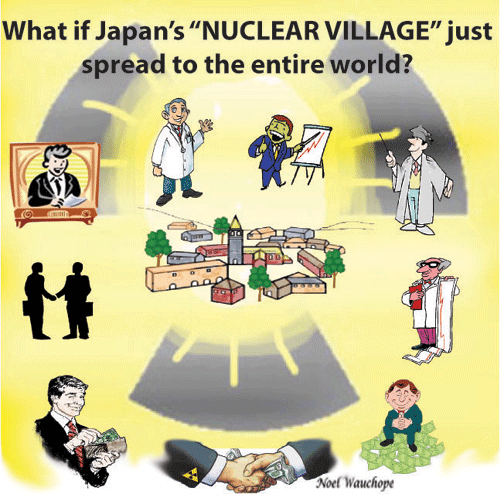
#………..Atomic power is entrenched in the Japanese government. In 2009 more than 70% of individual donations to the now ruling Liberal Democratic Party came from current or former electric-company executives. The LDP supports restarting Japan’s nuclear power plants, which were idled by a previous government. Toshikazu Okuya, director of the energy supply and demand office at the Ministry of Economy, Trade and Industry, frames the need to restart the reactors as both environmental and economic in a land starved of domestic energy resources. Japan’s greenhouse-gas emissions increased by 7% from 2010 to 2012 as imported fossil fuels replaced carbon-free nuclear. The government has estimated the direct impact of the nuclear shutdown to be $35.4 billion a year—this at a time when Abe is trying to revive the national economy. “We cannot say there is no risk,” Okuya admits of nuclear power. But “we need to try to take back public confidence.”
In Fukushima, that starts with mothers, an unlikely demographic that has become politically active and increasingly antinuclear. For months after the meltdown, Kayoko Hashimoto’s daughter wore a dosimeter to school, just as authorities urged. The radiation cloud had passed over the region, but locals were told the area was safe. So why was her daughter’s dosimeter recording high levels of radiation? Hashimoto bought a top-of-the-line dosimeter and began testing the route her daughter took to school. To her shock, she discovered tiny hot spots of radiation throughout the community: one by a bakery, another by a dog kennel, still another in the school parking lot. These levels were even higher than in some towns that had limited outdoor playtime because of fears over radiation exposure. The health effects of such small hot spots aren’t clear, but Hashimoto is worried. “People are scared of radioactivity,” she says, “but they don’t want to make a fuss or draw attention to themselves.”
Hashimoto has also campaigned against the storage of decontamination waste on school grounds. Piles of black plastic bags—filled with radiation-tainted topsoil and vegetation—are scattered across Fukushima. But no one wants a formal dumping ground near them. Even designating temporary storage sites for the bags is difficult, which is why schools have been used. The bags have a life span of a few years, and already some have grass and debris poking through. “It’s wrong to call this decontamination,” says nuclear analyst Kurasawa. “It’s just moving around contaminated waste.”
Some of the laborers in charge of that decontamination are poorly paid and trained; recruiters have even been known to target the homeless. At Fukushima Daiichi itself, three-quarters of the white-suited workers are subcontracted laborers. In March a contract worker died in an accident after it took an hour to get him to a hospital. “Before I was proud because I thought I was helping to save Japan,” says Sunny, who uses a nickname because he still works at the plant and isn’t supposed to speak out. “But it’s long hours and bad pay. The new foot soldiers don’t get any training, and the media say we’re constantly screwing up. I’ve lost my pride.”……http://time.com/worlds-most-dangerous-room/
August 22, 2014 -
Posted by Christina Macpherson |
Uncategorized
No comments yet.

 Antinuclear
Leave a comment