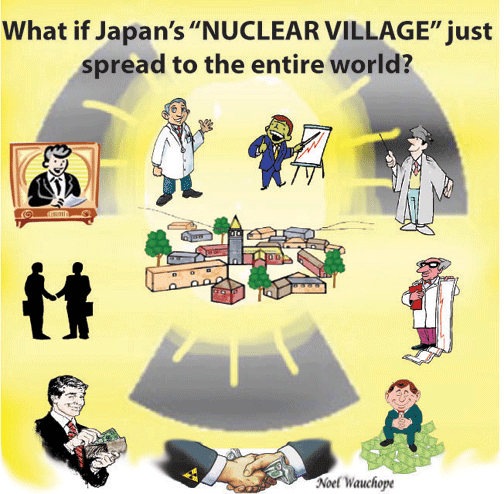
Power structure that supports nuclear power – as seen in Japan’s Fukushima disaster
 Life in a Fukushima world Asian Currents, By Adam Broinowski, 21 Aug 14 The focus of sovereign intervention in response to the nuclear meltdowns since 3/11 risks long-term consequences for short-term gains.The meltdowns of the Fukushima Daiichi Nuclear Power Plant (NPP) since the earthquake and tsunami of 11 March 2011 (3/11) have exposed not only the dangers of nuclear power but the visibility of the power structure that supports it.
The focus of sovereign intervention has demonstrated the major priorities of this power structure, while local responses have sought to increase public knowledge of the nuclear industry and the health dangers from radiation exposures. Given the myriad factors in play, it is useful to consider the disaster in terms of immunity.
Three main forms of immunity are applicable to the disaster.
First, is a biological immunity of the commons (social and ecological immunity), in relation to radioactive contamination dispersed from the ruptured power station.
Second is a political and economic form of immunity, which reflects the interests of a transnational ‘nuclear village’ (international institutional and local experts, bureaucrats from multiple levels of government including foreign governments, and executives from transnational corporations and media outlets).
Third is a military form of immunity, which overlaps the first two, and is informed by a strategic logic of national defence (and nuclear power).
Biological immunity Public responses to radioactive contamination dispersed into the commons can be touched on through the film Kibō no kuni(Land of hope 2012), by Japanese filmmaker Sono Shion, ……….Though not widely enough known, decades of research into radiation effects on living organisms have shown that ionising radioactive particles are misrecognised by metabolic systems. The distortion of cellular structures and functions through inhalation and ingestion causes chronically weakened immune systems, accelerated ageing, and the production of cancers, leukaemia, non-cancerous illnesses, fertility problems, early mortality and congenital malformations.
Given that nuclear reactors release toxic emissions even when operating normally, we see how peripheral communities which host nuclear reactors provide a buffer zone to absorb the violence of capital accumulation for centralised power.
Political and economic immunity The Fukushima nuclear crisis has exposed the extensive interdependency of the transnational ‘nuclear village’ (genshiryoku mura) and sovereign power in Japan. Against majority public opinion, the Abe government reversed the plan to phase-out nuclear power by 2030, and pushed for nuclear restarts and nuclear exports as a central pillar of its Basic Energy plan.
The new plan prioritised the protection of investors’ confidence in the Tokyo Electric Power Company (TEPCO), in nuclear power-related and construction industries, and in ‘Japan’s brand’…..While sharing nuclear waste, the government controlled the public narrative through such methods as spreading uncertainty, encouraging false assurance, and delay through ineffective ‘decommissioning and remediation’ programs. …..
National/military immunity…….It is not a secret that Japan has long considered procuring tactical nuclear weapons as long as they could be justified as the minimal force necessary for national defence. Although a signatory to the Non Proliferation Treaty (NPT), Japan has the fourth largest stockpile of ‘civilian’ plutonium and the largest stockpile of any non-nuclear weapons state.
It is claimed that Japan’s adherence to a costly nuclear reprocessing program (closing the nuclear fuel cycle) is to obtain ‘energy autonomy’. But achieving this could also make Japan invulnerable to energy sanctions, making it more feasible to leave the NPT and divert its plutonium into producing nuclear-tipped missiles.
The JSDF Anti-Ballistic Missile System (ABMS) has been developed to be ‘interoperable’ within the extended US ‘global missile shield’ and US global nuclear strike force. One factor in Abe’s collective security shift is to permit the use of this system. In fact, the ABMS is designed not to be defensive but ‘offensive’. Given the catastrophic destruction from a nuclear exchange, the actual use of a nuclearised capability could hardly stand up to the sovereign duty to protect the immunity of the people……….. Adam Broinowski is an Australian Research Council postdoctoral research fellow at the Australian National University. He is currently conducting an ARC research project entitled Contaminated life: Hibakusha in Japan in the nuclear age’. A version of this article was presented at the Asian Studies Association of Australia conference. http://asaablog.tumblr.com/post/94878108901/life-in-a-fukushima-world
No comments yet.
1 This month

of the week – Australians for War Powers Reform (AWPR)
To see nuclear-related stories in greater depth and intensity
 Antinuclear
Leave a comment