Australia’s pro nuclear lobby in the spotlight
Australia – uranium and nuclear power, Online opinion By Helen Caldicott -, 26 August 2014
“………… an  ardently pro-nuclear group in Adelaide has arisen led partly by Barry Brook a Professor of Climate change at Adelaide University, who is an adamant supporter of uranium mining and nuclear power in Australia and is promoting small modular reactors http://www.huffingtonpost.com/helen-caldicott/small-modular-reactors_b_5653378.html.
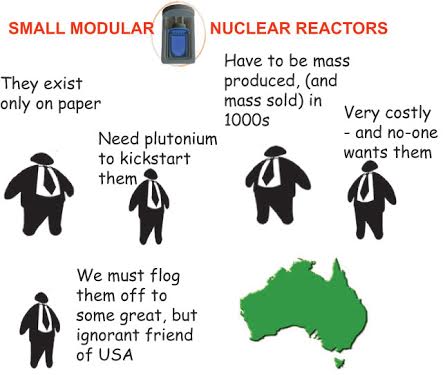
To make matters worse former Prime Minister Bob Hawke is advocating that Australia enrich uranium and become the repository for the world’s nuclear waste. “We would get an enormous stable flow of income which could be used for the benefit of the world and our own benefit” he says. Nuclear waste must be isolated from the environment for 1,000,000 years according to the US Environmental Protection Agency – a scientific impossibility.
These people clearly do not understand the carcinogenic and medical dangers arising at all stages of the nuclear fuel chain, nor do they understand radiobiology, genetics or teratology. Furthermore nuclear power does not alleviate global warming because it is supported by a massive industrial infrastructure which creates large quantities of global warming gases including CO2 and CFCs. It is hugely expensive – $12-15 billion per new reactor, and unable to gain funding from Wall Street it is totally government subsided. And most importantly, investment in nuclear power would take money away from desperately needed renewable energy.http://progressillinois.com/quick-hits/content/2014/05/18/report-new-nuclear-power-technology-would-siphon-resources-away-renewa.
Each large reactor contains as much radiation as 1000 Hiroshima bombs, and uranium becomes one billion times more radioactive in a reactor, creating 200 new dangerous radioactive isotopes……..http://www.onlineopinion.com.au/view.asp?article=16621
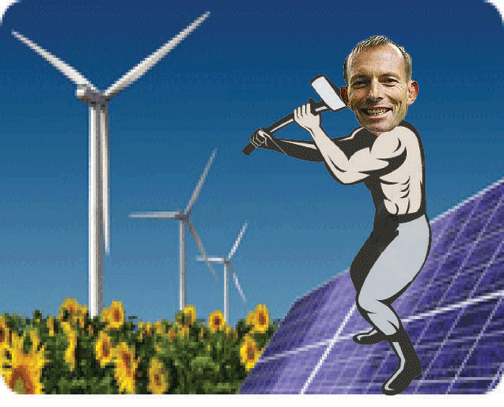
Pandering to coal-fired utility companies. Tony Abbott is out to destroy the Renewable Energy Target
Abbott and some in his Cabinet are close to the coal-fired electricity generators whose business model the target is helping to destroy.
Unused to competition, even competition that coal-fired generators knew was coming, they feel wronged.
But their beef is nothing to that of the less well-connected solar and wind generators who would be hung out to dry by a changed or axed target.
They’ve invested $11 billion to date on the understanding that both sides of politics meant what they said when they set the requirement at 41,000 gigawatt hours. Some will go bankrupt if the Renewable Energy Target is abandoned. Others will never invest in Australia again.
 Renewable energy target in the spotlight http://www.smh.com.au/comment/renewable-energy-target-in-the-spotlight-20140825-107zn1.html August 26, 2014 Peter Martin Economics Editor, The Age So concerned was Greg Hunt about the future of the solar industry that he went skydiving at Tooradin in his electorate of Flinders to back an industry he said was in freefall.
That was in 2008 when he was shadow environment minister. Labor had means tested its solar panel rebate. More recently, after the 2013 election, he promised $500 million for a One Million Solar Roofs program and a further $50 million each for a Solar Towns and Solar Schools program. He was going to plant 20 million trees and keep the Renewable Energy Target.
The budget killed his One Million Solar Roofs program, shrank his Solar Towns program to just over $2 million and made no mention of his Solar Schools program.
The Renewable Energy Target stands, just. Introduced by the Howard government in 2001, it forces electricity retailers to buy an increasing number of gigawatt hours of electricity from renewable sources peaking at 41,000 a year in 2020 and staying there for a decade.
It’s given foreign and Australian investors the confidence to build $10 billion of new wind and solar farms knowing there’ll be a market for what they produce.
Even better, it’s had bipartisan support. The targets are locked in by law.
Cutting or axing them mid stream would leave the investors stranded with little hope of making good on the money they’ve outlaid. Continue reading
Sabotage, defects, aging – shut down more nuclear reactors
 Nuclear power: reliably unreliable http://www.greenpeace.org/international/en/news/Blogs/nuclear-reaction/nuclear-power-reliably-unreliable/blog/50384/
With wind power filling the energy gap left by shutdown nuclear reactors in the UK, and police investigating allegations of sabotage at a reactor in Belgium, the myth of “reliable” nuclear energy is being exposed like never before. The nuclear industry tells us that nuclear power is a reliable energy source, that it offers “energy security“. Tell that to Belgium and the UK who are seeing significant parts of their nuclear fleet shutdown.
It’s been confirmed that the major damage that shut down Belgium’s Doel 4 reactor was caused by sabotage. Meanwhile, cracks found in two other reactors – Tihange 2 and Doel 3 – means they may never reopen. The three reactors make up over half of the country’s nuclear power output.
(Worryingly, there are 22 other reactors around the world that share the same design as Tihange 2 and Doel 3.)
In the UK, four nuclear reactors – at Heysham and Hartlepool – are out of action while defects are investigated.
There have previously been issues with nuclear power plants being closed in EU and USA at times of drought because of water shortages.
What fills the energy gap while these “reliable” nuclear reactors are shut down? Continue reading
‘Seed’, Australia’s first Indigenous youth climate network
Seed: Australia’s first Indigenous Youth Climate Network
After more than a year of hard work, today I’m joined by young Indigenous leaders from across the country to launch “Seed”, Australia’s first Indigenous youth climate network.
Our vision is to build a movement of Indigenous young people taking action on climate change. Seeds need to be planted in the earth in order to sprout, grow, and to produce more seeds – representing our strong connection to country as well as a cycle that’s been going on for tens of thousands of years. We’re building this movement for our country, for our people, and for our culture.
Our plans are exciting and ambitious. In October we’re holding the first ever Indigenous youth climate summit in Australia, where we will bring 50 young Aboriginal and Torres Strait Islander leaders together in Melbourne, to learn skills from some of our best climate and Indigenous campaigners and plant the first seeds of our movement. We need to ensure that Indigenous young people from all over Australia have the opportunity to get involved. Can you help us grow our movement by sharing this video with your family and friends?
https://www.facebook.com/AYCC.org.au/posts/10152653974384491
Aboriginal and Torres Strait Islander peoples have looked after this land sustainably for tens of thousands of years, and this gives us hope that we can do it again. This is why Indigenous communities need to be front and centre of our efforts to solve the climate change – and why at the AYCC it is our responsibility to ensure that Indigenous youth are leaders of our generation-wide movement. Click share our Seed launch video with your family and friends.
If you would like to attend the summit you can register here.
$15 billion in large scale renewable energy projects on hold, in uncertainty ov Renewable Energy Target
 The Implications of Axing RET Sourceable, Marc Howe, 26 Aug 14 The potential demise of the Renewable Energy Tax (RET) is already taking its toll on Australia’s clean energy sector, with major projects annulled due to developers’ concerns about their economic viability in the absence of government-backed incentives……..
A total of $15 billion in large scale renewable energy projects are reported to be on hold as a result of jitters over RET, with next to no new financing committed during the past 18 months.
With Australia’s clean power sector already so heavily shaken by uncertainty surrounding the future of RET, what will the implications be for the country’s broader energy sector should the Abbott government succeed in reducing it, or bringing about its total demise?
According to a recent study commissioned by environmental groups, a reduction in RET would come as a huge boon for coal and gas suppliers, who could look forward to an additional $10 billion in profits over the next decade and a half.
Modelling by the Jacobs Group for the Climate Institute, the Australian Conservation Foundation and WWF-Australia found that reducing RET’s goal to 20 per cent renewable energy by 2020 as advocated by EnergyAustralia and Origin Energy would provide huge economic benefits to these conventional power providers.
………While the big three power companies would reap huge gains from a watered down RET, Australia’s burgeoning yet still fledgling renewable energy sector would suffer from heavy adverse effects. Jacobs’ modelling also found that Australia would see a decline in new renewable energy investment of $8 billion in current dollar terms by 2040.
The Australian Solar Council said the country’s solar energy sector would be “gutted” by any reduction in RET, while a cancellation of the measure completely would have even more disastrous effects.
According to Australian Solar Council CEO John Grimes, the total removal of RET would halve demand for solar power almost immediately.
“If the government goes ahead with its plans to axe the RET, demand for solar will fall 40 – 50 per cent straight away,” he said. “Thousands of Australians will lose their jobs. Hundreds, if not thousands, of small businesses will shut up shop.”
– See more at: http://sourceable.net/the-implications-of-axing-ret/#sthash.X4jJVwt7.dpuf
New UN report finds that global warming could now be irreversible
 Global warming is already here and could be irreversible, UN panel says http://www.theguardian.com/environment/2014/aug/26/global-warming-irreversible-un-panel-report A 127-page draft report by the UN Intergovernmental Panel on Climate Change describes what can be done about it
Global warming is here, human-caused and probably already dangerous – and it’s increasingly likely that the heating trend could be irreversible, a draft of a new international science report says.
The United Nations’ Intergovernmental Panel on Climate Change on Monday sent governments a final draft of its synthesis report, which combines three earlier, gigantic documents by the Nobel Prize-winning group. There is little in the report that wasn’t in the other more-detailed versions, but the language is more stark and the report attempts to connect the different scientific disciplines studying problems caused by the burning of fossil fuels, such as coal, oil and gas.
The 127-page draft, obtained by The Associated Press, paints a harsh warning of what’s causing global warming and what it will do to humans and the environment. It also describes what can be done about it.
“Continued emission of greenhouse gases will cause further warming and long-lasting changes in all components of the climate system, increasing the likelihood of severe, pervasive and irreversible impacts for people and ecosystems,” the report says. The final report will be issued after governments and scientists go over the draft line by line in an October conference in Copenhagen.
Depending on circumstances and values, “currently observed impacts might already be considered dangerous,” the report says. It mentions extreme weather and rising sea levels, such as heat waves, flooding and droughts. It even raises, as an earlier report did, the idea that climate change will worsen violent conflicts and refugee problems and could hinder efforts to grow more food. And ocean acidification, which comes from the added carbon absorbed by oceans, will harm marine life, it says.
Without changes in greenhouse gas emissions, “climate change risks are likely to be high or very high by the end of the 21st century,” the report says.
In 2009, countries across the globe set a goal of limiting global warming to about another 2 degrees Fahrenheit (-16.67C) above current levels. But the report says that it is looking more likely that the world will shoot past that point. Limiting warming to that much is possible but would require dramatic and immediate cuts in carbon dioxide pollution.
The report says if the world continues to spew greenhouse gases at its accelerating rate, it’s likely that by mid-century temperatures will increase by about another 3.6 degrees Fahrenheit (2 degrees Celsius) compared to temperatures from 1986 to 2005. And by the end of the century, that scenario will bring temperatures that are about 6.7 degrees Fahrenheit warmer (3.7 degrees Celsius).
TEPCO found by court to be liable for Fukushima related suicide

 In a first, Japanese court rules that nuclear plant operator is liable for suicide WP, By Anna Fifield and Yuki Oda August 26 at 6:07 AM TOKYO — A court in Fukushima has ruled that Tokyo Electric Power Co., the Japanese nuclear power plant operator, can be held responsible for the suicide of a woman who became depressed after the 2011 disaster.
The court ordered Tepco to pay $470,000 to Mikio Watanabe and his children after his 58-year-old wife, Hamako, killed herself a few months after the nuclear meltdown in the wake of the earthquake and tsunami forced them out of their home and destroyed their livelihoods.
The ruling was the first time that the struggling utility has been found liable for a suicide resulting from the accident, and it could galvanize others seeking redress from the company…….
The family’s attorney declared the verdict a “complete victory.”
“This ruling is significant as the precedent of a case caused by the nuclear power plant accident,” Tsuguo Hirota said. “Today’s verdict will greatly influence future lawsuits.”……..http://www.washingtonpost.com/world/in-a-first-japanese-court-rules-that-nuclear-plant-operator-is-liable-for-suicide/2014/08/26/bc43af62-6c30-4e70-8e22-ffe1895727c1_story.html
How SunFarmer is powering health clinics in rural communities
 More Than A Light Bulb: How Clean Energy Is Powering Health Clinics Beyond The Gridhttp://cleantechnica.com/2014/08/26/light-bulb-clean-energy-powering-health-clinics-beyond-tthe-grid/August 26th, 2014 by Vrinda Manglik It is hard to overstate the effect that access to reliable electricity can have on people’s lives in rural communities worldwide.
That’s why we are so supportive of interventions like off-grid clean energy that not only put power directly in people’s hands, but do it in a time frame that matters: now, not decades from now. That’s something traditional grid extension and centralized power plants simply can’t do. Despite the important leg up off-grid clean energy provides these communities, we’ve heard some concerns that these interventions can only be used to provide lighting and supplies like light bulbs. This couldn’t be further from the truth.
To help us understand what kinds of resources these companies are powering with clean energy, we turned to SunFarmer, a US- and Canada-based non-profit organization, to learn more about off-grid companies powering health clinics.

SunFarmer is a pretty unique organization. As a non-profit, it has learned important lessons all off-grid companies should live by, including not to give things away for free. That’s why SunFarmer employs a rent-to-own business model that specifically seeks to empower local companies to deliver clean energy services to hospitals and health clinics. SunFarmer’s value to these companies is simple, but big: it unlocks crucial financing. Given how hard financing is to come by in this market, that’s incredibly important.
In addition, SunFarmer provides ever critical after-sales service in the form of technical assistance, quality assurance, and system maintenance — while local partners lead on project management. SunFarmer is also developing a monitoring and control platform to track the levels of energy production, observe the system’s battery performance, and communicate any issues (including energy theft) to health clinic staff. All of these critical data points prove that the next big frontier for these markets is data analytics.
But why should SunFarmer target large consumers, like health clinics, when most organizations working in this clean energy market start with small household needs — including lighting and mobile phone charging?
The answer is simple: the founders of SunFarmer were moved by the negative effect unreliable power has on 300,000 healthcare facilities worldwide. These critical public health care providers suffered from hours of power shortages and cuts that were keeping them from doing their job — saving lives.
When hospitals or health clinics lack reliable power, they can’t refrigerate vaccines. They can’t perform surgeries. Babies are delivered by flashlights or candlelight. Health clinic staff with SunFarmer projects have described the difference between delivering babies in darkness versus light, noting, “Previously, delivery was difficult using flashlights held in the mouth as they could neither see clearly nor could give instructions.” Continue reading
Dr Helen Caldicott- a brief outline of Australia’s anti-nuclear movement
 Australia – uranium and nuclear power, Online opinion By Helen Caldicott -, 26 August 2014 The Australian anti-nuclear movement started in Adelaide in 1971 when fallout from French atmospheric nuclear tests polluted Adelaide’s water supply. People were warned that strontium 90 concentrating in milk would further concentrate in childrens’ teeth and bones and years later could cause leukemia or bone cancer. Australians in general were not enamoured of the French, and were so incensed that they were polluting the southern hemisphere with their tests that a huge movement erupted. Spontaneous marches occurred in Adelaide streets, people stopped buying French wine and cheese, postal workers refused to deliver French mail and whole pages were devoted to indignant letters to the editor.
Within nine months 75% of Australians fervently opposed the tests. Jim Cairns, deputy Prime Minister, Ken Newcomb, Union of Australian Students, and I then travelled to Paris to inform the French Government of our opposition. Australia and New Zealand took France to the International Court of Justice and they were forced to test underground.
Despite this international victory, three years later Whitlam decided to mine and export uranium. I knew nothing about medical hazards of nuclear power until I read “Poisoned Power” by Gofman and Tamplin who had been commissioned by the US Atomic Energy Commission to research the dangers of nuclear power. I then travelled to Canberra to warn Whitlam of the medical dangers of the enterprise, but to no avail.
A group began in Adelaide called Campaign Against Nuclear Energy CANE and in Melbourne, Movement Against Uranium Mining MAUM. Unions learned of the dangers and became so deeply concerned that when a man refused to shunt a truck containing yellow cake in Brisbane, the Australian Railways Union called a 24 hour nationwide strike. The medical dangers of uranium and nuclear power hit the headlines. Finally in 1978 the ACTU passed a resolution to ban uranium mining, transport and export which lasted for five years until Bob Hawke introduced the Three Mine Policy ending the ban. The antinuclear movement in Australia was very powerful and prevailed for many years…….http://www.onlineopinion.com.au/view.asp?article=16621
Online Green Electricity Guide gives thumbs down to Simply Energy, Energy Australia and Origin Energy
Green guide ranks big energy providers in the red, SMH, August 15, 2014 Lucy Cormack Some of Australia’s biggest energy providers have been ranked the worst performers on a green energy scale, among them Energy Australia and Origin Energy in NSW.
 The online Green Electricity Guide produced by Greenpeace Australia and the Total Environment Centre ranks electricity retailers, state by state, on seven criteria relating to carbon emission rates, solar power offers, GreenPower products and investments in fossil fuels.
The highest-ranked companies in NSW were Diamond Energy, which relies predominantly on solar generation, and Momentum Energy, the owner of Australia’s biggest hydropower generator.
Among the biggest energy providers with a poor ranking were Simply Energy, which predominates in the Victorian and South Australian electricity markets, and Energy Australia and Origin Energy, ranked consecutively the least efficient in green energy in NSW.
Senior Greenpeace campaigner Reece Turner said the days are gone of customers staying with one power company for life. “There’s now a new breed of retailers investing in renewables, eager to snare customers with an appetite for a renewable energy future,” he said.
The guide has encouraged Kylie Hitchman and her family to switch from Origin Energy to Diamond Energy this month. “I’m very disappointed with Origin Energy. Initially we started with them because we thought they were the cleanest and greenest,” she said.
Ms Hitchman said the smaller and 100 per cent renewable Diamond Energy was a better fit. “It follows my ethics to go with someone like them,” she said………
In Victoria, the advocacy group GetUp! and a Victorian energy provider are trying to encourage consumers to switch to companies that have a greater commitment to renewable energy. Their campaign urges people to switch from the big energy providers and use Powershop, an online company that monitors energy companies’ prices and offers customers a monthly review of their energy usage and recommends better deals.
Powershop has added 10 per cent of its total customer base in the past two months as a result of the campaign, which GetUp! believes has providers like AGL on the offensive.
“The big power companies are trying to win back customers who have switched to Powershop,” GetUp! spokesman Matt Levinson said. “AGL is offering customers who have switched to Powershop huge discounts of up to 39 per cent to try and win them back.” ….
GetUp! said it plans to make the Powershop campaign a national one, following the success of the Victorian trial. : http://www.smh.com.au/environment/green-guide-ranks-big-energy-providers-in-the-red-20140821-104mw0.html#ixzz3BcvGw1WS
1 This month

of the week – Australians for War Powers Reform (AWPR)
To see nuclear-related stories in greater depth and intensity
 Antinuclear