Radioactive Strontium-90 was found in secret testing of over 20,000 Australian corpses
 British scientists tested dead Australians for nuclear radiation, Australian Times.co.uk Startling evidence that British scientists secretly tested up to 21,830 dead young Australians, without the knowledge of their parents, for radiation contamination following nuclear weapons tests in the 1950s. By Estelle Vosloo on 1 September, 2014 Dead Australians were tested for nuclear radiation contamination following nuclear tests, according to a new book.
The author of Maralinga, Frank Walker, laid his hands on minutes of a top secret UK Atomic Energy Research Establishment meeting in England on 24 May 1957 approving a program to determine the long-term effects of the tests on Australia and its citizens.
In his book, Walker describes how officials at the meeting, chaired by Professor Ernest Titterton, decided to first obtain soil samples from pasture regions near Adelaide, Sydney, Melbourne, Brisbane and Perth to check for fallout from the nine nuclear bombs detonated at Maralinga in the Australian Outback and the Monte Bello Islands, off WA.
The group also sought to collect animal bones from the regions around where the nuclear explosions were carried out.
In the document, the professor says that the final phase of testing would be to determine if Strontium-90 was being absorbed by the Australian population – most likely through the food chain.
“We have to find out if Strontium-90 is entering the food chain and getting into humans,” says the document. The scientists then agreed to start testing the bones of dead Australian infants and children for radiation contamination.
Acting on these orders, hundreds of bones from the bodies of 21,830 dead babies, infants, children, teenagers and young adults across Australia were collected without the knowledge of their parents, according to Adelaide newspaper, The Advertiser.
In a 2001 report to then federal health minister, Michael Wooldridge, the Australian Radiation Protection and Nuclear Safety Agency said it had detected varying levels of Strontium-90 in the bone ash samples it had collected from hospitals in Adelaide, Sydney, Perth, Brisbane and Melbourne………..http://www.australiantimes.co.uk/news/uk-australian-news/british-nuclear-tests-australia-maralinga-radiation-contamination.htm
In UKraine, Europe’s largest nuclear power plant is at risk
Ukrainian nuclear plant vulnerable to Kiev’s artillery strikes – Greenpeace expert Rt.com August 31, 2014 Europe’s largest nuclear power plant is vulnerable to ‘direct bombardment’ in Ukraine if caught in the conflict, a Greenpeace nuclear energy expert told a German newspaper, claiming that its nuclear reactors are not protected from armor-piercing weapons.
Greenpeace nuclear expert Tobias Münchmeyer revealed his concerns over the six-reactor Zaporizhia Nuclear Power Plant in eastern Ukraine to Westdeutsche Allgemeine Zeitung. He said the plant was insufficiently protected against a direct bombardment and that 1.2-meter thick reinforced concrete shells surrounding each reactor are strong enough to withstand only a small aircraft crash.
“There are many armor-piercing weapons in the region, which could penetrate these protective covers,”Münchmeyer said, as cited by Deutsche Welle on Saturday.
The Soviet design reactors at Zaporizhia are largely dependent on Russian expertise and spare parts, the expert also said.

Zaporizhia is the largest nuclear power plant (NPP) not only in Ukraine, but also in Europe and also the fifth largest NPP in the world. It is situated on the bank of the Kakhovka water reservoir on the Dnieper River. This is some 200 kilometers from the warzone in Donetsk region……..http://rt.com/news/184004-greenpeace-zaporizhia-npp-danger/
Dick Warburton’s RET Review puts thousands of Australia’s solar energy businesses at risk
 Why Warburton wants to set solar industry back a decade REneweconmy, By Giles Parkinson on 1 September 2014 “………In the long term, it seems that the solar market in Australia – which could be leading the world – will be set back a decade.
That seems to be the clear and deliberate intention of the RET review panel, which says that large-scale solar farms are not needed, and not desirable. It expects its recommendations on the small-scale solar sector to set the market back by around 10 years.
Yingli Green Energy, the world’s biggest solar module manufacturer, warned that if these recommendations are adopted, Australia will be left behind in a world that is embracing renewable energy as a tangible player in the global energy mix.
“Australia’s extremely high levels of solar radiation mean that solar PV technology is particularly efficient in producing energy outputs,” Yingli’s Australian head Daman Cole said in a statement.
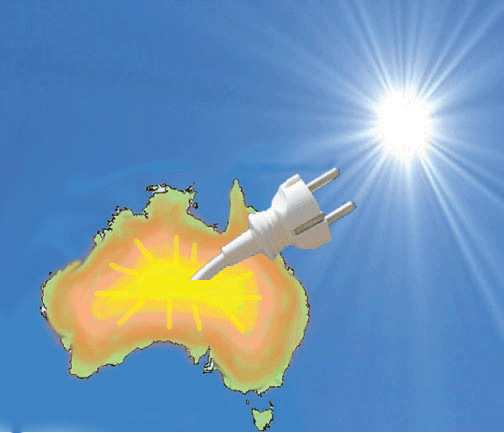 “This country can lead in the adoption, investment and innovation in solar energy. Academically, our universities lead the world in solar photovoltaic innovation, but regretfully the political uncertainty is hurting Australia’s solar industry.
“While we remain stranded in uncertainty around Australia’s clean energy future, the solar industry is experiencing strong growth in many other markets such as China, Japan, South East Asia and the Americas.
The problem with solar is that it is being adopted at a rate unforeseen and unimagined by the fossil fuel industry. Australia leads the world in residential rooftop solar, with more than one in five houses having solar systems, or 1.3 million homes, with a total of 3.3GW installed – even if it does trail in large scale installations. (The first utility-scale solar farm to be connected to the National Electricity Market will be formally opened this week).
Various official studies, such as those done by the market operator in WA, have predicted that installation rates could treble – reaching three-quarters of residential homes, and 90 per cent of businesses. New financial models would allow rental homes and apartments to become part of the market.
This is causing massive problems for generators, such as those owned by the Queensland government and recently sold by the NSW government, because it is eating away at demand, andrevenue, at what used to be the most profitable time of the day.
The RET review variously describes rooftop solar as causing cross-subsidies, an assessment repeated by the AEMC in its analysis of network costs and tariffs, but rarely are the benefits brought to the front. Last week, the South Australian network operator said that the 565MW of rooftop solar in that state – it has the highest penetration – had delivered clear benefits in moving and reducing the peak, and for grid stability.……..
A new report by the REC Agents Association on Monday warned that 1,000 small and medium-sized businesses could collapse if the RET Review recommendations were implemented.
It says that the solar industry currently comprises more than 3,800 businesses, with annual retail sales of more than $2.5 billion.
“Should the Government axe or significantly reduce the Renewable Energy Target, we would see a 40-50 per cent reduction in demand for solar and the closure of at least a thousand small businesses,” it says.
It says the absolute majority (96%) of the 3,800 solar businesses in Australia are SME sized businesses, and more than 93 per cent of the roughly 21,000 Australians who work in the Australian solar industry work in SME’s.
“It has been one of Australia’s fastest growing employment and business sectors, having grown twenty fold in the last decade. In less than ten years, the industry has created more than $17 billion of direct retail sales and tens of billions of flow on expenditure on in-direct support services.” http://reneweconomy.com.au/2014/warburton-wants-set-solar-industry-back-decade-57479
Purpose of the Renewable Energy Review – to promote the coal and gas industries
 The RET review cares only about coal profits, not renewable energy Greg Jericho Monday 1 September 2014 theguardian.com The review did not conclude that the RET had failed to fulfil its objectives, rather it decided that the objectives were irrelevant Let’s not beat around the shrubbery: the review of the renewable energy target (RET) led by Dick Warburton was a sham designed from the very start to conclude that the RET should be wound back. If you don’t agree with the overwhelming scientific view on climate change you are not going to feel any great need for Australia to bother about pursuing renewable energy. Instead, you’ll view renewable energy as an optional extra – and that view permeates the RET review.
The RET was not implemented because of some random desire to force businesses to use electricity generated by a more expensive method. It was introduced by the Howard government in 1997 to reduce greenhouse gas emissions. It was included as part of “the largest and most far-reaching package of measures to address climate change ever undertaken by any government in Australia”.
Thus, if you think climate change is all a bit of a scam driven by the UN and NASA with an assist from the Bureau of Meteorology and a vast majority of the world’s scientists, media and governments, then your position on the need for renewable energy is rather altered.
Which brings us to Dick Warburton, a man who told the ABC in Februarythat he was “sceptical” of “the claims that man-made carbon dioxide is the major cause of global warming”.
Warburton of course says his views had “no bearing on this report at all”. But it is clear that they did, because throughout the report there are logical inconsistencies which have the RET judged against different criteria than its purpose. The review is also founded on the view that renewable energy is something needed only if the demand for electricity requires it…….. the review did not conclude that the RET failed to fulfil its objectives, rather it concluded that the RET’s objectives were irrelevant……..
given we no longer have a carbon price, it would seem the report is putting all its faith in the government’s Direct Action emissions reduction fund (ERF). However, the government has not modelled the cost of abatement under that plan; thus the review’s conclusion that there are “lower cost options” is utterly reckless……..
The reality is that this report didn’t give a stuff about renewable energy, or the reduction of carbon emissions. It cared about the profits of coal fired power generators, laughably suggesting the RET might in time cause their profits to fall so low that they would reduce spending on maintenance.
If the government accepts the review’s recommendations to either close the scheme to new entrants or to severely adjust the cap, it can only do so on the basis that its direct action will achieve the same goals more efficiently.
But to do that it needs to show us the modelling. Otherwise they’re just selling us snake oil. http://www.theguardian.com/business/grogonomics/2014/sep/01/the-ret-review-only-cares-about-coal-profits-not-renewable-energy
1 This month

of the week – Australians for War Powers Reform (AWPR)
To see nuclear-related stories in greater depth and intensity
 Antinuclear