Digging up trouble: NSW uranium plan is risky and flawed
 11 Sept 14, Development of a uranium exploration and mining industry should not be permitted in NSW because it poses an unprecedented threat to the environment and public health, community groups have warned. NSW Resources Minister Anthony Roberts announced today that six companies have the opportunity to apply for uranium exploration licences near Broken Hill, Dubbo and Cobar. [1]
Groups opposed to uranium exploration and mining in NSW said the government had no mandate to lift the 28-year-old ban on uranium exploration.
Nature Conservation Council CEO Kate Smolski said: “The uranium exploration ban was removed in 2012 without consultation with, or a mandate from, the people of NSW. “Uranium exploration presents a very real risk to the environment, workers and local communities in NSW.
“It is disingenuous for Minister Roberts to say on one hand that the ban on uranium mining remains in place while on the other discussing uranium export safeguards and preparing the ground for a full-scale nuclear industry in NSW.”
Australian Conservation Foundation nuclear free campaigner Dave Sweeney said: “It is only three years since the Fukushima nuclear disaster – directly fuelled by Australian uranium – reminded the world about the dangers of nuclear energy and the contaminating uranium trade.
“Since Fukushima the Australian uranium industry has been under-performing and under pressure. This is no time to give a green light to yellow cake, and the door should not be opened further in NSW to this high-risk, low-return sector.”
Beyond Nuclear Initiative convenor Natalie Wasley said: “A broad coalition of organisations, including environmental groups, health organisations, trade unions and others in NSW signed on to the Uranium Free Charter. [2]
“The charter details concerns over the impact of uranium mining and the wider nuclear industry on communities, workers and the environment, and calls for a shared energy future that is renewable, not radioactive. Attempts to further develop the uranium industry in NSW will be strongly challenged. We urge the NSW Government not to progress down the yellowcake road. ”
Queensland State Labor pledges to block hazardous uranium mining
 Q, North West Star Sept. 10, 2014, “..[Queensland’s OPPOSITION environment spokeswoman] Jackie Trad was adamant there was little benefit from uranium mining.
“Even if all known deposits of uranium were mined the expected royalties would only be around 1% of the State’s current royalty revenue,” she said.
“We are just a few steps away from having trucks and trains filled with uranium making their way through communities to ports and waterways.”
Ms Trad said there had been no uranium extraction in Queensland since 1982 and confirmed that a future State Labor Government would move swiftly to reinstate the ban” .
Demand no dumping of nuclear waste on lands belonging to Indigenous Australians

 This petition has been signed by 25 720 people! The target before it is presented to Tony Abbott is 26000 so its almost there.
The Australian Government has been attempting to dump radioactive waste on lands belonging to Indigenous Australians.
In a recent dispute, Indigenous owners of Muckaty Station located north of Tennant Creek in the Northern Territory won a seven-year battle to stop domestic nuclear waste being dumped on their land, saying they were not properly consulted.
It follows more than 20 years of Indigenous communities in South Australia and the Northern Territory fighting and defeating federal government plans for a national radioactive waste dump on their country.
Australia has resisted using nuclear power and storing radioactive waste from overseas. This is in spite of the country holding some of the largest deposits of uranium in the world.
Why should Indigenous Australians who have been systematically disadvantaged by white settlement have radioactive waste dumped on their lands?
Please sign and share the petition to demand no nuclear waste dumping on lands belonging to Indigenous Australians.
Announcement of “restart” to Japan’s nuclear reactors is really a propaganda and confidence trick
 The NRA is still reviewing many remaining unresolved safety issues that scientists and citizens groups are also challenging.
So flawed is the safety case for Sendai that local citizens are seeking an injunction against Kyushu Electric and the government to stop them from operating the plant. No restart reflects public opinion
Japanese regulator caves to the nuclear industry and government pressure – but still no restart for Sendai http://www.greenpeace.org/international/en/news/Blogs/nuclear-reaction/Sendai-reactor-restart/blog/50534/ by Kendra Ulrich – 10 September, 2014 As with all things nuclear, things are not always what they seem.
Good example – today’s decision on the so called restarting of the Sendai reactors by the Japanese Nuclear Regulatory Authority (NRA), the best nuclear regulator in the world, according to the Abe government.
The five NRA commissioners decided that a proposal submitted by Kyushu Electric, owner of the Sendai reactors, complies with new guidelines brought in after the 2011 Fukushima-Daiichi nuclear catastrophe.
What the commissioners actually did was capitulate to pressure from Japan’s infamous nuclear village – the same industry and government alliance that created the Fukushima nuclear disaster. The decision really means that Kyushu Electric has moved restarting the Sendai reactors forward a bit, but it’s still not a restart approval. It doesn’t mean the NRA has certified the reactors as safe to operate or that they will restart anytime soon.
Why the confusion?
In part, it’s a savvy political strategy and a deliberate effort by the regulator, acting for the nuclear utilities and the Abe government, to signal that nuclear power is back in Japan. Continue reading
Bernie Fraser calls for extending the deadline for reaching the Renewable Energy Target
 Call to extend deadline for reaching Renewable Energy Target THE AUSTRALIAN, Sid Maher
ANNABEL HEPWORTH 11 Sept 14 THE nation’s climate change adviser has called for the deadline for reaching the Renewable Energy Target to be extended to allow time to build political consensus as Industry Minister Ian Macfarlane ramped up calls for Labor to do a deal on the issue.
Bernie Fraser, the chairman of the Climate Change Authority, yesterday called for the timeline for a 41,000GWh target to be extended a few years beyond 2020 to provide confidence for the industry’s bankers.
He also called for the government to examine using some of its Direct Action climate change funds to help close inefficient coal-fired power stations, thereby eliminating some of the overcapacity in the system and making room for cleaner generation capacity. Last month, a report by the Energy Market Operator found Australia was facing the biggest power glut in the history of the national electricity market, with surplus capacity potentially between 7650 megawatts and 8950MW……..
Flexible home solar energy storage system available in Australia
SMA Flexible Energy Storage System Available In Australia http://www.energymatters.com.au/index.php?main_page=news_article&article_id=4486 11 Sept 14, For Australian solar households looking to distance themselves from the mains grid, the competitively-priced Sunny Home Manager Flexible Storage System is worth considering.
Whether the ultimate goal is to completely ditch the grid or still maintain a mains connection; this clever system from SMA is up to the task.
The system has been developed to enable households to store surplus electricity generated by their solar panel array for use when the sun isn’t shining or in blackout conditions. It consists of a Sunny Island battery inverter, a Speedwire Data Module, SMA Energy Meter and Sunny Home Manager.
Available from national solar provider Energy Matters; it’s an open concept that works with most battery technologies (including lithium-ion) and any existing grid connect inverter. This degree of flexibility allows Energy Matters to package an entire energy storage solution, including batteries, according to a customer’s needs and circumstances.
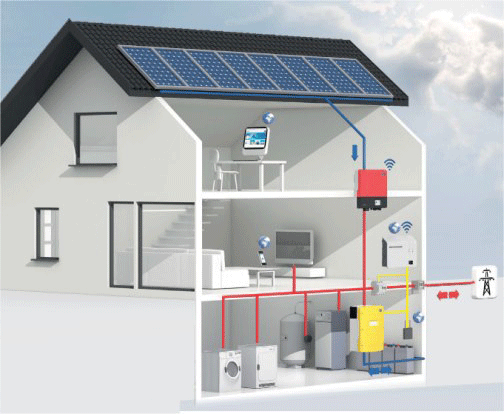
In the image above, the solar inverter converts the DC current produced by the solar panels to AC power for household use.
Any power not being used by household appliances is transmitted to the Sunny Island. The Sunny Island charges the batteries and also offers an uninterruptible, grid-quality power supply.
Power not being utilised by either the household or Sunny Island is exported to the mains grid.
At night, or when called upon, the Sunny Island converts the DC energy stored in the batteries back into AC power for use by the household.
The SMA Energy Meter communicates solar generation and consumption data via Speedwire to the Sunny Home Manager.
The Sunny Home Manager provides live data on electricity use to aid in smart energy management. Reports and visualisations of all the relevant electricity flows are displayed via a user-friendly interface, providing comprehensive and concise data.
Reports and data generated by the Sunny Home manager can be accessed on a PC or smartphone.
Unlike some grid-connected energy storage solutions, if a mains-grid blackout is experienced; the system doesn’t shut down – it will automatically switch to using the energy stored in the battery bank.
The SMA flexible storage solution is also “future-proof” – it will be compatible with future smart grid technologies.
Developing methods for renewable energy to the grid
 The biggest factor is the roll out of electric vehicles
How to get renewable energy into the grid — without losing power The Conversation, Anthony Vassallo Delta Electricity Chair in Sustainable Energy Development at University of Sydney, 11 September 2014
The recent review of the Australian Renewable Energy Target has once again raised the issue of the “unreliability” of some renewable power sources such as wind and solar power. Their variability, which arises from the weather or daily and seasonal cycles, leads some to conclude that they will only ever be able to supply a minority fraction of Australia’s electricity.
But for the most part we have the technology available to ensure a steady supply of power, and where we don’t, technology is rapidly advancing.
South Australia is at the forefront of integrating renewables into the existing grid. With more installed wind than any other state (almost 1,500 megawatts), wind now provides on average 25% of its annual electricity production. On recent occasions it provided 100% of the state’s needs and even exported 487 megawatts of power in June this year………
….Our national electricity grid (mostly on the eastern and southern states) is the result of decades of growth, largely built on legacy operation — large, remote, baseload coal power plants that need to operate continuously.
This resulted in the three tier generation comprising baseload, intermediate and peaking.
Baseload is the term used to describe the large coal-fired power plants that were designed to provide cheap, continuous power. In fact because of their size and design it was not feasible to greatly reduce their output overnight, so it was necessary to provide an incentive to consumers to use power at night to keep them running efficiently.
This was the “off-peak” hot water and other time independent loads that were encouraged through very low tariffs……….
Improving forecasts
There are a number of alternatives to managing this variability, such as more accurate renewable generation forecasting and demand response (i.e. specific actions to reduce customer loads, such as payments for reducing consumption).
Wind power generation can now be forecast with useful accuracy. In Australia, wind forecasting is now better than 10% error for 40 hours ahead, and better than 4% error for 1 hour forecast……. Continue reading
1 This month
7 April – WEBINAR – Australia and the Doomsday Clock – Preventing nuclear war through NoFirstUse and other policies
Online | Tuesday April 7, 4:00-5:30pm, Australian Eastern Time / 8:00-9:30am Central Europe Time
– Access the registration link
15 April – Zoom –Nuclear Power is Not the Solution
Apr 15, 2026 01:00 AM in Canberra, Melbourne, Sydney

Join the International Physicians for the Prevention of Nuclear War (IPPNW) on Tuesday, April 14th for a timely webinar exploring the risks associated with nuclear power and challenging the myth that it offers a simple, safe, carbon-free solution to the climate crisis

21 April Webinar: No Nuclear Weapons in Australia
Start: 2026-04-21 18:00:00 UTC Canberra, Melbourne, Sydney (GMT+10:00)
End: 2026-04-21 19:30:00 UTC Canberra, Melbourne, Sydney (GMT+10:00)
Event Type: Virtual
A virtual link will be communicated before the event.
Host Contact Info: australia@icanw.org

of the week – Australians for War Powers Reform (AWPR)
To see nuclear-related stories in greater depth and intensity
 Antinuclear