The Anthropocene Age and the role of nuclear power – theme for September 14
Great changes in the Earth’s history are marked in geological Ages, with great changes caused by events such as volcanoes, meteorite impacts, climate change and the movement of the Earth’s tectonic plates, and occurring over millions of years. Now geologists are seeing changes in the Earth that are occurring over merely one hundred years.
These changes are caused by the activities of one species – human beings. They usher in a new Age – the Anthropocene (or human-caused ) Epoch.
The changes in the Anthropocene Age are already profound:
- Landscape – Deforestation, desertification, mountains carved by mining, rivers dammed and rerouted, islands sinking under sea level rise.
- Ecology – massive extinctions of species – loss of habitat, loss of biodiversity
- Climate change – rise in greenhouse gases in atmosphere, heating of air and oceans, acidification of oceans, glaciers melting, sea level rise
- Water – shortage of clean drinking water, pollution of groundwater and surface waters.
Those are just a few “headlines” for the changes that we have already wrought on the only liveable planet.
THE NUCLEAR CONTRIBUTION to the Anthropocene Epoch has already been great – with the landscape scarring effect of thousands of atmospheric and underground atomic bomb tests.
Radioactive pollution – from atomic bomb making, and testing, and from several parts of the nuclear power chain has affected soil, groundwater and air.
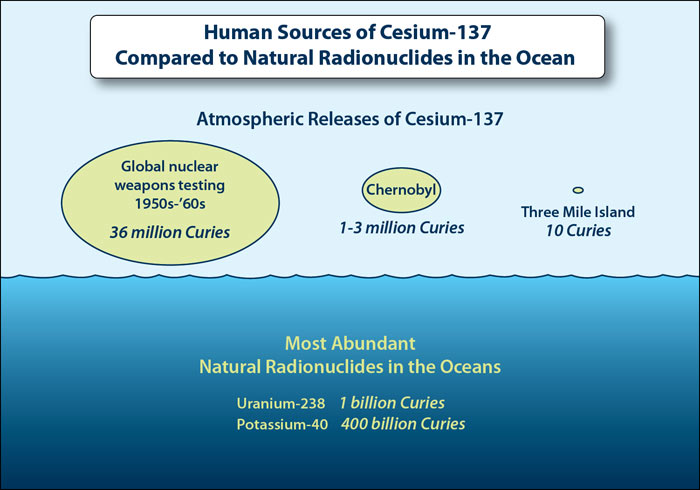
The nuclear lobby loves to talk about “background radiation” as if it’s all naturally caused and benign. However it includes radionuclides that never before existed on Earth – plutonium, strontium, cesium, carbon-14, and radioactive iodine from atomic bomb testing and other nuclear activities.
Australia’s Aboriginal Central Land Council suspicious of the government’s nuclear waste dump plans
CLC seeks more Red Centre nuclear waste dump answers http://www.abc.net.au/news/2014-09-12/clc-seeks-more-nuclear-waste-dump-answers/5740226 By Robert Herrick Fri 12 Sep 2014,
The Federal Government is seeking a new location for the facility, after a nominated site at Muckaty Station, near Tennant Creek, was abandoned.
The Government has given the Northern and Central land councils until the end of the month to put forward an uncontested site for a nuclear waste dump, before considering proposals from all landowners.
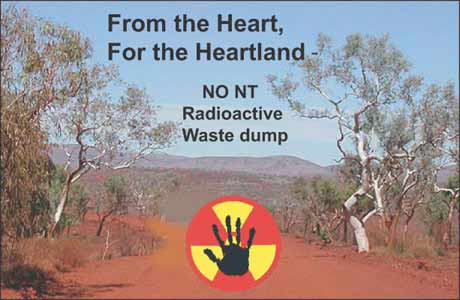
Traditional owners in the Tanami Desert are offering a site 540 kilometres west of Alice Springs.
However, the Central Land Council (CLC) said Commonwealth officials could not answer all the questions put to them at a meeting this week at the Tanami Mine, including how waste would be transported.
The CLC says it has a responsibility to ensure traditional owners are fully informed of the potential impacts of a nuclear waste dump before it can back any nomination.
Forget the hype – Australia’s uranium trade with India is of little economic benefit
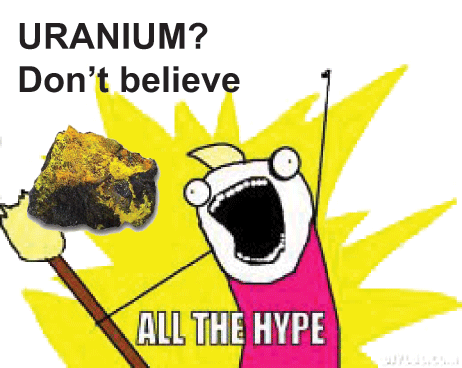 The future is renewable, not radioactive http://www.hindustantimes.com/comment/analysis/the-future-is-renewable-not-radioactive/article1-1263460.aspx?utm_medium=twitter&utm_source=twitterfeed Jim Green 12 Sept 14 India and Australia have signed a nuclear cooperation agreement that may open the door for uranium sales. However, obstacles remain and claims of an economic bonanza for both countries ignore facts.
If Australia supplies 20% of that demand, uranium export revenue will increase by 3% — two orders of magnitude short of the figure in the Fairfax press.
Indian demand would have to grow ten-fold just to sustain one small uranium mine in Australia. Projections of exponential growth leading to hundreds of gigawatts (GW) of nuclear capacity in India should be disregarded. Continue reading
1984 Royal Commission concluded that Australian servicemen were nuclear guinea pigs
 TODAY IN HISTORY – Bendigo Advertiser 12 Sept 14
1984 – Australian Royal Commission starts an investigation into whether servicemen were deliberately exposed to radiation in British nuclear tests at Maralinga in 1956-57. It will conclude that they were. http://www.bendigoadvertiser.com.au/story/1880269/good-morning-bendigo-12092014/?cs=80
Check on how the electricity utilities charge you big-time for solar hot water
 I think you could fix this excessive cost problem by switching to Powershiop
Dennis Matthews, 13 Sept 14 Matching supply and demand has always been a problem and is not unique to renewables.
An interesting thing about wind power in SA is that the % installed capacity (MW) is the same as the % delivered electricity (MWhr). In other words, wind power is no worse than non-renewables in terms of the amount of time that it is generating.
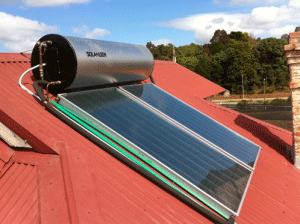 Concerning off-peak electricity. This is very wasteful, you end up heating and reheating the same water because of heat losses, especially over night. In addition in some areas off-peak electricity is controlled centrally through a square wave distortion (SWD) system. This means that off-peak is no longer just overnight. It can be any time of the day that suits the electricity utilities. This has the effect of undercutting solar hot water systems. After sunrise, when solar starts to heat a solar hot water system, the electricity utility can, and does in my area, switch on the off-peak heater. In order to prevent this I have to physically switch off the off-peak hot water system at the meter box and turn it on again late in the day when solar is no longer effective.
I suspect this is happening to a lot of people in SA with solar hot water and they are wondering why their bills are still high. Look for the SWD box (grey in my case) in the meter box. If you have one then you may have to do the same as me.
Shadow Environment Minister Jackie Trad exposes foolish decision of Queensland govt on uranium mining
 LNP under fire as companies target Qld uranium http://www.sunshinecoastdaily.com.au/news/lnp-uranium-green-light/2384465/ Bill Hoffman | 12th Sep 2014 THE ALP has slammed the Newman government decision to grant mineral development leases to two companies planning to mine uranium in Queensland.
Shadow Environment Minister Jackie Trad accused the LNP of lying before the last election when it gave what she described as a clear commitment not to endorse uranium mining.
“The Premier gave a clear election commitment but the granting of six exploration licences shows once again the value of an LNP promise,” she said.
“In breaking the promise, the Newman Government is ignoring the widespread objections of Queenslanders, ignoring the substantial environmental risks associated with uranium mining, ignoring the risks associated with the transportation ofradioactive material and ignoring the risks to public health and safety.
“It is a massive betrayal of trust.
“We are just a few steps away from having trucks and trains filled with uranium making their way through communities to ports and waterways.”
Ms Trad accused the Newman Government of arrogantly ignoring the wishes of the majority so it could pander to the demands of powerful vested interest groups.
She said there had been no uranium extraction in Queensland since 1982. Any future State Labor government would move swiftly to reinstate the ban. “It remains our view that the risks and hazards inherent in uranium mining far outweigh the economic benefits,” Ms Trad said.
“Even if all known deposits of uranium were mined the expected royalties would only be around 1% of the state’s current royalty revenue.”Uranium mining simply doesn’t stack up on either economic or environmental grounds.”
Ms Trad will be on the Sunshine Coast as special guest at her party’s Sunshine Coast Hinterland branch forum on the environment and the Newman Government’s track record on green policy.
It will be held at Maleny Neighbourhood Centre on Saturday, September 27 at 2pm.
WA’s clean energy industry up in arms over possible changes to the Renewable Energy Target
 VIDEO: The green energy sector fires up http://www.abc.net.au/news/2014-09-12/the-green-energy-sector-fires-up/5741332 12 Sep 2014,
Source: 7.30 WA | Duration: 7min 41sec
Let’s Bury King C.O.N.G. at People’s Climate March

 Harvey Wasserman | September 11,
Above all, the worldwide People’s Climate March on Sept. 21 must bury King C.O.N.G.: Coal, Oil, Nukes and Gas.
Which also means abolishing corporate personhood and saving the internet.
The fossil/nuclear corporations have been given human rights but no human responsibilities. They’re about to gut our most crucial means of communication.
They’re programmed to do just one thing: make money. If they can profit from killing us all, they will.
Ironically, we now have the technological power to get to Solartopia—a socially just, green-powered planet.
But our political, economic and industrial institutions answer to Big Money, not to us or the Earth.
On Sept. 21 some of us will carry to the UN a petition with more than 150,000 signatures, demanding that Fukushima be turned over to a global authority.
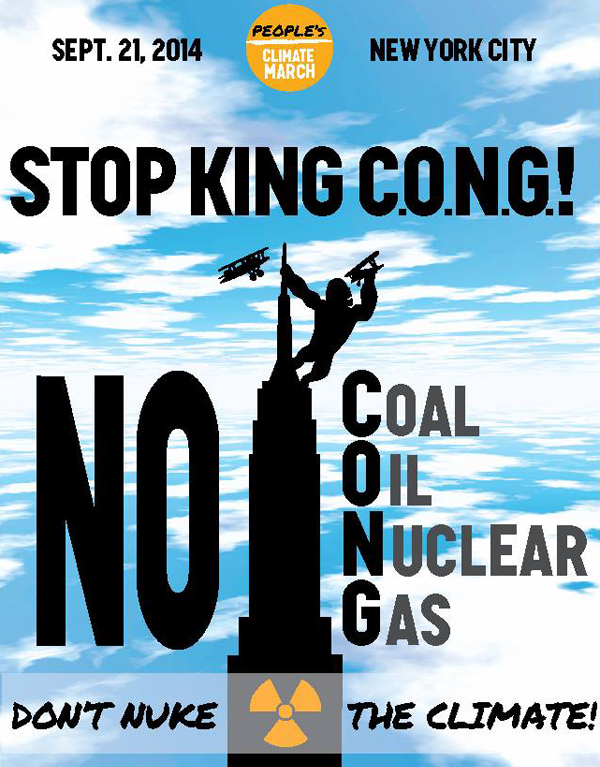
This petition was personally delivered to UN Secretary-General Ban Ki-Moon last Nov. 7. We’ve never gotten a response.
Meanwhile, Tokyo Electric Power makes huge profits from the “clean-up” at Fukushima. It’s turned much of the labor force over to organized crime. And more than 300 tons of radioactive liquid still pour into the Pacific every day, while downwind children suffer a 40-times-normal thyroid cancer rate.
A powerful new insider report says another Fukushima could easily occur at California’s Diablo Canyon, surrounded by FIVE known earthquake faults. Similar dangers plague other reactors worldwide.
Nuclear power makes global warming worse.
So do coal, oil and gas.
March organizer Bill McKibben says fracked gas is just as bad for global warming as coal. Oil is even worse.
But we’re in the midst of a great revolution. Solartopian technologies—solar, wind, tidal, geothermal, ocean thermal, sustainable bio-fuels, mass transit, increased efficiency—are all plunging in price and soaring in efficiency. They can completely green-power our Earth. They can allow individuals and communities to control our energy supply, democratizing our society.
But they can’t come without transforming the corporation.
As long as our chief economic engine has no mandate but to make money, dominates our political system, claims legal personhood and is not held accountable for the damage it does, our species is doomed.
Congress is now debating a constitutional amendment to strip corporations of their illegitimate, illegal personhood. This must happen to save our democracy and our eco-systems.
But the debate appears virtually nowhere in the corporate media …
…Except for the internet, which the Federal Communications Commission may soon gut by killing net neutrality.
Without a free and open internet, and without ending corporate personhood, our efforts to stop King C.O.N.G. and save our ability to live on this planet will go nowhere.
So as we march to stop climate chaos, as we contemplate divestiture campaigns, as we demand a global take-over at Fukushima, as we work to win a Solartopian future … we must see the whole picture.
The corporate beast that’s killing us all draws its power from a lethal mutation with no basis in law or sanity.
Without a free and open internet to bring it down, our struggle to survive is in serious jeopardy.
We can win.
But to do so we must preserve net neutrality, transform the corporation and bury King C.O.N.G. in the Solartopian compost heap.
Harvey Wasserman edits www.nukefree.org and wrote SOLARTOPIA! Our Green-Powered Earth, where King C.O.N.G. made its literary debut, at last brought to visual life by Gail
China shows value of renewable energy in the cause of energy security
 China shows there’s more to renewable energy than fighting climate change ” The Conversation.11 September 2014, .… China’s large investments in renewables are best understood as enhancing the country’s energy security and not solely as a means of reducing carbon emissions…….
As the scale of Chinese manufacturing has grown — in our article we note that production of solar cells has expanded about 100-fold since 2005 — the costs of renewable-energy devices have plummeted. Countries such as Germany and South Korea, like China, are boosting their national renewable-energy industries and markets.
But others, including the United States, seem yet to notice this shift and are pursuing ineffective energy policies, including considering alternative fossil-fuels sources like coal-seam gas and putting trade tariffs on Chinese-made solar panels. Indeed oil addiction in the US appears to be worse than ever.
There are clear implications for Australia too. The current wave of anti-renewables rhetoric and negative reaction by the Australian government is out of step with the rest of world, and in particular with China and India, (and Germany) all of which countries see renewables as an important and growing element of their energy mix.
And there is a second clear implication: as they build their renewables industries, these countries will come to depend less and less on fossil fuels – and (China in particular), less and less on imports of Australian fossil fuels……..
In terms of electric power generation, China generated over 1,000 terawatt hours of electricity from water, wind and solar sources in 2013, which is comparable to the entire power generation combined of France and Germany.
But it is the rate of expansion that is so remarkable. China is rapidly expanding its renewable energy industries and its use of renewable devices to generate electric power.
Its latest target is that renewables will have a capacity of 550 gigawatts — over half a trillion watts — by the year 2017. We calculate that this will exert a major impact in China — enhancing energy security; reducing emissions pollution; and reducing carbon emissions.
But the primary impact will be on energy security. China became a net importer of oil in 1993; of natural gas in 2007; and of coal in 2011. If it can reach its 2017 target of 550 GW renewables, we calculate that this would translate into a saving of 45% on current imports of coal, oil and natural gas.
China is leading the way to a world of decarbonized energy, by placing the emphasis of its policy on growing the markets for renewables and building the industries to supply wind turbines, solar cells, batteries and other devices.
In this way it is driving down costs, through the learning curve, and making renewables more accessible to all countries. This is good for China, and for the world.http://theconversation.com/china-shows-theres-more-to-renewable-energy-than-fighting-climate-change-31471
China can be effective in limiting global warning – says Kevin Rudd at US Forum
 Kevin Rudd warns of climate change consequences at US forum, SMH September 12, 2014 – Latika Bourke National political reporter There is still time for China to curb its carbon emissions to give the planet a “reasonable future”, former prime minister Kevin Rudd has said.
And Mr Rudd has proposed a “transformation” of the US-China relationship, arguing the two should co-lead a “new strategic deal” aimed at resolving tensions on the Korean peninsula.
Mr Rudd said while it was a “very hard call” for China to curb its emissions the “mathematics and science” of the planet demanded action and warned of huge consequences, including extreme weather events and the loss of arable land, if there is no change.
Mr Rudd made the comments appearing alongside former US Treasury secretary Hank Paulson to discuss “Asia and the World Order” at a forum in New York.
“Climate change threatens all of us, it threatens China, it threatens America and it threatens Australia,” he warned.
The former Labor leader – who in 2007 declared climate change “the greatest moral challenge of our generation” – told the audience that if the concentration of greenhouse gases in the earth’s atmosphere exceeded 450ppm (parts per million), “four thousand humourless guys in white coats” have concluded that we run a “huge risk of irreversible climate change”.
He outlined the former Labor government’s success in introducing a carbon tax but said the conservatives were about to repeal it in Australia. Prime Minister Tony Abbott successfully unwound Labor’s carbon price in July.
Mr Rudd said the Chinese view that the Western economies had unfairly been allowed to grow its economies until they were “drunk” on “energy and cheap carbon” was legitimate. But he said “mathematics dictates” there is a “finite quantum” of greenhouse gases humans can pump into the air.
“Based on that, our friends in China need to work on what ultimately becomes China’s own carbon ceiling, now that’s hard stuff, because China is late in the development curve,” he said.
“But if China gets this right, then the planet’s got a reasonable future, if it doesn’t get this right, I don’t think we’ve begun to think through the broad implications for the planet and the world about going past 450ppm,” he said.
He warned that drifting pollution from China across Japan, Korea and the United States would open up new foreign policy challenges………
Mr Rudd envisioned the package comprising the removal of nuclear weapons from the north, a form of “political coexistence between the two sides of the peninsula” and an American troop withdrawal from the Chinese border.
“You might say that’s all too hard, three of four years ago it was too hard but I think smart people in both capitals begin to think about this,” he said.
Mr Rudd said while he understood Washington’s “preoccupation with the Middle East” the world should not underestimate the significance of a non-English speaking and non-democratic economy set to overtake America’s as the world’s biggest.
Australian solar investment – over 1500 businesses have gone solar!
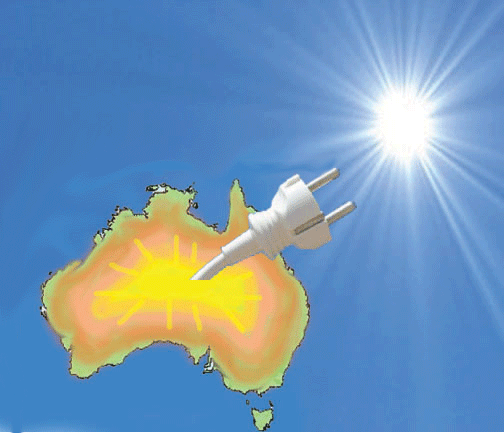 15,000+ Australian Businesses Have Gone Solar More than 15,000 Australian businesses have installed solar panels says the Clean Energy Council.http://www.energymatters.com.au/index.php?main_page=news_article&article_id=4490
“Businesses have now invested almost $460 million in solar power systems across the country, helping them to collectively save about $64 million on their bills every year,” said Clean Energy Council Acting Chief Executive Kane Thornton.
Mr. Thornton says the businesses operate in a broad range of sectors – from dairy and chicken farmers through to wineries, offices, supermarkets and retail outlets.
“There is an increasing recognition that the current modest support provided by the RET means the business case for solar power makes sense, helping businesses become more competitive in tough economic conditions.”
However, he warns slashing the Renewable Energy Target could see the opportunity lost or make it so paperwork-heavy some businesses simply wouldn’t bother.
“The rest of the world is going full-speed ahead on solar and there is a huge opportunity here for Australian businesses if we leave the RET alone,” he said.
Mr. Thornton states slashing the RET would also see the loss of up to 5800 jobs in this part of the nation’s solar power sector.
For now, the segment is humming along. National commercial solar providerEnergy Matters reports it has installed 4 megawatts capacity of commercial scale systems (10kW+) and currently has 2MW of projects in the pipeline.
Among the high profile projects in Energy Matters’ portfolio are Western Australia’s largest privately-owned rooftop solar power system (Bidvest Foodservices) and Australia’s largest privately funded array (NEXTDC’s M1 Data Centre in Melbourne).
In August, Energy Matters stated that just among its monitored systems, 1 million kilowatt hours of solar electricity had been generated and it expects cumulative generation for those systems to reach 3 million kilowatt hours by end of this year.
According to the August Sunwiz Insights, of the 48 x 100kW commercial solar power systems installed in Australia in the previous 3 months; Energy Matters led the rankings with 5 x 100kW systems.
A portfolio featuring a selection of Energy Matters’ commercial solar projects can be viewed here. Businesses interested in learning more about how solar can benefit their bottom line can contact Energy Matters’ commercial team on 1300 553 213 or by emailing commercial@energymatters.com.au.
Launch of Australian Energy Storage Council
Australian Energy Storage Council launched to bring together industry and promote standardisation PV Tech, By Andy Colthorpe Sep 12, 2014 The Australian Energy Storage Council, a new industry representative body has been launched for energy storage in Australia, backed and co-founded by the Australian Solar Council.
The Australian Energy Storage Council was formally launched this morning. The Australian Solar Council will back the new organisation with resources initially, with solar council chief executive John Grimes also acting as its head.
“It is important that energy utilities engage with the energy storage sector sooner rather than later,” said Grimes. “Too often the energy sector ignores emerging technology trends and is blindsided when they are deployed widely. That’s why one of the first things the Energy Storage Council will do is to focus on developing standards and protocols for embedding energy storage into the energy network.”

The call for standardisation across the energy storage industry has been voiced by a wide cross section of parties, including academics and battery manufacturers.
The storage council will be a non-profit organisation, paid for by memberships, training activities and from hosting industry events. According to the council, it will seek to connect local members with global industry partners.
The new group joins other regional and international energy storage industry associations in the growing space, including the International Battery and Energy Storage Alliance (IBESA) and one of the earliest-formed organisations of its kind, the California Energy Storage Alliance, which according to CESA’s deputy head Chris Edgette, was influential in helping the California Public Utilities Commission (CPUC) in drafting the recently issued mandate for utilities to install 1.3GW of storage by 2020………http://storage.pv-tech.org/news/australian-energy-storage-council-launched-to-bring-together-industry-and-p
Large solar company First Solar not impressed with Abbott govt’s proposed compromise on Renewable Energy Target
US’s First Solar says Australian govt’s renewable energy ‘compromise’ likely to be rejected KERRIE SINCLAIR THE COURIER-MAIL SEPTEMBER 12, 2014 A COMPROMISE position on Australian renewable energy market reform being touted by federal ministers won’t be palatable to the industry as it would still mean certain death, a leading solar company said Thursday.
Jack Curtis, regional vice president for Asia Pacific at First Solar, the US’s largest solar panel company, said a reform proposal now being floated, as well as the proposals of a federal government-commissioned review released last month, were all potentially fatal to Australia’s renewable energy industry.
First Solar has a $500 million active project pipeline in Western Australia, Queensland and New South Wales, a potential future pipeline of $250 million and has a venture with Rio Tinto to build an up to 6.7 megawatt, $23.4 million solar power plant at the Weipa bauxite mine on the west coast of Cape York Peninsula……..
GE, one of Australia’s largest foreign investors, has rejected the Warburton review proposals, saying either option would risk pushing up household power bills and raise sovereign risk issues for the Australian economy.
First Solar on Thursday said the option that appeared to be emerging as the federal government’s possible compromise position would not be acceptable to the industry.
“I think you’ve already started to see this idea of a ‘real 20 per cent’ target being thrown about as the government’s potential compromise position,” Mr Curtis said.
“But any one of those three (the first two of the Warburton report or that compromise position) wouldn’t be palatable at all to the industry.
“Because it’s gradations of death for the industry. It’s a question of, ‘Do you want to die from one bullet in the head or two or three bullets in the head?’ It’s irrelevant because you’re still lying on the ground dead.”
Mr Curtis said it wasn’t clear if the federal LNP had decided its position on large-scale RET reform…….
“In some of the large projects we’re involved with, say in western NSW, more than 50 per cent of the project procurement comes from local companies that for example used to make parts for auto companies and have retooled to provide parts for solar projects.”
Mr Curtis also questioned Rio Tinto’s call this week for governments, industry and communities to support development of ‘clean coal’ technology which aims to capture and bury underground forever the planet-warming emissions of coal-fired power stations…….
“I’ve seen clean coal promoted as the solution to the world’s dirty coal problems for a long time and I’m yet to see anything that’s a commercially viable solution,” Mr Curtis said…….http://www.couriermail.com.au/business/uss-first-solar-says-australian-govts-renewable-energy-compromise-likely-to-be-rejected/story-fnihsps3-1227056769087
Tony Abbott’s messy attempt to rub Aboriginal affairs
 Tony Abbott’s indigenous takeover in ‘disarray’, The Age September 12, 2014 – Noel Towell Reporter for The Canberra Times Prime Minister Tony Abbott’s takeover of indigenous affairs is in “disarray”, public service insiders allege, with hundreds of specialist public servants retrenched, funding and programs stalled and staff morale in the “doldrums”.
Senior leaders in the Prime Minister and Cabinet department’s Indigenous Affairs Group have based themselves in Canberra’s dress circle, nearly 10 kilometres away from their rank-and-file workers, who are still reeling after repeated restructures to their workplaces.
The internal problems have emerged on the eve of the Prime Minister’s trip to Arnhem Land, part of his pledge to be “a prime minister for indigenous affairs” that also included the takeover by PM&C of indigenous functions from several other government agencies…….: http://www.smh.com.au/national/public-service/tony-abbotts-indigenous-takeover-in-disarray-20140912-10fgbf.html#ixzz3DEoYGeH2
1 This month
7 April – WEBINAR – Australia and the Doomsday Clock – Preventing nuclear war through NoFirstUse and other policies
Online | Tuesday April 7, 4:00-5:30pm, Australian Eastern Time / 8:00-9:30am Central Europe Time
– Access the registration link
15 April – Zoom –Nuclear Power is Not the Solution
Apr 15, 2026 01:00 AM in Canberra, Melbourne, Sydney

Join the International Physicians for the Prevention of Nuclear War (IPPNW) on Tuesday, April 14th for a timely webinar exploring the risks associated with nuclear power and challenging the myth that it offers a simple, safe, carbon-free solution to the climate crisis

21 April Webinar: No Nuclear Weapons in Australia
Start: 2026-04-21 18:00:00 UTC Canberra, Melbourne, Sydney (GMT+10:00)
End: 2026-04-21 19:30:00 UTC Canberra, Melbourne, Sydney (GMT+10:00)
Event Type: Virtual
A virtual link will be communicated before the event.
Host Contact Info: australia@icanw.org

of the week – Australians for War Powers Reform (AWPR)
To see nuclear-related stories in greater depth and intensity
 Antinuclear