Double benefit in farming both cattle and wind, in Western Australia
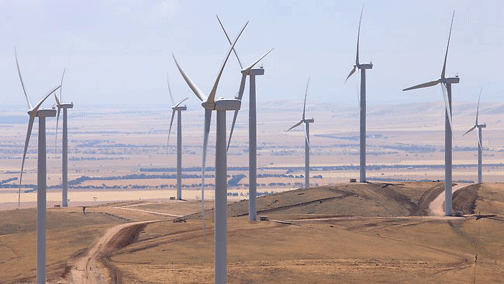 WA farmer living amongst wind turbines backs keeping Renewable Energy Target 7 NEWS BY CLAIRE MOODIESeptember 14, 2014 Living amongst 15 massive wind turbines might not be everyone’s idea of paradise, but West Australian Mid West farmer Bruce Garratt believes he is investing in the future.
Eight years ago, he agreed to accommodate the turbines as part of WA’s first privately-built wind farm, south of Geraldton, and is still enjoying the serenity.
“People tell me how noisy they are, people tell me how they affect your health,” he said. “I’ve had lots of people tell me different things that honestly, unless they have lived on a wind farm, they don’t really know what they are talking about.”
Mr Garratt, who manages cattle and crops on his 2,000 acre property, said the turbines — part of the Alinta Walkaway Wind Farm — provided an additional passive income, as well as a sense of purpose.
“No-one in their right mind could put up an argument and say that wind turbines aren’t of benefit,” he said. “They’re not producing C02.”
Mr Garratt is critical of the recent Warburton review that recommended either closing the Renewable Energy Target (RET) to new entrants or scaling it back…….
Coal-fired generators the winners: wind farm owner
Uranium oversupply bodes ill for the future of the industry
 Rally in Uranium Prices Is Unlikely to Last, WSJ, 14 Sep 14 Gains Fueled by Ukraine Crisis, Mine Unrest Don’t Offset Oversupply SYDNEY—A multiweek rally in uranium prices fanned by the Ukraine conflict and labor unrest at a large mine in Canada looks unlikely to continue for long as the reality of oversupply and lackluster demand sinks in among buyers of the nuclear fuel.
Industry analysts and some uranium producers believe that even as supplies fall, a substantial increase in demand is needed to drive prices up to levels that would make new investments worthwhile, when many operations are running at a loss……..
Demand for the fuel hasn’t recovered since the disaster at Japan’s Fukushima Daiichi nuclear-power plant in 2011, which sparked nuclear-plant closures across the country and tarnished uranium’s image globally…….
state governments in resource-rich Australia have been encouraging the growth of the nation’s uranium industry. A decadeslong ban on uranium production in Queensland was lifted in July, opening the door to new applications to build mines in the state. The government of New South Wales this month said it would invite six companies to apply for exploration licenses.
Still, there is expected to be little investment in new projects until the market stages a more substantial comeback. Cameco said it would need to see much higher uranium prices before it started construction of its proposed Kintyre uranium mine in Western Australia.
“The nuclear industry is still in the midst of upheaval,” said Jonathan Hinze, senior vice president at nuclear-research firm Ux Consulting Co. …http://online.wsj.com/articles/rally-in-uranium-prices-is-unlikely-to-last-1410726782
A year of no nuclear power in Japan – nuclear-free anniversary!

the people’s dedication to energy efficiency – the cheapest and quickest way to reduce costs and carbon emissions – has led to a reduction in electricity demand equal to 13 nuclear reactors. At the same time, citizens are installing thousands of micro solar PV every month.
Happy nuclear free birthday to the people of Japan http://www.greenpeace.org/international/en/news/Blogs/nuclear-reaction/one-year-nuclear-free-Japan/blog/50594/ by Kendra Ulrich – 15 September, 2014 Every birthday is special – but today Japan is celebrating something unique. Japan has been nuclear-free for one year.
Nuclear-free – a phrase that in its simplicity carries a devastating message for the worldwide nuclear industry, and an inspiring lesson for people across the globe. The future can indeed be free of the threat of another Fukushima disaster.
One year ago today, the last commercial nuclear reactor operating in Japan was shutdown. It joined the other 47 nuclear reactors that had been idled for most of the period since the devastating Fukushima catastrophe in March 2011.
Japan is the world’s third largest economy, with 130 million people, and with the largest number of nuclear power plants after the United States and France.
Except none have operated for 12 months. And, not only were there were no electricity blackouts, but Japan came in second worldwide for installing solar PV in 2013 (only China installed more). This was a massive and rapid expansion.
In fact, the total collective time when Japan’s 48 reactors have not been operating amounts to 152 years – over a century and a half when they generated zero electricity. (One reason why nuclear reactors are not built by the market but subsidized by the state and/or foisted onto ratepayers.)
What sort of industry can believe it still has a future when all of its nuclear assets stop generating, on average, for three and half years?
An industry that for decades has sucked billions from taxpayers and has defied logical justification, whether it be judged on economic, environmental, security or human health grounds.
And in Japan, the nuclear industry has collapsed. Continue reading
Japan’s problem of radioactive wastes – nowhere to put them
With no plans, designated waste sits by farms Japan News, September 12, 2014 The Yomiuri Shimbun Most radioactive-contaminated materials being kept at temporary storage sites in Fukushima and nearby prefectures still have nowhere to go.

In the Tohoku and Kanto regions, the 2011 crisis at the Fukushima No. 1 nuclear power plant has produced a massive amount of waste tainted with radioactive substances that were released into the air from the power plant.
However, the central government is having difficulty finding locations to build final disposal sites, where the waste will be buried underground. At this stage, there are no clear prospects for construction plans anywhere in the regions.
“Authorities say it’s safe, but will it really be safe, even when we’re hit by tornadoes or typhoons? I hope it moves somewhere else soon,” said a rice farmer in his 60s in Tome, Miyagi Prefecture, referring to one of the warehouses of “designated waste” that stand in an area of farmland near his rice paddies. The city is one of the most famous rice-producing areas in the prefecture.
Covered in sheets of silver foil designed to protect against the sun’s rays, the warehouses store the designated waste — rice straw that was originally supposed to be used as livestock feed. The city government initially explained that the warehouses would be kept in the farmer’s vicinity for only two years — until January this year.
Waste with cesium levels higher than 8,000 becquerels per kilogram will receive an environmental ministry designation based on the special measures law on handling environmental pollution caused by radioactive substances. The amount in Tokyo and 11 other prefectures totaled about 146,000 tons as of June 30, according to the Environment Ministry……..
As a construction plan for final disposal site has been substantially delayed, the contaminated rice straw will remain in the warehouses for the time being…….http://the-japan-news.com/news/article/0001561227
Australia no longer ready to cope financially with the new climate changed world
 Can Australia prosper in a 2°C finance world? REneweconomy, By Giles Parkinson on 11 September 2014Global investment bank HSBC has coined a new expression: 2°C finance. It uses it to describe massive licks of capital that will flow into low carbon investments – a tipping point that is nearing as renewable energy costs fall, the world edges towards a “Universal Climate Agreement” in Paris next year, and governments realise the cost of doing nothing.
In a new report dubbed Keeping it Cool; Financing a 2°C World, the economists at HSBC says there is now clear momentum towards a low-carbon global economy.
“We think the drivers for the transition are falling in to place now,” they write.
“1 We have the real possibility of a universal climate agreement to be signed in Paris in December next year;
“2 The cost of renewables has fallen significantly even before the full costs to the economy (of high-carbon) are priced-in; and
“3 We are beginning to understand how to better price-in other climate risks which would make low-carbon options not just economical but also beneficial.”
Australia might have been well placed to benefit from this and attract some of the hundreds of billions of 2°C finance – money that HSBC says is consistent with a 2°C world – given its carbon price, renewable energy target, and other measures.
Those, however, are now either gone (in the case of carbon pricing) or neutered (in the case of renewables). Energy efficiency schemes are being wound back, and in their place is the government’s controversial Direct Action plan – capped at $2.5 billion – and the Green Army, a program of cheap young labour for environmental projects.
The HSBC report highlights a couple of key factors of a low-carbon economy, and what it means for governments. Here are a few of them, and an observation fromRenewEconomy on how the Australian government will be doing……….
“Over the longer term we expect carbon to be priced and this should naturally favour lower carbon projects. In addition, the carbon price should rise as climate policies change (e.g. subsidy removal; increased urgency of reacting to the climate impact) and the external costs of high carbon projects are better priced-in (i.e. pollution damage, health costs). Essentially, we think it’s going to become more expensive to emit in the future.
“Pricing carbon is a slow process. In the meantime, the rewards can be enhanced by giving low-carbon a “leg up” via mechanisms like feed-in-tariffs. To make these work, policy commitment is key since policy drivers can create the right signals to grow markets and increase revenue potential. For example, targets for renewable energy as a percentage of the overall energy mix.”
HSBC argues that a climate agreement in Paris next year would be a key policy signal that shows political commitment to the transition to a low-carbon world. As a result, both industry and financiers should then be more willing to invest in projects that help deliver this transition because they would come with more assurance that the associated returns are less risky.http://reneweconomy.com.au/2014/can-australia-prosper-2c-finance-world-35343
Fighting climate change on the investment frontier
 Climate activism’s new frontier is targeting fossil fuel investors, The Age September 15, 2014 Michael Green In mid-July, the peak body of the Uniting Church in Australia voted to sell its investments in fossil fuels. The decision was available online for anyone who cared to peruse the church’s minutes, but it didn’t issue a media release until a month and a half later, on the last Friday afternoon in August.
“We didn’t think it was the most earth-shattering news, because it’s a pretty mainstream issue in the Uniting Church now,” explains the church’s president, Reverend Professor Andrew Dutney. Yet its resolution included a moral claim that may be confronting for most Australians, who, by way of their superannuation funds – at the very least – own a stake in coal, oil or gas projects.
“Further investment in the extraction of fossil fuels contributes to, and makes it more difficult to address climate change,” the church states. Given the harm climate change will cause, “further investment and extraction is unethical”. “A number of people have found that to be a strong statement,” Dutney says. “But it’s very hard to argue against.”……
There are dozens of campaigns targeting universities, churches, councils, superannuation funds and banks.
In Australia, there are campaigns at 19 universities, including Melbourne, Monash, Latrobe and RMIT, calling for the institutions to sell whatever investments they have in fossil fuel companies……..
In July, the World Council of Churches, an umbrella group representing over half a billion Christians, announced its plans to fully divest from fossil fuels. The same month, the Anglican Church of Australia passed a motion encouraging its diocese to divest. A global campaign for the Vatican to divest has just been launched…….
Nearly 30 city councils have pledged to divest, including San Francisco and Portland in the US and Dunedin in New Zealand, as well as 13 US universities and colleges. In May, Stanford University, in California, committed to divest from companies that mine coal for energy generation. Its endowment fund is worth about $US19 billion ($21 billion).
A fortnight ago, the University of Sydney announced it would suspend further investment in coal companies while it reviews its ethical investment policy. It is also assessing what to do with its existing $900,000 holding in Whitehaven Coal Limited, owner of the controversial Maules Creek mine in NSW. …..
One of the key divestment advocates is Market Forces, which is affiliated with Friends of the Earth. Its founder, Julien Vincent, argues that as well as an environmental imperative, there’s also a financial case for divestment, especially for long-term investors such as banks and superannuation funds……
Market Forces has just launched a website called Super Switch, which helps people compare various funds’ investments in fossil fuels………
Reverend Professor Dutney says the church’s decision was strongly influenced by the worries of its sister churches in the Pacific. “We’re already seeing the results of climate change across the globe and it affects the poorest people disproportionately badly,” he says.
“For us, the idea was simply to do the right thing, regardless of what anybody thought about it.” http://www.smh.com.au/national/climate-activisms-new-frontier-is-targeting-fossil-fuel-investors-20140912-10fxoc.html#ixzz3DRXmzQls
CSIRO prints solar panels!
 The Power Of The Press: CSIRO Installs Solar Panel Printer https://newmatilda.com/2014/09/11/power-press-csiro-installs-solar-panel-printer By Amy McQuire Solar technology In Australia took a step forward recently, with the installation of a machine that can print solar panels. Amy McQuire reports.
Printable solar panels could power our laptops and rooftops – even our skyscrapers – sooner than we think after a new solar-cell printer, the nation’s largest, was recently installed at the CSIRO.
The printer, worth $200,000 and funded by the Victorian Organic Solar Cell Consortium (VOSCC), is able to print organic solar cells ten times the size of what was previously possible, and straight onto paper-thin plastic or steel.
It’s a faster and more cost-effective method than solar panels using traditional silicon cells (used to power objects like our calculators) because it uses organic polymers (a bonding of different materials) that absorb sunlight , generate charges and produce electricity.
Because these organic solar panels are more related to materials like cling wrap they are thin, flexible and printable.
The cells produce 10-50 watts of power per square metre (50 watts is enough to power a small laptop computer) and they can be printed fast, at speeds of up to ten metres per minute.
But the printer is not entirely new technology, the CSIRO says. It’s similar to what you would use to screen-print T-shirts. CSIRO materials scientist Dr Scott Watkins said the aim was to make the technology as accessible as possible.
“We’re developing the technologies to work with existing printing processes, so the printers that we’ve got are the same sort of printers that you could use for paper, or even things like t-shirts, and we’re developing our processes to be able to use these existing printing technologies so that the barrier to entry for manufacturing these new printed solar cells is as low as possible,” Dr Watkins said.
The printer represents a significant step forward for the VOSCC team, which is made up of a consortium of the CSIRO and the Melbourne and Monash Universities, who have been working on printing solar cells since 2007.
The size of the solar cells were increased to an A3 size sheet of paper from the size of a coin in only three years.
The CSIRO says the possibilities are growing and there are companies interested in taking the technology commercial.
“Eventually we see these being laminated to windows that line skyscrapers,” VICOSC project coordinator Dr David Jones said.
“By printing directly to materials like steel, we’ll also be able to embed cells onto roofing materials.”
Western Australia to lose 1000s of jobs if RET is scrapped – Senator Ludlam
 Ludlam warns of job losses in wake of Renewable Energy Target review http://www.watoday.com.au/wa-news/ludlam-warns-of-job-losses-in-wake-of-renewable-energy-target-review-20140914-10gu11.html Liam Ducey WA Greens Senator Scott Ludlam has warned $800 million will be slashed from the WA renewable energy sector if the Abbott Government dumps the Renewable Energy Target.
The Warbuton Review into the RET, commissioned by the federal government in February, has recommended scrapping the target, which Senator Ludlam says will see up to $10.7 billion in renewable energy investment head overseas, threatening 21,000 jobs.
In WA, 16 per cent of households are solar-powered, and Mr Ludlam said the RET had benefited Perth’s poorer suburbs.
“A study by the Greens shows that WA’s poorer suburbs have the highest uptake in solar, which has collectively saved $87million a year or $560 per household,” he said. “WA is in a unique position to be the best investors in clean energy with our plentiful sunshine and independent energy market.
“WA now boasts 414 accredited solar installers and scrapping the RET would result in a loss of thousands of local jobs. The Greens has shown that if more investment into clean energy was supported, another 27,000 jobs could be created.”
A spokeswoman for State Environment minister Albert Jacob said the potential scrapping was federal government issue.
Comment is being sought from Federal Environment Minister Greg Hunt.
Fukushima Nuclear Plant manager envisioned catastrophe for eastern Japan
Top-Secret Fukushima Interview: All the melted nuclear fuel will escape from containment vessel … it’s completely exposed — Nuclear annihilation of entire eastern part of Japan envisioned http://enenews.com/top-secret-fukushima-interview-all-nuclear-fuel-will-melt-escape-containment-vessel-fear-nuclear-annihilation-entire-eastern-part-japan?utm_source=feedburner&utm_medium=email&utm_campaign=Feed%3A+ENENews+%28Energy+News%29
Asahi Shimbun, Sept 12, 2014 (emphasis added): Yoshida feared nuclear ‘annihilation’ of eastern Japan, testimony shows — Continue reading
International Renewable Energy Agency (IRENA) reports on solutions for electricity needs

In an accompanying media release, IRENA Director-General Adnan Amin said speeding up the adoption of renewable energy technologies is the most feasible way of reducing carbon emissions and avoiding catastrophic global warming.
Speeding Up Renewable Energy Access Critical for Climate, Health and Economy: Report DESMOGBLOG.com Chris Rose, 14 Sep 14 Renewable energies are increasingly seen as the best solution to a growing global population demanding affordable access to electricity while reducing the need for toxic fossil fuels that are creating unsustainable levels of greenhouse gas emissions.
That’s the underlying message of a new report — REthinking Energy: Towards a New Power System — published this week by the Abu Dhabi-based International Renewable Energy Agency (IRENA).
“Rapid technological progress, combined with falling costs, a better understanding of financial risk and a growing appreciation of wider benefits, means that renewable energy is increasingly seen as the answer,” the 94-page report says. Continue reading
Canberra protestors worried about wind farms disturbing their rural setting
 Residents fighting Jupiter wind farm plan Canberra protest, Canberra Times September 15, 2014 Land owners in communities along the Goulburn-Braidwood Road are continuing their self-described “David and Goliath battle” to stop a $400 million wind farm development proposed for 12,000 hectares in the area.
The Residents Against Jupiter Wind Turbines group last week said progress was being made in the fight, after another community meeting at Tarago and contact with Goulburn MP and planning Minister Pru Goward.
Planning is underway for a demonstration outside the ACT Legislative Assembly on Tuesday as group members want territory residents to know the local impact of some renewable energy sources.
An Australian-Spanish joint venture is developing the 110 turbine wind farm on the properties of 25 landholders. The individual turbines are set to be more than 110 metres high, with three 63-metre rotor blades, near small towns at Lake Bathurst, Tarago, Mayfield, Boro, Mount Fairy and Manar.
Group spokesman Michael Crawford said many of the residents were current and former Commonwealth and state public servants who had migrated to the area, east of Goulburn, and were desperate to preserve their rural setting……..
The group believes the state’s wind farm development guidelines are inadequate, and fail to take full account of impacts including noise, visual changes, sleep and health effects and property values…..
The company has several proposed wind farm projects in New South Wales and Victoria.
Is Australia ready for the financial impacts of this warming world?
Can Australia prosper in a 2°C finance world? REneweconmy, By Giles Parkinson on 11 September 2014 “……HSBC: The path to a low-carbon economy means increasing energy efficiency, scaling up low-carbon energy provision and embedding resilience to the consequences of warmer temperatures. The idea is to lower the chances of the most catastrophic climate system effects (through reducing emissions) as well as prepare for some of the impacts.
RE: Australia lags the world on energy efficiency measures, particularly in relation to vehicles and transport. Coalition governments have dismantled basic housing requirements, and the federal government is yet to act on the national energy efficiency plan. Despite all this, consumption per household has fallen more than 10 per cent in the last few years, mostly because people have installed rooftop solar and have bought more efficient appliances.
HSBC: In a 2°C world, the development of energy would take into consideration both the benefits of energy access (e.g. education, economy, time saved and spent doing other things etc.) as well as the associated costs with certain types of energy (e.g. health, climate change, pollution).
RE: Australia is not doing too well on that. It has deliberately ignored climate change and health impacts in its consideration of the renewable energy target, and sought to dismantle the Climate Change Authority (which thinks about these things) and has already abolished the Climate Commission and cut funding to the CSIRO, the leading scientific body. The only criteria for the RET Review was the cost to coal generators.
HSBC: The concept of co-benefits has gained momentum in recent years. For example, tackling the sources of pollution in China helps tackle climate change at the same time. Alternatively, tackling climate change through policy and innovation could bring other co-benefits such as reduced health costs (since the sources of pollution and climate change are similar).
A recent study by MIT, published in Nature Climate Change, finds that the “co-benefits…. May offset some or all of the near-term costs of GHG mitigation.” For instance, the study finds that a cap-and-trade system might cost $US14 billion, but the associated air pollution health benefits from implementing this system could be of the order of $US139 billion. For reference, $US6.5 trillion was spent globally on health in 2010 (WHO).
RE: Co-benefits have not entered the vocabulary of the Coalition government, with climate change deniers advising it in four key industry areas – banking and finance, renewable energy, business, and budget measures.
HSBC: The three main reasons why capital has not been channeled in the right direction for a low-carbon economy, historically, are: unfavourable economics for low-carbon, weak policy signals and the uncertain timing of high CO22 impacts.
RE: Australia exemplifies this. Having attracted billions of dollars in low-carbon investments in recent years, thanks to the short-lived carbon price and the renewables target, that capital is now drying up, with major international companies leaving, or warning they will direct capital elsewhere. Only households, keen to offset rising electricity bills, are keeping up momentum, although this is largely confined to rooftop solar and LED lighting. http://reneweconomy.com.au/2014/can-australia-prosper-2c-finance-world-35343
Abbott self-publicises on Aboriginal land: he cuts funding to Aboriginal Child and Family Centres
Aboriginal family and children’s centres in limbo SMH, September 14, 2014 Julie Power The future of some of the most disadvantaged children across Australia is now in limbo, following the federal government’s withdrawal of funding from 38 Aboriginal Child and Family Centres.
“We are in no man’s land. No one wants to take ownership,” said Catherine Edwards-Bott, the executive director of the indigenous-run Brewarrina Business Co-operative. The co-op manages two Aboriginal Child and Family Centres in the poorest local government areas in NSW.
These centres were previously funded under the $300 million “closing the gap” partnership between the states and the federal government to provide early childhood services and health programs to Aboriginal children and their families……..
26 have no long-term guarantee of funding. Some had barely opened before funding was axed. Some had not moved into custom-built premises. Two out of the 38 have received nothing since the National Partnership Agreement, introduced three years ago, was cut in June 2014. Another 11 centres have been given some limited funding that will last between six months and two years.
“To say it is a mess is an understatement. To say that Aboriginal people feel betrayed is an understatement,” said Frank Hytten, the chief executive of the Secretariat for National Aboriginal and Islander Child Care (SNAICC). “This is yet another betrayal by white fellas of Aboriginal people. Promises made and promises broken.”
Many people were overlooking the centres’ role as community-managed hubs……
A Victorian centre, Bubup Wilam at Thomastown, has attracted 58 children since it opened, with many going on to the local primary school that did not even know these children lived in the area. Half of its 26 staff members are Aboriginal. Like many of the centres, Bubup Wilam runs an early learning program, health checks, nutrition and family support services.
In Fitzroy Crossing, the Baya Gawiy early childcare centre – with similar services to Bubup Wilam – will close in late December if no other funding is found.
Its manager, Sarah Cleaves, said the centre played a huge role in getting Aboriginal children ready for school. “Many of our children have early life trauma, some have foetal alcohol spectrum disorder, or they are developmentally delayed. So the integrated service provision is designed to get them to start school on par with other Australian children.”
In addition to providing the children with 80 per cent of their nutritional needs, the centre’s program was designed to create an early love of learning and teach children about structure, show them how to sit down and listen to a teacher.
“If they haven’t been to a centre like ours, they hit school and they see it as alien,” Ms Cleaves said.
The centre’s closure will also mean many Aboriginal and non-Aboriginal professionals whose children attend the childcare centre may have to leave the remote town because there are no other childcare services in the Kimberleys.
“We have a manager of Centrelink [child], the [children of the] only permanent GP in town, health services … and other services who run BP roadhouse, their children all come to us,” she said. http://www.smh.com.au/nsw/aboriginal-family-and-childrens-centres-in-limbo-20140912-10fvqb.html#ixzz3DPzDPmkr
While Abbott struts about in Arnhem Land, Aboriginal legal aid funds are cut
Abbott’s Top End trip: Indigenous legal aid agency seeks meeting with PM to discuss funding cuts, ABC News, 12 Sept 14 By political reporter Anna Henderson Tony Abbott will face fresh questions about the federal budget and spending on Indigenous affairs when he touches down in north-east Arnhem Land on Sunday at the start of a week-long trip to the Top End.
Some organisations are already taking action to find savings even before knowing the scope of their potential budget cuts.
For decades the North Australian Aboriginal Justice Agency (NAAJA) has been providing legal aid in the remote town of Nhulunbuy, on the northern tip of Arnhem Land, as well as in the nearby community of Yirrkala and surrounding outstations.
But the agency is set to close its doors in Nhulunbuy at the end of the year, in anticipation of severe budget cuts, and is seeking a meeting with the Prime Minister during his visit…….
Eighty per cent of inmates in Territory jails are Aboriginal. In the juvenile justice system, it is 95 per cent.

The closure of the NAAJA office means those needing to see a lawyer face-to-face will have to fly or make the massive drive to Darwin, or wait for a fly-in fly-out lawyer to come to them.
The agency’s principal lawyer, Jonathon Hunyor, said the other option was a phone consultation with someone in Darwin.
“Often the issues that our clients bring to us are very complicated, they can be very sensitive and they can be very personal,” he said.
“So issues like child protection or issues like a medical complication where bad service was provided by the hospital, or a family law issue where someone is the victim of abuse.
“They are very difficult things to talk about and they don’t want to have to talk about them over the phone.”
He said ultimately Indigenous clients would not get the representation they deserved, “which means that Aboriginal people get second-rate justice”. ………
Ms Yunupingu fears those seeking legal advice may travel to Darwin on their own, without family support……….
May’s federal budget included plans to strip half a billion dollars from Indigenous programs administered by the Prime Minister and Cabinet and Health portfolios. http://www.abc.net.au/news/2014-09-12/pm-to-face-questions-over-legal-aid-funding-during-top-end-trip/5738500
Australia’s situation on renewable energy targets
Coal and where Australia stands on renewable energy targets September 15, 2014 Colleen Ricci Colleen Ricci writes on Issues in the News for Education online http://www.theage.com.au/national/education/coal-and-where-australia-stands-on-renewable-energy-targets-20140912-10fbp2.html#ixzz3DPxZWYTH“……..-What about Australia?
Despite a tentative global shift away from coal, Prime Minister Abbott says there would be “few things more damaging to our future” than leaving coal in the ground and insists that it will continue to “fuel human progress” as an “affordable energy source”. He says Australia should be an “energy superpower” and use “nature’s gifts” to supply the world’s energy. While agreeing that it is “prudent” to reduce carbon emissions where possible, Mr Abbott says that this should not be accomplished by “ostracising any particular fuel” or “harming economic growth”.
In providing the bulk of Australia’s electricity and billions of dollars to the economy through thriving exports, the fossil fuel industry continues to be supported by government policies with taxpayer funded subsidies, tax incentives and infrastructure approvals. However many argue that despite these benefits, there are public health and environmental issues that cannot be ignored. For example, the potential damage to the Great Barrier Reef as a result of the increased shipping of coal exports. Others say we can’t be “the world’s quarry” forever; suggesting that the nation’s future could be equally prosperous by further harnessing Australia’s other abundant “natural gifts” such as wind and sunshine and investing even more in clean energy.
What happened at Victoria’s Hazelwood Mine?
In Victoria, brown coal production occurs in the Latrobe Valley at the Hazelwood, Loy Yang and Yallourn power plants. Earlier this year, when embers from a nearby forest fire took hold in the Hazelwood mine, the public health costs associated with coalmining became apparent for many Australians. The fire burned for 45 days, releasing toxic smoke, carbon monoxide and ash across surrounding towns. Thousands of residents were affected and complained of blood noses, headaches and sore eyes. Others with existing health conditions experienced a worsening of symptoms.
Research indicates that the human impacts from coal emissions include lung cancer, bronchial and respiratory illnesses and cardiovascular disease: more than200,000 coal-related deaths occur around the world annually. In Australia, coal-emission related health impacts cost $2.6 billion each year. Many argue that it should be mandatory for all coalmines to regularly monitor air, soil and water quality and are alarmed that this isn’t common practice.
What is the Renewable Energy Target?
The Renewable Energy Target (RET) scheme was designed to ensure that 20 per cent of Australia’s energy comes from renewable sources by 2020. At a cost of $22 billion, it is one of the measures intended to help Australia cut greenhouse emissions by 5 per cent (on 2000 levels) by 2020: a target both major political parties are ostensibly committed to. Current figures indicate that the RET will overtake its target and reach more than 25 per cent by 2020; partially due to falling electricity demand brought on by the decline in manufacturing and improved household efficiencies.
However, a recent review of the RET commissioned by the federal government has led to fears for the scheme’s future. Headed by self-professed climate sceptic Dick Warburton, the review makes numerous recommendations, including the option to scale back the target. It claims the RET is increasing the electricity supply at a time when demand is falling and consequently driving down wholesale electricity prices. The panellists further argue that renewable energy investment is not “justifiable” when “lower-cost alternatives” already exist in the economy.
Many are angered by this assessment, saying it misses the point of the RET entirely. They say that increasing the amount of renewable energy in the system should result in less dependence on fossil fuels; asserting that the scheme is therefore working exactly as intended and should be left alone.
Recent Headlines
“The RET may be a success, but that’s exactly why its on the Coalition hitlist” The Guardian, August 29
“Exporting dirty habit makes for a grubby future” The Age, August 9
“BHP chief Mackenzie defends coal industry despite leftist leanings” Sydney Morning Herald, August 4
“We must kill dirty coal before it kills us” The Age, September 3
1 This month
7 April – WEBINAR – Australia and the Doomsday Clock – Preventing nuclear war through NoFirstUse and other policies
Online | Tuesday April 7, 4:00-5:30pm, Australian Eastern Time / 8:00-9:30am Central Europe Time
– Access the registration link
15 April – Zoom –Nuclear Power is Not the Solution
Apr 15, 2026 01:00 AM in Canberra, Melbourne, Sydney

Join the International Physicians for the Prevention of Nuclear War (IPPNW) on Tuesday, April 14th for a timely webinar exploring the risks associated with nuclear power and challenging the myth that it offers a simple, safe, carbon-free solution to the climate crisis

21 April Webinar: No Nuclear Weapons in Australia
Start: 2026-04-21 18:00:00 UTC Canberra, Melbourne, Sydney (GMT+10:00)
End: 2026-04-21 19:30:00 UTC Canberra, Melbourne, Sydney (GMT+10:00)
Event Type: Virtual
A virtual link will be communicated before the event.
Host Contact Info: australia@icanw.org

of the week – Australians for War Powers Reform (AWPR)
To see nuclear-related stories in greater depth and intensity
 Antinuclear