ERA digs itself into a deeper hole with underground uranium plan
 Dave Sweeney, 6 Oct 14 Today’s announcement that Energy Resources of Australia (ERA) has lodged its Environmental Impact Statement for underground mining (the Ranger 3 Deeps or R3D project) at its embattled Ranger uranium mine in Kakadu raises serious concerns about the project’s environmental impacts and economic viability, the Australian Conservation Foundation said today.
This application faces significant procedural and market hurdles and will be actively contested by national and NT environment groups.
“Uranium mining at Ranger has been the source of headlines, heartache and hazard for years but all mining and mineral processing ends in January 2021 when a mandated rehabilitation and closure process commences. ERA faces a serious management challenge to rehabilitate the Ranger site to a standard suitable for inclusion in the surrounding World Heritage listed Kakadu National Park”, said ACF nuclear free campaigner Dave Sweeney.
“Ranger 3 Deeps would add considerable cost and complexity to this challenge. Instead of literally digging itself into a deeper hole ERA and parent company Rio Tinto should be advancing a comprehensive clean-up and closure program at Ranger”.
“ERA runs a failing mine in a fragile place. Kakadu deserves the highest protection and ERA requires the highest scrutiny. Instead of promises and plans to go underground Rio Tinto needs to ensure its under-performing subsidiary ERA meets its rehabilitation requirements in time and in total. After decades of being able to mine and mill Rio Tinto must not now be allowed to cut and run”.
Concerns around the planned R3D project include:
- the projects impact on the required rehabilitation of the Ranger site (note: ERA’s authority for mining and mineral processing expires in January 2021)
- doubts over the capacity of ERA and the commitment of parent company Rio Tinto to fund required rehabilitation works at Ranger. The former mine will need to be rehabilitated to a standard suitable for inclusion in the surrounding World Heritage listed Kakadu National Park. This complex and costly task is being actively undermined by the lack of certainty surrounding rehabilitation financing. Rio Tinto argue they have no legal obligation to do the job, while ERA say they do not have the money. One corporation lacks commitment, the other capacity and Kakadu is held to ransom.
- uncertainty surrounding the safety and adequacy of related infrastructure at the Ranger site (most starkly highlighted by the collapse of a leach tank and spill of overa million litres of radioactive and acidic slurry in December 2013)
- ERA’s poor operational history which has seen over 200 leaks, spill, licence breaches and incidents at the Ranger mine and detailed concerns raised over the adequacy of the mine’s regulatory regime.
- The poor uranium commodity price post Fukushima – a continuing nuclear crisis directly fuelled by Australian uranium – ERA’s revenue has been steadily declining and net profit after tax has been negative in the last three years (2011-13). There is a real concern that falling costs will lead to ERA cutting corners.
Context and comment: Dave Sweeney, ACF – 0408 317 812
Ranger uranium mine new plan, dubious, now scrutinised by Aborignal land owners
 Traditional owners scrutinise environment plan for Ranger uranium mine SMH October 6, 2014 Angela Macdonald-Smith The traditional owners of the Ranger uranium mine will look carefully at a draft environmental impact statement for an underground expansion lodged by Energy Resources of Australia on Friday, says Gundjeihmi Aboriginal Corporation chief executive Justin O’Brien.
He said the group, which represents the Mirarr people, would “weigh up the cultural, social and environmental considerations that will bring to bear on our decision-making”.
Rio Tinto-controlled ERA has pressed ahead with the potential expansion of the mine, near Kakadu, despite heightened fears among traditional owners over safety and health since a radioactive leak at the site late last year.
Chief executive officer Andrea Sutton said the company would “continue to seek their support” for the Ranger 3 Deeps project, which could start producing ore in December 2015……concerns over safety and health were still high since a leach tank accident last December and due to “the history of leaks and spills and accidents over many decades”.
ERA does not technically need the backing of the Mirarr traditional owners to go ahead with the underground mine, but Ms Sutton said “we certainly are seeking their support”.
Mr O’Brien said the economic dependence of Jabiru and the Mirarr people on Ranger, as well as cultural considerations would come into play in the Gundjeihmi Aboriginal Corporation’s decision, alongside the environmental issues.
The open pit at Ranger has already been depleted and is being re-filled, leaving ERA dependent on the processing of low-grade ore for production until production starts from any underground mine.
However, some analysts have voiced doubts about the underground project after ERA warned earlier this year that geotechnical conditions at the site were “less favourable than assumed”, leading to expectations it could cost more than originally anticipated.
Ms Sutton said it was too early to estimate costs for the underground project for which a pre-feasibility study is due for completion by the year-end. It is then due to be considered by the board in the first quarter of 2015……..
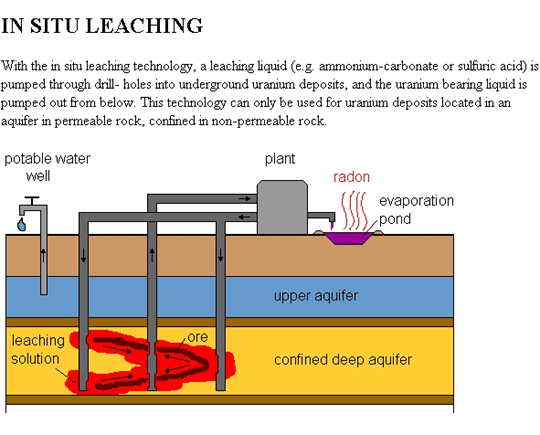
Making the project more difficult is the weak uranium price, which has recovered from this year’s low of $US28 ($32) to about $35 but still remains less than half of the level most analysts say is required for a new green-field mine.
However, Ranger Deeps would be a brown-field expansion and Ms Sutton said ERA was not in any case counting on a material lift in the price until “mid to late this decade”. http://www.smh.com.au/business/mining-and-resources/traditional-owners-scrutinise-environment-plan-for-ranger-uranium-mine-20141005-10qhbd.html#ixzz3FOVx41Yf
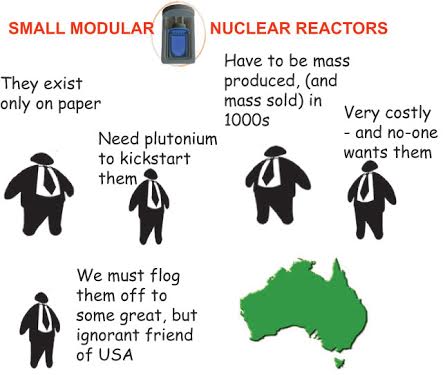
Small Modular Nuclear Reactors not viable – too costly, too late
Nuclear Power Costs Billions More Than Promised By Conan Milner, Epoch Times | October 1, 2014 “……Smaller Scale Other types of power plants are at risk of time and cost overruns as well, but experts say nuclear plants are particularly vulnerable to this problem. They require an enormous investment upfront and take longer to bring on line.
For the past 50 years, the nuclear industry has pushed for bigger units in an effort to spread costs over a larger number of kilowatt hours. But some are calling to shrink the scale with small modular reactors: compact, factory-fabricated designs that require less initial investment, and are easier to assemble than conventional units.
The United States has approved small reactor designs, but Bradford is not impressed.
“There really is no basis for optimism,” he said. “The only cost studies—they hardly even deserve the name studies. They’re provided by the vendors.”
Schneider said these smaller reactors might be a better fit for the changing electricity market, which increasingly favors a horizontally integrated system and a more eclectic approach to energy generation.
“It’s hard to imagine a huge plant whatever the source, but especially nuclear in such a new environment,” he said. “But it’s very clear the biggest problem the nuclear industry has besides cost is the time factor. Small modular reactors will not be available for a long time—for decades. We need solutions in the short term—the next 20 years.”
“It’s very interesting to see the Financial Times reporting about the U.S. market saying that wind and solar can now compete without subsidies with gas. Where is nuclear in that comparison? And that is now, not something that we have to develop over decades.”http://m.theepochtimes.com/n3/990670-nuclear-power-costs-billions-more-than-promised/
Would YOU buy meat from land hosting a radioactive trash dump?
 NT cattleman offers to host nuclear waste dump 6 Oct 14 “…….recently Federal Resources Minister Ian Macfarlane has been looking at pastoral leases, and his problem could soon be over.

A Northern Territory cattleman, John Armstrong, from Gilknockie Station, 250 kms south of Katherine, says he’s willing to have the nuclear waste dump built on his property. Why? Because it’s a money spinner………
But something’s not right here. There’s no way in the world I would buy meat from a supermarket or a butcher if I had the slightest suspicion it was produced on the same property housing a nuclear waste dump. It’s just not cricket.
To date, Mr Armstrong hasn’t been in touch with the federal minister but he’s watching and waiting for a government announcement for interested parties to apply……http://annamariacom.blogspot.com.au/
Government cover-up of Australia’s involvement in nuclear bomb testing
The following summarizes some of the key conclusions of the Royal Commission:
- The Australian government controlled media reporting such that news items provided what the UK government deemed suitable only;
- Prior to the first tests on the Australian mainland, the Government Cabinet, Parliament and news media were not informed of what was happening;
- It is likely that the major tests resulted in a general increase in cancer within the Australian population;
- Exposure to radiation increased the risk of cancer in nuclear veterans;
- There was a failure to adequately take into account the distinctive lifestyle of Aboriginal people living in the region;
- The authorities were negligent in their management, equipping and briefing of the crews of the Lincoln aircraft who were directed to fly through the nuclear cloud in the Totem 1 test;
- In the Buffalo tests, “. . . the attempts to ensure Aboriginal safety during the Buffalo series demonstrate ignorance, incompetence and cynicism on the part of those responsible for that safety.” (12)
This summary is a very small and selective account of the content of the Royal Commission’s Report.
Since Hiroshima: Australia’s Active Involvement in the Use and Abuse of Nuclear Energy Sunday, 05 October 2014 09:59By Lindsay Fitzclarence, Truthout “………..By 1952, the government had signed a contract with the CDA (Combined Development Agency) representing the UK and United States to supply uranium (5).

At the same time, in a remarkable expression of executive power, the pro-royalist prime minister of Australia, Robert Menzies, agreed to a British request to begin testing of atomic weapons in its former colony (6). At the dawn of the Cold War nuclear arms race, Australia was an active participant at both ends of the weapons cycle: the source of primary nuclear fuel and as a nuclear testing ground. Continue reading
IAEA’s guidelines on six types of nuclear waste
Nuclear waste is going nowhere slowly 03 OCT 2014 ANSIE VICENTE, SARAH WILD Generations from now, there will still be no-go areas storing radioactive by-products of nuclear power production. ……….
 Six ways to neutralise nuclear excess
The International Atomic Energy Agency’s guidelines published in 2009 define six different types of nuclear waste, each with its own suggested disposal method, determined by how dangerous the waste is to humans and the environment, how much heat it generates, and its reaction to water and temperature.
- “Exempt waste” does not require any protection and is simply disposed of like other rubbish;
- “Very low-level waste”, typically soil and rubble with low levels of radioactivity, is disposed of in landfills;
- “Very short-lived waste” is first shielded and then stored, usually in a purpose-built building, to decay by itself over a few years;
- “Low-level waste” needs a few hundred years to be considered safe and is buried near the surface once it has been encased in concrete or metal and shielded;
- “Intermediate-level waste” needs time but no heat protection, and consists mainly of the cladding and resins used in nuclear plants, and contaminated materials that come from decommissioned nuclear reactors. It is generally covered in concrete or bitumen and buried in the region of 10 to hundreds of metres underground; and
- “High-level waste”, such as spent fuel rods, remains radioactive for tens of thousands of years and generates its own heat. It can be stored on site, as it is at Koeberg or Pelindaba. The United States and Russia vitrify the waste (mix it with glass particles), clad it in concrete, shield it with lead or water and bury it, sometimes kilometres underground, in a process called “deep geological disposal”. – Ansie Vicente http://mg.co.za/article/2014-10-02-nuclear-waste-is-going-nowhere-slowly/
….
NT News reports Aboriginal owners wanting to host radioactive trash dump
 Northern Territory land councils race clock to nominate a radioactive dump site, NT News BY ZACH HOPE OCTOBER 04, 2014 TRADITIONAL owners are racing against the clock to nominate a site to house Australia’s nuclear waste before the Federal Government opens the process to a national tender.
Traditional owner Geoffrey Wangapa Barnes, from the Ngatijirri clan of the Tanami Desert, said about 50 of 60 traditional owners gave in-principle support for a site northwest of Yuendumu during a meeting with Commonwealth staff and scientists last month.
It comes as the Northern Land Council continues its talks with traditional owners of the Muckaty Land Trust for a nomination north of the controversial site scuttled in June because of clan and family divisions.
Mr Barnes, a delegate of the Central Land Council, said traditional owners were left confused when the desert meeting ended without a compensation package put on the table.
It prompted him to email Indigenous Affairs Minister Nigel Scullion but he said he received no response.
Industry Minister Ian Macfarlane, who has responsibility for finding the radioactive waste site, said the department staff were only at the meeting to explain the issue and not negotiate a package.
“They (the traditional owners) need to write to me and put their case but they haven’t done that,” he said…….
Mr Barnes and his uncle, ousted CLC chairman Maurie Japarta Ryan, have called for another meeting between traditional owners, scientists and the Government before the next CLC meeting in the first week of November.
Despite an arbitrary deadline expiring on September 30, the land councils still have exclusive rights to nominate a site until November 10, when Mr Macfarlane will open a tender to groups anywhere in Australia. …….http://www.ntnews.com.au/news/northern-territory/northern-territory-land-councils-race-clock-to-nominate-a-radioactive-dump-site/story-fnk0b1zt-1227079798955
Wind and solar generation rising fast, as nuclear slows
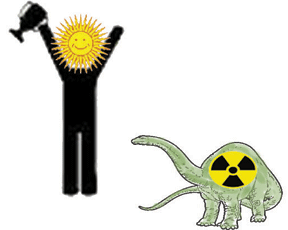 Wind & Solar Energy Generation Capacities Both Catching Up With Nuclear, Clean Technica October 5th, 2014 by James Ayre Renewables have been capturing a larger and larger portion of the total global energy infrastructure pie, while the portion nuclear energy has not just been stagnating but actually shrinking somewhat, as noted by a new Vital Signs report from Worldwatch Institute.
More interesting than that observation, though, is the fact that solar and wind energy have been gaining fast on nuclear — and are now, more or less, on the same trajectory that nuclear power was on in the 1970s and 1980s, in its heyday.
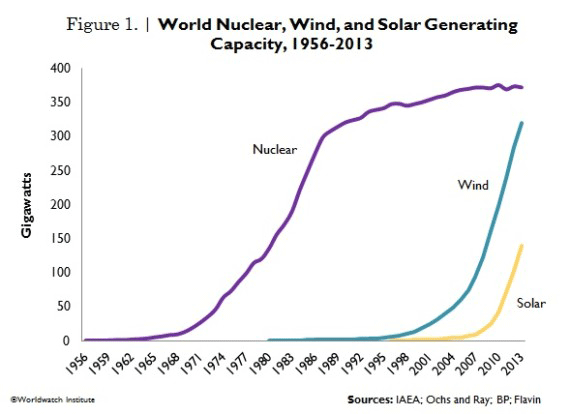
So, it looks like that “nuclear renaissance” that some analysts have been babbling about for the last several years will have to wait for at least another couple of years — or, more likely, forever. Solar and wind energy will no doubt continue growing at a fair rate (at the least) in the years to come.
Here are some of the exacts: nuclear’s share of total global power production has steadily declined from a peak of 17.6% in 1996 to 10.8% in 2013. And renewables have increased their share from 18.7% in 2000 to 22.7% in 2012. Continue reading
A worry for the govt when John Carlson gets worried about the India nuclear deal
 Nuclear deal with India compromised by ‘vague’ details on keeping track of uranium The Age October 5, 2014
Daniel Flitton Senior Correspondent “…….Prime Minister Tony Abbott signed such a deal with India last month, a ‘‘treaty for co-operation in the peaceful uses of nuclear energy’’. But there is a worry that this difficult agreement, years in the making, might not have the same careful protections as Australia’s other arrangements.
This concern hardly comes from a usual left-of-field suspect, stridently opposed to anything nuclear. Instead, the alarm is from the former chief of Australia’s atomic watchdog and, in assessing the India deal, he used words like vague and meaningless.
John Carlson headed the Australian Safeguards and Non-Proliferation office for more than two decades until 2010. Continue reading
Tony Abbott’s profound ignorance about the effect of climate change on Aborigines
 Abbott Hasn’t Joined The Dots On Black Affairs And Climate Change, SaysActivist https://newmatilda.com/2014/09/30/abbott-hasnt-joined-dots-black-affairs-and-climate-change-says-activistThe gaping hole in Australian Prime Minister Tony Abbott’s self-declared interest in Aboriginal aspirations is his ignorance on climate change. Amy McQuire reports.
Tony Abbott’s ambition to become the “Prime Minister for Aboriginal affairs” doesn’t align with his position on climate change, with First Nations communities the most vulnerable to the disastrous effects of global warming, according to a young Bundjalung environment warrior. Continue reading
Another revolutionary development in solar energy storage
 New rechargeable ‘solar battery ‘promises to revolutionize solar technology By Daily Digest News October 04, 2014 Scientists from Ohio State University invented a revolutionary breakthrough green energy technology that has the chance to upend the solar power industry.
Led by Professor Yiying Wu, scientists created a solar cell that also doubles as a rechargeable battery– the first combined device of its type.
“The state of the art is to use a solar panel to capture the light, and then use a cheap battery to store the energy,” Wu said. “We’ve integrated both functions into one device.”…….
By combining both the generation and storage processes, Wu and his team have been able to drastically reduce lost potential, saving nearly 100 percent of the electrons produced.
“Any time you can do that, you reduce cost,” said Wu.
The team estimates that their device brings down costs by 25 percent, which would be a significant boon to the solar energy industry.
Costs and innefficiency are the two factors consumers often point to that inhibits solar energy usage compared to traditional fossil fuel sources.
The team filed for a patent on the solar battery, and plans to license it to the broader energy industry for sale and distribution.http://dailydigestnews.com/2014/10/new-rechargeable-solar-battery-promises-to-revolutionize-solar-technology/
Southern hemisphere ocean heating has been under-estimated
 Oceans heating up faster than we thought: study, SMH October 6, 2014 Hannah Francis Oceans in the southern hemisphere are warming faster than anticipated, with implications for rising sea levels and climate modelling.
A team of scientists in California has studied rising temperatures of the southern hemisphere over the decades between 1970 and 2004, and recommended lifting estimates of ocean heat content by between 48 and 152 per cent.
Lead author Paul Durack said it was the first time scientists have been able to quantify how big the gap is between earlier estimates and the reality of rising ocean temperatures.
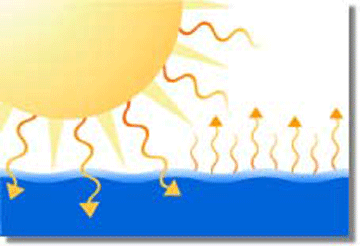
Sea temperatures are a crucial yardstick for global warming as the ocean stores more than 90 per cent of human-induced excess heat.
Higher sea level temperatures are also closely linked with rising sea levels, because water expands as it warms.
Ocean warming down to two kilometres below the surface accounts for around a third of the annual rate of global mean sea-level rises.
The study by Lawrence Livermore National Laboratory and the California Institute of Technology, published in the journal Nature Climate Change on Monday, attributed the missed estimates to a history of poor sampling of temperatures in the southern hemisphere oceans, which make up 60 per cent of the world’s oceans.
The region, which includes the Indian and South Pacific oceans as well as the South Atlantic and Southern oceans, has not been sampled nearly as frequently to date as oceans in the northern hemisphere…….. http://www.smh.com.au/environment/climate-change/oceans-heating-up-faster-than-we-thought-study-20141005-10qgfn.html#ixzz3FPcZ9tZW
Australian National University sells off fossil fuel interests – but not enough of them
ANU decision to sell fossil fuel company holdings not enough: students By Lisa Mosley ABC News, 3 Oct 2014, An Australian National University (ANU) decision to sell off about $16 million worth of its investments in seven fossil fuel companies does not go far enough, a students’ group says.
ANU said it would divesting itself of shares in Newcrest Mining, Iluka Resources, Oil Search and Santos, among other companies.
Vice-chancellor Professor Ian Young said it was important that the university did not invest in companies that are doing some form of social harm……….
Louis Klee from the group ANU Fossil Free said while it was a big achievement for the university, the decision did not go far enough.
He said the ANU still had major holdings in BHP Billiton, Rio Tinto and Woodside Petroleum.
“It is wrong for ANU to continue to profit from these industries that are responsible for the wreckage of the planet,” he said. …….http://www.abc.net.au/news/2014-10-03/anu-selling-fossil-fuel-company-holdings-not-enough-student-says/5789748
Australia’s historic involvement in use and abuse of nuclear energy
Since Hiroshima: Australia’s Active Involvement in the Use and Abuse of Nuclear Energy Sunday, 05 October 2014 09:59By Lindsay Fitzclarence, Truthout |Pandora’s Promise, a 2013 documentary, mobilizes the voices, expertise and credibility of a number of prominent commentators who speak out in favor of nuclear energy (1). In the film, Stewart Brand, once a critic, recants his former positions to advocate the use of nuclear energy as a way of combatting the perils and dangers associated with greenhouse gas-producing carbon fuels. Brand’s new eco-political platform represents much of the spin and simplified logic of those on the bandwagon that might now be “branded”: No to Carbon Yes to Nuclear.
In an article titled “Remembering Hiroshima in an Age of Neoliberal Barbarism,” Henry Giroux (2) provides a timely provocation and reminder for those rushing to jump on board this pronuclear movement. With regard to the events surrounding the use of atomic bombs in Japan in 1945 Giroux asserts:
“Historical memory is not simply being rewritten but is disappearing. . . . History under the reign of neoliberalism has been either cleansed of its most critical impulses and dangerous memories, or it has been reduced to a contrived narrative that sustains the fictions and ideologies of the rich and powerful.” (3)
Within the context of current debates about “climate change” and “appropriate fuel sources” for these turbulent times, the nuclear power industries are making a powerful global pitch as dramatized by the messages of Pandora’s Promise. This article takes up Giroux’s storyline by outlining an account of the nuclear power story in Australia. The narrative contains content that is little known within Australia, let alone in the wider global community……….
This willingness to be involved in the first phase of the nuclear fuel cycle needs to be interpreted against the backdrop of cultural ignorance, political duplicity and neocolonial arrogance and exploitation. It is around this matter that Henry Giroux’s observation about the redemptive politics in remembering Hiroshima (and Nagasaki) becomes relevant. What is required in Australia, and elsewhere, is a politics of reclaiming a radical imagination and accepting responsibility to take part in activities aimed at avoiding these tragedies that must be better understood in order not to be repeated http://www.truth-out.org/news/item/26593-since-hiroshima-australia-s-active-involvement-in-the-use-and-abuse-of-nuclear-energy
Abbott govt’s Review of Renewable Energy Target has caused slump in investment in renewables
Australia’s investment in renewable energy slumps 70% in one year The Coalition’s review of the Renewable Energy Target has caused investment in clean energy to drop below that of Algeria, Thailand and Myanmar theguardian.com, Friday 3 October 2014 Australia’s investment in renewable energy projects has slumped below that of Algeria, Thailand and Myanmar, new figures have shown, with the sector “paralysed” by the government’s review of the Renewable Energy Target.
Just $193m was invested in new large-scale clean energy projects in the third quarter of 2014, according to Bloomberg New Energy Finance. Investment in the year to date is $238m.
This represents a massive 70% slump on 2013 investment and has resulted in Australia slipping from the world’s 11th largest investor in clean energy to 31st in 2014.
This ranking is below Algeria, Myanmar, Thailand and Uruguay. By comparison, Canada has invested $US3.1bn in large clean energy projects so far in 2014.
The slowdown in renewable energy investment is pinned squarely by Bloomberg on the government’s review of the RET, which mandates that 41,000 gigawatt hours of Australia’s energy comes from renewable sources by 2020………
Kobad Bhavnagri, an analyst at Bloomberg New Energy Finance, told Guardian Australia that the renewables sector is “in the doldrums.”
The government’s position has caused this, it has had some pretty strong anti-renewables rhetoric, particularly anti-wind, and wants to close certain clean energy programs,” he said. “The review has been particularly protracted. The industry was fearful the recommendations would be extreme and they were. It has been shattering.
“I think the government has backed itself into a corner because the Warburton review lacks credibility. I don’t think it’s in Labor’s interest to agree to any changes to the target.”
Bhavnagri said that should the RET be scaled back rather than abolished, investment would resume but at around half its current level, meaning that $10bn would be invested between now and 2020.
The figures follow an analysis done by the Clean Energy Council and, separately, the Greens, which shows that New South Wales would suffer most if the RET was scrapped. An estimated $4.24bn in projected investment and 4,410 jobs in the state would be at risk if the scheme was dismantled.
“NSW will be the hardest hit if the RET is dumped, with huge negative implications for jobs growth, power prices and the environment,” said Greens senator Lee Rhiannon.
“The Greens will continue to work to retain and expand the Renewable Energy Target and to give the industry certainty.”http://www.theguardian.com/australia-news/2014/oct/03/australias-investment-in-renewable-energy-slumps-70-in-one-year
1 This month

of the week – Australians for War Powers Reform (AWPR)
To see nuclear-related stories in greater depth and intensity
 Antinuclear