Incident on nuclear waste ship illustrates why we should shut down Lucas Heights nuclear reactor
 Why Australia should shut down the Lucas Heights nuclear reactor, Independent Australia Last week’s fire on a nuclear waste ship off Scotland shows why Australia’s Lucas Heights nuclear reactor should to be shut down, writes Noel Wauchope. 15 Oct 14, “……. The ship, the Parida, was carrying radioactive wastes that were being returned to Belgium……
In the case of Dounreay, there is now pressure on the countries where the wastes originated, because the Dounreay nuclear site is being decommissioned and demolished……
Transport of radioactive wastes to and from Lucas Heights is indeed a hazardous operation, requiring much expensive security. However, transport is not the only safety consideration. The previous HIFAR reactor ‒ and the present OPAL one ‒ have troubled safety records…….
Australia’s most notorious terrorist, Willie Brigitte was gaoled in France in 2007 for joining an al-Qaeda backed Pakistani terror cell that had conspired to blow up the Lucas Heights nuclear plant. …….
We should shut Lucan Heights down before we regret it. http://www.independentaustralia.net/life/life-display/why-australia-should-shut-down-the-lucas-heights-nuclear-reactor,6999
Uranium companies rejoice, as universities and groups get out of fossil fuel investments?
 Divestors painting themselves into the uranium corner, JAMES KIRBY THE AUSTRALIAN OCTOBER 11, 2014
SUDDENLY the urge to “divest” is reaching fever pitch. Inside a couple of weeks there has been more noise than we have had in years as universities, religious groups and super funds announce they are “getting out of polluters”.
Indeed, the ANU’s plan to divest itself of seven resource companies, including oil and gas major Santos, has been branded a “disgrace” by federal Infrastructure Minister Jamie Briggs.
Like most trends, this started in the US where a number of leading funds have been loudly exiting resource stocks. The rush reached something of a climax in recent weeks when the heirs of Standard Oil founder John D Rockefeller said they were getting out of oil.
Now Australia will mark a national “Divestment Day of Action” targeted largely at banks that invest in resources on October 18, an initiative backed by 350.org………
Australia invites a nuclear non proliferation disaster, in its flawed deal with India
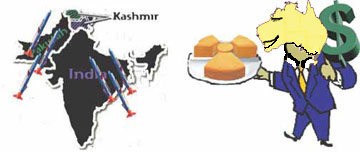 Australia–India nuclear treaty: a non-proliferation disaster, The Strategist, the Australian Strategic Policy Institute Blog 14Oct 2014 By Crispin Rovere “…….Nuclear suppliers do have a responsibility, however, for ensuring their nuclear material isn’t used to build nuclear weapons, and must maintain strict mechanisms for that purpose. If countries can access nuclear supply without the attendant responsibilities, then support for longstanding non-proliferation regimes will be undermined, countries will see less value in treaties such as the NPT, and a key pillar of the nuclear arms control regime as a whole will be weakened.
The text of the proposed Australian export deal fails that basic test. In addition to a range of other flaws, for the first time in 40 years Australia won’t be able to guarantee how the nuclear material it supplies is being used. Specifically, the agreement allows India to reprocess uranium supplied by Australia to create plutonium, potentially at weapons grade, with no direct accounting by India to Australia for that material, and unusually, no provision for the return of the material in the event of it being misused. As former Director-General of ASNO, John Carlson, explains, Australia currently allows reprocessing only by two export partners, the EU and Japan, each with direct reporting requirements and specific permission being given by Australia as to how the reprocessed material is to be used.
Accordingly, the deal with India isn’t comparable to Australia’s other nuclear export agreements. Australia is privileging India by excluding key provisions normally included to ensure a recipient of nuclear material is accountable to the supplier. Australia’s other nuclear export partners might demand similar concessions, undermining the integrity of the non-proliferation regime as a whole.
Moreover, the concessions made by Australia are unnecessary. ………Not only does this agreement undermine long established non-proliferation regimes and Australia’s credibility as a nuclear supplier, it represents a missed opportunity to strengthen it. Given that what matters most to India is being treated on a par with China and the United States, India should be expected to ratify the Comprehensive Nuclear-Test-Ban Treaty (CTBT) after the US Senate does, just as China has already agreed to do……..
The agreement marks a significant departure from Australia’s longstanding practice. By excluding the normal provisions that ensure a nuclear recipient is directly accountable to the supplier, Australia is abrogating the principle that nuclear suppliers are accountable for how their exported nuclear material is used……..Crispin Rovere is a former PhD student at the Strategic and Defence Studies Centre, ANU and co-author of Non-strategic nuclear weapons: the next step in multilateral arms control. Image courtesy of Flickr user Indiawaterportal.org. http://www.aspistrategist.org.au/australia-india-nuclear-treaty-a-non-proliferation-disaster/
New South Wales town Uralla in the running for getting 100% renewable energy
 Uralla competes for more renewable energy http://www.armidaleexpress.com.au/story/2625862/uralla-competes-for-more-renewable-energy/?cs=12 By LYDIA ROBERTS 15 Oct 14 URALLA is vying with five other towns to become the first in Australia to rely solely on renewable energy.Mayor Michael Pearce says the move will cut power bills for the town’s ratepayers and businesses. It could also mean wind turbines become a fixture on the Uralla landscape.
“We already have solar panels powering our aged-care facilities and heating our swimming pool; our community is telling us they want more renewable initiatives and this could fit the bill,” Cr Pearce said yesterday.
Non-for-profit company Starfish Enterprises has secured a $105,000 state government grant to develop a blueprint for a zero net energy town, ideally located in the Northern Tablelands.
While more than 100 businesses have tendered to draw up the blueprint, the next step in the process is to find a suitable town willing to become the first to switch to 100 per cent green power.
Uralla, Walcha, Glen Innes, Inverell, Bingara and Manilla have all expressed an interest in becoming the model town. Cr Pearce said Uralla stood a good chance of becoming the selected town because there was substantial community support for the idea.
The move would follow several towns in the United States and Germany, all of which have shifted to zero net energy. This means the towns are powered by LED lighting, bio-gas plants, daytime solar panels and energy efficient pumping systems.
Starfish executive director Adam Blakester said expressions of interests from towns closed next Friday.
“An average town of 5000 people would spend up to $20 million a year on energy,” he said. “If we can produce that energy locally and competitively, we create a new industry.”
South Australia’s remarkably high renewable energy production
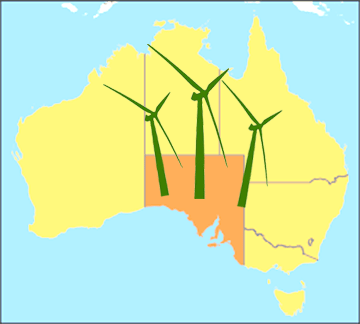
 South Australia Achieves 100% Renewable Energy For A Whole Working Day Clean Technica October 13th, 2014 by Giles Parkinson (good graphs)_ RenewEconomy. There have been several instances in recent months when wind energy has accounted for all, or nearly all, electricity demand in South Australia. Last Tuesday, however, set a new benchmark – the combination of wind energy and rooftop solar provided more than 100 per cent of the state’s electricity needs, for a whole working day between 9.30am and 6pm.
The data comes from Hugh Saddler, at consultants Pitt & Sherry, and is part of his monthly overview of electricity market, emissions and pricing trends in Australia.
Saddler notes there were several periods in South Australia from Saturday September 27, and over the following days, when wind generation was greater than total state NEM demand. (South Australia has nearly half the country’s wind capacity with around 1.5GW of wind energy).
It occurred briefly on Saturday afternoon, for much of Sunday, and again, most strikingly, between about 9.30am and 6.00pm on Tuesday, September 30, a normal working day.
In reality, renewables contributed well over 100 per cent because they were generating and consuming their own electricity from rooftop solar – the state has 550MW of rooftop solar, with nearly one in four houses with rooftop modules.
That meant that “true” demand by consumers on that day, i.e. the amount of electricity being used by consumers, including rooftop solar, was in fact considerably higher than NEM demand — up to 20 per cent according to the Australian Photovoltaic Institute — because of the contribution of rooftop PV to total electricity supply…….
Interestingly, the South Australia government has already exceeded its target of generating 33 per cent of the state’s electricity needs from renewables (over a full year), and has now set a 50 per cent target by 2025. In reality, it will likely reach that mark well before that, particularly if the Ceres wind farm and the Hornsdale wind farm are built. It could even be the first mainland state towards 100 per cent renewables over the whole year.
Considerable volumes of electricity were exported to Victoria. “In simple arithmetic terms, though not of course in how the grid actually operated, the state’s electricity supply was 100 per cent renewable while coal and gas-fired electricity was exported,” he says…..http://cleantechnica.com/2014/10/13/s-australia-achieves-100-renewable-energy-whole-working-day/
Dr Caldicott warns on how a US-Russia nuclear war could wipe out humanity
 US-Russia Nuclear War Could Wipe Out Humanity – Nuclear Physician Warns http://au.ibtimes.com/articles/569300/20141013/nuclear-war-russia-over-ukraine-vladimir-putin.htm#.VD7HmWddUnk By Athena Yenko | October 13, 2014
A nuclear war that will deplete the ozone layer, emit radioactive pollution, form massive fire storms, and a nuclear winter could ignite between the United States and Russia over theUkraine crisis. Helen Caldicott, an Australian physician, an advocate of citizen action to address nuclear and environmental crises, the founding president of Physicians for Social Responsibility and a 1985 Nobel Prize nominee warns that the Cold War has returned and could escalate into a nuclear war between Russia and the United States. “It’s an incredibly dangerous situation. … If there’s a nuclear war tonight, that’s the Northern Hemisphere (of the entire world) gone,” she said at the National Press Club Newsmaker press conference.
She highlighted that the advances made by NATO to Russia’s border is perilous. She implied that NATO’s strategy was a provocation. She said that the only war that the two countries could engage is a nuclear one. The United States and Russia, she said, owns gigantic stockpiles of nuclear armaments. In fact, these two nations hold the 94 percent of the total 16,300 nuclear weapons around the world. “Do they really want a nuclear war with Russia? The only war that you can have with Russia is a nuclear war. … You don’t provoke paranoid countriesarmed to the teeth with nuclear weapons,” she stressed, according to The National Press Club.
Caldicott called attention to the fact that the impending nuclear war is a medical issue that “will create the final epidemic of the human race.” Ukraine has 15 large nuclear power plants in its possession. Any attack on these plants, whether with the most conventional of weapons, would result to a meltdown comparable to the Chernobyl in 1986. She underlined that the Chernobyl meltdown took the lives of more than a million people.
She lauds President Barack Obama for his support of nuclear disarmament. However, with the threats of the ISIS and the Ebola outbreak on his plate, other agencies have overwhelmed his decision. On the other hand, she thinks highly of Russian president Vladimir Putin saying that he is “very restrained at the moment.”
Caldicott underscored that the centenary of the start of the World War 1 had just passed but it the conflicts that spark it stand still. “You know how the First World War started 100 years ago: One person shot an archduke. The pride of the leaders and generals of the great nations did the rest: They went to war. Human fallibility was a major cause then. It is just as common today,” she said.
European Commission Report finds wind is the world’ s cheapest energy source
 Wind is the World’s Cheapest Source of Energy According to EU Report, Inhabitat, by Beverley Mitchell, 10/14/14 A report prepared for the European Commission has found that onshore wind power provides the cheapest source of energy once external factors such as air quality, health impacts and expenditure, and the costs of climate change are taken into consideration. The report’s authors found that onshore wind costs around $133 per MW/h to produce, whereas gas and coal cost up to $208 and $295 per MW/h each. However, continuing a controversy that shadowed the Commission last year, extracts from the report have already been published that fail to include the external costs, which is where many of the subsidies to coal, gas and nuclear are made.
Sodium Fast Cooled Reactor looking to be dud, like the other new nuclear power designs
These Are The 6 Concepts For The Future Of Nuclear Power, Business Insider GEERT DE CLERCQ OCT 13 2014 “………..the sodium-cooled fast reactor (SFR), developed by France, Russia and China from a concept pioneered in the United States in the 1950s.
Early SFRs built by France, Russia and Japan have suffered corrosion and sodium leaks. But these were not built to GIF standards and the CEA research facility amid the pine trees in Cadarache, southeast France, is working on how to tame sodium as the agency seeks to convince lawmakers to allow construction of its new Astrid reactor, a 600 megawatt SFR.
The Astrid project was granted a 652 million euro ($823 million) budget in 2010 and a decision on construction is expected around 2019.
The use of sodium, which occurs naturally only as a compound in other minerals, presents huge challenges, however.
Nitrogen-driven turbines are being designed to prevent sodium from mixing with water, while purpose-built electromagnetic pumps are seen as the solution to moving the superheated metal within reactors. Then there’s the headache of not being able to see through the liquid metal should something go wrong in a reactor core.
The other five concepts – including lead and helium-cooled fast neutron reactors and three very-high-temperature reactors – are less mature than the SFR and face similar technological hurdles.
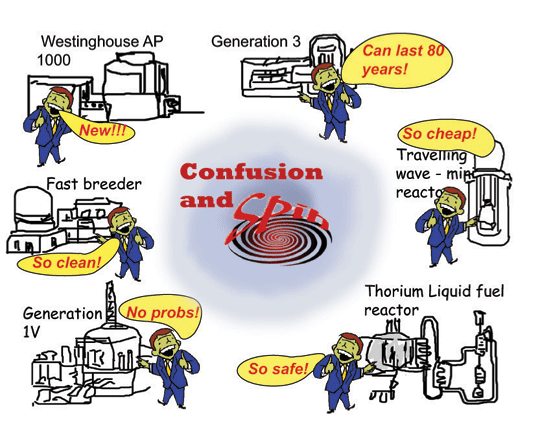
But technology is not the only obstacle. Cost is key, as ever, and abundant U.S. shale gas and a renewables energy boom in Europe have undermined the viability of the nuclear industry, leading some GIF member states, including Japan, Canada and Switzerland, to scale back funding. …..http://www.businessinsider.com.au/r-the-key-to-nuclear-s-future-or-an-element-of-doubt-2014-10
Potassium iodide pills for all communities near nuclear power plants in Canada
 Radiation protection pills delivered by end of 2015, Star.com New rules from the Canadian Nuclear Safety
  Commission dictate that iodine thyroid-blocking pills must be delivered to homes and workplaces near nuclear plants by the end of next year. By: John Spears Business reporter, Oct 14 2014
People living and working within 8 to 16 kilometres of a nuclear power plant should have radiation protection pills in their hands by the end of 2015, under new federal regulations.
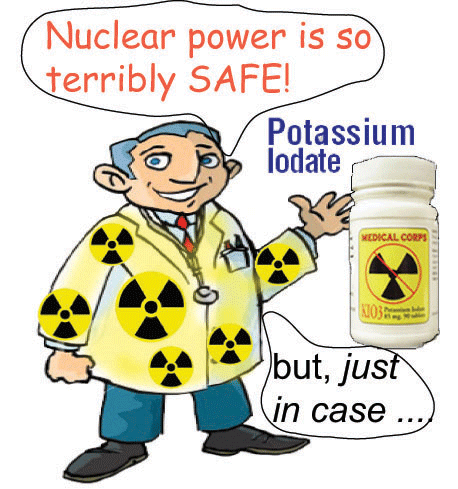
But Durham’s Medical Officer of Health says it will be “very tight – extremely tight” to meet the deadline.New rules from the Canadian Nuclear Safety Commission dictate that iodine thyroid-blocking pills must be delivered to homes and workplaces near nuclear plants by the end of next year.
The pills, often known as potassium iodide pills or KI pills, inhibit the thyroid gland from absorbing radiation.Nuclear plant operators must pay the cost of buying and distributing the pills, but provincial and local health officials will be working out how to get them into the hands of tens of thousands of people from Scarborough to Clarington in time for the deadline.
Dr. Robert Kyle, Durham’s medical officer of health, said his unit already given stocks of pills to pharmacies and to institutions like schools, daycares, and police and fire departments……..
The pills will have to be sent out with readily understandable directions in different languages, he added.And someone will have to track new residents to make sure they get their pills.
The new rules also require pills to be stocked in institutions over a wide area beyond the immediate zones around the plants, he said. Continue reading
Abbott to close Co-operative Research Centres, in favour of science in the service of big business
 Abbott govt to terminate CRCs for new plan, Herald Sun AAP OCTOBER 14, 2014
THE federal government will pump $188.5 million into new Industry Growth Centres to provide infrastructure in five key sectors of the economy in a move that will spell the end of Cooperative Research Centres……..
The Abbott government’s agenda heading down the authoritarian path
Abbott’s thuggish agenda steers country down authoritarian path Old Dog Thoughts, 14 Oct 124 THE Abbott Government is a regime with a taste for authoritarianism the like of which we have not seen in Australia since World War II.
It is using the pretext of a terrorist group called ISIS, operating thousands of miles from this island continent, to strip freedoms and empower security and police agencies in a way that is frightening, so frightening in fact that the venerable Washington Post last week described Australia as a “national security state”.
The authoritarianism of the Abbott Government also manifests itself in seeking to suborn the ABC and turn it into a tame propagandist for the reactive conservatism of Mr Abbott and thuggish lieutenants like Immigration Minister Scott Morrison and Attorney-General George Brandis. Sounding more like Zimbabwe’s Robert Mugabe or Russia’s Vladimir Putin than the leader of a democratic country, Mr Abbott once complained that the ABC is too often not on the side of Australia. A troubling comment and symptomatic of the intolerance of dissent and critical commentary that is part and parcel of the modus operandi of the Abbott Government……….
All this — anti terror laws, Abbott’s patting the ABC on the back for being loyal and Mr Morrison’s legal bullying — in only a month. But look at the pattern. This is a government obsessed with secrecy and pumping taxpayers’ dollars into police, spies and the military. It is a government that berates its critics in a way that makes former Liberal prime minister John Howard look positively tolerant.
Australia suffers from having no real check on an authoritarian leader like Mr Abbott. In Canada, Prime Minister Stephen Harper shares many of the unfortunate undemocratic traits of Mr Abbott, but he is fortunately constrained by a cultural and legal commitment in that country to citizens having enforceable protections via a human rights charter. Even in the US, citizens have more protection against authoritarian actions than is the case in Australia.
Maybe Australians don’t care. After all, this country started its European days by wiping out indigenous Australians and as a jail for the UK. It is a country that has never had to struggle to maintain democracy. It is a lazy democracy as a result and easily scared by mythical invaders from elsewhere.
It would be a pity if the Abbott Government were allowed to continue along the authoritarian path it is taking this country down. But it will only stop if Australians realise that the democracy they think exists is being dismantled by a bunch of thugs running Canberra, and a weak opposition in the form of an unprincipled ALP. http://olddogthoughts.com/
1 This month
7 April – WEBINAR – Australia and the Doomsday Clock – Preventing nuclear war through NoFirstUse and other policies
Online | Tuesday April 7, 4:00-5:30pm, Australian Eastern Time / 8:00-9:30am Central Europe Time
– Access the registration link
15 April – Zoom –Nuclear Power is Not the Solution
Apr 15, 2026 01:00 AM in Canberra, Melbourne, Sydney

Join the International Physicians for the Prevention of Nuclear War (IPPNW) on Tuesday, April 14th for a timely webinar exploring the risks associated with nuclear power and challenging the myth that it offers a simple, safe, carbon-free solution to the climate crisis

21 April Webinar: No Nuclear Weapons in Australia
Start: 2026-04-21 18:00:00 UTC Canberra, Melbourne, Sydney (GMT+10:00)
End: 2026-04-21 19:30:00 UTC Canberra, Melbourne, Sydney (GMT+10:00)
Event Type: Virtual
A virtual link will be communicated before the event.
Host Contact Info: australia@icanw.org

of the week – Australians for War Powers Reform (AWPR)
To see nuclear-related stories in greater depth and intensity
 Antinuclear