Sodium Fast Cooled Reactor looking to be dud, like the other new nuclear power designs
These Are The 6 Concepts For The Future Of Nuclear Power, Business Insider GEERT DE CLERCQ OCT 13 2014 “………..the sodium-cooled fast reactor (SFR), developed by France, Russia and China from a concept pioneered in the United States in the 1950s.
Early SFRs built by France, Russia and Japan have suffered corrosion and sodium leaks. But these were not built to GIF standards and the CEA research facility amid the pine trees in Cadarache, southeast France, is working on how to tame sodium as the agency seeks to convince lawmakers to allow construction of its new Astrid reactor, a 600 megawatt SFR.
The Astrid project was granted a 652 million euro ($823 million) budget in 2010 and a decision on construction is expected around 2019.
The use of sodium, which occurs naturally only as a compound in other minerals, presents huge challenges, however.
Nitrogen-driven turbines are being designed to prevent sodium from mixing with water, while purpose-built electromagnetic pumps are seen as the solution to moving the superheated metal within reactors. Then there’s the headache of not being able to see through the liquid metal should something go wrong in a reactor core.
The other five concepts – including lead and helium-cooled fast neutron reactors and three very-high-temperature reactors – are less mature than the SFR and face similar technological hurdles.
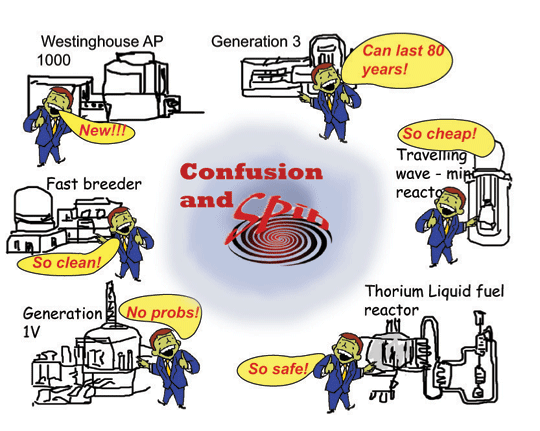
But technology is not the only obstacle. Cost is key, as ever, and abundant U.S. shale gas and a renewables energy boom in Europe have undermined the viability of the nuclear industry, leading some GIF member states, including Japan, Canada and Switzerland, to scale back funding. …..http://www.businessinsider.com.au/r-the-key-to-nuclear-s-future-or-an-element-of-doubt-2014-10
No comments yet.
1 This month
7 April – WEBINAR – Australia and the Doomsday Clock – Preventing nuclear war through NoFirstUse and other policies
Online | Tuesday April 7, 4:00-5:30pm, Australian Eastern Time / 8:00-9:30am Central Europe Time
– Access the registration link
15 April – Zoom –Nuclear Power is Not the Solution
Apr 15, 2026 01:00 AM in Canberra, Melbourne, Sydney

Join the International Physicians for the Prevention of Nuclear War (IPPNW) on Tuesday, April 14th for a timely webinar exploring the risks associated with nuclear power and challenging the myth that it offers a simple, safe, carbon-free solution to the climate crisis

21 April Webinar: No Nuclear Weapons in Australia
Start: 2026-04-21 18:00:00 UTC Canberra, Melbourne, Sydney (GMT+10:00)
End: 2026-04-21 19:30:00 UTC Canberra, Melbourne, Sydney (GMT+10:00)
Event Type: Virtual
A virtual link will be communicated before the event.
Host Contact Info: australia@icanw.org

of the week – Australians for War Powers Reform (AWPR)
To see nuclear-related stories in greater depth and intensity
 Antinuclear
Leave a comment