We cannot ignore the fact of massive melting of ice sheets
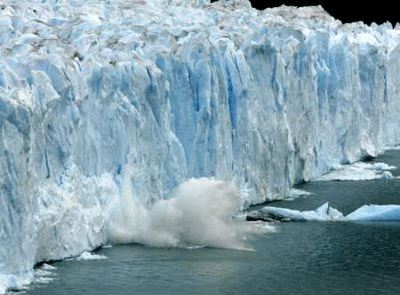 we cannot ignore it, because the sheer volume of land ice on Earth is enormous – equivalent to more than 65m of global sea level rise; Greenland alone accounts for 6 to 7m, West Antarctica for some 5-6m, and East Antarctica for the remainder. These melting ice sheets will dominate major sea level changes for centuries to come.
Why ice sheets will keep melting for centuries to come, Skeptical Science By Eelco Rohling, University of Southampton 17 Oct 14 Ice sheets respond slowly to changes in climate, because they are so massive that they themselves dominate the climate conditions over and around them. But once they start flowing faster towards the shore and melting into the ocean the process takes centuries to reverse. Ice sheets are nature’s freight trains: tough to start moving, even harder to stop.
We know this process has been going back and forth throughout history – it’s why we’ve had ice ages and warm periods. But until now we haven’t known exactly how quickly ice sheets retreated and reformed. New research published in the journal Nature Communications gives us an answer, and it isn’t great news.
It turns out sea levels often rose at scary rates in response to natural climate changes, long before mankind began pumping carbon into the atmosphere.
In the short-term sea level is affected by ocean warming and so-called “thermal expansion”, or melting glaciers based on land. These changes can occur quickly – within a decade – but their impact on sea level is relatively small, in the tens of centimetres. The drivers of longer-term sea level rise, over decades or centuries, are the continental ice sheets of Greenland and Antarctica.
On the fringes of these ice sheets are “ice shelves” stretching far out into the ocean. Ice shelves can be hundreds of meters thick and, because 90% of ice in water floats below the surface, they remain “grounded” on the sea floor as long as the sea is less deep than 90% of the ice shelf thickness. Where the sea floor is deeper or the ice shelf gets thinner, there will be an area of floating land ice; here, warming ocean water can get underneath and melt the ice. Once sufficiently destabilised, an ice shelf can break up catastrophically.
Such an ice shelf collapse takes the brakes off the ice stream that feeds into the ice shelf, and land ice starts to flow much quicker towards the ocean.
Ice flow is a relatively slow process, and it takes some forcing to get a major ice sheet to systematically respond (like trying to set a fully loaded freight train into motion). Once moving, however, it will be equally hard to arrest that movement (like trying to stop a moving, fully loaded freight train).
Still, we cannot ignore it, because the sheer volume of land ice on Earth is enormous – equivalent to more than 65m of global sea level rise; Greenland alone accounts for 6 to 7m, West Antarctica for some 5-6m, and East Antarctica for the remainder. These melting ice sheets will dominate major sea level changes for centuries to come.
We can learn something about what to expect by examining sea level changes during the past five ice-age cycles (past half million years), especially through comparing them with the total amount of ice on the planet at the time……….
How long will it take?
In the 120 different events we looked at, ice sheets went from initial change to maximum retreat within 400 years 68% of the time, and within 1100 years for 95%. In other words: once triggered, ice sheet reduction (and therefore sea level rise) kept accelerating relentlessly for many centuries.
Research we carried out previously found that modern sea level rise seems to be conforming to what we would expect from (high end) natural responses to warming. That is: after 150 years of increasing (man made) warming, the ice sheets would only recently be reaching the point where they start making a noticeable contribution to sea level rise.
But that time has come and, once ice sheets start to melt, the freight train is in motion. It will then keep moving for many centuries to come, no matter how hard we stamp on the brakes. http://www.skepticalscience.com/Why-ice-sheets-will-keep-melting_The-Conversation.html
No comments yet.
1 This month

of the week – Australians for War Powers Reform (AWPR)
To see nuclear-related stories in greater depth and intensity
 Antinuclear
Leave a comment