Tony Abbott thinks that he can get away with one tiny concession on climate change, at the G20
 G20: Australia makes token concession on climate change after US lobbying Lenore Taylor, Guardian Australia political editor theguardian.com, Sunday 2 November 2014
Government resists calls for climate change to be listed as a major agenda item, but agrees to include in final communique Australia has reluctantly conceded that climate change can be included in a single brief paragraph of the G20 leaders’ communique after heavy lobbying by the US and European nations.
The government had resisted any discussion of climate at the Brisbane meeting on the grounds that the G20 is primarily an economic forum, but other nations argued leaders’ agreements at meetings like the G20 are crucial to build momentum towards a successful international deal at the United Nations conference on climate change in Paris next year.
The final wording of the leaders’ statement after the meeting is still being finalised but it is believed to simply recommit to addressing climate change through UN processes.
The outcome – and Australia’s resistance – have been attacked by the leading climate economist Lord Nicholas Stern, who has written for Guardian Australia that the latest “synthesis” report by the Intergovernmental Panel on Climate Change (IPCC) should be “high on the agenda” for the G20 meeting.
“The G20 is the most effective forum for the discussion of the growth story of the future, the transition to the low-carbon economy. Yet the local politics of a country of less than 25 million is being allowed to prevent essential strategic discussions of an issue that is of fundamental importance to the prosperity and well-being of the world’s population of 7 billion people,” he writes.
Australia has agreed the G20 should discuss climate-related issues as part of its deliberations on energy efficiency, but this also appears to be wrapped up in a general commitment that countries consider taking action in the future on some of a long list of areas where energy efficiency improvements might be made……
In a special “message” about the G20 release on Sunday, Tony Abbott also did not mention climate change……..
US president Barack Obama’s international adviser, Caroline Atkinson, has insisted publicly that leaders around the table at the G20 will raise climate change. http://www.theguardian.com/world/2014/nov/02/g20-australia-makes-token-concession-on-climate-change-after-us-lobbying
Tony Abbott to tell G20 that cutting payments to unemployed will boost economic growth
 Cuts to jobless benefits will boost economic growth, Australia tells G20, SMH November 10, 2014 Tom Allard National Affairs Editor The Australian government has cited controversial cuts to unemployment benefits as one of the key structural reforms that will increase economic activity by 2 per cent, according to a draft of its growth strategy to be submitted to the G20 leaders’ summit.
The reference to the jobless reforms – which include a measure preventing unemployed people under 30 from accessing welfare payments for up to six months – comes even though the changes have been blocked in the Senate.
The objective of boosting economic growth by 2 per cent “above what is currently expected” during the next five years is the main goal of the G20 meeting, to be held in Brisbane at the weekend.
Each of the countries that make up the G20 is required to submit action plans to boost growth ahead of the meeting.
“Employment welfare reforms” is ranked as the No 2 commitment, and notes that the changes will “strengthen participation and activation strategies”.
By cutting payments entirely to some unemployed and requiring jobseekers to search for more jobs to qualify for payments, the government argues it will spur the unemployed to look for work rather than live on welfare, thereby boosting economic activity……….
According to its draft action plan for growth, the government’s first key commitment to expanding economic activity is infrastructure spending, including its “asset recycling initiative” – encouraging state governments to privatise assets and then plough the proceeds into new projects. The other key commitments are “cutting red tape”, “contributing to global trade liberalisation” and “creating self-reliant industries”. http://www.smh.com.au/federal-politics/political-news/cuts-to-jobless-benefits-will-boost-economic-growth-australia-tells-g20-20141109-11jcy5.html#ixzz3IhoCFbZR
Global economy depends on global environment – but world leaders don’t ‘get it’
 Marton-Lefèvre is in Sydney for the World Parks Congress, a once-in-a-decade international conservation gathering that starts this week.
The week-long congress will feature an update on global progress in meeting the Convention on Biological Diversity’s Aichi Biodiversity Targets. Signed in 1992 by 193 nations, a key target is to protect at least 17% of the world’s terrestrial areas and 10% of marine areas by 2020.
World governments failing Earth’s ecosystems, says top conservationist, Oliver Milman, The Guardian, 10 Nov 14, Julia Marton-Lefèvre, director general of the IUCN, says political leaders have not properly embraced conservation Governments are lagging behind on international commitments to safeguard the planet’s ecosystems, with politicians failing to grasp that economic growth depends upon environmental protection, the head of the world’s leading conservation organisation has warned. Continue reading
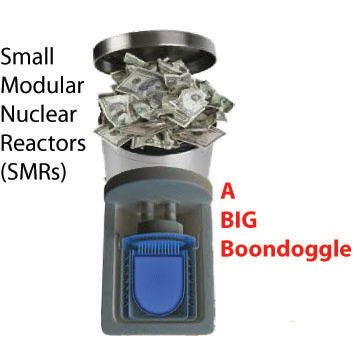
The delusion of Small Modular Nuclear Reactors (SMR’s)
nuClear News Nov 14
…………..Small Reactor delusion There’s an Alice in Wonderland flavour to the nuclear power debate, writes Jim Green of FoE Australia, in the Ecologist. Lobbyists are promoting all sorts of new reactor types – an implicit admission that existing reactors aren’t up to the job. But the designs they are promoting have two severe problems.
They don’t exist. And they have no customers. (1) On Patterson’s favoured Small Modular Reactors (SMRs) he quotes Thomas W. Overton, associate editor of POWER magazine, who wrote in a recent article: “At the graveyard wherein resides the “nuclear renaissance” of the 2000s, a new occupant appears to be moving in: the small modular reactor (SMR). … Over the past year, the SMR industry has been bumping up against an uncomfortable and not-entirely-unpredictable problem: It appears that no one actually wants to buy one.”(2)
Protesters outside Japan’s PM’s office against decision to restart 2 nuclear reactors
 Hundreds in Tokyo protest Japan’s decision to restart nuclear plant, ABC News 7 Nov 14 By North Asia correspondent Matthew Carney Hundreds have protested near the Japanese prime minister’s office in Tokyo against the decision to restart a nuclear plant.
The decision paves the way for a revival of the stalled nuclear industry more than three years after the Fukushima disaster.
Two reactors will restart at the Sendai nuclear plant, 1,000 kilometres south-west of Tokyo.
It represented a victory for Japan’s prime minister, Shinzo Abe, who said the shutdown of the nuclear industry led to an over-reliance on imported and costly fossil fuels.
But the move sparked protests and critics said proper safety and evacuation plans were not yet in place……..http://www.abc.net.au/news/2014-11-08/protests-as-japan-to-restart-sendai-nuclear-plant/5877040
As global momentum grows for action on climate change, Australia is an outsider
That’s understandable, given that countries tend to have one eye on what others are doing to cut emissions. But host nation Australia, once one of the leaders on carbon policy, is now lagging behind the pack.
The top dogs – China, the United States and the European Union – are tackling climate change, and in the process they’re leaving Australia looking like a pup, according to the latest Climate Council report.
In the past 12 months China and the United States (the world’s largest greenhouse emitters) have stepped up their efforts to tackle climate change. Meanwhile, the European Union’s 28 nations (including some of the world’s largest economies) has almost achieved its 2020 target for reducing emissions and has recently pledged to cut emissions by 40% by 2030, as well as setting ambitious targets for renewable energy.
China: from laggard to leader………
United States: stepping up to the plate……….
European Union: falling personal emissions
As of 2012, the EU had cut its emissions by 19.2% relative to 1990 levels, putting its 2020 target of 20% well within reach. Emissions per capita have fallen dramatically, from 9.1 tonnes per person in 1990 to 6.8 tonnes in 2013.
The EU is now looking to redouble its efforts beyond 2020, with the EU Commission launching a new framework in January 2014 to set out even more ambitious 2030 targets for reducing emissions and increasing renewable energy. Renewable energy now provides 23.5% of the EU’s electricity needs.
Global momentum
Global momentum is building on action on climate change. As in the world’s biggest polluters, the most common types of action include carbon pricing, reducing pollution from coal-fired power plants, and investing in renewable energy.
The number of countries and sub-national jurisdictions putting a price on carbon continues to increase: 39 countries are putting a price on carbon – up from 35 in 2013. A further 26 countries are currently considering introducing carbon pricing.
Worldwide, the number of countries with policies supporting renewable energy also continues to increase. In early 2014, 144 countries had renewable energy targets and 138 had renewable energy support policies in place (up from 138 and 127, respectively, in the previous year). http://theconversation.com/australia-is-losing-ground-as-the-climate-policy-race-gains-pace-33941
Energy executive, Rick Berman reveals the dirty tricks campaign by the fossil fuel industries
Listen to the audio recording of Berman spilling his secrets in full………..
 Fossil fuel industry’s dirty tricks campaign exposed, Independent Australia, DeSmog Blog 4 November 2014 A leaked tape from an oil and gas industry conference shows how Big Carbon uses dirty tricks to undermine science, vilify its critics and discredit journalists who criticise the use of fossil fuels, writesSharon Kelly via DeSmogBlog.
Leave it to Washington’s top attack-dog lobbyist Richard Berman to verify what many always suspected: that the oil and gas industry uses dirty tricks to undermine science, vilify its critics and discredit journalists who cast doubt on the prudence of fossil fuels.
In a speech at an industry conference in June, surreptitiously recorded by an energy executive, Rick Berman ‒ the foremost go-to guy for Republican smear campaigns ‒ gave unusually candid advice to a meeting of drilling companies.
“Think of this as an endless war,” he told executives in a speech, which was leaked to the New York Times by an attendee at the conference who was offended by Berman’s remarks. “And you have to budget for it.”
He said the industry needs to dig up embarrassing tidbits about environmentalists and liberal celebrities, exploit the public’s short attention span for scientific debate, and play on people’s emotions: Continue reading
India plans for $100 Billion Investment In Renewable Energy
 India Eyes $100 Billion Investment In Renewable Energy Clean Technica, November 9th, 2014 by Smiti Mittal The new Indian government is taking serious initiatives to boost the power sector, which is in dire need of financial and structural reforms. A large number of these reforms will be implemented in the renewable energy sector.
India’s minister for coal, power, and renewable energy last week announced that his government would push for an unprecedented $100 billion investment in the renewable energy sector over the next few years. With this plan, he also announced seemingly impossible solar energy capacity addition targets for the next five years………http://cleantechnica.com/2014/11/09/india-eyes-100-billion-investment-renewable-energy/
Australia well out of the race, as renewable energy investment goes to China and USA
 Australia losing renewable energy business to China and the USA http://www.9news.com.au/national/2014/11/10/00/04/australia-losing-green-business-overseas Investment in renewable energy has dropped by 70 per cent as Australia loses green business overseas, a report has found.
The slide in investment has seen China consolidate its position as the world’s renewable energy powerhouse, according to the Climate Council Report, Lagging Behind: Australia and the Global Response to Climate Change.
“Investment that could be coming to Australia is instead going overseas to countries that are moving to a renewables energy future,” report’s co-author, Professor Tim Flannery said. “Unfortunately the lack of federal government commitment to renewable energy is hurting the industry.”
Australia has come under pressure to cut its carbon emissions deeper after the European Union last week agreed on a new target of 40 per cent by 2030.
The agreement, labelled by the EU as a new global standard, also includes a 27 per cent target for renewable energy by 2030. The coalition government has said it will consider a new post-2020 target in early 2015 before a United Nations conference in Paris, where a new commitment will be discussed and possibly settled.
Prof Flannery said over the past year investment in Australian renewable energy projects dropped 70 per cent, while China installed more renewable energy capacity than fossil fuels in 2013. Continue reading
Business Council of Australia offers dodgy bribe to Australian Renewable Energy Agency
 I see this deal as a very dodgy one for the Australian Renewable Energy Agency, (ARENA) ARENA is fighting for its life – no guarantee that it will survive beyond 2014. The Business Council of Australia (BCA) is bribing it to include the wasteful and useless Carbon Capture and Storage project to be included in ARENA’s brief. And that’s not all. Look out for those weasel words “low emissions technologies”. For the BCA, tied as it is to nuclear lobby enthusiasts, “low emissions technologies” include nuclear power. Matthew Franklin reported, in The Australian March 01, 2011 on a BCA report arguing that “the nation must consider all power sources to meet rising energy needs, including nuclear power”
 THE taxpayer-funded Australian Renewable Energy Agency — the body given a stay of execution following a deal struck with Clive Palmer — will support projects including Carbon Capture and Storage and other low-emission technologies if a new reform blueprint is adopted.
The Business Council of Australia proposals for ARENA are contained in a paper that also urges a swift bipartisan deal on the renewable energy target.
Under a deal that the government struck with the crossbenchers in order to get the $2.55 billion Emissions Reduction Fund through the Senate, the government promised that it would not reintroduce bills to abolish the Clean Energy Finance Corporation and the ARENA in the spring sitting period — which guarantees it would not be abolished before the end of 2014.
In its report on energy policy, the BCA calls for the ARENA’s mandate to be expanded so that as well as overseeing the renewable energy sector it supported “emerging low-emission technology and systems”……….
Finance Minister Mathias Cormann told the Senate on October 30 that the “government’s position is that we are committed to the abolition” of the ARENA and the CEFC………
On the RET, the paper says that, unless a compromise deal is reached on the target, investment in wind energy could stall.
“Unless a compromise deal can be reached on the RET, investment in wind is unlikely to occur, creating the risk of higher electricity prices for consumers,” the paper says.
The Coalition is pushing Labor MPs to agree to cut the large-scale target. http://www.theaustralian.com.au/national-affairs/climate/renewable-energy-agency-will-back-ccs-if-reform-redrawn/story-e6frg6xf-1227117617594
Indigenous Canadians learning from Australian indigenous protected areas
 The meetings come just a week before the World Parks Congress in Australia, which will feature programs and partnerships from around the world, including the Australian ranger/IPA model and Canadian indigenous protected area initiatives like Thaidene Nene.
Australians share indigenous protected area strategies with N.W.T. Visits to Yellowknife and Lutsel K’e involved talking with Thaidene Nene negotiators By Rachel Zelniker, CBC News Canada Nov 09, 2014 Daryl Lacey knows what it’s like when environmental concerns and development come head to head.
Twenty years ago, Lacey’s elders grew concerned about the impacts mining was having on their traditional territory. “Employees of the mine … were driving on our land, on sacred sites and where we didn’t want them to go,” he says.
Lacey is a member of the Yolngu people in Australia’s Northern Territory.
“My people set up Dhimurru as an organization so nothing gets damaged.”
Dhimurru is one of 60 Indigenous Protected Areas established in partnership with the Australian government that cover more than 48 million hectares across Australia. Continue reading
Indigenous Land Corporation chair calls for strengthening the indigenous land fund
$2bn indigenous land fund next on agenda THE AUSTRALIAN OCTOBER 27, 2014 Patricia Karvelas
FRESH from a win against merging two indigenous economic bodies, Dawn Casey will lobby politicians to support a $2 billion “land account’’ to be managed by the Future Fund.
The Indigenous Land Corporation chairwoman wants the land account to be made more secure.
Minister for Indigenous Affairs Nigel Scullion confirmed last week that he did not intend to make changes, after commissioning an independent report that provided ambiguous recommendations and failed to back the government’s preferred option of amalgamation of the corporation and Indigenous Business Australia.
The move was a win for Dr Casey, who has lobbied strongly against an amalgamation and enlisted the support of Aboriginal leaders to call for the protection of the $2bn indigenous land account presided over by the land corporation. “We call on all parties to support the Stronger Land Account Bill currently in the Senate,’’ she said. “It strengthens indigenous involvement and will lock in stronger corporate governance of the funds allocated from the land account through the ILC.
“In addition, we seek government support to broaden the current narrow investment parameters of the land account and allow the Future Fund to manage it so as to maximise the benefits available to indigenous Australians, particularly those whose native title rights have been extinguished over the past two centuries………..http://www.theaustralian.com.au/national-affairs/indigenous/bn-indigenous-land-fund-next-on-agenda/story-fn9hm1pm-1227102873877
1 This month
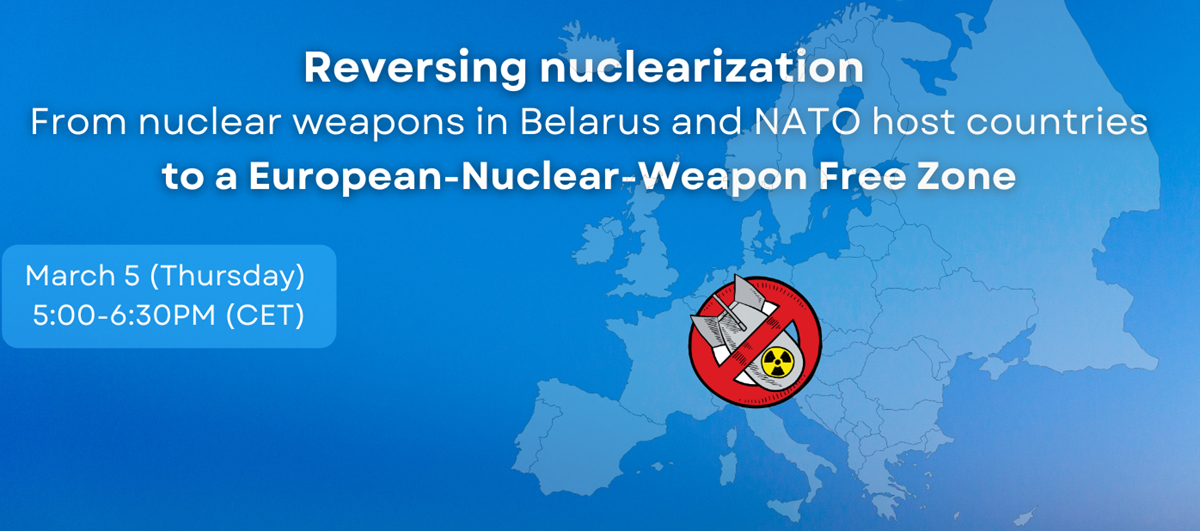
6 March -Online – Reversing nuclearization:
From nuclear weapons in Belarus and NATO host countries to a European-Nuclear-Weapon Free Zone
Mar 6, 2026 03:00 AM in Canberra, Melbourne, Sydney

of the week – Australians for War Powers Reform (AWPR)
To see nuclear-related stories in greater depth and intensity
 Antinuclear