The delusion of Small Modular Nuclear Reactors (SMR’s)
nuClear News Nov 14
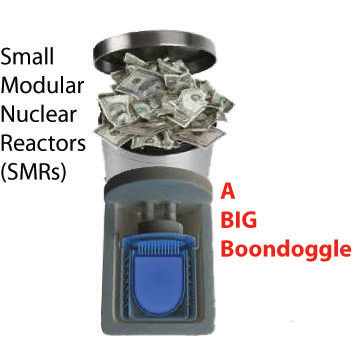
…………..Small Reactor delusion There’s an Alice in Wonderland flavour to the nuclear power debate, writes Jim Green of FoE Australia, in the Ecologist. Lobbyists are promoting all sorts of new reactor types – an implicit admission that existing reactors aren’t up to the job. But the designs they are promoting have two severe problems.
They don’t exist. And they have no customers. (1) On Patterson’s favoured Small Modular Reactors (SMRs) he quotes Thomas W. Overton, associate editor of POWER magazine, who wrote in a recent article: “At the graveyard wherein resides the “nuclear renaissance” of the 2000s, a new occupant appears to be moving in: the small modular reactor (SMR). … Over the past year, the SMR industry has been bumping up against an uncomfortable and not-entirely-unpredictable problem: It appears that no one actually wants to buy one.”(2)

The reason conventional nuclear plants are built so large is the economies of scale: Big plants can produce power less expensively per kilowatt-hour than smaller ones.
The SMR concept disdains those economies of scale in favour of others: large-scale standardized manufacturing that will churn out dozens, if not hundreds, of identical plants, each of which would ultimately produce cheaper kilowatt-hours than large one-off designs. But first someone needs to build a massive supply chain. Money for that would presumably come from customer orders – if there were any.
Former CoRWM Chair, Professor Gordon Mackerron says no SMR (properly defined) has yet been commercialised anywhere in the world, and work on them – mainly in the USA – has been waning, as their developers, notably Westinghouse, have said they cannot find a market. This is unsurprising as their cost per unit of output is higher than the already expensive conventional,
larger reactors, unless hundreds can be sold to give manufacturing economies.
The MIT, in their study of the future of nuclear power convincingly argue that radically new nuclear technologies take up to 50 years to become established due to factors like the need for safety licensing, prototype experimentation, planning and siting approvals, slow construction times – all in the context of historically rising costs and a need to win public acceptance. So we should expect no significant contribution from SMRs by 2050, even if they do become commercialised, which is
November 10, 2014 -
Posted by Christina Macpherson |
Uncategorized
No comments yet.

 Antinuclear
Leave a comment