Buy Nothing Day 28 Nov – North America 29 Nov International
 Buy Nothing Day 28 Nov – North America 29 Nov International https://www.adbusters.org/campaigns/bnd
“Today, humanity faces a stark choice: save the planet and ditch capitalism, or save capitalism and ditch the planet.” – Fawzi Ibrahim
Until we challenge the entrenched values of capitalism – that the economy must always keep growing, that consumer wants must always be satisfied, that immediate gratification is imperative – we’re not going able to fix the gigantic psycho-financial-eco crisis of our times.
That challenge is a deeply personal one: in a world where every inch of the capitalist system is bullying you into submission, can you resist? When advertisers hound you day and night, can you escape? This Black Friday, a massive, absurd, and destructive consumerist machine will coordinate against you for one simple reason – to convince you to max out your credit card to buy shit you don’t need so that a broken system stays afloat. So when they say “BUY!”, will you say NOTHING!”?

Buy Nothing Day is legendary for instigating this type of personal transformation … as you suddenly remember what real living is all about … you sense an upsurge of radical empowerment and feel a strange magic creeping back into your life.
Join millions of us in over 60 countries on November 28/29 and see what it feels like. Then, after Buy Nothing Day, take the next step … for generations, Christmas has been hijacked by commercial forces … this year, let’s take it back.
And why not get playful while you’re at it!? … Put up posters, organize a credit card cut up, pull off a Whirl–mart, or a Christmas Zombie walk through your local mall.
Who got to Jacqui Lambie- to get her to support Abbott’s trashing of renewable energy?
 Christina Macpherson, 26 Nov 14 What has happened to our democracy when a truly not representative person like Jacqui Lambie can get the power to sabotage Australia’s renewable energy programme?
Jacqui Lambie, a failed trier for the Liberal party in Tasmania, was picked up as a member for Clive Palmer’s Palmer United Party, and was elected to the Senate in 2013.
Jacqui Lambie got only 1501 first preference votes
 She got in through (a) her membership of the Clive Palmer push, and (b) on a horde of preferences from other parties, – in the disgusting and undemocratic shemozzle of preference deals.
The PUP’s Jacqui won the seat – just short of the vote of the sex industry’s Eros Foundation. All fine and dandy. The PUP pledged to vote for keeping the Renewable Energy Target.
Now we find Jacqui Lambie potentially in a position of great power – she can do deals with Tiny Abbott – ostensibly to support soldiers’ wages and conditions. All very good. I want the soldiers to have fair wages and conditions too.
But at what price? And – Jacqui’s not over-burdened with ideas of her own – who is putting the pressure on her?
Senator Jacqui Lambie’s turnabout on Renewable Energy
Jacqui Lambie gets on with push for Defence pay rise STEVEN SCOTT THE COURIER-MAIL NOVEMBER 25, JACQUI Lambie has begun negotiating with the government to wind back the Renewable Energy Target and cut funding for the Clean Energy Finance Corporation if it offers some increase in Defence pay.
Within hours of cutting ties with the Palmer United Party, Senator Lambie held talks with Environment Minister Greg Hunt about backing government bills in return for doubling the Defence pay rise to 3 per cent.
Senator Lambie’s willingness to talk – despite vowing to oppose all bills until Defence pay was increased – has given the government hope it could benefit from the collapse of Clive Palmer’s influence in the Senate……
She also voted with the government in support of an inquiry into wind farms that was proposed by Liberal Democrat David Leyonhjelm…..http://www.couriermail.com.au/news/queensland/jacqui-lambie-gets-on-with-push-for-defence-pay-rise/story-fnn8dlfs-1227133566044
Aboriginal struggles to save beautiful Kakadu from uranium mining
 The Dog Catcher of Jabiru, About Place Journal, Margaret Spence 24 Nov 14 “……….Uranium was discovered in Kakadu in 1953 and for the next decade much of the ore was bought by British and American governments for the development of atomic weapons. If the Aborigines knew of the potential fate of their ancestral earth, their objections were overruled.
But the nineteen seventies were a period of change for civil rights, and Aboriginal people campaigned to have their lands returned to them. In stages, the Australian Federal Government acquired title to the tracts of land that had been taken over the years by private, non-Aboriginal settlers. The land was returned to Traditional Owners under the newly established Aboriginal Land Rights Act (Northern Territory) and most of it was leased to the Commonwealth to become the joint managed Kakadu National Park.
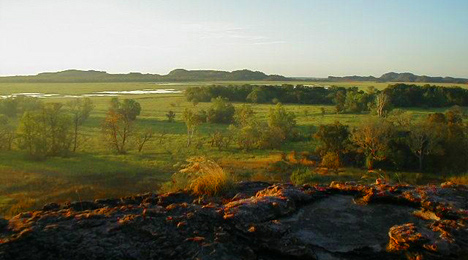
Three areas were excised from the National Park due to the presence of significant uranium deposits. While this land was granted to Traditional Owners as Aboriginal Land, the legal right to veto mining projects which the new laws provided was explicitly removed in the case of Ranger uranium mine and mining commenced there in 1981 against the clear opposition of the Mirarr Traditional Owners……… Continue reading
Victorian election: Labor will re-introduce emissions reduction target, and promote wind and solar energy
 Victoria election 2014: Labor promises to reintroduce emissions reduction target ABC News, 25 Nov 14 Victoria’s Opposition has promised to reintroduce a state-based emissions reduction target if it is elected on Saturday.
The pledge is part of of the state Labor’s newly-released environmental platform.
The Opposition said it would bring back the target, which was introduced in by Labor in 2006 before being wound back in 2009 after the federal renewable energy target was extended.
The Victorian Coalition Government removed the state’s target of 20 per cent by 2020 from the Climate Change Act in 2012
A report by the Climate Council released earlier this month found that Victoria and New South Wales had the worst approach to renewable energy in the country.
Labor environment spokeswoman Lisa Neville said she wanted Victoria to play a leading role in tackling climate change…….
Ms Neville said Labor would also establish a $20 million fund to encourage investment in renewables.”[The fund] will co-invest with the private sector to drive wind and solar energy, and new technologies,” she said.
“We’ve also said that we’ll use the planning laws to actually encourage and promote renewable energies like wind farms in Victoria.”……..http://www.abc.net.au/news/2014-11-26/victorian-labor-to-reintroduce-renewable-energy-target/5918118
British government is getting cold feet about its new nuclear power programme
On the surface, all is well……..But leaks from civil servants in Whitehall suggest that the government may be getting cold feet about its open-ended guarantees…….With a general election in the UK looming in May next year, no decisions will be reached on any of these projects any time soon. And a new government might think renewables are a better bet.

 Renewables Help Push Nuclear Giants to Brink of Collapse, Eco Watch Paul Brown, Climate News Network | November 24, 2014 Plans to build two giant nuclear reactors in south-west England are being reviewed as French energy companies now seek financial backing from China and Saudi Arabia—while the British government considers whether it has offered vast subsidies for a white elephant.
Construction estimates have already escalated to £25 billion, which is £9 billion more than a year ago, and four times the cost of putting on the London Olympics last year.
Costs Escalate Continue reading
Nuclear power is in Australian govt’s Energy Green Paper, but no real enthusiasm for it
Nuclear power still some way off for Australia Financial Review, 24 Nov 14 JOANNA MATHER “…….Nuclear rated a brief mention in the energy green paper released by the federal government in September. “Nuclear energy remains a serious consideration for future low emissions energy,” the paper says.
But it would be a mistake to view this as a sign of any real appetite within the government to progress the issue, says Ken Baldwin, director of the Energy Change Institute at the Australian National University.
“White papers always list the options available to the country,” he says. “Nuclear is in the mix but that doesn’t mean it is being given particular significance in the white paper.”…..
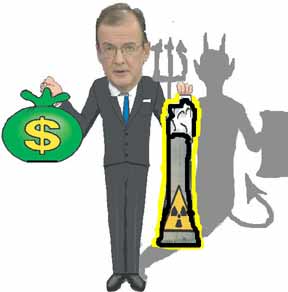 Former Telstra boss Ziggy Switkowski, who headed a review of nuclear’s potential during the Howard years, believes Australia is forfeiting a great opportunity………
Switkowski says falling demand for electricity in Australia and intractably adverse community attitudes “will see the window for nuclear power begin to close”.
At present, legislation prevents the development of an Australian domestic nuclear energy industry. Removing legislative barriers to Australia using nuclear power for electricity, when there is an economic case for its deployment, would include amending the Australian Radiation Protection and Nuclear Safety Act 1998 and the Environment Protection and Biodiversity Conservation Act to allow construction or operation of nuclear fuel plants.
The green paper commits the government to reviewing the regulatory framework that governs nuclear and waste facilities to remove any duplication and streamline regulations…
Risk of sea level rise to nuclear power plants
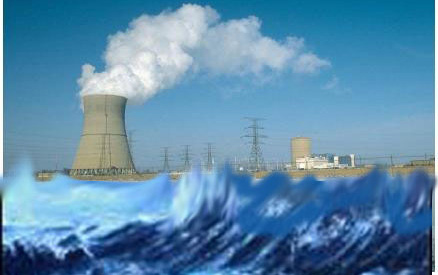 Nuclear power’s dark future Japan Times, 25 Nov 14 BY BRAHMA CHELLANEY “…….New nuclear plants in most countries are located in coastal regions so that these water-guzzling facilities can largely draw on seawater for their operations and not bring freshwater resources under strain.
But coastal areas are often not only heavily populated but also constitute prime real estate. Moreover, the projected greater frequency of natural disasters like storms, hurricanes, and tsunamis due to climate change, along with the rise of ocean levels, makes seaside reactors particularly vulnerable.
The risks that seaside reactors face from global-warming-induced natural disasters became evident more than six years before Fukushima, when the 2004 Indian Ocean tsunami inundated the Madras Atomic Power Station. But the reactor core could be kept in a safe shutdown mode because the electrical systems had been installed on higher ground than the plant level.
In 1992, Hurricane Andrew caused significant damage at the Turkey Point nuclear power plant in Florida, but fortunately not to any critical system. And in a 2012 incident, an alert was declared at the New Jersey Oyster Creek nuclear power plant — the oldest operating commercial reactor in the U.S. — after water rose in its water intake structure during Hurricane Sandy, potentially affecting the pumps that circulate cooling water through the plant.
All of Britain’s nuclear power plants are located along the coast, and a government assessment has identified as many as 12 of the country’s 19 civil nuclear sites as being at risk due to rising sea levels. Several nuclear plants in Britain, as in a number of other countries, are just a few meters above sea level……http://www.japantimes.co.jp/opinion/2014/11/25/commentary/world-commentary/nuclear-powers-dark-future/#.VHYvqNLF8nk
Western Australian government’s high-handed changes to Aboriginal Heritage Act anger traditional owners
 Traditional owners rally against changes to WA Aboriginal Heritage Act, Guardian, Helen Davidson, 290 Nov 14 Proposed amendments could see owners stripped of say over sacred site listings, which will have lower standards than buildings Proposed amendments to the Aboriginal Heritage Act in Western Australia could see traditional owners stripped of any say over the heritage listing of their sacred sites in a lowering of standards compared to built heritage sites.
A representation of about 50 traditional owners from across Western Australia travelled to Perth to deliver a petition signed by 1,600 people calling for the amendment to be dropped and redrafted. Ten people also met with the Aboriginal affairs minister, Peter Collier, to discuss their concerns.
The proposed amendments would give the final say on the heritage value of cultural sites on Aboriginal land to the CEO and minister of the Department of Aboriginal Affairs, speeding up the approval process for mining and development applications. There would be no avenue for appeal by Indigenous groups, the delegation said.
They also said there has been no consultation with Indigenous people in the designing of the amendment, which has no requirement for an Indigenous person to be on the Aboriginal cultural materials committee and has removed a previous requirement for at least one anthropologist.
“We want the legislation removed, brought back to the table and properly negotiated and consulted on with Aboriginal people,” Simon Hawkins, CEO of the Yamatji Marlpa Aboriginal Corporation, told Guardian Australia.
“We want the legislation to reflect modern legislation in other states in terms of how they manage cultural heritage issues … even just brought up to the standard of built heritage legislation of WA, which has very strong controls on conservation management, protection, education on sites. Why is cultural Aboriginal heritage treated so differently and [with] such lower standards? We don’t understand that, it seems so unfair.”……..
The delegation follows a meeting of 250 traditional owners, elders and community members in Port Hedland in September, to which the minister was invited but did not attend…….
The chair of the Kimberley Land Council, Anthony Watson, was left still wary of the government’s plans after the meeting.
“We pushed the minister to try and have the discussion, but due to the timeframe it looks like they have their mind set [on introducing the bill]. It’s a very dangerous the position we’re in,” Watson told Guardian Australia.
“If the bill is getting pushed through, rushed through, without consultation then it’s discriminatory and there is going to be problems across our region for Aboriginal people.”……….http://www.theguardian.com/australia-news/2014/nov/20/traditional-owners-rally-against-changes-to-wa-aboriginal-heritage-act?utm_source=PoliticOz&utm_campaign=2cdc26cb18-PoliticOZ_21_November_2014&utm_medium=email&utm_term=0_673b6b002d-2cdc26cb18-302705445
The Clean Energy Council slams Senator Leyonhjelm’s “economic vandalism” in attacking the Renewable Energy Target
The Clean Energy Council labels Senator Leyonhjelm’s proposal as “economic vandalism” and has called on all parties to return to negotiations in search of a sensible outcome for the RET.
Groundhog Day For Australian Renewable Energy http://www.energymatters.com.au/renewable-news/groundhog-day-renewables-em4568/ November 26, 2014 If insanity is doing the same thing over and over expecting different results, then what is again being inflicted upon Australia’s renewable energy sector might fit that particular definition.
The Senate has given the green light to yet another review of renewable energy – the ninth in just three years. The Senate inquiry will focus on wind farms and include an examination of their economic impact and health effects.
“This is a farcical situation given that the industry is still awaiting the outcome of the government’s recent Warburton Review as well as another legislated review of the Renewable Energy Target by the Climate Change Authority,” said Clean Energy Council Policy Director Russell Marsh.
“It is unclear how yet another review could draw any different conclusions given the many inquiries and reviews already undertaken in Australia. It is pretty obvious this inquiry is about politics rather than science, and it’s basically just Groundhog Day for this industry yet again.” Continue reading
 Australia and Japan, both NPT and NSG members, have become complicit in India’s nuclear weapons program and partially responsible for increasing the risk of nuclear accident in India, and for potentially aggravating nuclear rivalry in Asia.
Nuclear Proliferation in the Australia-India-Japan-U.S. Nuclear Nexus By Adam Broinowski Asia-Pacific Journal Global Research, November 24, 2014
“…….despite PM Abbott’s assurances that ‘suitable safeguards’ were in place to guarantee that Australian uranium would be used for ‘peaceful purposes’ and for ‘civilian use only’, as the former Director General of the Australian Safeguards and Non-Proliferation Office John Carlson points out, the Agreement departs from two principles of Australia’s 1987 Safeguards Act (section 51):40 the acquirement of ‘consent to reprocessing’ from the Australian government prior to the separation of plutonium from spent fuel; and the ‘right of return’ of nuclear materials supplied in the event of a breach of the agreement.41 Instead, the Agreement defers to the US-India nuclear cooperation agreement in which India would reprocess in facilities built with the assistance of US companies, and leaves open the question of how separated plutonium would be used or how arbitration would apply to settle disputes.
Ten of India’s twenty nuclear facilities are beyond the regulatory authority of the IAEA and India only selectively recognises IAEA safeguards for specific foreign supplied reactors and facilities. India also refuses to submit to suppliers inventory reports and accounting processes for nuclear material flowing through the nuclear cycle. As the IAEA is not able to fully inspect India’s dual-purpose (civilian and military) indigenous reactors and facilities for reprocessing, enrichment, retransfers to third countries, research and development or the production of tritium (used as a trigger for weapons), India is not fully accountable to either the IAEA or the supplier nation with which it has a bilateral agreement with in-built IAEA norms. Continue reading
China palling up with Paladin
Hopu To Inject $52M In Australia’s Paladin Energy, China Money Network By Staff Writer | November 24, 2014 Western Australia-based uranium production company Paladin Energy Ltd. says it plans to raise a total of US$177 million in a private placement deal, including a capital injection of US$52 million from a unit of Chinese private equity firm Hopu Investment Management Co., according toa company announcement……..the number of shares Hopu is buying represents around 15% of Paladin’s current capital base, but Hopu has received approval from Australia’s Foreign Investment Review Board (FIRB) to investment further and own up to 19.99% of Paladin.
Paladin says it will use the proceeds to repay the company’s medium-term debt that is coming due. Zhang Wendong, senior managing director at Hopu, will join Paladin’s board………http://www.chinamoneynetwork.com/2014/11/24/hopu-to-inject-52m-in-australias-paladin-energy
BHP not all that crash hot
BHP warns more cost cuts, management shake up before demerger Minng.com, Cecilia Jamasmie | November 24, 2014 Mining giant BHP Billiton (ASX, NYSE:BHP) (LON:BLT) warned Monday of further cuts to capital expenditure and a major shake-up of its senior management in the wake of its demerger plans, as the company moves to lower costs amid weak commodity prices.
In the much-anticipated markets briefing, the world’s largest miner by market value said it would trim spending by $1bn to $13bn in the 2016 financial year…………. Clarke Wilkins, director of metals and mining research at Citi in Sydney, said the market had shifted from debating when BHP starts its capex cuts to the “touchier question” of whether its progressive dividend can be maintained given the tumbling price of key commodities such as iron ore and oil…….Mackenzie also outlined a management reshuffle, as the mining group is next year poised to spin off non-core assets into a separate diversified mining company……http://www.mining.com/bhp-warns-more-cost-cuts-management-shake-up-before-demerger-88671/
1 This month

of the week – Australians for War Powers Reform (AWPR)
To see nuclear-related stories in greater depth and intensity
 Antinuclear