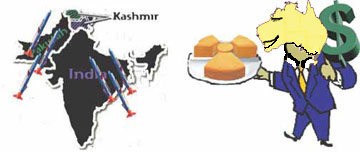
 Australia and Japan, both NPT and NSG members, have become complicit in India’s nuclear weapons program and partially responsible for increasing the risk of nuclear accident in India, and for potentially aggravating nuclear rivalry in Asia.
Nuclear Proliferation in the Australia-India-Japan-U.S. Nuclear Nexus By Adam Broinowski Asia-Pacific Journal Global Research, November 24, 2014
“…….despite PM Abbott’s assurances that ‘suitable safeguards’ were in place to guarantee that Australian uranium would be used for ‘peaceful purposes’ and for ‘civilian use only’, as the former Director General of the Australian Safeguards and Non-Proliferation Office John Carlson points out, the Agreement departs from two principles of Australia’s 1987 Safeguards Act (section 51):40 the acquirement of ‘consent to reprocessing’ from the Australian government prior to the separation of plutonium from spent fuel; and the ‘right of return’ of nuclear materials supplied in the event of a breach of the agreement.41 Instead, the Agreement defers to the US-India nuclear cooperation agreement in which India would reprocess in facilities built with the assistance of US companies, and leaves open the question of how separated plutonium would be used or how arbitration would apply to settle disputes.
Ten of India’s twenty nuclear facilities are beyond the regulatory authority of the IAEA and India only selectively recognises IAEA safeguards for specific foreign supplied reactors and facilities. India also refuses to submit to suppliers inventory reports and accounting processes for nuclear material flowing through the nuclear cycle. As the IAEA is not able to fully inspect India’s dual-purpose (civilian and military) indigenous reactors and facilities for reprocessing, enrichment, retransfers to third countries, research and development or the production of tritium (used as a trigger for weapons), India is not fully accountable to either the IAEA or the supplier nation with which it has a bilateral agreement with in-built IAEA norms.
So even if India adheres to Australia’s requirements that its uranium be used solely to supply civil nuclear reactors for electricity generation that may be inspected by IAEA as per the nuclear safeguards agreement, Australia’s (or any other NPT members’) uranium export to India effectively supplements or liberates limited supplies of Indian uranium for military uses.42 Nor could, in the unlikely discovery of the ‘misallocation’ of some Australian origin uranium toward military use, the IAEA force compliance. In fact, whether or not India accounts for the flows of Australian material in its nuclear fuel cycle, it is impossible to verify whether it has actually adhered to the safeguards.
the option of nuclear power as the ‘clean’ alternative is nothing of the sort. Although the fission operation of nuclear power stations may be ‘cleaner’ than coal-fired power stations in terms of carbon emissions, and although the heat from fission may produce more energy and less waste per volume of uranium than coal, many problems remain unresolved. These include the safe storage of long-lived nuclear waste, long build time of reactors in proportion to rapidly accelerating effects of climate change, enormous financial costs, use and contamination of vital resources required across the nuclear cycle from mining to waste production (including water and fossil fuels),55centralised monopolisation of power management necessitated by nuclear power generation, excess heating of the atmosphere through the discharge of excess heat through water and air, danger to ecologies downwind or downstream from venting while refueling reactors, and increased potential for large-scale and long-term damage from accidents.
Given the advances of wind, solar, tidal and geothermal energy production which have become cheaper and more productive, as field-tested in China, Germany,56 Spain and other countries, and the abundance of these sources of energy in countries like Australia, the myth of base-load power is less sustainable than it was in the heady renaissance days. India’s pitch to rapidly increase economic growth has been embraced by the transnational nuclear industry as it represents an opportunity to expand the nuclear industry, and an opportunity to diversify from reliance on the Chinese market. But when typical cost-benefit analyses are extended to include the actual costs of the above-mentioned scenarios (nuclear weapons exchange, public health effects from industrial pollution from uranium mining and nuclear reactors, nuclear reactor disasters, nuclear waste storage, renewable energy alternatives), in an already fragile ecology in India, India’s nuclear energy plan reflects neither deep commitment to climate change mitigation nor serious concern for India’s impoverished populations.
To resume and expand uranium mining and nuclear energy generation will not significantly reduce the effects of climate change. The possibility of nuclear accidents presents a serious, long-term security, social and environmental threat. The standards required to prevent such threats are too onerous, and the damages from the manifestation of such threats are too enormous to be sufficiently covered by insurance. The risks of uranium trade and nuclear projects far outweigh the benefits. This is understood even in the ‘pragmatic’ world of business economics.57
Conclusion
Under the Australia–India uranium trade agreement, India will use Australian yellow cake to diversify its nuclear program. If and when the Japan–India Nuclear Cooperation Agreement is concluded, it will supply the nuclear technology India requires to build its industrial capacity and indirectly enhance its nuclear arsenal. Negotiated almost simultaneously and in coordination, both of these Agreements, together with and following the US–India nuclear agreement, tacitly legitimise India’s nuclear status and assist in its ambitions for greater international influence. Australia and Japan, both NPT and NSG members, have become complicit in India’s nuclear weapons program and partially responsible for increasing the risk of nuclear accident in India, and for potentially aggravating nuclear rivalry in Asia.
India claims to need more electricity for domestic and industrial growth as well as to lift a significant population out of poverty. Yet there are many factors which create the conditions for the advance of India’s poor, just as there are many forms of alternative energy generation beyond nuclear and coal which would be safer, more reliable and powerful if given comparable investment and with smart power grid distribution networks.76 To the extent that governments and corporations continue to invest in nuclear power construction and reprocessing as a source of ‘renewable energy’, they diminish the potential to stem the destructive and exponentially increasing effects of climate change.77 China, Germany, the United States, India and even Japan are presently leading the world in investing in renewable energy technology. Yet, with the exception of Germany, this is being done in parallel with plans to expand nuclear power production.
The ongoing contamination from radiation dispersed from the Fukushima Daiichi nuclear power plant came, in part, from Australian uranium.78 When the benefits of uranium trade are weighed against the potential and actual costs and damages from uranium mining, the actual risks of nuclear reactor accidents and mismanagement, the decline in costs and advances in renewable technologies, potential nuclear weapons use (broadly defined) and proliferation, and the steady production of nuclear waste, it becomes clear that state-corporate policies to expand the industry are ill-conceived.
In 2014, as in 1945 and throughout the intervening decades, uranium mining, nuclear power generation and nuclear weapons remain ineluctably tied to the formation of a global power structure of nation-states and transnational corporations and instrumental in their overarching ambitions. http://www.globalresearch.ca/nuclear-proliferation-in-the-australia-india-japan-u-s-nuclear-nexus/5415955
No comments yet.
1 This month

of the week – Australians for War Powers Reform (AWPR)
To see nuclear-related stories in greater depth and intensity
 Antinuclear
Leave a comment