Aboriginal struggles to save beautiful Kakadu from uranium mining
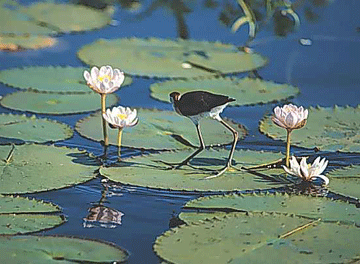 The Dog Catcher of Jabiru, About Place Journal, Margaret Spence 24 Nov 14 “……….Uranium was discovered in Kakadu in 1953 and for the next decade much of the ore was bought by British and American governments for the development of atomic weapons. If the Aborigines knew of the potential fate of their ancestral earth, their objections were overruled.
But the nineteen seventies were a period of change for civil rights, and Aboriginal people campaigned to have their lands returned to them. In stages, the Australian Federal Government acquired title to the tracts of land that had been taken over the years by private, non-Aboriginal settlers. The land was returned to Traditional Owners under the newly established Aboriginal Land Rights Act (Northern Territory) and most of it was leased to the Commonwealth to become the joint managed Kakadu National Park.
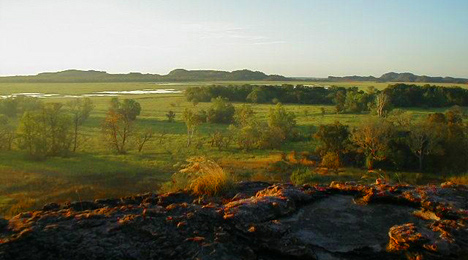
Three areas were excised from the National Park due to the presence of significant uranium deposits. While this land was granted to Traditional Owners as Aboriginal Land, the legal right to veto mining projects which the new laws provided was explicitly removed in the case of Ranger uranium mine and mining commenced there in 1981 against the clear opposition of the Mirarr Traditional Owners………
Energy Resources Australia (ERA) a publicly traded company, owns the Ranger Mine, which exports ten percent of the world’s uranium. The company employs white and Aboriginal people and also pays fees, rent and royalties to the Federal Government which is then paid back to the Aboriginal people under the terms of the Aboriginal Land Rights Act (NT) of 1976. However, the controversy has not ended. In 1996 ERA announced its intention to mine the Jabiluka uranium deposit, twenty kilometres north of Ranger. This was strongly resisted by the Mirarr Traditional Owners and their thousands of supporters. Because of the potential impact of uranium mining, UNESCO’s World Heritage Committee sent a scientific mission in 1998 to consider whether the park should be listed as World Heritage In Danger. The mission recommended against the development of Jabiluka and the World Heritage Committee maintains a strong interest in the interplay between uranium mining and Kakadu National Park…..
The French nuclear company Areva held exploration rights to Koongarra, where uranium deposits are estimated to be worth billions of dollars.
Nourlangie contains cave art that is thousands of years old. Koongarra has further significance. Towering above it is an escarpment known as Burrunggui, and climbing its rust-colored rocks, the visitor eventually comes to a plateau with a view for miles over the plains. From here one can see another escarpment, the border of Arnhem Land, a reserve that is owned entirely by the Traditional People. Its other side faces the creation ancestor, Lightning Dreaming……
Like Jabiru, Koongarra had been excluded from Kakadu National Park to allow mineral exploration. But a local clan, the Djok people, fought to prevent mining in the area. In June 2011, the UNESCO World Heritage Committee voted to reincorporate Koongarra into Kakadu and a formal vote in Parliament in March 2013 sealed it into Australian law.
Djok Senior Traditional Owner Jeffrey Lee, explained that he and his people had given up billions in potential revenue from uranium mining in order to preserve their cultural heritage. Lee said his father and grandfather wanted mining in the area, but he had seen the devastation it had caused and this confirmed his commitment to protecting his land.
Part of the environmental impact of uranium mining is not just the scarred earth, but the danger created through the extraction process. Ore is excavated, crushed, agglomerated and treated with chemicals, and the uranium concentrate leached out. This yellowcake is transported by truck to Darwin, then shipped to the USA, Britain, Japan and Europe. That cargo is dangerous enough, but its making has already leaked radioactive waste. Tailings, crushed rock from the extraction process, cause radioactive water to seep into rock fissures when monsoonal rains soak the Top End. More than two hundred leaks from the Ranger Mine had reportedly contaminated water upstream of aboriginal settlements and protected wetlands before ERA announced in September 2013 that it would bring state of the art water management to the mine.
Public outcry against uranium mining has continued since 1996. Under the leadership of Mirarr Senior Traditional Owner Yvonne Margarula, five thousand activists from all over the country traveled north in 1998 to block the construction of a mine at Jabiluka by ERA. Following the arrest of hundreds of the protestors, multiple legal challenges, appeals to international for a including the World Heritage Committee, the campaign succeeded. After a long legal and emotional battle, ERA began filling in the mine entrance at Jabiluka. No uranium has ever been mined from that site.
In 2011, Yvonne Margarula wrote to Ban Ki Moon, the Secretary-General of the United Nations, explaining that for thousands of years the Aboriginal people feared the spirit Djang lay underneath the land at DjidbiDjidbi, adjacent to Ranger mine. If Djang were disturbed, the Mirarr people worried, the spirit would cause havoc throughout the world. Her people believed, Margarula said in her 2011 letter, that Ranger uranium was used in the Fukushima Nuclear Plant which failed in the Japanese tsunami and earthquake. This fact was confirmed by the Australian Government.
In August 2013, after lobbying by Mirarr for fifteen years, the federal government formally ceded over twelve thousand acres of land surrounding the town of Jabiru – though not the township itself – to the Traditional Owners. The Mirarr immediately leased that land into Kakadu National Park, protecting it from development. Negotiations continue with regard to the township itself……..
Australia’s international agreements insist its uranium be used for peaceful purposes, but the fact is that uranium is an ingredient for nuclear bombs.
In this place, the power of the past is palpable, even if the earth that holds everything together is literally undermined. A dystopian future is easy to imagine. The death of civilization as we know it, by the unleashing of an unpredictable power. Aboriginal people are warning us. They have experienced it first hand. http://aboutplacejournal.org/voices/s3-iii-ii/margaret-spence-iii-ii/
No comments yet.
1 This month

of the week – Australians for War Powers Reform (AWPR)
To see nuclear-related stories in greater depth and intensity
 Antinuclear
Leave a comment