For the Mirrar Aboriginal people, a new era may be opening up, if ERA’s Ranger uranium mine finally closes
 Uranium mining in Kakadu at a crucial point, SMH, 29 Nov 14 Peter Ker Resources reporter “……..place facing an uncertain future. Jabiru is a town in limbo. Four decades after arriving, uranium miner Energy Resources of Australia (ERA) will decide soon whether it will continue digging here. There is a chance it will choose not to, which will bring down the curtain on perhaps nation’s most controversial mine, Ranger.
Built on the faultlines of environmental and indigenous land rights policy, Ranger is at a defining moment. It has provided fuel to nuclear power stations of the world but the end of its working life is in doubt.
The end of mining at Ranger would be cause for celebration for some. Continue reading
Byron Bay to get Australia’s first community-owned clean energy generator?
 Byron Bay residents push for Australia’s first community-owned clean energy generator, ABC News By Kerry Brewster , 26 Nov 14 Australia’s first community-owned clean energy generator and retailer is taking shape in the counter-culture capital of Australia.
Known for its alternative lifestyles, the Northern Rivers region of New South Wales is hoping to establish a not-for-profit energy company – Northern Rivers Energy – to rival the big retailers………
Northern Rivers Energy wants to attract 20,000 members, who would be able to buy, generate or invest in the enterprise.
After a feasibility study funded by the NSW Government is completed, a series of public meetings will begin.
Ms Crook has little doubt the people of the Northern Rivers will seize the opportunity to take control of their energy production………..
Rooftop solar and other renewables attractive for communities
With a surge predicted in rooftop solar and other power sources, renewable energy expert Giles Parkinson said consumers should expect profound change to electricity systems.
“The traditional domination by the three big retailers, that’s something of the past. How it evolves will be very interesting to see but certainly community ownership and the community-owned retailer is one of those options and we’ve seen it happen in Germany and other parts of Europe where it’s very powerful because you have people grouping together,” Mr Parkinson said.
“They’re not trying to make massive profits and they’re responding to what the people want to do.”……..
John Truman, manager of civil services for Ballina Shire Council, said his was one local council keen to get involved.
“We’re very interested in renewable energy sources so the opportunity to talk to anybody to assist in our future projects is something we’d be very interested in,” Mr Truman said. http://www.abc.net.au/news/2014-11-27/byron-bay-pushes-for-community-owned-clean-energy/5920272
11 very disturbing facts about the state of the Fukushima nuclear power station
11 Facts About The Ongoing Fukushima Nuclear Holocaust Too Horrifying To Believe World Truth.TV 29 Nov 14 Is Fukushima the greatest environmental disaster of all time? Every single day, 300 tons of radioactive water from Fukushima enters the Pacific Ocean. The radioactive material that is being released will outlive all of us by a very wide margin, and it is constantly building up in the food chain. Nobody knows for sure how many people will eventually develop cancer and other health problems as a result of the Fukushima nuclear disaster, but some experts are not afraid to use the word “billions”. It has been well over two years since the original disaster, and now they are telling us that it could take up to 40 more years to clean it up. It is a nightmare of unimaginable proportions, and there is nowhere in the northern hemisphere that you will be able to hide from it. The following are 11 facts about the ongoing Fukushima nuclear holocaust that are almost too horrifying to believe…
#1 It is estimated that there are 1,331 used nuclear fuel rods that need to be removed from Fukushima. Because of all of the damage that has taken place, computer-guided removal of the rods will not be possible. Manual removal is much riskier, and it is absolutely essential that the removal of each of the 1,331 rods goes perfectly because a singlemistake could potentially lead to a nuclear chain reaction.
#2 According to Reuters, the combined amount of cesium-137 contained in those nuclear fuel rods is 14,000 times greater than what was released when the U.S. dropped an atomic bomb on Hiroshima at the end of World War II. Other estimates put this number far higher.
#3 Officials in Japan admit that 300 tons of radioactive water from Fukushima is entering the Pacific Ocean every 24 hours. Continue reading
How the Renewable Energy Target benefits Tasmania (despite claims by Sen Jacqui Lambie)
Tasmania big net beneficiary from RET, Australia Institute report finds, SMH November 28, 2014 Peter Hannam
The report found the state generated about $125 million in renewable energy certificates in 2013 under the federal scheme with costs from consumers of only about $22.5 million.
One target of the report is claims by four big power users in the state that the RET was costing them alone $20 million a year, placing at risk thousands of jobs in the struggling state.
That claim was “bogus”, with partial exemption certificates covering 40-67 per cent of their costs under the scheme usually omitted from the analysis, Matt Grudnoff, a senior economist at the institute and author of the report, said………
The Australia Institute report is also aimed at discouraging newly independent Tasmanian Senator Jacqui Lambie adding her vote to the RET cut plan.
However, her chief of staff, Rob Messenger, said “trite, little studies” were unlikely to sway the former Palmer United Party senator’s views……..
Senator Lambie’s vote, should it swing to the Coalition, won’t alone be enough to force through a reduction of the RET.
So long as Labor and the Greens remain united in their opposition to the move, they need only Senator Nick Xenophon and the two remaining PUP senators – Dio Wang and Glenn Lazarus – to give them the 38 votes required to block any change. http://www.smh.com.au/environment/tasmania-big-net-beneficiary-from-ret-australia-institute-report-finds-20141128-11vbz9.html
The irrationality of Senator David Leyonhjelm’s plan for renewable energy in Australia
 The new conservative plan to shut down renewable energy, REneweconomy, By Giles Parkinson on 26 November 2014 More details have emerged about the plan hatched by a group of conservative cross-bench Senators to dramatically reduce the amount of new renewable energy projects to be built in Australia over the next five years, and to deliver a windfall subsidy to old hydro electric plants.
The plan outlined by libertarian (low taxes, minimal government) Senator David Leyonhjelm essentially delivers on the Coalition plan to limit new build renewables to around 26,000GWh, but has the bizarre inclusion of handing subsidies earmarked for new projects to state-owned hydro plants that were built decades ago.
The renewable energy industry has reacted with horror. The Clean Energy Council said it would result in a transfer of nearly $14 billion of wealth to those plants, remove more than $14 billion from new development, causing new projects to remain at a standstill and put 18,000 jobs at risk. (See its list below)
The proposal was described by The Australia Institute as a “shocker” and by the Australian Wind Alliance as “hair-bained” and “madness”. All agreed it would be worse than even what the controversial Waburton Review proposed. It is truly absurd. But what is really unsettling for the industry – and anyone who cares about the development of renewable energy in Australia – is how similar the policy is to what the ruling Coalition is proposing.
Now, while it seems preposterous that the Coalition would ever allow renewable energy certificates to be pocketed by the hydro operators (over and above the baseline currently in place), nothing can be ruled out from this government.
But it’s really just about mixing numbers to get to the same answer, and right now it seems that that answer is 51,000GWh – what the conservative side says is equivalent to a “real” 20 per cent of the revised demand forecast by 2020. They just propose different routes to get there, although the impact on the renewable energy industry would be equally devastating………………..
the Coalition doesn’t care. It’s mission is quite clearly to reduce the “new build” component of the RET to the 26,000GWh suggested by Warburton and endorsed by Macfarlane, Hunt and Abbott.
If it can do that with support of the cross-benchers, then that is exactly what it will do. Already, the idea has the stated support of John Madigan and Bob Day, Jacquie Lambie seems interested, Nick Xenophon will support anything that kills the wind industry, and even Clive Palmer – as we discussed in our article Can Palmer be tusted to defend the RET” – has made similar noises about pre-existing hydro.
Leyonhjelm’s ridiculous proposal will just be a smoke-screen for what is really on the agenda as confirmed by the support of the Coalition and many of these cross-benchers, including the Motorist Party’s Ricky Muir – of yet another investigation into wind energy and its economic impact.
The CEC described that “farcial” move – approved by the Senate on Monday – as “groundhog day”. It will be the 9th such inquiry – and all have so far supported the case for wind energy.
Here is the CEC’s list of reasons why the Leyonhjelm’s scheme is madness:
- Supporting existing hydro at the expense of new renewable energy. This proposal would provide additional support to existing hydro generation, reducing the amount of new renewable energy generation needed by over 60 per cent, from 25,000 Gigawatt-hours (GWh) to just over 9,000 GWh. This scale of reduction would have a devastating impact on existing market participants, while the flaws in this approach would likely undermine any new investment.
- Transfer of $13.5 billion to existing hydro operations. It would lead to a massive wealth transfer to existing hydro generation, at the expense of new renewable energy, worth more than $900 million per year, or $13.5 billion between now and 2030 when the policy ends. Almost 60 per cent of this would flow directly to Tasmania.
- Loss of broader economic benefits. The benefits of investment in new large-scale renewable energy would be lost. This includes the $14.5 billion of expected investment and thousands of new jobs in rural and regional parts of Australia.
- Loss of carbon abatement benefits. The new investment delivered by the current RET is expected to deliver carbon reductions of 194 megatonnes of carbon by 2030. If the policy was altered as proposed, taxpayers would need to fund additional measures through the Direct Action policy to replace this abatement.
- Higher power prices for consumers. A reduction in new electricity supply and competition in the wholesale electricity market would lead to higher power prices for consumers. The benefit of new renewable energy investment on power prices was demonstrated by the ACIL Allen modelling for the recent Warburton Review, which showed that any scenario which led to less renewable energy also led to higher power prices.
- Hydro power is already supported by the RET. Hydro is already eligible under the RET, where it generates above a pre-determined baseline. This provides an incentive for the maintenance and upgrade of existing hydro generation, and has provided revenue to Australia’s existing hydro power generators over the life of the policy. http://reneweconomy.com.au/2014/the-new-conservative-plan-to-shut-down-renewable-energy-96690
Financial Post reports on the dismal state of the uranium market
Uranium spot price plummets as buyers exit market Peter Koven | November 24, 2014 | http://business.financialpost.com/2014/11/24/uranium-spot-price-plummets-as-buyers-exit-market/?__lsa=3fae-7175
ERA’s very Bad Timing to consider a new Uranium Development
Uranium mining in Kakadu at a crucial point, SMH, Peter Ker, Resources Reporter, 29 Nov 14 “….. As fate would have it, ERA could barely have picked a worse time to evaluate a new uranium development.
 Prices for uranium have been depressed since an earthquake and tsunami sparked a nuclear crisis in Japan in 2011.
Most Australian uranium miners haven’t made a profit since. ERA has received just $US46 ($54) a pound for its product during most of this year. That is 12 per cent below the price it received in 2009.
Commodity prices are not the only threat to the project going ahead. A series of events over the past year have shaken investors’ confidence.
A tank failure in December last year spewed toxic substances around the Ranger site and prompted a six-month shutdown. Despite official surveys suggesting none of the substances escaped into Kakadu, a fierce debate ensued over the mine’s social licence to operate in such a delicate and difficult location.
The exploration results for the project have also fuelled concerns, with some analysts expressing alarm at the quality of some sections of the underground geology and cases of unstable rock formations.
At the same time ERA’s 68 per cent shareholder, Rio Tinto, is aggressively cutting back capital spending on new projects.
With Rio focused on boosting dividends rather than building large numbers of new mines, many doubt it will be willing to spend the hundreds of millions of dollars that would be required to go ahead with a new underground mine at Ranger.
When the geological concerns were reported to the market in July, Credit Suisse published the most pessimistic research note on the project to date.
“We believe the results of the Deeps resource drilling are poor,” the note said.
“Ranger Deeps either adds value or there is close to none, and risks are increasing towards the latter. If ERA announces at the end of this year that Ranger Deeps is not viable, then the share price should collapse to very low levels.”……..
JP Morgan analysts said the weak uranium prices, combined with the 2021 expiry of the mining lease, put ERA in a difficult position.
“We believe the project likely needs prices of $US50 per pound to $US60 per pound over the life of the project,” they wrote. ……..
ERA chief Andrea Sutton said the geological results had been consistent with expectations, and sufficiently good for the company to conduct less drilling than planned.
The spot uranium price enjoyed a small surge in early November, and while the longevity of that rise is unclear, Sutton said the company was confident the price would rebound in the medium term……….http://www.smh.com.au/business/mining-and-resources/uranium-mining-in-kakadu-at-a-crucial-point-20141128-11vmr3.html
Indigenous leaders’s at First Nations Summit for Freedom
Federal government cuts to Aboriginal legal services and frontline organisations and attempts by state and territory governments to water down land rights and other Indigenous legislation are also on the agenda
Indigenous leaders to meet at First Nations Summit for Freedom, Guardian, Helen Davidson, 27 Nov 14 Summit aims to reclaim Indigenous rights agenda and representation from a few high-profile voices First nations leaders and elders are holding a summit to establish a community-elected committee which would reclaim Indigenous rights and 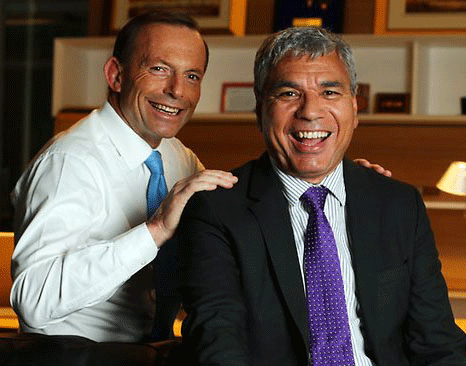 representation from a few high-profile voices.
About 100 people from across the country are expected to gather at the First Nations Summit for Freedom to discuss the major issues facing Indigenous people and address a feeling that the federal government is not speaking with Indigenous people when making decisions which have a direct impact on them.
The summit is being held on Thursday and Friday at the Old Telegraph Station in Mparntwe/Alice Springs. The site is the birthplace of the Aboriginal social activist Charlie Perkins.
“This is all about the local issues first and how the national agenda is responding to them, and how we’re not very happy about it,” said one of the summit organisers, Tauto Sansbury.
Sansbury pointed to attempts by the WA government to amend the Aboriginal Heritage Act, stripping traditional owners of a say over the cultural heritage value of their land and sacred sites, as well as a recent announcement that remote communities would likely be closed.
“The heritage act is having a big impact on Western Australia,” Sansbury, who is a long time Aboriginal advocate and was heavily involved in the royal commission into Aboriginal deaths in custody, told Guardian Australia.
“The closures of the communities over there … Aboriginal people are going to be removed off their land and there are suggestions that the SA government is thinking along the same lines.”
Federal government cuts to Aboriginal legal services and frontline organisations and attempts by state and territory governments to water down land rights and other Indigenous legislation are also on the agenda…………….http://www.theguardian.com/australia-news/2014/nov/27/indigenous-leaders-to-meet-at-first-nations-summit-for-freedom
Tony Abbott’s policies and statements belie his claim to be “a prime minister for Aboriginal affairs”
Out there was white-hot anger that $500m+ had been cut from funding to Indigenous programs in Abbott’s first budget, without broad consultation. Those voices of protest didn’t get a hearing.
Abbott, perhaps invoking the now nostalgic colonial concept of terra nullius, declared Sydney was “nothing but bush” when the Brits arrived
 Abbott’s homogeneous approach to Indigenous affairs will not erase the stain on Australia’s soul, Guardian, Paul Daley, 27 Nov 14
Abbott’s pronouncements on Aboriginal Australia coincide with his waning political will to amend the constitution so it meaningfully recognises Indigenous Australians On the way to government, Tony Abbott vowed he’d be a special prime minister for Indigenous Australians. He said:
It is my hope that I could be, not just a prime minister, but a prime minister for Aboriginal affairs. The first, I imagine, that we have ever had………. Continue reading
1 This month

of the week – Australians for War Powers Reform (AWPR)
To see nuclear-related stories in greater depth and intensity
 Antinuclear