The week that was, in Australia’s nuclear and climate news
 Federal politics: Australia’s Foreign Minister Julie Bishop has suddenly discovered that climate change is real, and nuclear power is the obvious cure for it. Interestingly, Australia’s top nuclear power proponent, Dr Ziggy Switkowski now thinks that renewable energy sources could be more viable than nuclear.
Renewable Energy Target (RET). Maverick Senator Jacqui Lambie’s turnabout on Renewable Energy – makes you wonder just what vested interests are pressurising her. Silence in Parliament and in the media – about changes to the RET. But Tony Abbott doesn’t need to crush the RET in any hurry – just prolonging the uncertainty is all that he needs to destroy Australia’s renewable energy industry
State politics: Victorian election. The dust has barely settled. But the Labor victory, and support for The Greens must have given the federal Abbott government a nasty shock. Labor has hardly been forthcoming on matters nuclear or climate change. Labor came out with a feeble afterthought on climate change, promising a $20 million New Energy Jobs Fund for renewable projects. “The ‘policy’ contains nothing on coal, nothing on coal seam gas, nothing on forest logging and nothing on a Victorian Renewable Energy Target”. However, Labor does promise to reintroduce emissions reduction target
The Greens, hope for one MP now in the Legislative Assembly, will promote their policies for action on climate change, and for renewable energy.
Uranium sales to India . Wikileaks reveals that Australia was pushed to nuclear deal with India, by USA strategic interests
ERA’s Ranger uranium mine at crisis point. Mirrar people are prepared to develop a different, non-uranium mining, economy in Kakadu NationaPark
Indigenous Leaders’ Summit aims to reclaim Indigenous rights agenda and representation from a few high-profile voices.
Analysing the Julie Bishop pro nuclear prouncement
In all the delight about Julie Bishop, Australia’s Foreign Minister, promoting nuclear power, surprisingly, The Sydney Morning Herald did have a go at analysing this.
I was sorry to see that the SMH still accepts the nuclear lobby’s lie that nuclear power doesn’t emit greenhouse gases. They should know that the nuclear fuel chain, in its entirety, emits masses of greenhouse gases.
However, this article DID examine the unaffordable costs of nuclear power – it must be tax-payer funded.
And importantly – the writer, Andrew P Street, did expose the fallacy of the “base load” myth.
He thinks that Julie Bishop’s tactic was just to distract Australia from the Abbott government’s climate denialist position. Perhaps so. Or perhaps Abbott thinks it’s now timely to get on the “nuclear power cures climate change” bandwagon. (but let Julie take any flak)
In another Sydney Morning Herald article, we learn that Dr Ziggy Switkowski, Australia’s foremost  proponent of nuclear power, now thinks that renewables could be ‘more viable than nuclear ‘. Ziggy’s worth watching – always the man with an eye out for the main chance
Julie Bishop toes the Liberal Party line on nuclear power, climate, and renewable energy
View from the Street: Bishop goes nuclear, SMH November 30, 2014 Andrew P Street “………..Atomic! Meanwhile Foreign Minister and probable next Coalition PM Julie Bishop has come out in favour of nuclear energy.
“It’s an obvious conclusion that if you want to bring down your greenhouse gas emissions dramatically you have to embrace a form of low or zero-emissions energy and that’s nuclear, the only known 24/7 baseload power supply with zero emissions,” she said, in a statement that no-one especially asked for and that seems timed principally to give people something to talk about other than the Victorian election.
Now, nuclear power doesn’t emit greenhouse gases. It does, however, produce a lot of waste that’s incredibly radioactive – uranium, plutonium, neptunium, californium – and we have zero idea of how to store it aside from “bury it and walk away”.
Nuclear waste dumps are not unreasonably considered one of those things that absolutely everybody wants nowhere near them, making them a political nightmare.
And while things don’t generally go wrong in nuclear plants, those rare accidents tend to beome major disasters – as Fukushima and Chernobyl discovered to their considerable cost.
However, there’s another more immediate, practical reason why nuclear isn’t a likely alternative for Australia: our energy industry now almost entirely consists of private companies, who are not going to build nuclear reactors.
See, nuclear power plants take a long time to build. Depending on the design, construction takes between four and eight years, followed by six-to-twelve months of testing before it actually starts generating electricity. By comparison, building a wind farm takes six months.
As a result reactors are also extraordinarily expensive and typically take decades to turn a profit. AGL’s shareholders are very unlikely to back the company building something that won’t provide any return until most of them are dead.
So it’s not seriously going to happen in Australia. But there’s another issue in there.
Let’s look at that “baseload power” thing
The question of baseload revolves around the fact that people need power all the time including when there’s no sun or wind. Thanks a bunch, nature.
While this sounds at first blush like an insurmountable issue and is inevitably raised by people condescendingly dismissing renewable energy, it’s not that big an issue – and in fact the problem has already been solved.
Mark Diesendorf and colleagues at the University of NSW did a comprehensive study of Australia’s electricity demand and discovered that “It turns out that wind and solar photovoltaic are only unable to meet electricity demand a few times a year… Since the gaps are few in number and none exceeds two hours in duration, there only needs to be a small amount of generation from the so-called flexible renewables: hydro and biofuelled gas turbines. Concentrated solar thermal is also flexible while it has energy in its thermal storage.”
Then again, Bishop’s staying on message. After all, talking up nuclear energy is a great option if you want to move your political party away from your denialist position on climate change while still supporting the mining industry, doing nothing about reducing emissions, and keeping the conversation away from solar and wind.
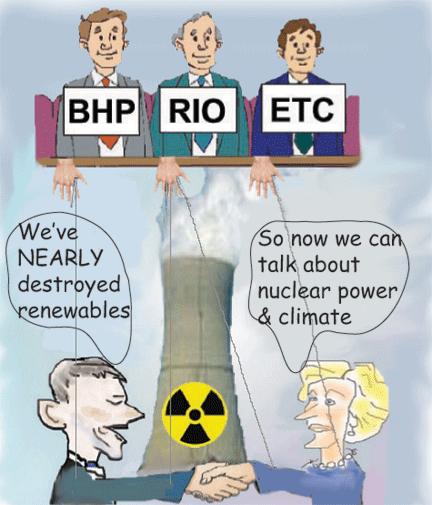
So: expect the Coalition to be banging on about it for the foreseeable.
The cocktail hour: cities in dust
Speaking of Chernobyl, CBS cameraman Danny Cooke posted video he shot of the abandoned city of Pripyat mere days ago.
It’s haunting stuff – especially his sweeping drone shots – and it’s a timely reminder of what nuclear energy can cost. That’s an entire city falling to ruin, right there. http://www.smh.com.au/comment/view-from-the-street/view-from-the-street-bishop-goes-nuclear-20141130-11x4ns.html
Public can comment on Cameco’s uranium plans – still time left for this
 Deadline looms for say on Cameco uranium plans http://www.abc.net.au/news/2014-11-28/deadline-looms-for-say-on-cameco-uranium-plans/5925776 27 Nov 2014, The public has a week to give feedback on a proposal for a company to mine uranium ore in WA’s northern Goldfields.
The Environmental Protection Authority (EPA) is assessing Cameco’s proposal to mine and process uranium at Yeelirrie, an open pit mine site 70 kilometres south-west of Wiluna.
In May 2010, the EPA approved a similar proposal for the same project submitted by BHP Billiton, before it was sold to Cameco in 2012.
The company plans to extend the roughly 30-year mine life and increase the rate of milling and processing previously outlined to 7,500 tonnes per year.
The public has seven days to comment on the proposal.
Some people welcome Julie Bishop’s nuclear power push. Most want more renewable energy
Julie Bishop’s calls for nuclear power debate welcomed, SMH December 1, 2014 Lisa Cox National political reporter “………Environment Minister Greg Hunt said on Sunday that although nuclear power was not Coalition policy, he was supportive of a debate but any shift would require bipartisan support………
new polling for the clean energy industry showed voters want Australia to adopt more ambitious policies for renewable energy.
A survey of 1442 people commissioned by Solar Citizens, and conducted by the Australian Institute, found 76 per cent of people were either supportive or very supportive of increasing Australia’s renewable energy target, rather than scaling it back.
Thirty-five per cent favoured increasing the target to 50 per cent by 2030, while a further 30 per cent wanted a target greater than 50 per cent by 2030. http://www.smh.com.au/federal-politics/political-news/julie-bishops-calls-for-nuclear-power-debate-welcomed-20141130-11x4pl.html
Julie Bishop goes for nuclear power, as Ziggy Switkowski hedges his bets
But he [Dr Ziggy Switkowski] agreed that if there were improvements in wind and solar technology over the next two decades to make them more reliable around the clock, renewable energy sources could be more viable than nuclear.
Julie Bishop reopens nuclear debate as route to cut carbon dioxide emissions, SMH, November 30, 2014 Latika Bourke Foreign Minister Julie Bishop says nuclear energy remains an option for Australia, describing it as an “obvious direction” as it considers how to cut carbon dioxide emissions after 2020.
Ms Bishop called for a an open discussion about the feasibility of nuclear power, given Australia’s abundance of uranium, but accused Labor of resorting to a scare campaign when the issue was raised during the Howard government years
……….Ms Bishop flies to Lima, Peru, in just over a week to attend the annual United Nations climate conference, where Australia will face pressure to announce its climate targets for beyond 2020 and it’s understood the Prime Minster has personally requested Trade Minister Andrew Robb chaperone Ms Bishop so he can factor in the economic impacts of any new targets Australia considers. Continue reading
Belgium phasing out nuclear power. Fire shuts down nuclear reactor
 Fire shuts down Belgian nuclear reactor https://au.news.yahoo.com/world/a/25650869/fire-shuts-down-belgian-nuclear-reactor/A Belgian nuclear reactor has shut down after a fire broke out at the plant in the east of the country, the Belga news agency reported. The incident on Sunday could put a further strain on Belgium’s electricity grid, after warnings in August that outages at other nuclear plants could lead to power cuts in the approaching winter.
The Tihange 3 power station, situated 70 kilometres south-west of the German town of Aachen, shut down automatically after one of its transformers reportedly caught fire. The fire, which has since been extinguished, was caused by an explosion, Sudpresse newspaper group reported on its website.
It was unclear Sunday how long the 1,048-megawatt reactor will remain out of service.Tihange 3 is now the fourth Belgian nuclear reactor to be out of service, as another plant at Tihange and two at Doel have been shut down due to defects or security concerns.
The Tihange 1 reactor was not affected by Sunday’s incident, however. Belgium has adopted a nuclear phaseout plan that foresees the complete abandonment of nuclear energy by 2025.
Australia pushed to nuclear deal with India, by USA strategic interests – Wikileaks reveals
WikiLeaks shows US push behind Australia-India nuke deal, Green Left November 30, 2014By Linda Pearson A deal to sell Australian uranium to India has been signed, despite opposition from most people in Australia.
In September, Prime Minister Tony Abbott signed an agreement which will allow sales of Australian uranium to India for the first time.
India has consistently refused to sign the Nuclear Non-Proliferation Treaty (NPT) and has manufactured up to 110 nuclear warheads, but has been given a free pass to take part in international nuclear trade by virtue of its new strategic relationship with the United States.
The Australia-India deal conflicts with Australia’s obligations under the South Pacific Nuclear Weapons Free Zone Treaty, as well as the NPT.
As Greens Senator Scott Ludlam said in September: “Australia will now be directly complicit in a nuclear arms race in South Asia, with India moving to lock in foreign uranium supplies for power generation so it can preserve its domestic uranium for weapons production.”
The deal is the culmination of a bipartisan shift in policy that began under the Howard government, stalled during the Rudd years, and was completed by the Gillard government in 2011.
As US diplomatic cables published by WikiLeaks illustrate, this shift took place despite most people in Australiaopposing uranium sales to India. It was pushed by governments bending to US interests.
New strategic partnership
In the three decades after India’s first successful nuclear test in 1974, relations between the US and India were cool. By the early 2000s, however, US policy-makers looking to maintain US dominance in Asia came to view India as a potential counterweight to China.
In January 2004, President Bush and India’s Prime Minister Bihari Vajpayee announced they had signed what would become known as the Next Steps in Strategic Partnership (NSSP) agreement.
Under the NSSP, the US and India pledged to take a series of reciprocal steps towards greater co-operation on civilian nuclear activities, space programs and high-technology trade.
The NSSP was hailed as a milestone in US-India relations. However, strong opposition within India threatened to derail the agreement.
When it became clear that a dramatic change in nuclear policy would be needed to win Indian support for the new strategic relationship, the US obliged. So did Australia……..https://www.greenleft.org.au/node/57915
Why should tax-payers take the nuclear power risk?
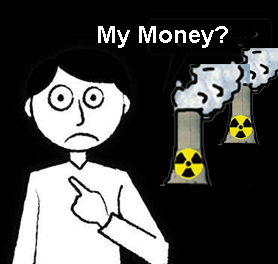
Estimating the cost of building a nuclear power plant is difficult even in countries with established nuclear industries. For a start, not too many have been built in recent years. Further, very few — in fact, not really any — have been built in an open, competitive, private power-supply market where the plant would face competition from alternative electricity sources. Governments indirectly or indirectly play a huge role in offsetting costs, transferring risk from company balance sheets into governments programs, tax offsets and implicit guarantees.
Worst of all, the construction of nuclear power plants is notoriously prone to cost overruns. Continue reading
Islamic State extremists claim to have a ‘dirty bomb’
Islamic State has a ‘dirty bomb’ says British jihadi, amid claims 40kg of URANIUM was taken from Iraqi university, Daily Mail,
- Chemical was stolen from Mosul University, northern Iraq, in July
- UN ambassador wrote letter at time of theft fearing ‘mass destruction’
- Hamayun Tariq among jihadis to boast of explosives on Twitter
- Hinted at the potential destruction of such a bomb if detonated in London
- British 37-year-old had social media account suspended afterwards
By JENNIFER SMITH FOR MAILONLINE, 30 November 2014 |slamic State fanatics claim to have constructed a dirty bomb after stealing 40kg of uranium from an Iraqi university.
Militants boasted of the device on social media, with one even commenting on the destruction such a bomb would wreak in London, four months after the chemical was reported missing from Mosul University.
Among extremists making online threats to the West is British explosives expert Hamayun Tariq, who fled his home in Dudley, West Midlands, for the Middle East in 2012.
Scroll down on original page for video ………http://www.dailymail.co.uk/news/article-2854729/Islamic-State-dirty-bomb-says-British-jihadi-amid-claims-40kg-uranium-taken-Iraqi-university.html
1 This month

of the week – Australians for War Powers Reform (AWPR)
To see nuclear-related stories in greater depth and intensity
 Antinuclear